The floater basketball shot is the finish a driver uses when the rim is guarded and the layup is gone. The player shoots a high, soft ball over the incoming defender from a few feet out and does not go all the way to the rim. Coaches use different names and different footwork for it, so this guide lists each way it is taught. It also covers the read that tells a player when to shoot it, the entries, the drills and the mistakes.
What a Floater Basketball Shot Is
The floater is any high-arching shot over an incoming defender, taken on a drive, that uses the space between the lines of the defense. Coaches draw the lines in different places:
- Two feet only. Count a shot as a floater only off two feet and call the one-foot version a runner.
- One hand only. Count it only when it is one-handed.
The loose definition settles neither argument. The table shows four ways of teaching it.
| Approach | Name | How it is taught |
|---|---|---|
| Any foot, any hand | Floater, any foot, any hand | Release high and soft over the second defender. Foot and hand depend on the situation and what the player does best. |
| Three shots | Three shots. The runner, the floater and the hanger | Runner: one foot, one hand, heel down, shooting knee up, a little backspin so the ball drops over the front of the rim. Floater: two feet, one hand, more of a push than a wrist snap. Hanger: one foot, two hands, a small one-foot shot for high school players who struggle with floaters. |
| Stop short | Floater, also called a runner | One-footed with standard layup footwork or two-footed off a jump stop. Right or left hand. Stop short of the big defender under control to avoid a charge and launch a high, soft arc over his reach. |
| Same foot | Floater or runner | A right-hand shooter takes off from the right foot. Every guard needs one and sometimes the fours and fives do too. |
The shot is the same idea in all four. Where the foot lands and how many hands touch the ball are details a coach can choose. Pick one vocabulary for your team and use it every day.
When to Shoot a Floater
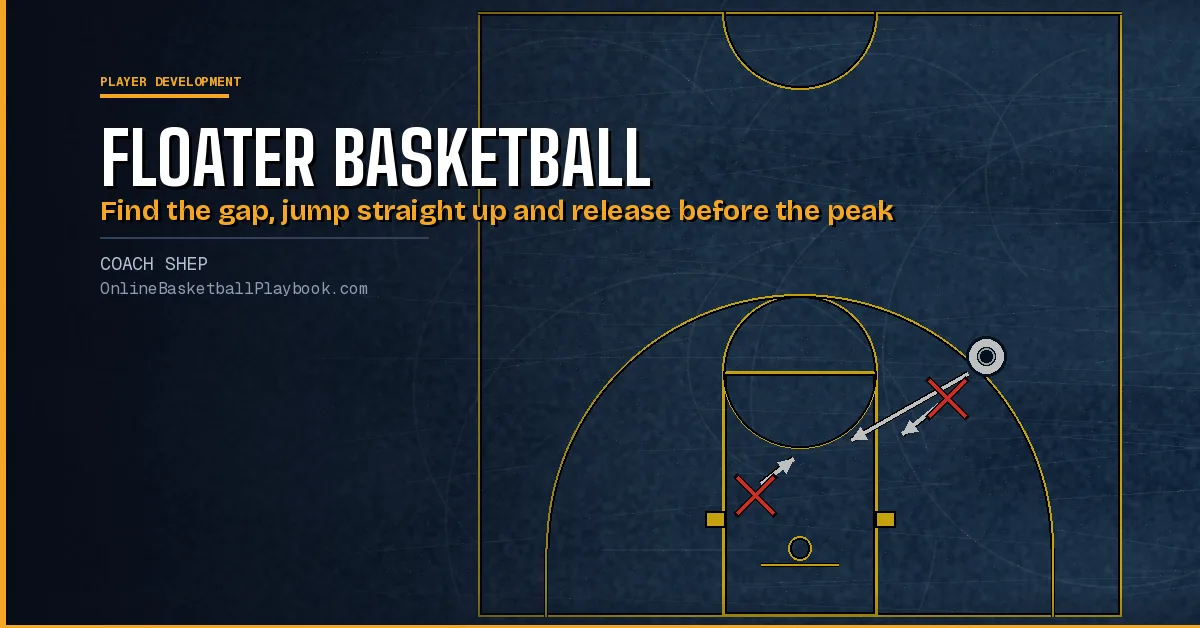
The shot belongs to a specific picture of the defense. A defender is on the driver's hip and a second defender is stepping up late to help, so the driver is too far out to get to the rim and too close to the helper to drive into him. Practice as if one defender is on your hip and another is stepping up late, and take off from the space between them.

Add situations to that picture.
- Drop coverage and back-pedaling defenders. The floater exploits drop coverage or a defender who is back-pedaling to the rim. The shot is quick and the release is hard for a blocker to time because it happens in the flow of the drive. See Drop Coverage for the defense side.
- A shot blocker is waiting. Get the floater or runner off before the helper arrives to block it. Keep balance, jump straight up and down and hold the follow-through, and jump from a strong athletic base if your own defender is still on your hip.
- The defense collapses. A scoring drill called Attack the Lane Lines works this read. The player attacks the nail, which is the middle of the free-throw line, then redirects to the lane line and shoots a runner off the glass when the defense collapses. A Lane Line Runners drill works the same read.
- A hesitation at the free-throw line. A drill has a player hesitate at the free-throw line to read the help and choose a layup, a runner or a pull-up.
One rule sits over all of these. The defender and the help defense should determine the finish, so a player should read them and not drive with a finish chosen in advance. The finish menu below shows where the floater sits among the others.
| What the defense does | Finish that fits |
|---|---|
| Defender on the hip | Inside-hand layup or a hold-off floater |
| Shot blocker waiting at the rim | Reverse, an early one-foot takeoff or a power finish |
| Help defender in the gap | Floater or runner |
| Defender set to take a charge | Euro step or pro hop |
More finishes are on Basketball Finishing Moves, Keys to Finishing at the Basket and Reverse Layup.

Read the defense first and the finish follows.
How to Shoot a Floater in Six Steps
The shot comes in six steps, and the order is useful for a practice.
- Identify the space. It sits between the on-ball defender and the late help defender.
- Start slow. Quickness matters less than balance and control while the shot is new. Begin with no-dribble floaters after a couple of steps, then drive at half speed and pull up from the same range before adding pace. Start with a two-foot jump and move to one-foot floaters later.
- Keep your head up. A player who stares at the floor cannot see whether the space is there.
- Go up straight. The basic floater jumps almost vertically. Drifting forward closes the space to the rotating defender, puts the release near a tall defender's reach and makes an offensive foul more likely. The same warning applies to a charge when the help defender is set in front of you.
- Release high. Let go just before the peak of the jump. A late release breaks the rhythm and gives the defense more time to rotate.
- Practice variety. Shoot from the top of the key, from the wing with and without the backboard, from the baseline and from different distances and arc heights.
The hand and the arm add pieces:
- High elbow. Lock the elbow high, pull the string and shoot a high arc. The shot needs great touch and you do not lock for layups.
- Push, not snap. A push and not a snap on the two-foot floater and a little backspin on the one-foot runner.
- Hold the follow-through. Floaters and runners are like jump shots, so hold the follow-through, and the harder the shot, the more form and touch matter.

Keep your head up, go up straight and let it go before the peak.
Entries and Footwork Into the Floater
Practice these entries before the shot: going left, going right, a Euro step, a change of speed and a jump stop. A Euro step floater demands more balance and coordination than a jump stop floater, and it is the answer when the help defender closes faster than expected. A Euro floater does not jump as vertically and a jump stop floater squares the shoulders, so the form changes a little with the entry.
A decelerated Euro step ends in the same shot. The player drives at three-quarter to full speed, plants the outside foot, slows the whole body, steps laterally onto the other foot with the ball cradled or brought over the top, and shoots a floater or runner off that foot.
- Sell it with speed. Sell the move with a change of speed.
- Protect the ball. Keep the ball protected.
- Keep the pivot foot up. Do not drag the back pivot foot.
The use is against a bigger shot blocker running the player down in transition or an over-aggressive defender on the hip. See Euro Step for the base footwork.
The jump stop entry uses the same footwork as the layup. How to Do a Layup covers the gather and the steps. Practice each entry until it ends in the same balanced shot.
Floater Basketball Drills and Teaching Order
Teach in this order. Start with no-dribble floaters, move to half-speed drives, add speed and then add variety in spots and entries.

- 2-Minute Floaters. The player starts outside the three-point line, drives and finishes with a floater from about 5 to 10 feet, rebounds, then retreats to anywhere outside the line and attacks again. It runs for two minutes. The angle and distance change on their own because the starting spots change. Players switch between one-foot and two-foot takeoffs and release the ball high to get over a defender's hand.
- Hold Off the Defense. A chair on the wing is the screen. The player starts on that wing and comes off the screen with the defender trailing on the outside hip.
- The hold-off move. He stays low through the first one or two dribbles, slows to hold the defender behind him for a moment, then explodes into the paint and finishes with a floater. It runs three minutes per side or until a set number of makes, and the screen can move to the baseline side. More is on Hold Off the Defense.
- Hold-off options. Add a dummy help defender in the paint and a second player at the low post for a lob or bounce pass.
- In and Out Into Floater. The player attacks a chair with an in-and-out move to freeze the help defender, then shoots a floater over the top. The target is 20 makes per side.
- Floaters against a coach. A 90-second on-the-clock series ends with a cone in-and-out move into a change of direction and then a floater against the coach.
- Baseline Attack (15-point workout). Three moves off a catch, a power layup driving baseline, a spin to the middle if the baseline is cut off and a pull-up floater, with 10 makes of each on both sides.
- Zig-Zag Floaters. The player uses only floaters in the Zig-Zag layup drill and switches between one-foot and two-foot takeoffs. See Layup Drills.

Get the next coaching guide in your inbox
One email when a new guide or diagram set goes up. Free.
The hanger, a one-foot shot with two hands, is for high school players who struggle with floaters.
The floater is highly replicable and especially useful for undersized players. It needs no range, size or power, only repetition and discipline. Start slow, then rep it until it is automatic.
Where Coaches Disagree
| Question | Approach |
|---|---|
| What counts as a floater? | Any high arc over an incoming defender on a drive |
| Two feet is the floater and one foot is a runner | |
| Which comes first? | Two-foot jump first, then one-foot floaters |
| A one-foot, two-hand hanger for high school players who struggle with floaters | |
| Which foot for a right-hander? | Left foot, standard layup footwork |
| Right foot | |
| How does the hand work? | Lock the elbow high and pull the string |
| Push, with more push than wrist snap |
Coaches agree on the read and on the vertical jump. They do not agree on foot, hand or name, which is why this guide lists each approach. Teach the read first and choose your vocabulary.
Want the printable playbook packs?
OBP Pro members get the premium playbook packs: the zone attack, out of bounds and practice plan PDFs, plus each new pack as it is finished. The membership page lists what is in each one. Or draw your own version free in PlayDraw.
See what OBP Pro includesQuestions Coaches Ask
What is a floater in basketball?
A high-arching shot taken on a drive that goes over an incoming defender. It is a shot that uses the space between the on-ball defender and a help defender.
What is the difference between a floater and a runner?
It depends on the coach. A three-shot system calls the one-foot, one-hand shot a runner and the two-foot, one-hand shot a floater. A stop-short system treats them as the same finish with a one-foot and a two-foot form.
How do you shoot a floater?
Find the gap between the two defenders, keep your head up, jump nearly straight up and release just before the peak. Start slow and add speed later.
When should a player use a floater instead of a layup?
When a help defender or a shot blocker is waiting near the rim and the path to the rim is not clear. On a straight-line drive with a defender on his side, seek the contact and finish strong.
Is a floater a good shot for smaller players?
It is especially useful for undersized players and needs no size or power. It still takes many reps.
How do you teach the floater to a young player?
Start with no-dribble reps close in, add a half-speed drive, then add speed. Young players should learn the basic layup footwork first and move to advanced finishes after it.
More Guides From This Batch
- Flare Screen Basketball: How It Works, Reads and Counters
- Layup Drills for Every Level, From One Step to Full Court
- Basketball Dribbling Drills for Beginners and Other Basics
- Basketball Rebounding Drills for Every Age and Level
Back to Basketball Finishing Moves and every Player Development page.
Keep Building
Related breakdowns
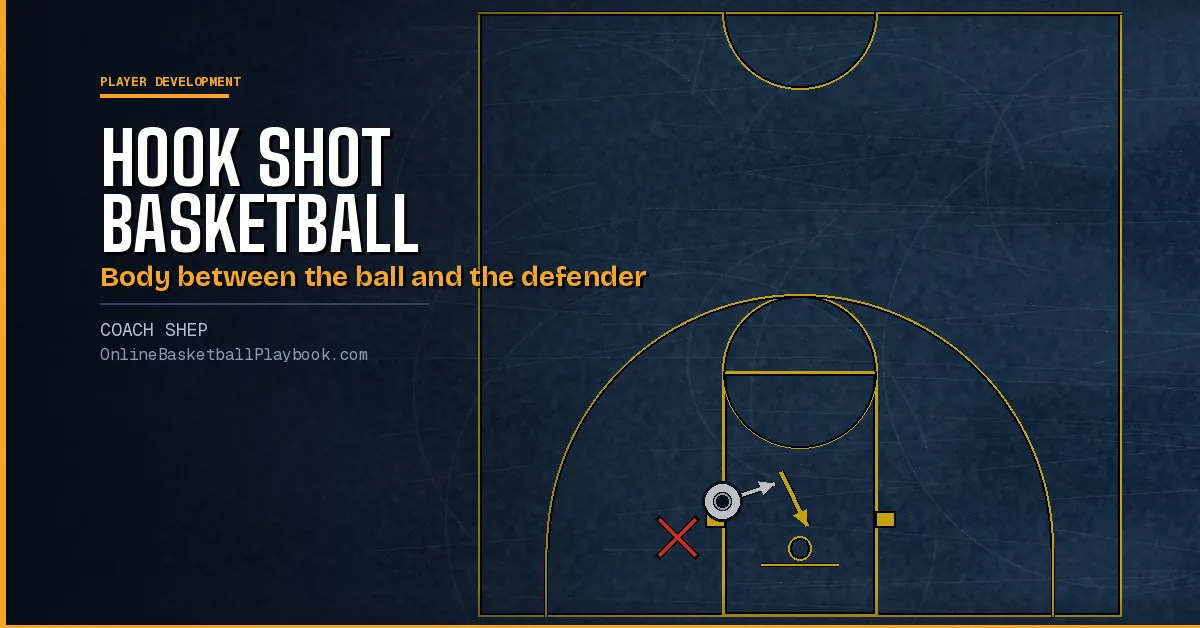
Hook Shot Basketball: How to Do It and How to Teach It
Hook shot basketball for post players and coaches: the classic hook, sky hook and jump hook, the footwork steps, when to use it, the pivot foot rules and drills.
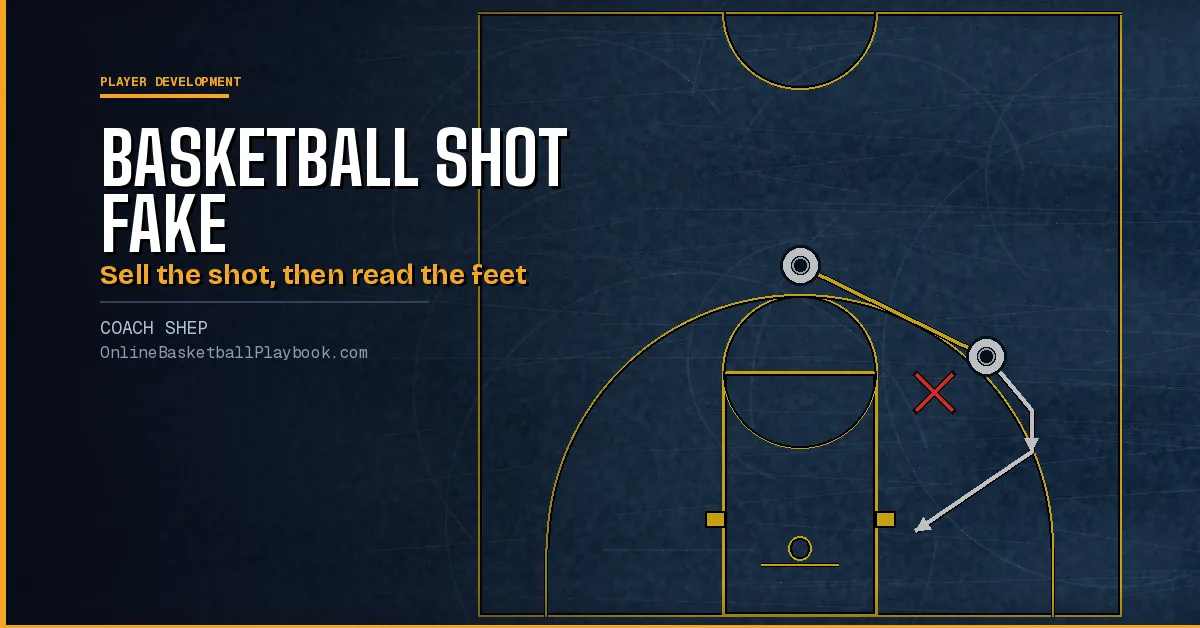
Basketball Shot Fake (Pump Fake): How to Do It and Teach It
The basketball shot fake, also called the pump fake, works when it looks like the real shot. The mechanics, the pivot foot footwork, the read and the drills.