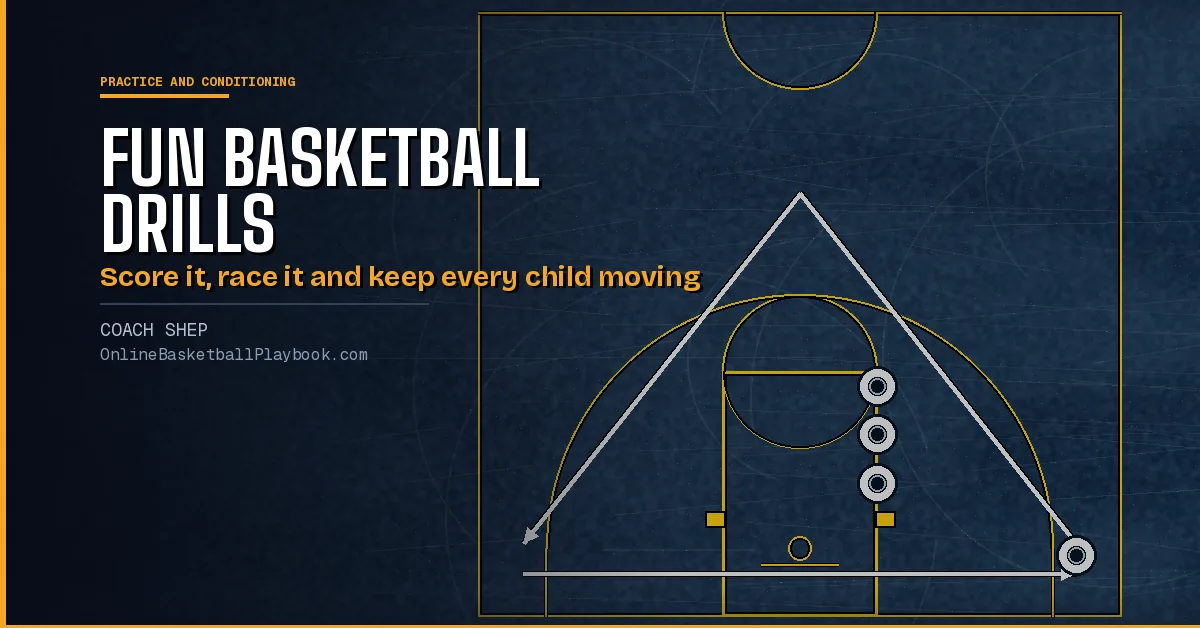
Fun basketball drills for kids work because the skill hides inside a contest. A child shoots to beat the next player, dribbles to avoid a tag or races a team across the floor, and the coach gets the reps without a lecture.
This page collects contests and relays by how they are played, shooting contests, dribbling games and team games, with the rules each game gives and the changes that keep every child involved. For drills sorted by age, see basketball drills for kids by age.
Fun Basketball Drills for Kids at a Glance
Each game below puts one skill inside a rule a child can learn in a minute.
| Game | Skill | How it is played |
|---|---|---|
| Knockout | Shooting under pressure | Each shooter tries to score before the player behind him |
| Home Run | Shooting and dribbling | Shooters race a dribbler on a lap |
| 21 Cone Shooting | Shooting and conditioning | Teams earn cones with makes |
| 40 and a Half | Shooting from range | Teams make shots from spots, ending with half court |
| All-Star Shootout | Team shooting | A team scores from every cone |
| Pressure Free Throws | Free throws | A make puts pressure on the next shooter |
| Sharks and Minnows | Dribbling under pressure | Dribblers cross the floor past taggers |
| Dribble Knockout | Protecting the ball | Dribblers knock away other balls |
| Red Light, Green Light | Stopping and listening | Dribble on green, stop on red |
| Dribble Relays | Handling skills | Teams race, one dribble skill per round |
| Cone Tip Over | Dribbling and teamwork | One team knocks cones down, the other stands them up |
| Drag Race | Layups at speed | Teams race to make layups |
| War | Reading the game | Called numbers play 1-on-1 up to 5-on-5 |
| Ultimate Basketball | Passing and moving | A scrimmage with no dribbling |
What Makes a Drill Fun
Drills fill most of practice, so boring drills mean a boring practice. Build practices around seven elements:
- Fast pace. No standing in lines.
- Success level. Drills are set at a level where players succeed.
- Discipline and attention. Discipline, and getting the players' attention.
- Simple structure. A lecture of about two minutes, a skill-building piece of two to four minutes and a game of one to three minutes.
- Positive coach, fun drills. A positive coach and drills that are fun.
Three habits support them:
- Score by team. Most shooting and passing drills count team baskets and not individual makes, so a weaker player is not singled out.
- Give plain skills a theme. Space Invaders is passing under pressure and Musical Slide is the defensive stance.
- Keep buffer activities ready. Jump rope, two-ball dribbling, the spider dribble and Mikan drill mean nobody stands idle while others wait.
Most of the shooting games scale. Move the shooting spot or change the dribble rule, and the same game fits a different age. A youth approach for ages 6 to 8 treats games as the teaching vehicle, with Sharks and Minnows for heads-up dribbling and Monkey in the Middle for the fake before the pass.
Keep the pace fast and the rules short.
Shooting Contests
Knockout
Players line up at a starting spot, often the free-throw line, and the first two hold a ball. The first shoots. The second shoots right after and tries to score before the first does, rebounding his own miss. If the first scores first, he passes his ball to the next player and goes to the end of the line. If the second scores first, the first player is out and cheers from the sideline. Play continues until one is left.
- No-touch rule. Nobody touches other players' balls, and an official catches players who sprint in with a miss and skip the dribble.
- Lightning. A player who is eliminated returns the players he eliminated to the game.

Home Run
Two teams of at least three play. A shooting team has one ball and a dribbling team has a ball for every player. The coach calls go. The first dribbler runs a lap, young players around the three-point line and baseline and older players up a sideline, across half court and down the other sideline, then across the baseline.
The first shooter shoots at the same time and passes to the next shooter after a miss. A dribbler who finishes the lap scores a run for his team. A shooter who makes a basket first puts the dribbler out where he stands. When the dribbling team is out, the teams trade roles. The team with the most runs after a set number of innings wins.
- Play both sides. Play from both sides of the floor so each hand dribbles.
- Let shooters make more. If no dribbler can finish a lap, let shooters make more than one.

21 Cone Shooting
Set out an odd number of cones, 21 or any odd number, away from the basket. Two teams stand at matching spots such as the elbows or blocks, each with a ball. On a miss, a player rebounds, passes to the next teammate and goes to the end of the line. On a make, he passes and sprints to bring a cone back to his team's side. When the cones are gone, the team with more wins.
- Pick a shared spot. Pick a spot every player can make from.
- Expect collisions. The two balls will sometimes collide at one basket, which is part of the game.

40 and a Half, All-Star Shootout and Pressure Free Throws
In 40 and a Half, two teams with two balls each go to their own end. The team makes 10 from the right block, 10 from the left block, 10 from the elbows and 10 from the top of the key, then the first team to hit a half-court shot wins. Every player should shoot from every spot, and the half-court shot can be as loose or as strict as you like.
In All-Star Shootout each team has a ball and cones at spots where its players can score. A player dribbles to a cone and shoots. A make earns him the rebound and the cone, which go back to the line. A miss goes to the next player. The first team to make a shot from every cone wins. A mix of near and far cones suits a mixed group.

In Pressure Free Throws, everyone lines up at the free-throw line with one ball. After a player makes one, the next must make his or he is out. Players who are out can shoot at another basket. With a small group, allow a set number of misses before a player is out. See free throw drills for more.

Pick the spot, then keep everyone shooting.
Get the next coaching guide in your inbox
One email when a new guide or diagram set goes up. Free.
Dribbling Games
In Sharks and Minnows, two sharks stand at half court facing away while the minnows, each with a ball, line up on the baseline. On the whistle the minnows dribble to the far baseline. A tagged minnow kneels where he was tagged and becomes a shark for anyone who dribbles near. Dribbling violations and going out of bounds also put a minnow out.
In Dribble Knockout everyone dribbles inside a marked area and tries to knock other balls out while protecting his own. As players go out, the coach shrinks the area until the last two meet inside the half circle. Eliminated players can shoot free throws at the other end. The no-hoop game suits a gym with more players than baskets, and the main problem is arguments over who stepped out of bounds, so use several referees.
In Red Light, Green Light, the players dribble on green and must stop legally on red. A player who keeps moving or travels goes back to the line. The coach can add colors such as a walking yellow light. The game also trains listening.
Dribble Relays split players into teams of four or five who share one ball. The coach names the skill before each round, a speed dribble, a weak-hand dribble, a backward dribble or a move at each cone, and every player hands the ball to the next and sits. The first team seated wins. Use a clear exchange line or players will pass the ball back and skip the dribble.
In Cone Tip Over, 5 to 10 cones stand on each side of the floor and every player has a ball. One team knocks cones over while keeping its dribble and the other stands them up. A player who loses his dribble does the opposite job once, so a cone goes back up or comes down.
After 30 to 60 seconds Team 1 scores a point for each cone down and Team 2 a point for each cone standing, and then the teams switch jobs.
Keep the rule simple and keep the eliminated players in the game.
Team and Transition Games
In Basketball Drag Race, two teams start on opposite baselines with balls spread along the half-court line. The first player on each team sprints to half court, picks up a ball, dribbles to his basket and shoots a layup. A miss means dribbling the ball back and replacing it on the line. The next player goes when a layup is made or a missed ball is returned.
The team with the most layups in a set time, five minutes to start, wins. Coaches can require a weak-hand finish.
In War, each team gets numbers. The coach calls one to five numbers and throws the ball to the middle. The called players run for it and play full court at their basket until someone scores. Give similar players the same number so matchups stay even, and a coach can throw the ball toward a struggling team's side. A progression calls one number, then adds more while play continues.
In Ultimate Basketball, two teams of four or five start with a jump ball, and a team that gets the ball cannot let it hit the floor. Passing the ball to a teammate beyond the opponent's baseline scores a touchdown.
A drop or a ball on the floor is a turnover and the other team takes over where it landed. Without dribbling, players have to cut and pass early. Substitutes enter after a score and not after a turnover. See reasons to use small-sided games.
Explain the rule in a minute, then let them play.
Where Coaches Differ
How long on one drill?
- No more than 5 minutes. That suits young children, ages 5 to 8.
- About 5 to 9 minutes per skill. Split it into a two-minute lecture, 2 to 4 minutes of skill and 1 to 3 minutes of game.
- 3 to 5 minutes. Each drill runs 3 to 5 minutes with a fun game between hard drills.
Score it?
- Count team baskets. In drills, so no child is singled out.
- Keep no score in league games. This applies to ages 6 to 8 and to ages 5 to 8.
What do eliminated players do?
- Sit out and cheer. That is the rule in Knockout.
- Shoot at another basket. That is the rule in Dribble Knockout and Pressure Free Throws.
- Do a buffer activity. Nobody stands idle.
Very young players. Run 30 to 45 minutes of pure games with no laps, lines or lectures, as in a practice plan for ages 5 and 6.
Pick what fits your age group and stick with it.
Building a Session
A 60-minute session for ages 6 to 8 is built from four blocks:
- Warm up and move. 5 to 10 minutes.
- Teach skills through games. 35 to 40 minutes.
- Play small-sided. 10 to 15 minutes.
- Cool down. 5 minutes.
A ball for every child, short directions and water breaks come with it. Large groups can use stations of about four minutes. A kindergarten plan stays with games only. Other ready-made plans are on the practice plan page and the practice plans hub.
Plan the minutes before practice, then let the games teach.
These games sit beside fundamentals. Youth fundamental drills, practice drills for youth teams, a kids training workout and drills for beginners supply the skill work, and fun basketball games for practice, Knockout and Around the World go deeper on single games. For coaching principles see how to coach youth basketball.
Want the printable playbook packs?
OBP Pro members get the premium playbook packs: the zone attack, out of bounds and practice plan PDFs, plus each new pack as it is finished. The membership page lists what is in each one. Or draw your own version free in PlayDraw.
See what OBP Pro includesQuestions Coaches Ask
What are fun basketball drills for kids?
Contests and relays such as Knockout, Home Run, Sharks and Minnows, Red Light Green Light, Dribble Relays and War, each with a skill built into a simple rule.
What is a fun shooting game for kids?
Knockout, Home Run, 21 Cone Shooting, 40 and a Half and All-Star Shootout scale by moving the shooting spot, and Pressure Free Throws adds pressure at the line.
What is a fun dribbling game for kids?
Sharks and Minnows, Dribble Knockout, Red Light Green Light, Dribble Relays and Cone Tip Over.
How long should a kids drill last?
Drills run from no more than 5 minutes to about 5 to 9 minutes per skill, or 3 to 5 minutes.
How do you keep eliminated players involved?
Send them to another basket, have them cheer or keep buffer activities ready.
How do you make a drill more fun?
Add competition, a countdown goal, team scoring or a themed name to a drill that already exists.
More Guides From This Batch
- Defensive Stance in Basketball: Weight, Feet, Hands and Drills
- Pack Line Defense: Rules, Post Coverage and How to Install It
- 1-3-1 Full Court Press: Roles, Traps and Rotations to Install
- Basketball Agility Drills: Cone, Reaction and Ladder Drills
Back to Practice Plans and every Practice and Conditioning page.
Keep Building
Related breakdowns
Best Basketball Drills for Kids: Fun Drills by Age
The best basketball drills for kids, sorted by age and skill. Fun dribbling, passing and shooting games that keep every child moving and learning.
Fun Basketball Games for Practice: Scored Games for Any Team
Fun basketball games for practice at any level: shooting games, defense-only scoring, rebounding contests and passing games, with scoring rules and records.
Basketball Conditioning Drills for Teams: Runs, Games and Tests
Basketball conditioning drills in three styles, timed runs, conditioning inside skill drills and scored games, with the tests and yearly plans coaches use.