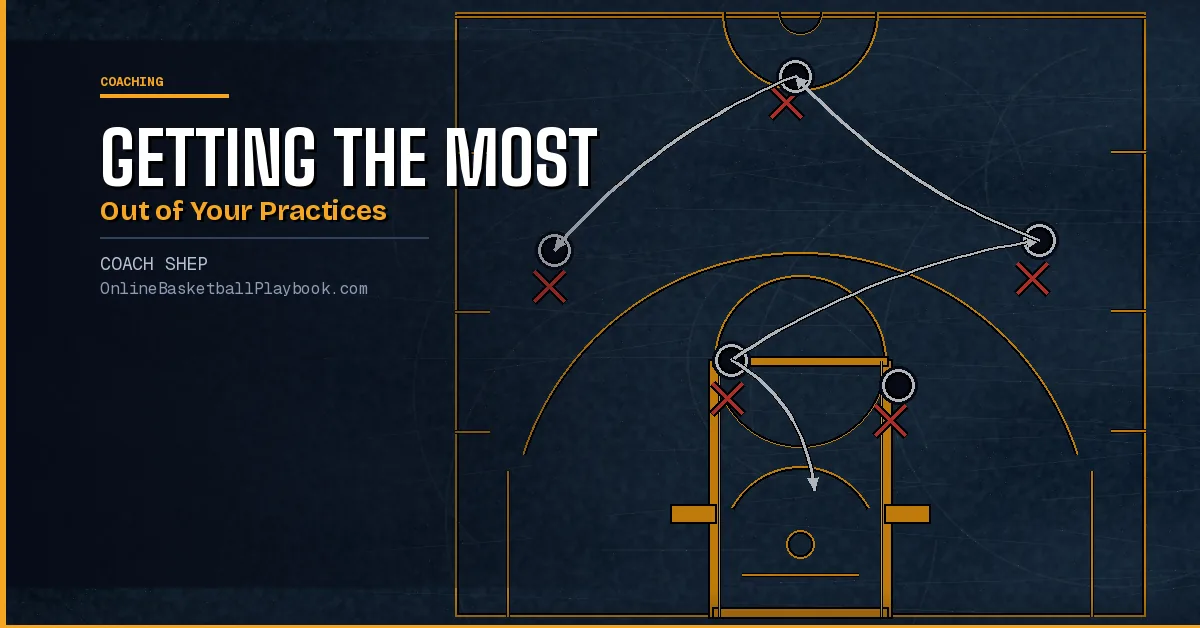
Great coaches don't run better drills. They run better practice systems. This guide breaks down the principles top coaches use to build competition, accountability, and real improvement into every single session.
Stop Enduring Practice. Start Attacking It
The most dangerous attitude a team can develop is the belief that practice is something to get through. When players are just enduring the session, watching the clock, coasting through drills, relieved when the whistle blows, they are not improving. They are surviving. And survival reps do not transfer to game performance.
The core principle that separates elite practice cultures from average ones is deceptively simple: the only way you get better is reps, and every rep needs to be attacked. That means an injured player who can't run can still work on footwork. A player sitting out a contact drill can coach his teammates, track mistakes, and stay mentally engaged. Nobody is excused from getting better.
Nate Oats's Alabama program, one of the most studied practice environments in recent college basketball history, runs on this exact premise. Players who are sitting out don't sit and watch. They run with their group's losses and learn to coach their teammates up. The message is clear: you are in this gym to get better, not to rest while your teammates work.
This attitude also applies to how coaches manage their own practice energy. Your team will take on your personality. If you show up flat, mechanical, or disinterested, your players will sense it within minutes. The standard you hold yourself to, your energy when you arrive, how you respond to mistakes, whether you give genuine praise, sets the ceiling for how hard your players will compete.
The antidote to the endurance mindset is simple accountability: make sitting out cost something. Have injured players track turnovers, count effort plays, or chart shooting percentages. Give them a job that matters. The moment they have something real to do, they are back in the practice culture instead of outside it.
Score Everything and Make Losers Run
One of the most powerful changes any coach can make to an existing practice structure costs nothing and takes less than five minutes to implement: start keeping score on every drill.
When a drill has no score, players coast at whatever pace feels comfortable. There is no urgency, no consequence, and no reason to make the extra effort on a loose ball or a close-out. The moment you attach a number to the outcome and tie that number to something real, like conditioning, the energy in the gym shifts immediately.
The scoring system used in high-level practices is straightforward. A made basket might be worth two points. A missed three is a minus three. A turnover costs two points. A putback offensive rebound earns one. An assist leading directly to a score earns three. Every possession has a value, and the teams know it.
At the end of each segment, the losing team runs. The margin matters. Losing by four runs more than losing by one. This isn't punishment. It's conditioning through competition, which produces a completely different response in players than conditioning for its own sake. Nobody gives up on a game. The same is true when the scoreboard is live and the legs are on the line.
Tracking turnovers on a separate chart adds another layer of accountability. Players start to understand that a careless pass isn't just a bad play. It's a documented event that affects the score and, eventually, the conditioning at the end of practice. Ball security becomes a discipline, not just a talking point.
The competitive scoring system also gives coaches real data. When a team is consistently winning the shooting segment but losing the transition segment, that tells you where the work needs to go. The numbers don't lie, and over a season, they reveal patterns that film alone can miss.
Validate Every Drill, Every Time
Every drill in your practice should have a winner and a loser. If it doesn't, it isn't a drill. It's an activity. And activities don't develop players at the rate that competitive reps do.
Validating a drill means building a clear outcome into its structure. The two most common methods are: requiring a team or player to make a free throw before they can leave the drill, or declaring a winner and loser based on the score and having the loser run. Both force players to perform under a small amount of pressure, which is the only environment that actually prepares them for game situations.
Before you put any drill into your practice plan, ask yourself two questions. First: why are we doing this drill? If you can't answer that in one sentence, the drill doesn't belong in your plan. Second: am I getting the desired results? If the drill is in your plan out of habit but your players aren't actually improving the skill it targets, pull it and replace it.
Every drill should serve at least two purposes. A defensive closeout drill should also train your players' conditioning and communication. A ball-handling progression should also develop footwork. When drills are multi-purpose, you get more return per minute of practice time, and practice time is the most limited resource any coach has.
Standards in practice are enforced not by what you say, but by what you tolerate. If a sloppy rep is allowed to slide once, players learn that sloppy reps are acceptable. Validation is the mechanism by which standards become real. The free throw at the end of the drill isn't about free throws. It's about executing under pressure when the rep counts.
Segment Practice with Intent
Elite practice plans are not a list of drills. They are a deliberate sequence of segments, each building on the one before it, designed to teach skills in the order players will use them in games.
The most proven segment skeleton for a full practice runs roughly like this: form running and conditioning, ball handling and footwork, transition, offensive organization built from one-on-zero up through four-on-zero, a shooting battery, defensive organization starting from stance and footwork through shell defense, press break, zone offense, and special situations. Shooting, pressure work, rebounding, and shell defense appear every single day, regardless of what else is on the schedule.
One of the most underused adjustments when numbers are short is going "half full." Instead of cutting intensity because you don't have enough players for a full five-on-five, you sprint both ways and reset. The players get the same conditioning and competitive reps with fewer bodies. Intensity does not have to drop when your roster is thin for a day.
The time allocation matters as much as the order. One master practice plan gives thirty minutes each to shooting and defense, twenty minutes to offensive skill work, fifteen to dummy offense, fifteen to special situations, and thirty minutes of five-on-five scrimmage, approximately two and a half hours total. The split doesn't have to match this exactly, but having an explicit budget prevents the most common practice failure: spending forty minutes on offense because it's comfortable and leaving eight minutes for defense.
Building defense and offense in order of importance, not in the order that feels easy, is what separates coaches who teach from coaches who facilitate. Do your heaviest teaching on the front end of practice and the front end of the season. The first week of practice, record film and review it before the next session. Your players will never be more receptive to fundamental instruction than they are in those first few days.
Write your practice plan the night before, then rewrite it the morning of practice after watching film from the previous session. The rewrite forces you to be intentional about what your team actually needs that day instead of defaulting to whatever drills you used last week. The more rewrites, the better the practice. Treat it like an essay, not a memo.
Know Your Four W's Before You Step on the Floor
Before practice starts, every coach should be able to answer four questions about every segment on the plan. What are we teaching? How are we going to teach it? Why does this matter for our team right now? And what does success look like at the end of this segment?
These are the four W's. If you can't answer all four for a given drill or segment, that segment isn't ready to go on the floor. It may still be a good drill, but without a clear answer to those questions, you will deliver it inconsistently, correct the wrong things, and walk away unsure whether your players actually learned anything.
Setting expectations at the start of each segment is the coachable version of this discipline. Tell players what they're working on and why before the drill starts. Not a long speech. One sentence. "We're working on closeouts because last game we gave up seven corner threes in the first half. I want zero close-outs from the paint today." That context changes how players approach the rep. They're not just going through the motion. They're solving a problem they understand.
The four W's also apply to your season as a whole. Before your first practice, you should have identified every skill your team needs, assessed their current level in each area, and sorted those skills into must-teach, should-teach, and could-teach categories. All of your must-teach skills should be installed in the first six practices before your first game. After week two, practices become game-plan driven, and you are refining skills your players already have rather than teaching new ones under competitive pressure.
This front-loading approach is curriculum design, not a practice calendar. The difference is significant. A practice calendar tells you what you're doing each day. A curriculum tells you what your players need to know by game one, and works backward from there to build a sequence that actually gets them there.
Hard Time Caps and Role Separation
Bob Knight's three mechanical rules for preventing energy leaks in practice are among the most practical pieces of practice management that exist, and they cost nothing to implement.
First, individual drills get exactly five minutes and team drills get exactly ten. Not approximately. Not until it feels right. When the clock hits zero, the drill ends. The reason is straightforward: players get bored, and when boredom sets in, effort drops before the drill is officially over. A hard stop prevents the last two minutes of a drill from becoming wasted reps.
Second, assistant coaches cannot stop practice to correct a player in front of the group. Instead, they pull one player to the sideline, correct the error until it's fixed, and return that player to the drill while everyone else keeps going. Practice doesn't stop for individual corrections. The group keeps moving, and the assistant handles the teaching on the side. This requires real role clarity, but it keeps the tempo of practice consistent and prevents the most common time leak: the three-minute whole-group lecture that could have been a twenty-second one-on-one correction.
Third, players sprint to the next drill and are in position before the coach finishes explaining it. This one rule alone can add fifteen to twenty usable reps to a practice. When the transition between drills takes forty-five seconds instead of fifteen, and you have twenty transitions in a practice, you have lost more than ten minutes to movement, minutes that could have been another competitive segment.
Together, these three rules, the time cap, the assistant correction protocol, and the sprint-to-drill standard, address the single biggest killer of practice quality: energy leak between reps.
Always End Practice on a Positive
The last drill of practice is the one your players will remember when they leave the gym. That memory shapes how they feel about coming back tomorrow. Never end practice on something that feels like punishment. End it on something the players enjoy.
This doesn't mean going easy. A competitive shooting game with a scoreboard and a consequence for the losing team can be intense, fast-paced, and fun at the same time. A 5-on-5 Restrictions game, where the offense is forced to face every defense it might see in a game, from a half-court trap to a run-and-jump, can be the hardest competitive segment of the day and still feel rewarding when the final buzzer sounds.
The principle behind ending on a positive is psychological, but its effects are practical. Players who leave practice energized are more likely to think about basketball between sessions. They are more likely to arrive early the next day. They are more likely to compete at full effort throughout a practice when they know that the last fifteen minutes will be worth it.
The "Perfection" drill used by multiple coaches is a perfect example of this principle in action. It's a demanding, high-stakes competitive drill, but it has a clear end state, a clear winner, and a moment of satisfaction when the team achieves it. Players run hard to get to that moment, not because they are told to, but because they want to finish on something they earned.
Practice culture is built one session at a time. The standards you hold, the score you keep, the validation you require, and the energy you close with, repeated every day over a full season, are what separate programs that develop players from programs that merely manage them. Build the system, enforce the standard, and give your players a reason to come back tomorrow ready to compete.
- Score every drill segment using a point system (+2 made basket, −2 turnover, +1 offensive rebound) and make the losing team run the difference at the end. Competition creates urgency that verbal standards alone never will.
- Set a visible countdown timer for every drill: five minutes for individual work, ten minutes for team drills. When it hits zero, end the drill regardless of where the score stands and move immediately to the next segment.
- Before any drill goes on your practice plan, answer the four W's: what are we teaching, how, why does it matter for this team right now, and what does success look like? If you can't answer all four, the drill is not ready.
- Have assistants pull and correct individual players on the sideline without stopping the group. The team keeps running at full pace while the correction happens, then the player rejoins. Practice never pauses for one person's mistake.
- End every practice on a competitive drill your players enjoy, a scored shooting game, a 5-on-5 Restrictions segment, or a "Perfection" closer, so they leave the gym energized instead of exhausted and resentful.
- When you are short on players, go "half full" (sprint both ways and reset) rather than dropping the intensity of your competitive segments. Conditioning comes from how you practice, not from tacking sprints on at the end.
Want more basketball coaching strategies, drills, and tools?
Join the Online Basketball Playbook newsletter →
Draw this play free in the play drawer →
Membership: the full library, playbook packs, and Pro drawing tools →
Keep Building
Related breakdowns
Fun Basketball Games for Practice: Scored Games for Any Team
Fun basketball games for practice at any level: shooting games, defense-only scoring, rebounding contests and passing games, with scoring rules and records.
Basketball Conditioning Drills for Teams: Runs, Games and Tests
Basketball conditioning drills in three styles, timed runs, conditioning inside skill drills and scored games, with the tests and yearly plans coaches use.
Basketball Agility Drills: Cone, Reaction and Ladder Drills
Basketball agility drills from timed cone tests to reaction, mirror and ladder drills and defensive circuits, with schedules and where coaches differ.