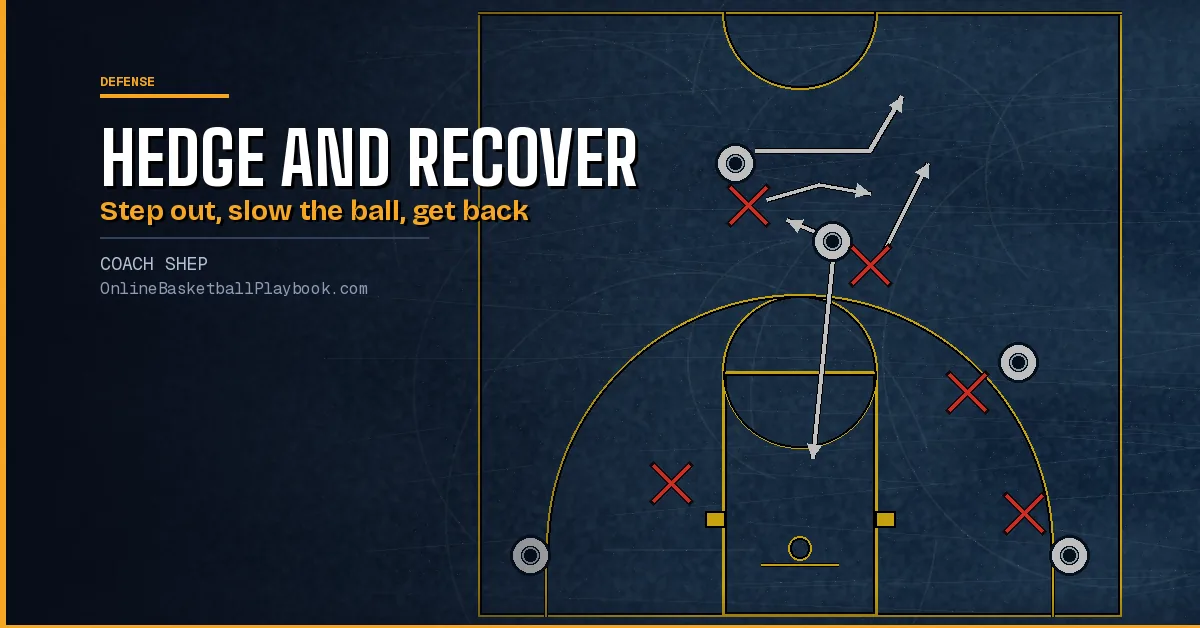
A hedge in basketball is a ball screen defense in which the screener's defender steps out into the handler's path for a moment, slows him down, then recovers to his own man. It is also called a show. He does not switch and he does not trap. He buys the on-ball defender time to get over the screen, then gets back to the screener before the pass reaches him.
This page covers what the hedge is for, the four steps, the hard hedge, the flat hedge and the soft show, show and recover, the help behind it, what beats it and how to teach it. The other coverages are compared on the pick and roll defense hub, and their international names are on FIBA basketball terminology.
Hedge in Basketball: What It Is For
A hedge has three aims.
- Stop dribble penetration.
- Buy time. Give the on-ball defender time to fight through the screen.
- Keep the ball from the screener. The ball must not reach the rolling or popping screener.
The hedge sits between the drop, where the big stays back, and the blitz, where he traps. Show is another name for it, and the depth can be named with separate calls, covered below. Other systems use hedge, show and flat for different depths, so write the job next to the call.
Ettore Messina wants the hedge committed.
- Make a short V. His screener's defender makes a short "V" into the handler's path that forces a backup dribble, then the on-ball defender recovers over the top.
- Never hedge passively. A passive hedge is worse than no hedge, because it gives the dribbler a rhythm jumper and still does not stop the roll.
- Be aggressive. The hedge must be aggressive, not just a step out to the side, so the screener cannot simply pop.
- Decisive first. He teaches the decisive version first and dials it back later if he needs to.
Commit to the hedge, then dial it back only if you must.

The Four Steps of a Hedge
- Anticipate the screen. Read the cues, a called screen or the screener's approach, so the hedger is in position before contact and is not reacting late.
- Beat the dribbler to the spot. The hedger gets into the handler's driving path and forces extra steps toward half court, which buys the on-ball defender time.
- Stay connected to the screener. He must not fully commit to the ball, because he still has to go with the screener on a roll or a pop, and he must not leave a gap the handler can split.
- Recover. He returns to his man with his arms up to deter the pass, while the on-ball defender slides underneath him to get back in front of the ball.
Anticipate, beat him to the spot, stay connected and recover.
Hard Hedge, Flat Hedge and Soft Show
Match the depth and the angle of the show to the handler and the screener. A four-call menu picks the show like this:
- Hard show. Against a handler who scores off the screen.
- Soft show. Against a creative handler with a pop threat.
- Slide. Against a handler who is no threat outside the scoring area.
- Flat. Against a screener who shoots or rolls hard.
The footwork:
- Hard hedge. The hedger faces the sideline and forces the handler several steps toward half court.
- Flat hedge. He faces half court, level with the screen, so the handler takes sideways steps instead of downhill ones, and he stays attached to a screener who rolls or pops.
- Soft show. In a pack line he sits about two steps off with his chest more square, to keep the ball in front. Use it for a slow big or a late arrival.
- One slide or none. A pack line gives one slide, or none at all, when the screener is a shooter.

Hard hedge technique. The footwork differs from coach to coach:
- Two hard slides. A pack line big steps up early with his chest parallel to the sideline and his inside hand on the screener, as an extension of the screen. He drives the handler up the floor with two hard slides while the on-ball defender shades the baseline and fights over, then under him.
- One slide, foot to foot. Hedge ahead of the screener, foot to foot with one slide, turn the handler away from the basket, keep pressure on the ball, then sprint back into the screen.
- Two dribbles back. Name the hedge by its result: it must force two hard dribbles toward half court.
- A straight line. Show in a straight line, because showing from behind opens the passing angle to the roller.
Show and Recover
Show and recover is the hedge with the second half named. The show defender releases back to the roller or popper once the on-ball defender is back in position. It is described as the coverage most NBA teams prefer.
- Show above the screen. The big shows above the screen until the guard recovers, then sprints back to the roller with his hands high.
- Step out hard. The screener's defender steps out hard until the ball defender recovers, then gets back to the roller with his back to the ball and both hands high.

The on-ball defender's path matters as much as the big's. He can slide underneath the hedger to get back in front, or fight over the screen, then under the big. Show, then get home to the roller.
Arrive With the Screen
The dance is a show with three rules:
- Arrive with the screen. A big who does not arrive with the screen is the number one killer.
- Stay in sync. Once there, wherever the screener goes, he goes.
- The on-ball defender never gets hit. The big calls the side, "left, left, left," and the on-ball defender keeps a foot angle that can still contain a reject. A reject counts as the on-ball defender's fault.
The dance shows only when both defenders are attached at the arc. If the ball is caught high or the handler already has separation, the call is a drop instead (see drop coverage). Or keep the bigs attached with their chest to the ball whether the call is a show, a trap or a switch, and call a show made while staying attached a contact show.
The Help Behind the Hedge
While the big is up, the roller is free for a moment, so someone has to be there.
- The last man. A last defender owns the deep roll and an X-out takes the first pass out, with new ones named on every pass.
- The blitz rotation on the throw-back. Use the same rotation behind a show as behind a blitz: the bottom defender takes the pass, the big sprints to the rim, and on a forward pass, everyone gets back to his man.
- The early rotator. Against a big who can fade and shoot, go over with a hard hedge and send the rotator early.
- A harder hedge, full rotation. Make a harder hedge backed by a full rotation a separate call from the plain hard hedge.
The last-man and low-man approaches are compared on drop coverage and help defense principles. If the coverage turns into a two-man trap instead, the rotation is on blitz and trap ball screens. Someone must always be there for the roller.
Get the next coaching guide in your inbox
One email when a new guide or diagram set goes up. Free.
What Beats a Hedge
Each hedge error has a matching read for the offense. The handler's side of these reads is on pick and roll reads.
- The split. Hedge too far from the screener and the handler dribbles through the gap. The guard splits any time he sees daylight between the hedger and the screener. In a trapping defense the big steps low into the hedge so he is not split.
- The early show. A big who shows early gets split, and one who shows late lets the handler turn the corner. Showing before the screen is used lets the screener slip for a shot or a finish.
- The slip. A high hedge is the screener's cue to slip to the rim before the screen is set. The dance treats a slip as no pick and roll at all: the big stunts at the ball and recovers, and the two defenders stay two on two.
- Back out and isolate. Against a hard hedge, the handler can back out to isolate the switch.
- The re-screen. Go over the first screen while the big hedges and recovers, then under the second, since the second screen is set more solidly. Or answer a screen and re-screen by recovering with vision, seeing the ball and the roller at once.
- The pop. Against a screener who shoots, hedge and recover with a less athletic big and switch with an athletic one, covered on pick and pop.


Teaching the Hedge
The committed version first. Messina trains the decisive hedge first and dials it back later. Young teams fight over with a high hedge first, because going under costs them the chance to learn to fight over.
Two on two, then add help.
- Stop the ball first. Go 2-on-1 and 1-on-1 to stop the ball, then 3-on-3 with a weak-side helper who pre-rotates to the roll, then 4-on-4 and 5-on-5.
- No help at all. A 2-on-2 drill with no help, so the hedge, the over and the under must work alone.
- Four coverages in turn. A 2-on-2 drill reps show and recover, a shallow show, the switch, and forcing the ball low.
More are on drills to teach ball screen defense and Ettore Messina pick and roll defense drills.
One coverage per cycle. A pack line shell gives ball screens three of its ten shell minutes and runs one coverage per cycle, from soft hedge and hard hedge to two under-the-screen calls and ice. The shell itself is on how to coach pack line defense.
The words. The screen call comes first, from the hedger, with the side. Talk standards differ.
- Call it three times. Call the terms at least three times, early and loud.
- One word, three times. Repeat one word three times.
- Early is never wrong. A big is never wrong on a call if it is early.
Teach the committed hedge first, then add help one step at a time.
Questions Coaches Ask About the Hedge
What is a hedge in basketball?
A pick and roll defense in which the screener's defender steps into the ball handler's path to slow him while the on-ball defender gets over the screen, then recovers to the screener. It is not a switch and not a trap.
What is the difference between a hard hedge and a soft hedge?
A hard hedge faces the sideline and forces the handler several steps toward half court. A soft show sits about two steps off with the chest more square, to keep the ball in front, and suits a slow big or a late arrival.
What is a flat hedge?
The hedger faces half court, level with the screen. The handler has to go sideways instead of downhill, and the big stays attached to a screener who rolls or pops.
Is a show the same as a hedge?
Yes, show is another name for the hedge. The depth can be named separately, such as hard show, soft show and flat.
What beats a hedge?
The split when the hedger goes too far, the slip when he shows too early, the pop from a shooting screener, and the re-screen while he is still recovering.
Want the printable playbook packs?
OBP Pro members get the premium playbook packs: the zone attack, out of bounds and practice plan PDFs, plus each new pack as it is finished. The membership page lists what is in each one. Or draw your own version free in PlayDraw.
See what OBP Pro includesMore Coaching Guides From This Batch
- Drop Coverage Basketball: How the Big Plays the Ball Screen
- Switching Defense Basketball: How to Switch Ball Screens
- Ice Basketball Defense: Push the Side Pick and Roll Down
- Blitz Pick and Roll Defense: How to Trap a Ball Screen
Back to Pick and Roll Defense and every Defense page.
Keep Building
Related breakdowns
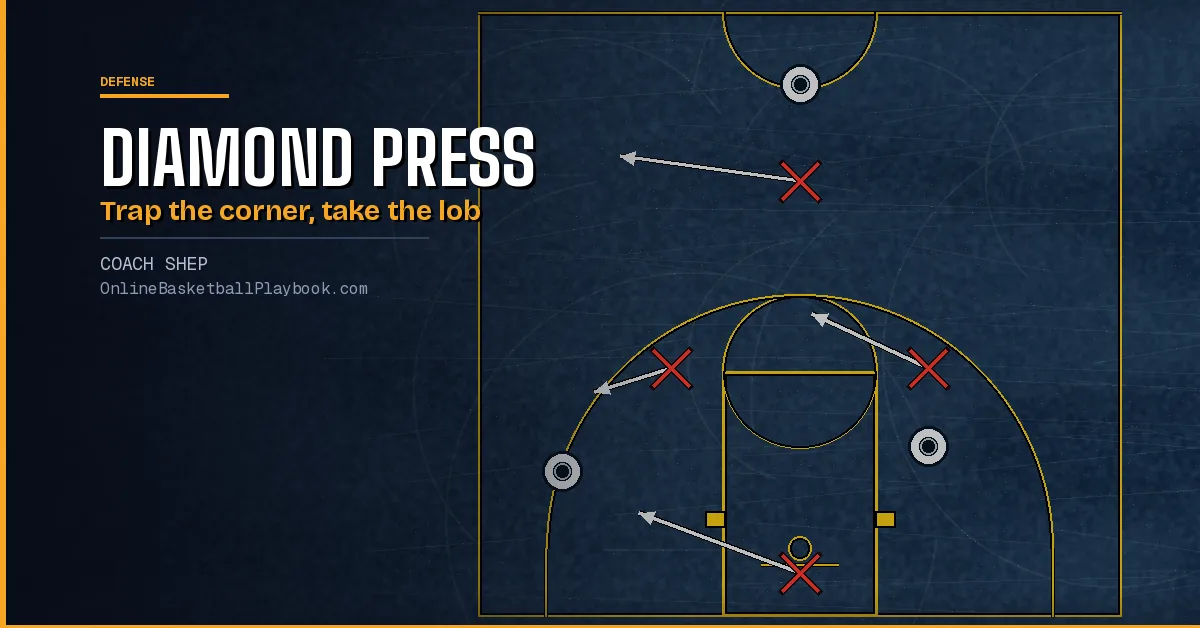
1-2-1-1 Diamond Press Basketball: Roles, Traps and Install
How to run the diamond press in basketball: who plays each role, how to trap the corner, what to do on the reversal and the lob, and how to install it step by step.
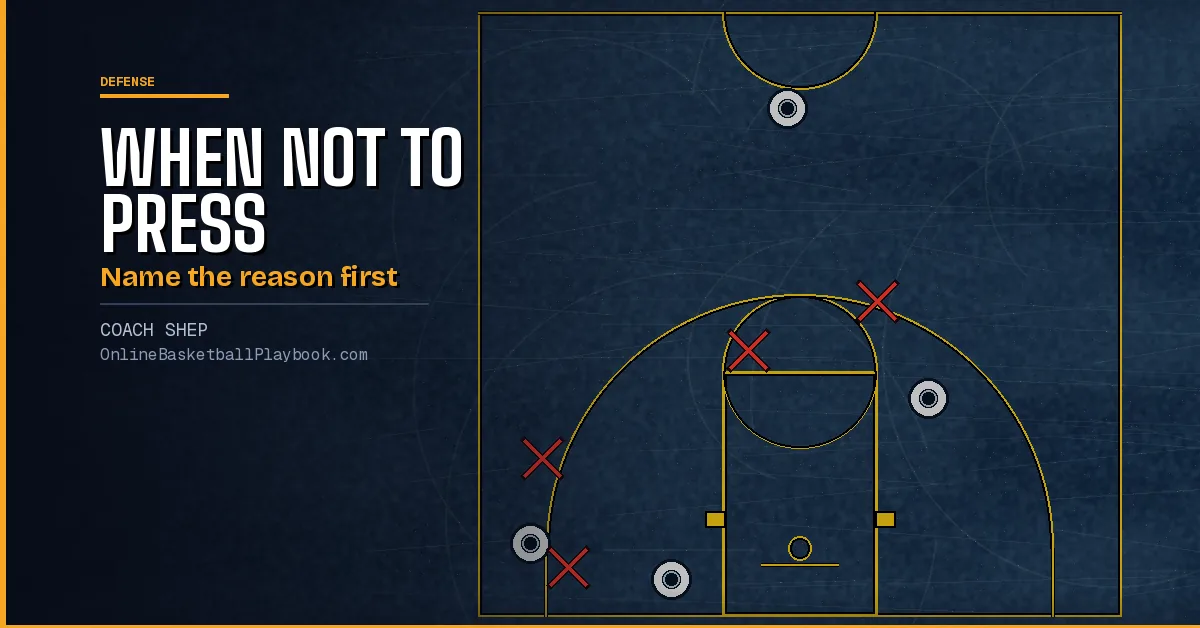
When Not to Press: Bad Reasons, Thin Benches, Poised Guards
When not to press in basketball: the bad reasons, the roster you need first, the opponents who beat it, the moments to drop it and the youth limits.
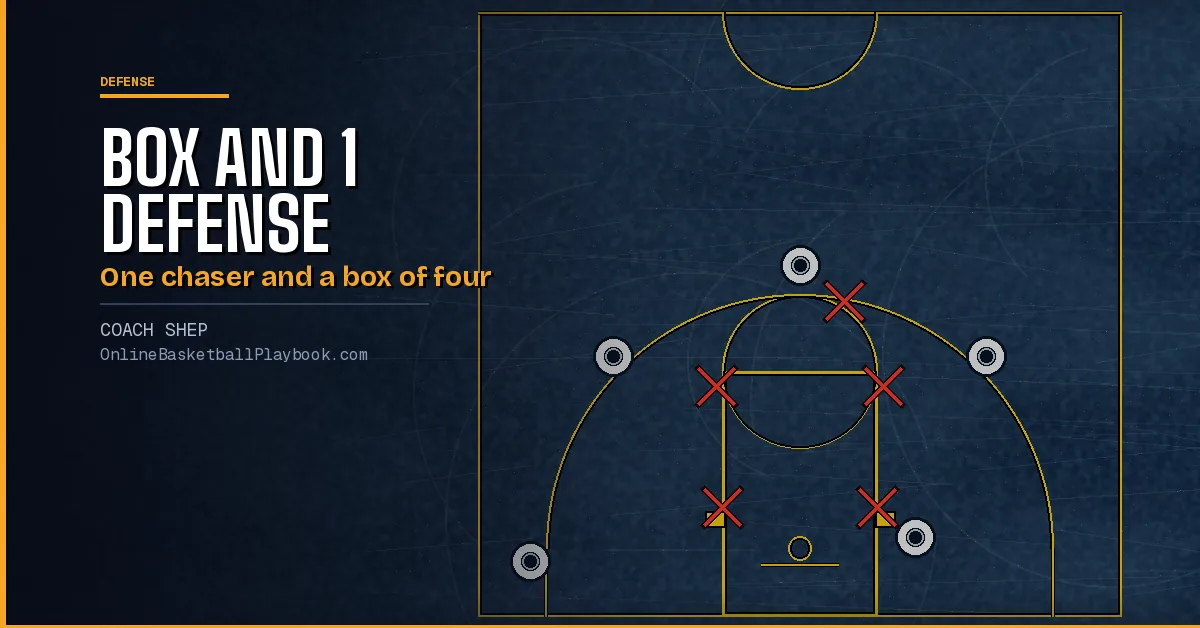
Box and 1 Defense: How It Works and How to Beat It
What the box and 1 defense is, how the chaser and the box play, when coaches call it, where it leaks, and how an offense beats it with a decoy star.