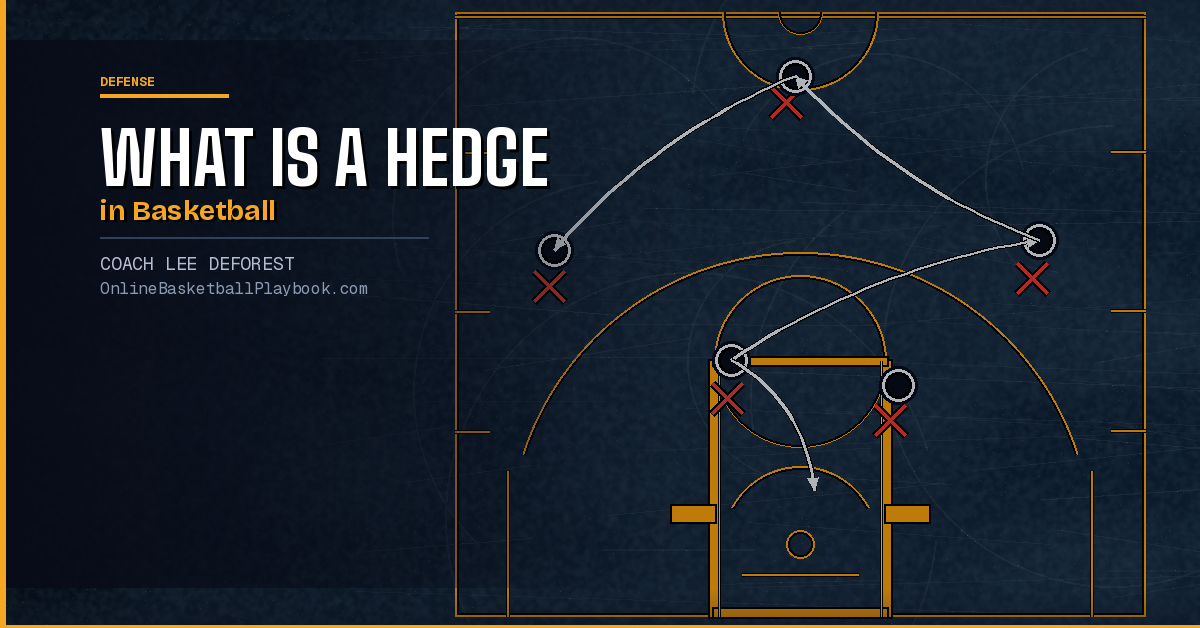

A hedge is a pick-and-roll defensive technique where the screener's defender jumps out aggressively to cut off the ball handler, buying time for the on-ball defender to recover around the screen.
What a Hedge Is and Why It Exists
Pick-and-roll defense is where games are won and lost at every level of basketball. The hedge — sometimes called a "show" — is one of the oldest and most direct answers to the ball screen. When the screener sets a pick on the ball handler's defender, the screener's defender does not simply sit back and wait. Instead, that big steps out hard, presenting a wide, active body at the level of the screen. The goal is simple: force the ball handler to slow down, change direction, or pick up the dribble before the on-ball defender has fully navigated the screen.
The hedge works by creating a momentary two-on-one trap at the point of attack. The on-ball defender fights through or goes behind the screen while the hedging big absorbs the ball handler's momentum. Done correctly, the ball handler has nowhere to attack — the lane is clogged, the corner is closed, and the ball goes backward. Done poorly, the hedging big is caught in no-man's land, his assignment gets the ball rolling to the rim, and the defense is scrambling.
This is not a passive technique. A hedge demands athleticism, timing, and communication. The hedging defender must arrive with the screen — not after it — and must hold ground without fouling. The on-ball defender must trust that help is there and commit to fighting back to their man. If either player hesitates, the coverage breaks down. That mutual trust and precise timing is what separates a well-drilled hedge from a rotation disaster.
For coaches working to build a complete defensive system, understanding the hedge is foundational. If you're also teaching man-to-man defense principles or want to layer in other pick-and-roll coverages, the hedge is typically the first coverage players need to learn because it clarifies the roles of both defenders at the point of attack.
Hedge vs. Drop Coverage
Coaches and players often confuse the hedge with drop coverage because both involve the screener's defender. The key difference is positioning and intent.
In a drop coverage, the screener's defender drops back to protect the paint — heels near the arc, keeping the ball handler in the middle third of the floor, taking away the roll and the drive while conceding the short midrange. Drop coverage is designed to remove the biggest threats (rim attack and the roll pass) and force the handler into a pull-up jumper. It is typically used when the on-ball defender can contain the handler and when the screener is a shooting big who must be kept in front.
In a hedge (or show), the screener's defender comes up to the level of the screen and extends past the three-point line. The body language is aggressive — almost like a stunt. The hedging big says, with his feet and shoulders: "You are not turning the corner here." The on-ball defender, meanwhile, fights over the top of the screen or chases tight to recover. The hedge is the right call when the ball handler is a dangerous driver, when the team wants to dictate tempo at the point of attack, or when the screener is a slower big who will not hurt the defense by leaving the paint temporarily.
The decision between hedge and drop is not random. It is a situational read — based on personnel, the shooter's range, the handler's tendencies, and the score. Coaches who want to dive deeper into the full menu of pick-and-roll coverages should explore defending the pick and roll for a complete breakdown of every option.
How to Execute a Proper Hedge
Execution is everything. A hedge concept that is understood but poorly timed is worse than no hedge at all — it leaves two defenders out of position simultaneously.
Step 1: Read the Screen Early
The hedging big must see the screen being set and begin communicating before contact. A verbal call — "screen," "hedge," "show" — alerts the on-ball defender to expect help. The big cannot wait until the screen is set to start moving; he must anticipate and begin positioning while the handler is still dribbling toward the screen.
Step 2: Arrive With the Screen
Timing is the most critical technical detail. The hedge must arrive the instant the ball handler reaches the screen — not a beat late. If the big is slow, the handler turns the corner before help is there. "Arrive with the screen" means the hedging defender's feet are planted, body angled, and arms active exactly when the ball hits the pick. This is a footwork problem as much as a conceptual one, which is why basketball footwork drills that simulate screen reads should be a regular part of practice.
Step 3: Show a Wide, Legal Body
The hedging big should present as wide a body as possible without fouling. Feet outside shoulder-width, arms extended (but not flailing), and hips low. The goal is to make the lane look completely closed. If the hedging defender can force the handler to pick up the dribble or reverse, the hedge has done its job even if no steal occurs.
Step 4: Recover to Your Assignment
After the ball handler reverses, the big must sprint back to the rolling screener. This is where many hedges break down — the big hedges successfully but recovers slowly, leaving the roller open for an easy catch. The recovery sprint must be immediate. On-ball defender covers the ball handler; the big must get back and account for the screener before the ball swings.
When Coaches Call for a Hedge
Not every ball screen calls for a hedge. Coaches who run hedge as a blanket coverage often find themselves exposed by shooting bigs who slip the screen or pop to the arc. The hedge is most effective in specific situations.
Against a dominant ball handler. When the opposing point guard is the primary offensive weapon — someone who will hunt the screen repeatedly to generate drives and layups — the hedge takes away his first option. It forces him to use more dribbles, make more decisions, and operate off the ball rather than off the pick.
When the screener is a non-shooter. If the screener cannot punish the defense from the perimeter, the hedging big can safely leave the paint for a longer beat without fear of a kick-out three. The moment a screener develops a credible three-point shot, hedge coverage becomes riskier.
In the final minutes of close games. When the defense needs to get the ball out of a star handler's hands, a hard hedge — sometimes escalating into a full blitz — forces the ball out of his hands and makes someone else beat you. This is why even teams that run drop coverage most of the game will shift to hedge or blitz in late-game situations.
In conjunction with pressure defense. Teams that run a full-court press often use aggressive on-ball pressure that flows naturally into hard shows on ball screens. The mentality is the same: attack the handler, force early decisions, create turnovers through pressure rather than passive positioning.
"Coverage is a decision, not a default."
— Basketball Vault
The Off-Ball Protection Layer
The hedge only works if the three defenders away from the ball are in the right positions. This is the piece most youth and high school coaches forget to teach. The on-ball coverage — who hedges, who recovers — gets all the attention. But if the off-ball defenders do not rotate correctly, the hedge creates open cutters, open corner threes, and easy passes to the roll man.
Off-ball defenders must compress toward the paint when the hedge is called. The defender on the roller's weakside must be aware that their man may receive the first pass out of the hedge — a ball-handler who picks up the dribble under pressure will immediately look to reverse the ball. The nearest help defender must be in position to contest or at least slow that reversal pass.
The "last man" concept is particularly important: one designated defender always has safety responsibility, holding at the level of the basket to stop any direct roll pass or lob. Without a last man, a crisp skip pass over the hedge leads directly to a dunk. This protection layer is why you cannot teach hedge coverage in isolation — the entire defense must understand their off-ball responsibilities every time the coverage is called.
Teams that work through help defense principles as a separate unit — and then layer in pick-and-roll coverage on top of it — build defenses that hold up under pressure. The protection layer is not something players figure out on the fly; it must be repped until it is automatic.
Teaching the Hedge to Your Team
Introducing hedge coverage requires a progression. Throwing players into live five-on-five without foundational reps leads to blown coverages, confusion about who recovers, and defenders colliding with each other at the point of attack. Build it from the ground up.
Start With Two-on-Two
Put a ball handler and a screener against the on-ball defender and the hedging big. No other players. The only job: hedge and recover. Run this at half speed, then game speed. Call the coverage before each rep so defenders develop the habit of communicating. Switch personnel frequently so every player understands both roles.
Add the Roller and a Safety
Introduce a third offensive player — the roller — and a third defender with safety responsibility. Now the hedging big has a time pressure: get back to the roller before the ball arrives. The safety defender learns to rotate if the big cannot recover in time. This is three-on-three pick-and-roll defense, and it is the most efficient teaching drill for hedge coverage at any level.
Progress to Five-on-Five Shell
Once the two-on-two and three-on-three reps are clean, run the coverage in a shell drill format with all five defenders. The shell forces off-ball players to stay connected to their assignments while the hedge unfolds at the point of attack. It reveals immediately which players lose their men during the hedge rotation — something two-on-two cannot expose.
Use Film
Short clips of clean hedge executions — and broken ones — teach more in five minutes than twenty reps without context. Show your players what "arriving with the screen" looks like when it works. Show them what happens when the recovery is a half-second late. Players who understand the why behind the technique commit to the footwork and communication details that make the coverage effective.
The most frequent breakdown is the hedging big arriving late — after the handler has already turned the corner. The second most common error is the big hedging and then standing still instead of sprinting back to the roller. Correct these two mistakes and your hedge coverage will hold up in most game situations.
- Communicate early: the hedging big calls "screen" before the pick is set, not after the handler has already turned the corner.
- Arrive with the screen: feet planted and body angled the instant the ball handler reaches the pick — not a beat late.
- Wide, legal body: feet outside shoulder-width, low hips, arms active — make the lane look completely closed without fouling.
- Immediate recovery sprint: the moment the ball reverses, the big must sprint back toward the roller — there is no pause after a successful hedge.
- Off-ball defenders compress: the three away from the ball rotate toward the paint and load up passing lanes to the roller and the corner during every hedge call.
- Use hedge selectively: reserve it for dangerous handlers and non-shooting bigs — running it as a blanket coverage invites kick-out threes from popping screeners.
Get free play diagrams, drills, and coaching guides delivered weekly.
Keep Building
Related breakdowns
Basketball Fitness: What You Need to Know as a Basketball Player
Basketball Fitness: What You Need to Know as a Basketball Player
Basketball Offseason Development: What You Need to Know as a Player
Basketball Offseason Development: What You Need to Know as a Player
What I Have Learned Over the Years Coaching Basketball
What I Have Learned Over the Years Coaching Basketball