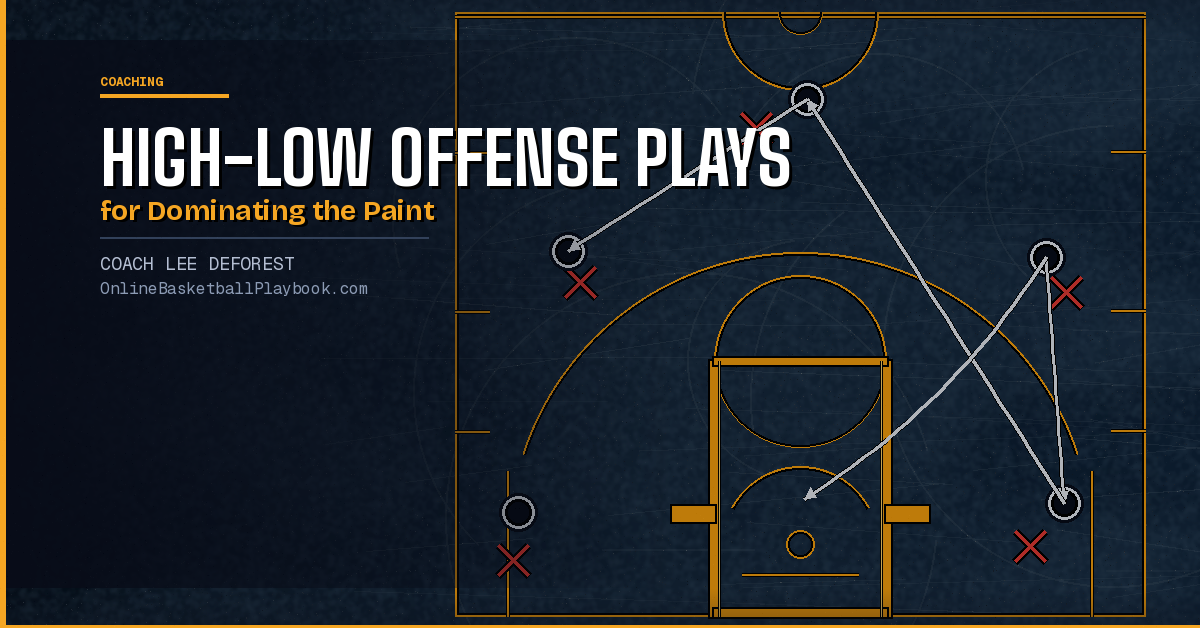

The high-low offense creates automatic scoring reads by connecting a high-post player to a low-post player. When run correctly, it forces defenses to choose — and punishes every choice they make.
What the High-Low Offense Actually Is
Before you can run the high-low effectively, your players need to understand the structural premise. The offense places one post player at or near the elbow — the high post — and a second post player at the low block on the opposite or same side. The two players read each other. When the ball enters the high post, the low-post player reads the defender and either seals for a direct feed or flashes to an open spot. When the ball skips to the perimeter, the sequence resets with both posts relocating.
This is not a set play in the traditional sense. Teams that try to memorize the high-low as a scripted sequence miss the point entirely. The high-low is a framework of reads. It operates on the same principle that elite motion offenses use: options emerge from what the defense gives, not from what the playbook demands. The high post makes a pass decision based on how the low defender plays. The low-post player reads the pass timing and seals or cuts accordingly. The perimeter players space and threaten, which is what keeps the paint open for those interior reads.
What makes this offense so difficult to guard is that the decision happens between two players, not one. Most defenses key on a single ball-handler making a pick-and-roll decision. The high-low splits that load across two positions. A weak-side helper collapses on the low post — and the high post skips to a corner shooter. A defender sags off the high post — and the high post fires the direct feed. There is no correct defensive answer, only a series of trade-offs. Your job as a coach is to make sure your players see the reads and punish each trade-off consistently.
The Core High-Low Reads Every Player Must Know
The high-low lives or dies on three primary reads. Every player on the floor, not just the two post players, must understand all three.
Read 1: Direct Feed to the Low Post
When the ball enters the high post and the low-post defender is behind the low-post player, the high post fires immediately. No dribble, no hesitation — ball goes directly to the low block for a power move. This is the highest-percentage shot in the offense. The key teaching point: the high-post player must catch and face simultaneously. The moment the ball is in the high post's hands, his eyes go to the low defender's position. If that defender is below the block, the pass goes. Coaches should drill this as a pure reaction, not a thinking moment. If the high-post player takes a dribble before making this decision, the window closes.
Read 2: The Dive After the Skip
When the ball is reversed from one side to the other — a wing-to-point skip, or a guard-to-guard swing — both post players read the new ball position and react. The high-post player on the ball side dives toward the low block. The low-post player on the weak side flashes toward the elbow. This crossing action puts two bodies in motion simultaneously, creating extreme difficulty for any help defense trying to communicate and rotate. The perimeter player receiving the skip has a one-second window to hit the diving high-post player before help collapses. Coaches must train that catch-and-look habit relentlessly.
Read 3: The Kick-Out When Help Comes
Any time the low post receives the ball and a defender collapses from the perimeter, the low-post player immediately locates the open corner or wing shooter and makes the kick-out pass. This requires your post players to be comfortable catching, feeling pressure, and passing before they put the ball on the floor. Teams that let their post players default to dribbling when doubled will never unlock the full high-low because they eliminate the kick-out read before it develops. The kick-out is what turns a two-person interior game into a five-player offense — it is what keeps perimeter defenders honest enough to stay at home, which in turn keeps the paint clear for the next direct feed.
Entry Options to Get Into High-Low Action
The high-low requires the right entry to put both post players in position before the defense can set. Teams that force the same entry every possession become predictable and allow defenses to front the low post before the action starts.
Wing Entry with the High-Post Flash
The most common entry: a guard passes to the wing, and the high-post player flashes to the elbow. The wing can feed the high post directly if the pass is available, or the high post can catch on the move and immediately look low. The advantage of this entry is that the high-post player arrives at the elbow with momentum, making it harder for a top-side defender to front him on the catch. Wing entry also sets up a natural drive-kick for the wing player if the high-post pass is denied — making it a double threat from the same look.
Point-to-Wing with the Low-Post Seal
A guard-to-wing pass triggers the low-post player to seal the defender as the ball moves. This entry puts the seal action in motion before the ball even arrives at the wing, meaning the kick-in window to the low block is open the moment the wing catches. The wing player must be trained to look low immediately — before any dribble, before any jab step. The low-post seal entry works particularly well against zone defenses where the zone is not yet organized as the ball moves wing-to-wing.
Dribble-Entry to Trigger the High-Post Cut
A guard dribbles at the wing, which triggers the wing player to cut to the basket. The high-post player reads the wing cut and fills the vacated wing spot or replaces at the elbow. This entry disguises the high-low setup as a simple dribble-drive action. Defenses that are focused on stopping the drive do not see the post relocations until it is too late. The dribble-entry is especially useful against man-to-man defenses that pressure the ball, since the pressure opens the guard-to-cutter pass and simultaneously sets the high-low positions for the next action.
Ball reversal is fundamental to any effective offense and forces the defense to change sides, exposing weakside defenders switching too late and creating hi-low duck-in reads in the process.
— Motion Offense Principles, Basketball Vault
Using Ball Reversal to Stress the Defense
Ball reversal is not a reset in the high-low offense — it is an attack mechanism. Every swing from one side of the floor to the other forces the defense to rotate help assignments, communicate switch responsibilities, and relocate sagging defenders. Each of those transitions creates a window that the high-low is designed to exploit.
The key principle: after every reversal, both post players are moving. The low-post player on the new ball side is sealing or flashing. The high-post player on the old ball side is diving or relocating. Perimeter players are replacing and spacing. This is five players moving simultaneously off a single ball swing — and every one of those moves is a read, not a memorized route. The defense must account for all five. They cannot.
Coaches should watch film to identify which reversal leaves the biggest gap in a particular opponent's defense. Some teams sag their high-side defender, which opens the direct high-post feed. Some teams send a help defender early to front the low post, which leaves the weak-side corner. Some teams switch the post cross, which creates a mismatch for your better post player. Once you know the pattern, you can use reversal as a deliberate pressure point — not just a way to move the ball.
Quick reversal — two passes without a dribble — is far more effective than a slow swing. Ettore Messina's foundational principle applies directly here: ball movement beats player movement when the ball moves at its maximum speed. A skip pass that arrives before the defense rotates is already a scoring opportunity. The same pass that takes three extra seconds to arrive finds a set defense waiting. Train your perimeter players to receive and release, not receive and hold.
High-Low Counters When the Defense Adjusts
Good defenses will take away the primary read. That is their job. Your team needs a counter for every defensive adjustment the high-low generates — and there are reliable answers to every look a defense can show.
Counter 1: When the Defense Fronts the Low Post
A front on the low post is the most common adjustment against a dominant post scorer. The counter is a lob over the front from the high post. This requires the low-post player to keep the defender in front by not fighting back into the defender, and to time a sealing step as the lob is released. Perimeter players must maintain spacing — any pinch from the corner or wing gives the help defender an easy rotation to the lob. The lob counter is high-risk, high-reward. Save it for clear fronting situations and make sure your post player has practiced finishing off the lob, not just catching it.
Counter 2: When the Defense Sends Two to the Low Post
A double team on the catch means one of your perimeter players is open. The low-post player must locate the open man before the double fully arrives — a fraction of a second is all the window available. The kick-out to the corner is the most common outlet. The kick-back to the high post who dropped the entry pass is a secondary option if the corner is covered. The high-post player who passed the entry must relocate immediately after the entry pass — standing in the passing lane after making a pass is one of the most common errors in high-low offense and eliminates the kick-back option entirely.
Counter 3: When the Defense Denies the High-Post Entry
High-post denial is a legitimate strategy that disrupts your entry timing. The counter is a backdoor cut by the high-post player when his defender overplays on the entry side. The guard reads the denial and delivers the lob or bounce pass for the backdoor layup. After the cut, the high post replaces or the low-post player flashes to the elbow. This backdoor counter keeps the defense honest — a high-post defender who denies the entry must weigh the risk of giving up a backdoor layup every time he reaches for the denial. Over time, that threat softens the denial and reopens the standard entry.
Run a live-ball 3-on-3 drill at practice — one high post, one low post, one guard — with the sole instruction that the guard cannot shoot until one of the two post read actions fires. This forces players to actually execute the reads under pressure rather than defaulting to perimeter jump shots when the interior actions feel slow or uncertain.
Installing the High-Low in Practice
The most common installation mistake is running 5-on-5 too early. Teams that move to full five-player scrimmage before the two-player read is automatic will never own the high-low — they will run a confused version of it that produces turnovers and collapses under pressure. Install the offense in layers, and do not advance to the next layer until the current one is automatic.
Layer 1: Two-Man Read Drill
High post and low post only. No perimeter players, no defense. High post receives the ball, reads a coach holding up a signal for "open low," "fronted," or "help coming." Player makes the correct pass decision based on the signal. This is pure read training without defensive noise. Run it until both players make the right decision every time without hesitation. The moment a player pauses to think about the read, the drill slows down and the habit does not form correctly.
Layer 2: Add Perimeter Spacing and Defense
Now add three perimeter players and a defense on the post players only. The perimeter players hold spacing — their job is not to shoot or drive, but to stretch the defense and give the post players the maximum working room. This teaches post players to make reads against live defenders while the perimeter load is simplified. Add live perimeter defense in the final layer, which brings you to full 5-on-5 with the reads already built in from the previous layers.
What to Watch in Film
When reviewing film of your high-low offense, track four specific errors: a high-post player dribbling before looking at the low; a low-post player fighting the front instead of sealing; a perimeter player collapsing spacing when the low post catches; and a kick-out pass that arrives after the help has rotated. Each of these errors has a specific cause and a specific drill fix. Do not correct all four in the same practice session — address one per week and let the habit stabilize before introducing the next correction.
- High post must catch and immediately face the basket — look low before any dribble, every single repetition in practice.
- Low post holds the seal for exactly one pass count after the high-post receives — releasing too early gives the defender time to recover and eliminate the feed window.
- On every reversal, both post players are moving within one second — if either player is standing at the two-second mark, stop the drill and reset.
- Perimeter players maintain floor spacing at all times — stepping in to screen without a read collapses the kick-out lanes and turns a five-player offense into a three-player pile in the paint.
- The kick-out pass goes to the first open player the low post sees — not the most comfortable outlet, not the best shooter, the first open player. Speed of decision beats quality of selection when help is collapsing.
- Ball reversal is a two-pass target — get the ball from one side to the other in two passes or fewer so the defense cannot complete its rotation before the post reads are in motion.
The high-low is one of the most consistently effective offensive frameworks at every level of basketball because it never stops generating problems for the defense. It does not require elite athleticism or a dominant individual scorer — it requires two post players who share reads and a perimeter that spaces and moves. That combination is coachable at the high school level, which is exactly why it appears in programs ranging from prep academies to division-one systems built around interior scoring.
The offensive principle underneath the high-low is the same one that drives all effective basketball: make the defense choose and punish the choice. A defense that protects the direct low-post feed gives up the elbow jumper. A defense that sends help on the catch gives up the kick-out three. A defense that fronts the post gives up the lob. There is no clean answer. Your team's job is to be accurate enough, composed enough, and well-read enough to find the right punishment every time the defense shows its hand.
Start with the two-man read drill. Get those reads automatic. Then expand. The high-low offense will do the rest — it generates good looks not because it is complex, but because it is relentless in presenting the defense with a problem it cannot fully solve.
Want more basketball coaching strategies, drills, and tools?
Keep Building
Related breakdowns
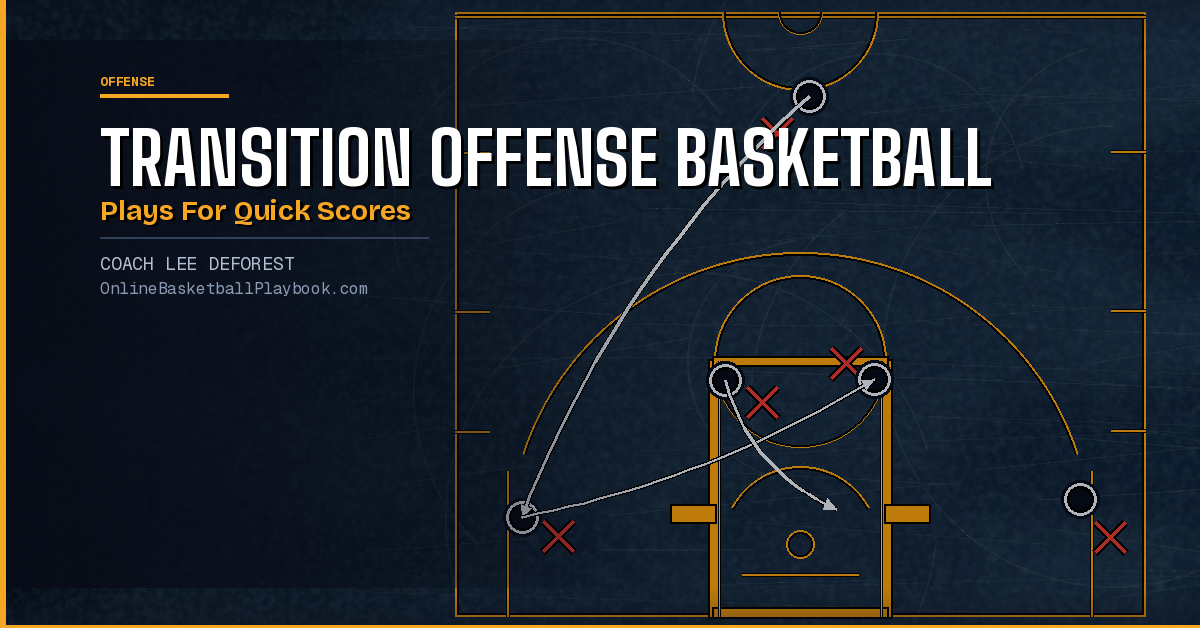
Transition Offense Basketball Plays for Quick Scores
Transition Offense Basketball Plays for Quick Scores