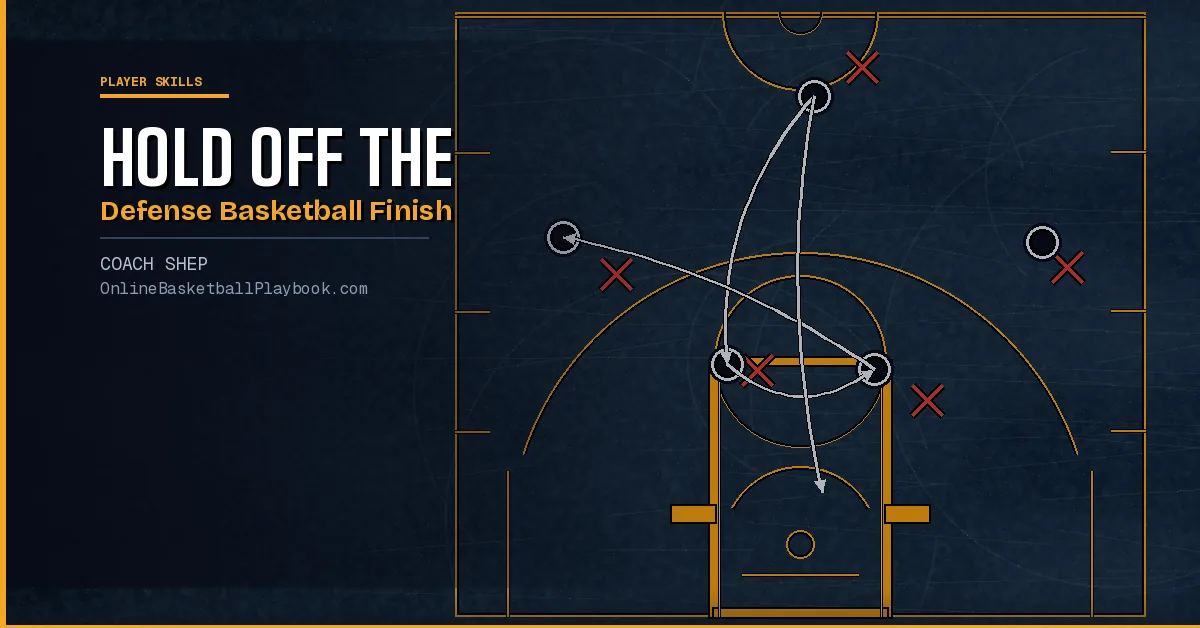
Getting into the paint is only half the battle. The finish you choose, and how well you shield the ball getting there, determines whether the basket counts. Here is how to do it right.
Why Body Position Beats Ball Skill at the Rim
Most young players think finishing in traffic is a ball-skill problem. They practice layup angles, off-hand finishes, and floater touch, all legitimate, but skip the step that actually separates finished from blocked: body position on the way to the basket.
When you drive into the lane, a help defender is rotating to meet you. Your job is to put your body between that defender and the ball before you release. That is what "holding off the defense" means. The ball goes up last. The body shield goes up first.
The principle comes directly from the finishing tradition built around using the rim as a barrier and the body as a moving pick against the help. A player who masters this is difficult to block cleanly, even when the defender is longer and more athletic, because a clean block requires a path to the ball, and a well-positioned finisher eliminates that path.
Body position also gives you time. When you feel the contact coming and you are already shielded, you can adjust the release angle, absorb the bump without losing the ball, or draw the foul. Players who arrive at the rim with no body shield have none of those options. They are just hoping the defender misses.
The Jump-Stop Foundation Every Finisher Needs
Every elite hold-off finish begins with a controlled gather. The tool for that gather is the jump stop, a small, simultaneous two-foot landing that preserves your pivot options and puts you in a balanced, low athletic position before the final move.
The coaching cue is simple: "Kill your dribble, take a small bunny hop, land simultaneously on both feet." When you land on both feet at once, you can choose either foot as your pivot. That means the defense cannot read your direction from your footwork alone. You have not committed yet.
Compare that to the drift-and-pray finish most guards default to. They float through the lane on one foot, no gather, no control. The defender steps in, makes contact, and the shot never had a chance. A jump stop puts the ball in your hands and your feet under you at the same moment. That is the platform for everything that follows.
The jump stop is also what forces a player to confront help defense rather than float through it. One skills coach, whose three-move live-ball curriculum is one of the clearest individual-offense frameworks in the coaching literature, applied a strict jump-stop-only-layup rule at the start of each season. No stride finishes for the first several weeks. The limitation is the point. When the jump stop is the only option, players learn to gather, read the help, and choose. Instead of just hoping to beat the contact.
Practice the jump stop in isolation before attaching it to a full drive. Two-foot landing, weight balanced, head above midpoint, ball protected at the chest. Once it becomes automatic, attach it to a one-dribble drive from triple threat. Then two dribbles. Then a pull-up option. The gather is not just a layup skill. It is the platform for the shot-fake, the rip-through, and the pass kick-out when the help collapses.
How to Use the Rim as a Shield
The rim is not just the target. Used correctly, it is a defender. One that the offense controls completely.
When a right-handed driver attacks the right side of the lane and the help slides over from the left block, the geometry of the play means the basket is between the driver and the help defender. If the driver finishes on the left side of the rim (a reverse or a cross-body finish), they force the blocker to reach through or around the basket to get to the ball. That reach usually results in a foul or a missed block attempt.
This is not a trick. It is a repeatable geometric advantage. The key is recognizing which side of the help the defense is on before releasing the ball. That read happens at or before the gather. Not after you are already in the air.
The same principle applies when a center steps up as a shot-blocker directly in front. A power finish, two feet, strong gather, ball high and protected, uses your body as the shield and dares the defender to make contact in a way the official can see clearly. The ball goes up after the body makes contact, not before.
Teaching cue: "Finish through contact, not around it." Players who try to avoid defenders on the way to the rim usually end up finishing off-balance from a bad angle. Players who finish through contact, body already in position, ball protected, draw fouls and make tough baskets look controlled.
Your Finish Menu: Choosing the Right Layup for the Defense
No single finish beats all defenses. The goal is a trained menu. A set of four or five options you can deploy based on what the defense gives you, not what you prefer. Players who train only one finish become predictable. Defenders adjust, coaches game-plan, and the one-trick finisher stops scoring.
Here are the core finish types and the situations each one is designed for.
Regular Layup (Inside Hand)
The default. Right-side drive, right-hand finish on the near side of the rim. Appropriate when there is no active help and the lane is open. The problem is that most players use this finish even when a help defender is in position. Because it is the only one they trained.
Power Finish (Two-Foot Gather)
Jump stop into a two-foot gather, both feet down, ball above the head, body square to or through the contact. Best against a charging shot-blocker or when you know you will absorb contact. Forces the defender to hit you cleanly, which officials notice. The jump stop from the previous section feeds directly into this finish.
Reverse Layup
Attack one side, finish on the opposite side of the rim. The basket is now physically between you and the help defender. Used when help is sliding across from the weak side. The ball travels on a curved path beneath or around the backboard. The degree of curve depends on how wide the drive was. Train it from both wings, both hands.
Floater or Runner
A mid-range release off one or two dribbles. The ball goes up before the help can get set. The floater is especially effective against a rim-protecting big who is late to slide over. The key footwork detail, from a guard-drill tradition, is releasing off the correct foot for the direction of travel. It controls the arc and the target point on the glass.
Euro Step
Two-step gather that changes direction in the air. One foot in one direction, gather, other foot in the opposite direction, release. Forces the shot-blocker to commit one way and then misses them in the other direction. Requires clean two-step timing to avoid traveling. Many young players pick up the dribble too late.
Drilling the Hold-Off Finish: Reps That Carry Over to Games
The hold-off finish is a decision-making skill, not just a motor skill. That means drills need to include a read component, not just a repetitive layup lane. Here is how to build the skill so it shows up in games.
1-on-1 Drive-and-Decide
Passer at the elbow, driver at the wing, live defender in the lane. Driver catches, attacks in one direction, defender presents a predetermined help angle (right side, left side, straight up). Driver must identify the help and choose the correct finish from the menu. Run each defensive angle five times before rotating. Passer tracks whether the finish matched the help. That accountability is the feedback loop.
Jump-Stop Finish Progression
Solo drill, no defense. Cone at the elbow extended, cone at the short corner. Driver dribbles from the arc, receives a pass or self-passes, executes a jump stop at the first cone, reads the second cone (representing a help defender), and selects: power finish (cone is straight ahead), reverse (cone is on the near side), floater (no cone set). The read happens at the gather, not in the air. This ingrains the gather-then-decide sequencing before live defenders are added.
Offensive Pivoting and Passing Breakdown Drill
Three-person groups: one dribbler/passer, one live defender, one receiver-shooter at the elbow. Dribbler kills the dribble, executes a jump stop, works through the four-phase ball-handler series (step-out, rip-through, swing-around, split) against the live defender, then kicks to the shooter. 55-second rotations, two rounds per foot as pivot foot. This drill, sourced from one footwork system, puts live resistance on the gather and forces the finisher to protect the ball and make decisions simultaneously. It belongs in pre-practice warm-ups precisely because it trains three skills (ball protection, defense, and shooting footwork) at the same time.
Mikan with Contact
Standard Mikan drill (alternating power finishes from each block) with a coach or manager providing shoulder contact on each release. The contact is not a block attempt. It is a bump delivered at the moment of gather. Players learn to absorb contact at the exact moment the ball goes up without losing the target or the timing. This is the simplest way to introduce hold-off muscle memory without setting up a full live rep.
Teaching Progressions and Common Mistakes to Correct
Even players who understand the concept intellectually will fall back to their default habits under pressure unless the correct sequencing is installed through repetition. These are the most common mistakes and how to address them in practice.
Mistake 1: Releasing the Ball Before the Body Is Shielded
The most common error at every level. Player catches the ball in the paint, feels pressure, and releases immediately. No gather, no body position, no shield. Result: contested finish from a bad angle, or a block that looks like a foul but does not get called because the defender had a clean path to the ball.
Fix: Require the jump stop before any finish in early-season drills. No exceptions. The jump stop forces a pause. And that pause is where the shield is set. Once the gather habit is installed, the body position comes with it.
Mistake 2: Drifting Laterally Instead of Attacking the Rim
Players who float to the side on the drive give the defender recovery space. The correct drive path goes directly at the defender's lead foot, the "north" direction, and scrapes off the defender's shoulder. Stepping east or west is a passing footwork move, not a driving footwork move. When a player drifts laterally to create space, they are using the wrong tool. A lateral step invites pursuit. A north step cuts off the pursuit angle.
Cue: "Attack the front foot." The drive is a straight line to the rim, not a curve around the defender.
Mistake 3: Using the Same Finish Regardless of Help
Some players execute a physically impressive finish, good gather, strong body position, but always use the same layup type regardless of where the help is. A right-hand finish against a left-side help defender is a contested finish that should have been a reverse. The ball goes to the wrong side of the rim.
Fix: Add the read cue to every drill, even solo drills. Coach calls "left" or "right" or "straight" as the player gathers. The player selects the correct finish. Over several weeks, the read becomes instinctive.
Mistake 4: Finishing Off the Wrong Foot on the Floater
The floater is the hardest finish to time correctly. Players who release off the wrong foot on a given drive direction lose the arc control and the target point. The floater off the correct foot puts a natural backspin on the ball and a high arc that clears the shot-blocker's reach. Off the wrong foot, it is a flat, arm-dependent shot with no margin.
Fix: Drill the floater in isolation from each direction, calling out the correct release foot before each rep. Left-side drive, right-foot release. Right-side drive, left-foot release. Once the footwork is automatic, reattach it to the full drive sequence.
Apply the jump-stop-only-layup rule for the first two or three weeks of every season. It feels restrictive, but that restriction is the lesson. Players who must jump-stop before every finish quickly learn to gather, read the help, and choose a finish instead of floating and hoping. By week four, the menu opens up and every finish in it is built on a controlled platform.
- Jump stop before every finish: land on both feet simultaneously to preserve pivot options and establish your body shield before the ball goes up.
- Read the help at the gather: Identify the help defender's position (left, right, or straight ahead) before you commit to a finish direction.
- Drive north, not east or west: attack the defender's lead foot directly; lateral steps give defenders recovery space and eliminate your angle advantage.
- Use the rim as a physical shield: when help is sliding across the lane, a reverse or cross-body finish puts the basket between the defender and the ball.
- Finish through contact, not around it: a power finish into a shot-blocker draws fouls and makes counted baskets; avoidance finishes are contested from awkward angles.
- Train all five finish types with a read cue: regular, power, reverse, floater, and Euro step, and drill them with a coach calling the help direction so the selection becomes automatic.
Want more basketball coaching strategies and drills?
Join the Online Basketball Playbook newsletter →
Draw this play free in the play drawer →
Membership: the full library, playbook packs, and Pro drawing tools →
Keep Building
Related breakdowns
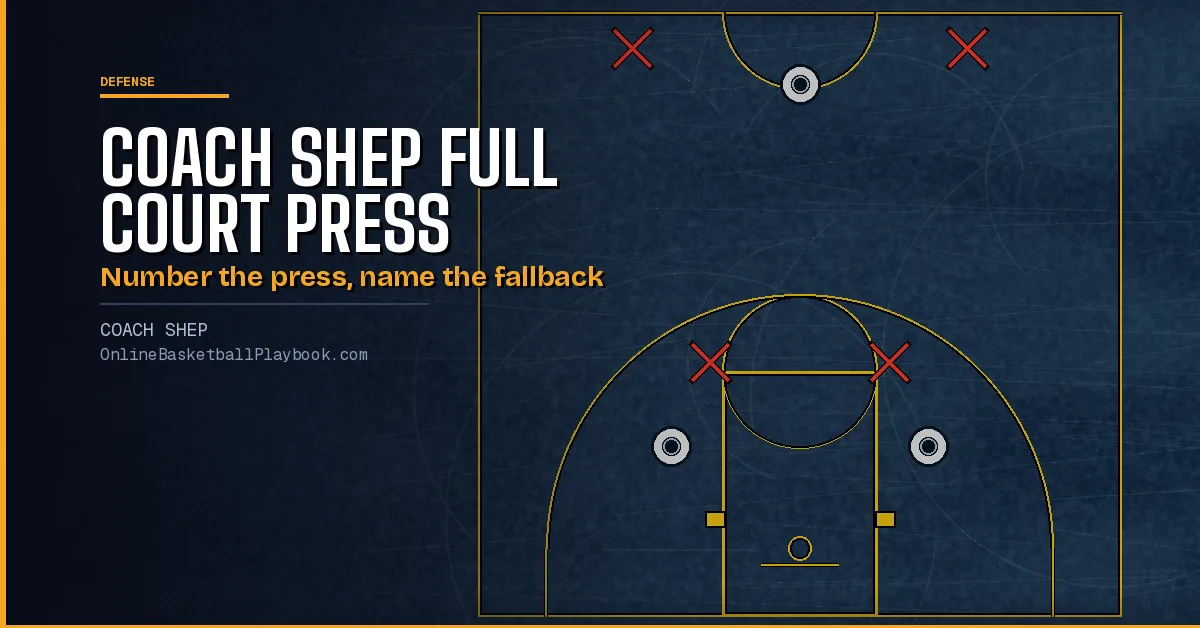
Coach Shep Full Court Press: Numbered Looks, Hold Fist, Black
Coach Shep's full court press: the numbered looks 55, 22, 25 and 12, Black, Hold Fist, the fallback behind each press, his scoring target and how he practices it.
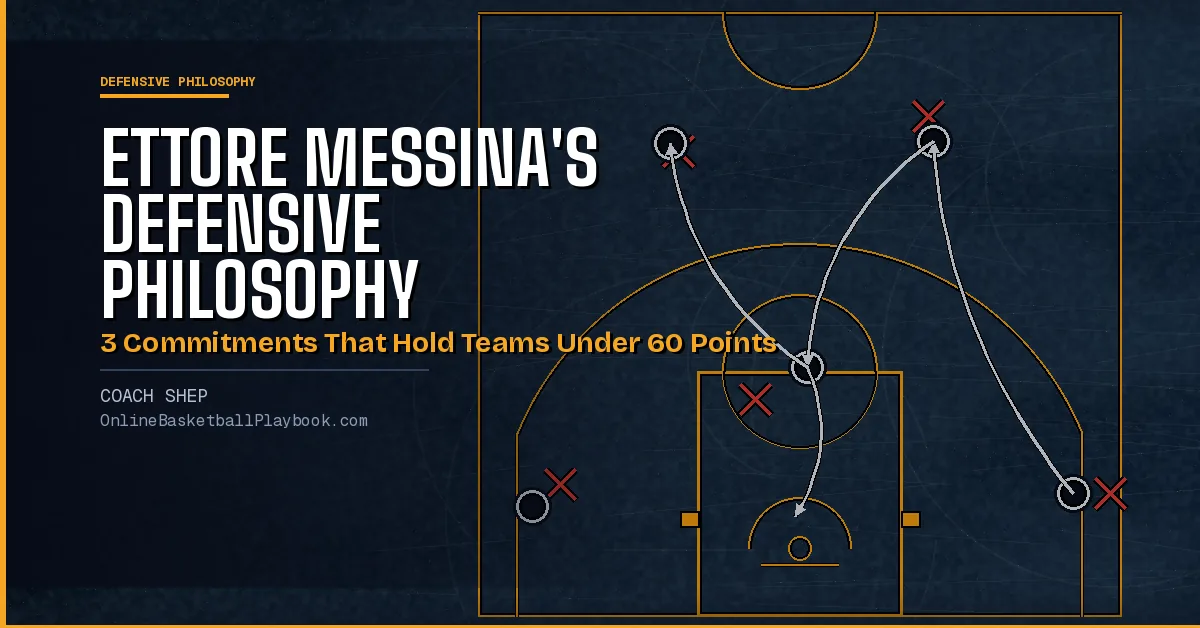
Ettore Messina's Defensive Philosophy: 3 Commitments That Hold Teams Under 60 Points
A four-time Euroleague champion and longtime Popovich assistant explains the three non-negotiable rules that have anchored his defenses for 30 years, and the off-ball positioning system that makes them work.
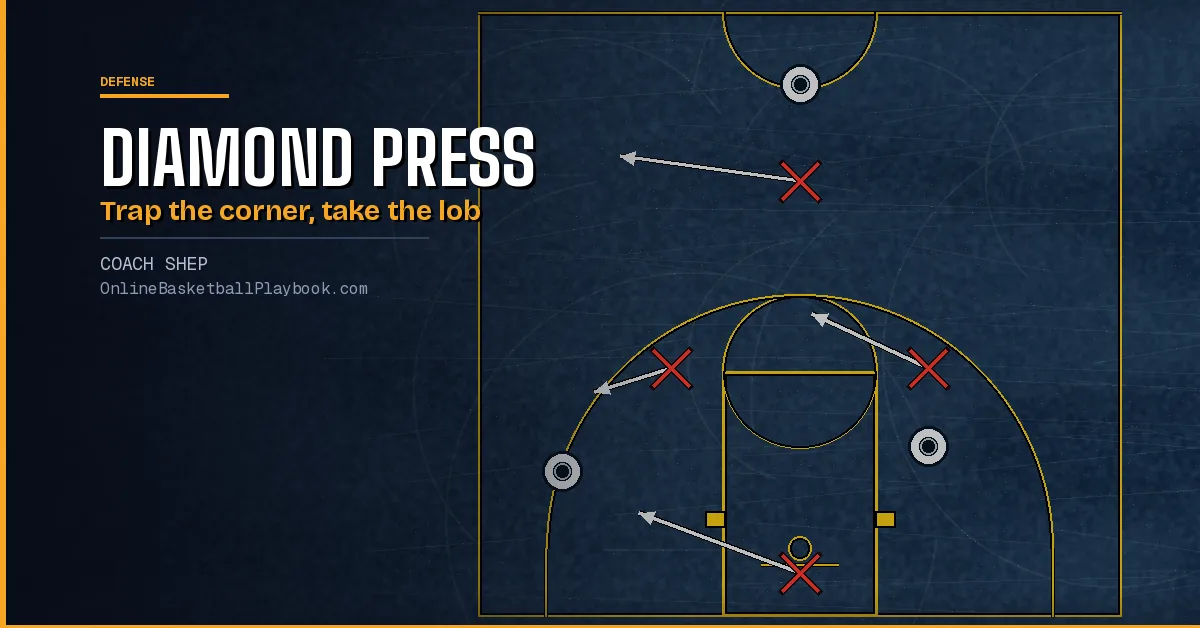
1-2-1-1 Diamond Press Basketball: Roles, Traps and Install
How to run the diamond press in basketball: who plays each role, how to trap the corner, what to do on the reversal and the lob, and how to install it step by step.