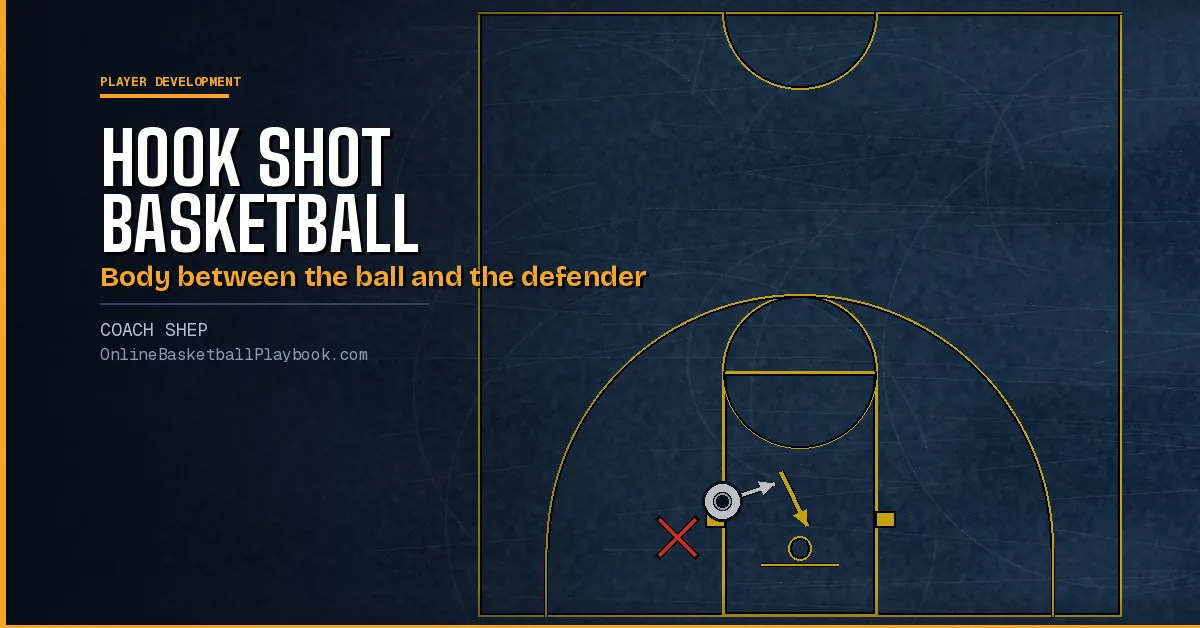
A hook shot in basketball is a one-handed shot taken with the body turned sideways to the basket, so the shooter's shoulder and the ball stay away from the defender.
Post players use it from the low block because a shot released high and to the side is hard to block, even against taller players. This hook shot basketball guide covers three types of the shot, five steps of footwork and release, how to choose the hook against different defenders, the pivot foot rules by level and drills that build both hands.
Hook Shot Basketball at a Glance
| Hook | Footwork | Release |
|---|---|---|
| Classic hook | Pivot sideways on the non-shooting foot, which stays on the floor | One hand from an extended arm at about 45 degrees from the basket, with a fingertip release and a wrist snap |
| Sky hook | A jump off the pivot foot (a one-foot layup-style jump also goes by the name) | The shooting arm extended high over the defender |
| Jump hook | A two-foot jump after a step | The shooting arm goes straight up above the shoulder, like a jump shot |
The range is about 10 to 12 feet. A player who can only hook with one hand is easy to guard, so coaches build both hands, and the hook is one of a small menu of post finishes with the drop step and the up-and-under. The other moves are on the post moves page and the whole game from entry to finish is on post play in basketball.
How to Shoot a Hook Shot
The jump hook breaks into five steps.
- Catch low and wide. Bring the ball to the chin with the elbows bent so a reach cannot strip it.
- Create space. Take a big step toward the middle or the baseline off one pivot foot. A low two-handed dribble, spiked hard, can protect the ball from help defenders while the step covers ground.
- Turn the shoulders. The shoulders end up parallel to the sideline, the stepping foot becomes the new pivot and the body sits between the ball and the defender.
- Jump off two feet. Bring the ball up along the side of the body, away from the defender.
- Release at the top. The guide hand leaves the ball and the shooting hand flicks the wrist, getting the ball as high and as far from the defender as possible.

A pump fake toward the baseline before the move can unbalance the defender and freeze a helper. The shot also runs on three cues that fit one rhythm.
- Lock. Lock the shooting hand under the ball after a ball fake, with the elbow flexed at the hip in line with the shoulder.
- Legs. Step away from the defender with the foot opposite the shooting side, protecting the ball with the head and shoulders and dipping the knee.
- Lift. Lift the shooting arm ear to ear and release off the index finger for backspin.
Pick whichever set of cues your players remember and teach one at a time.
Aim matters too, and it depends on the angle to the backboard.
- Inside about 45 degrees. Bank the shot off the top near corner of the square.
- Outside that angle. Aim just over the rim.
- Treat a miss as a pass to yourself. A defender who goes up to block the hook is out of position to box out.
Step, turn and release the same way every rep, and the shot takes care of itself.
Classic Hook, Sky Hook and Jump Hook
The three hooks share the same idea, the body between the ball and the defender, and differ in the legs and the release.
- Classic hook. The post player receives the ball with his back to the basket and pivots sideways on the non-shooting foot, which stays planted. His off shoulder points at the hoop, his shooting elbow stays locked against the body and he turns his head to find the rim. The off arm can be raised to ward off the defender but should not push or hook him.
- Sky hook. This adds a jump off the pivot foot with the arm extended high. A one-foot style swings the opposite knee up like a layup and trades some power for a finesse release.
- Watch the pivot foot. Going to the middle, the inside pivot foot should land parallel to the baseline. Turning it toward the baseline over-rotates the shoulders and exposes the shot to a block, and turning it toward half court costs balance. Going to the baseline side the rule flips.
- Jump hook. A modern blend of the classic hook and a jump shot. The shooter jumps off both feet, turns perpendicular to the basket and releases with the arm above the shoulder instead of out to the side.
- Own the jump hook. It is the base move that every player should own, with the up-and-under as the counter when the defender leaves his feet for the hook.
- Negate height. The hook is the only shot that negates height.
Own one hook first, then add the others.
When to Use the Hook
Read the defender first and pick the finish second.
| Defender | Read and finish |
|---|---|
| Baseline side | Baby hook with a quick, long lead step, or turn to the middle and drop step |
| No pressure | Slow down and take the middle jump hook, with the shoulders perpendicular to the backboard. If the middle is blocked, dribble back to the baseline with the same hand |
| High side | Power layup. Drop step away from the pressure into one dribble toward the rim. The hook is not the first read |
When a defender overplays the baseline and takes away the drop step, the post fakes to the baseline with his head or shoulders, drops the lane-side foot into the lane and finishes high with a jump hook. It is the counter off the baseline drop step and not a first move.

Do not open the shoulders on the hook, so the shot stays turned away from the defender. Getting the ball to a post in position is a separate skill, covered on how to post up in basketball. The offense can feed the hook with the high-low pass from high-low offense, or from the two-post motion on the 3 out 2 in basketball offense page.
Read first, then finish.
The Pivot Foot Rules
The hook is footwork, so it touches the traveling rules. A jump hook lifts the pivot foot, and the ball has to be gone before that foot comes back. Each rulebook says it in different words.
| Level | The pivot foot on a shot | Rule |
|---|---|---|
| NFHS | Check your state association rulebook | |
| NCAA men | After the pivot foot is set it may be lifted, but it may not come back to the floor until the ball has left the shooter's hand | Rule 9 Sec. 5 Art. 5 |
| NBA (2025-26) | If the pivot foot is raised, the player must pass or shoot before it returns | Rule 10 Sec. XIII(d) |
| FIBA (2026) | To shoot, the player may jump off the pivot foot, but neither foot may return before the ball is released | Art. 25.2.1 |
The full rule by level is on the traveling in basketball page and the footwork basics are on basketball pivot footwork.
Know your level's rule before you teach the jump hook.
Get the next coaching guide in your inbox
One email when a new guide or diagram set goes up. Free.
Common Errors and Fixes
- The shot comes up short. Add leg drive and a complete follow-through.
- The shot misses to one side. The shooting arm crossed in front of or behind the head. Lift it straight from ear to ear.
- The ball spins sideways off the rim. The hands were on the sides of the ball or the release came off the wrong finger.
- The shot gets blocked. Check the pivot foot first, since over-rotation exposes the shot.
- The player only has one hand. Rebuild the weak side. The defender can force the play away from one hand.
Hook Shot Drills
- Stationary hooks under the rim. Start with both hands close to the basket, and once the player makes five in a row add a crossover step toward the free-throw line.
- Alternating hook layups. A Mikan-style drill off the glass, no dribble, switching sides after each shot. Run it about five minutes a day, with a squared-up variation.

- Two-hook series. A chair or cone stands halfway up the lane line. The player starts on the wing with a ball, attacks the chair with a crossover or any other move, takes one dribble into the paint, jump-stops and passes to a partner on the opposite side.
- Hook from the block. He then goes to the block, catches a post feed and hooks to the middle, then catches the next feed and hooks to the baseline. A partner rebounds under the rim.
- Run it three times. The player runs it three times and then switches sides. Do not bring the ball down on the catch.
- Five-minute hook block. A post workout can give the jump hook five minutes, both sides, before moving to turnaround jumpers and up-and-unders.
- Add a defender. See Where Coaches Differ below for how coaches order guarded and unguarded reps.

Rep both hands every day, then add a defender.
More finishing work is on the Mikan drill page and basketball finishing moves. For a menu of footwork drills see basketball footwork drills.
Where Coaches Differ
Coaches split on three questions.
How many moves?
- A short menu. Drop step, jump hook and up-and-under before any variations.
- A go-to and a counter. A go-to move and a single counter.
- Two moves on each block. Master two moves on each block before adding more.
Cues.
- Five steps. Catch, step, turn, jump, release.
- Three cues. Lock, legs, lift.
- A pivot foot rule. Land parallel to the baseline going middle.
Guarded or unguarded reps?
- Always guarded. Never rep post moves without a defender.
- Unguarded blocks first. Unguarded five-minute blocks build the footwork, with the go-to move finished 80 percent of the time against a player your size.
- A ladder. Go from no defender to a token defender to a competitive one-on-one series.
Choose one set of cues for your team. For a post who needs more than a hook, add the fake and the counter from basketball post moves.
Want the printable playbook packs?
OBP Pro members get the premium playbook packs: the zone attack, out of bounds and practice plan PDFs, plus each new pack as it is finished. The membership page lists what is in each one. Or draw your own version free in PlayDraw.
See what OBP Pro includesQuestions Coaches Ask
What is a hook shot in basketball?
A one-handed shot taken with the body turned sideways to the basket, so the ball is released high and away from the defender.
What is the difference between a hook shot and a jump hook?
A classic hook is shot off a planted pivot foot. A jump hook is a two-foot jump with the shooting arm extended straight above the shoulder.
What is a sky hook?
A hook with a jump off the pivot foot and the shooting arm extended high. A one-foot style swings the opposite knee up like a layup.
How far can you shoot a hook shot?
The range is about 10 to 12 feet, and it should be built with both hands.
Is a hook shot a travel?
Not if the ball is released before the pivot foot returns to the floor. Rules differ by level, so see the table above and check your own rulebook.
How do you stop a hook shot from getting blocked?
Turn the body so it shields the ball, hold the ball high and out to the side, and add arc on the release.
More Guides From This Batch
- Sideline Out of Bounds Plays: SLOB Sets, Reads and Practice
- 3 Out 2 In Basketball Offense: Spacing, Actions and Reads
- Fun Basketball Games for Practice: Scored Games for Any Team
- Elevator Screen Basketball: How It Works, Plays and Counters
Back to Basketball Player Development and every Player Development page.
Keep Building
Related breakdowns
Basketball Shot Fake (Pump Fake): How to Do It and Teach It
The basketball shot fake, also called the pump fake, works when it looks like the real shot. The mechanics, the pivot foot footwork, the read and the drills.
How to Teach Effective Shot Selection in Basketball
How to Teach Effective Shot Selection in Basketball
Basketball IQ: What It Is and How to Teach It
Basketball IQ is knowing why and when, not just how: the reads players learn, thinking ahead, rebounding and shot reads, game state, and how coaches teach it.