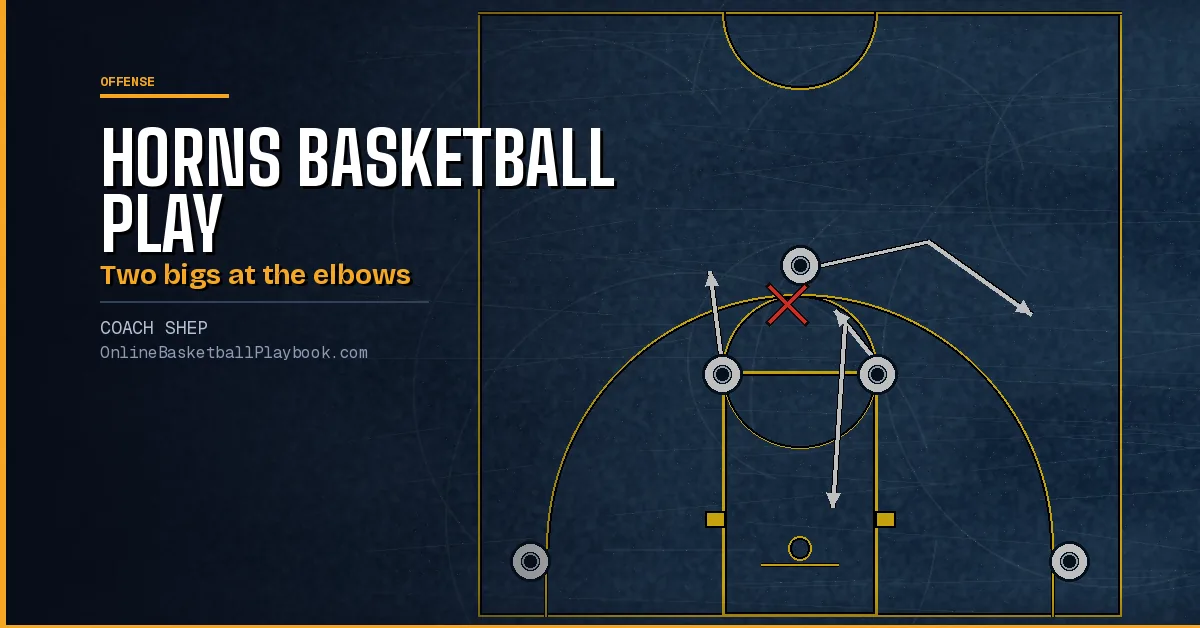
A horns basketball play starts from one picture. Two bigs stand at or just above the elbows, 1 handles the ball out front, and the other two players sit in the corners or on the wings. Drawn on a board, the two elbow players look like the horns of a bull, which is where the name comes from.
Horns is an alignment that many plays share. From the same start a team can run an elbow pick and roll, a hi-lo feed, handoffs, flares, flex cuts and shooter screens. This guide covers the horns set, why it works, the core horns actions with diagrams, the reads at the elbow screen, the counters, horns against a zone and how to install it. Every set on the site is listed on basketball plays.
The Horns Set
The base horns set has 1 at the top of the key, the two posts high at the elbows, and two shooters deep in the corners. It is also called the A-set, because the picture looks like a capital A drawn upside down, and it is filed under the 1-4 high or called a 1-2-2 with the posts at the elbows. The horns set is used at every level, from the NBA and WNBA down to high school.

The picture has two variants.
- Perimeter players on the wings. Put the two perimeter players on the wings instead of in the corners.
- The inverted set. A forward stands at an elbow and a big in the corner.
Other systems use the word "horns" for other jobs, such as a UCLA cut into the flex with no bigs at the elbows, so write the job next to the name and check the diagram before you borrow a call.
Why Coaches Run Horns
The main reason is the second screener.
- No pushing the handler away. With a high screen on each side of the ball, the defense cannot beat the action by pushing the ball handler away from one screen, because there is another one waiting on the other side.
- Denial, but less help. Both screeners being high also puts the defenders off the ball in first-pass denial, which limits help from the baseline when the guard drives.
- Good against pressure. The 1-4 high look is also good against pressure.
- Many plays, one picture. Hang a whole family of plays on the one start. One set of named plays attaches ten exits to it, and the deepest horns menus run to twenty or more calls.
- Easy to get into. It works out of transition and right off an inbounds pass.
- Built around personnel. Horns is a double high post look for a two-way screen, filed with the sets for a team that has two posts. Put the best scorer in one corner and the player you want out of the play in the other.
Learn the one picture first and the plays follow.
The Horns Basketball Play Starts With the Elbow Screen
The core of horns is the high pick and roll. Either big can screen, so the point guard can pick a side and dribble right or left around the screen. He looks to score, to hit the roller, or to kick out to a corner shooter whose defender drops in to help. As the screener rolls, the opposite post pops out toward the top of the key.

Two details decide whether the screen works. The dribbler waits for the screen to be set, because impatience causes most illegal screens. And the screener sets it on the defender's back hip with his own back to the corner, not the sideline, or the defender slides under. The technique is on setting screens in basketball, and the full read progression for the ball screen is on pick and roll.
The hi-lo option. If the drive, the roll and the kick-out are all covered, the point guard passes back to the big who popped to the top of the key. He shoots if he is a shooter, or feeds the other big posting up inside. A feed from the top of the key is usually open, because there is little help side when the ball is in the middle.

The feed from one big to the other is the same action as the high-low offense, and the popping big's shot is the pick and pop. Run the action to the better screener's side.
Who Rolls and Who Pops
Two bigs leave the elbows on every horns ball screen, so the team needs a rule for who goes where. Pick one.
- Side rule. Roll on the side the guard uses, pop on the other side.
- Mirror rule. If the screener rolls, the other big pops. If the screener pops, the other big cuts to the basket.
- Shooter rule. The better shooter of the two pops, the stronger post rolls.
- Screener rule. The big who sets the screen rolls and the other pops. Never two rollers or two poppers.
- Dive rule. The big who is not in the ball screen dives to the ball-side block.
- Double screen rule. When both bigs screen in turn, the first screener pops and the second rolls (it can be run the other way).
- Slip rule. The first screener slips for an inside catch and the second pops.
- Crossing rule. The bigs cross before the screen, so the coach names a set popper and a set roller and the post defenders cannot hedge early.
The opposite roll is the mirror rule drawn out.

Two tags change who screens without changing the play. In a post switch the bigs trade sides, which can confuse the post defenders and keep the far one from hedging. In a post cross one big cross-screens for the other, who loops under it and sets the ball screen. Pick one rule and drill it until the bigs never end up in the same place.
More Horns Actions
Staggered screens for the shooter. The point guard dribbles to one side while both bigs screen down, one after the other, for the corner shooter on that side. The shooter runs off both screens to the far wing and catches the skip pass with a whole side of the floor to himself. If nothing is there, the near big ball-screens for him and the two run the pick and roll, with the big rolling or popping.

Screen-flare. The point guard dribbles off a double screen, then the screener turns and sets a flare screen high, near the lane line extended, for a shooter cutting over it for the over-the-top pass.
Set it lower and there is no room for the pass, and if the defense switches it, the screener slips to the rim. The screens are on down screen, flare screen and elevator screen.
Flex finish. Horns often ends in another offense, and the flex is the most common.
- Dribble off the screen. The point guard dribbles off one big's screen to the wing while the other big cuts to the ball-side block.
- Pop to the top. The screener pops to the top of the key and gets the ball.
- Flex screen. The big on the block then sets a flex screen for the corner player, who flex-cuts to the far block, and the big posts up for a feed after the cut.

The full flex is on flex basketball plays, and the repeated ball screens horns can flow into are on ball screen continuity offense.
Handoffs. A big can dribble the ball to a guard and hand it off, which disguises the next action, but the big has to be able to dribble and deliver on the move. The reads are on DHO basketball. Pick the actions that fit your personnel and drill them from both sides.
Reads at the Elbow Screen
Every horns ball screen has a read tree. Here is an answer to each coverage.
The defense chases over the top.
- Turn the corner and drive. Drop the pass if the weak-side post's man helps, kick out if a wing sags.
- Attack the outside hip. Do it when the defender stays attached.
The defense goes under.
- Pull up and shoot. Shoot when the defender goes under with no help.
The defense switches.
- Feed the roller or post the smaller defender. With a big on the guard, clear out for the guard and dive the post.
The defense shows or hedges.
- Slip or pop. The screener slips or pops, and the ball handler strings the big out on the dribble.
- Split or isolate. Split a hedge that goes too far. Back out of a hard hedge, then isolate the switch or post the mismatch.
The defense cheats over early.
- Drive the other way. Use a crossover, behind the back or between the legs.
- Turn down the screen.
The defense traps.
- String it out. Pass in the air, and the screener rolls or pops.
- Retreat and short-roll. Take two retreat dribbles, and the screener short-rolls one step for a 4-on-3.
The defense overplays a screener.
- Back-cut for a lob. The screener back-cuts for a lob.
Scout the defense's first and second coverage, and attack its weakest defender. A big in foul trouble is a target when the defense shows and recovers.
The defense has its own horns rule. The on-ball defender pushes the ball toward the weaker of the two screeners, which takes away the choice of sides. That is why the offense runs horns to the better screener's side but drills both. Every coverage and its answer is on how to attack every ball screen coverage. Read the coverage, then make the counter.
Counters Built Into Horns
Coaches organize the same counters in different ways.
- One call per answer. Give every answer its own play call.
- One call, a list of reads. Keep one call with a list of coverage reads and a counter for each.
- One start, several finishes. Run one start with two or three finishes.
- A word names the finish. Add a word to the call that names the finish.
- The slip. A slip is built into many horns plays. A handoff and a flare screen can come first, then the screener slips to the rim. Or the screener fakes the screen and slips when the defense gets ready to switch it.
- The twist and the re-screen. The big re-angles the screen. 4 pops to catch, 5 replaces him at the elbow, then steps out and ball-screens for 4. Or the roller sprints back on the throwback to set a flat ball screen at a new angle.
- Spain action. A back screen on the roller's defender as he rolls. A wing can back-screen the rolling big's man for a lob.
- The backdoor. Against a team that overplays the first pass, the receiver cuts behind his defender. The read is on cut or backdoor.
Know the counter before you need it.
Getting Into Horns
Horns is easy to reach from many starts.
- Off the break or an inbounds pass. Players run to the four spots.
- Bigs sprint up from low. Start the bigs on the blocks and sprint them to the elbows. If the pass to the elbow is denied, bounce the ball wide and go to a zipper cut.
- From a box. The two high players in a box lift into the horns spots.
Coaches use horns in special situations in different ways.
- After a timeout. Title individual horns sets as after-timeout plays.
- Half court only. Keep horns in the half court and put the after-timeout plays elsewhere.
- End of a quarter. File a horns ball-screen set for the end of a quarter.
More timeout calls are on basketball after timeout plays, and quick two-pass sets are on how to run quick hitters.
Horns Against a Zone
Horns is used against zones too, since it can be run against man-to-man and zone alike. A zone set has 5 pop to the top of the key, 4 cross-screen, and then 5 ball-screen for the drive. Horns is also one of four entries into a high-low zone offense. The zone attack itself is on how to attack a zone defense and 2-3 zone offense.
Get the next coaching guide in your inbox
One email when a new guide or diagram set goes up. Free.
How to Install Horns
- Whole, part, whole. Show the whole play first, then drill the parts: 2-on-2 entries with two players, then a 3-on-3 double high post drill with dribble and pass entries, then half-court and full-court scrimmage. Have three skills in place first: on-ball screening, basic low post moves and offensive rebounding.
- 5-on-0, then live. Run horns 5-on-0 in the first block of practice, then live against a defense that traps the ball screen.
Mistakes to watch for:
- Leaving early. A dribbler who goes before the screen is set gets a screener called for a moving screen. See illegal screen.
- A bad angle. A screener with his back to the sideline lets the defender slide under.
- A weak screener. The defense will push the ball to him and take away the choice of sides.
Horns is also a set-play system, with the costs any set offense carries: many plays to remember, plays that cannot be run every trip, and the ball staying with a few players. If you want rules instead of plays, compare it with the elbow offense and the other systems on basketball offense.
Want the printable playbook packs?
OBP Pro members get the premium playbook packs: the zone attack, out of bounds and practice plan PDFs, plus each new pack as it is finished. The membership page lists what is in each one. Or draw your own version free in PlayDraw.
See what OBP Pro includesQuestions Coaches Ask
What is a horns basketball play?
A play run from the horns set, where two bigs stand at the elbows, the ball handler starts at the top of the key and the last two players fill the corners or the wings. The base action is a ball screen from one of the elbow bigs.
Is horns a 1-4 high?
It can be filed as one, a 1-4 high set with two high post screeners. It is also called a 1-2-2 with the posts at the elbows, or the A-set.
Who rolls and who pops in horns?
Coaches use different rules. Two are roll on the side the guard uses and pop on the other, or the better shooter always pops. Pick one rule and teach it.
Can you run horns against a zone?
Yes. Zone sets can start in horns, with a big popping to the top of the key and a cross screen before the ball screen, and horns is one entry into a high-low zone offense.
How do you draw a horns play?
Start the first frame with the alignment only, then draw each action in its own frame. The free play drawer has horns as a starting formation, and how to draw basketball plays walks through the order.
Every diagram on this page uses the symbols on how to read a basketball play diagram, and the terms are in basketball terminology.
More Guides From This Batch
- How to Become a Basketball Coach: Paths, First Jobs and Steps
- Youth Basketball Dribbling Drills: Cone Drills and Games by Age
- How to Draw Basketball Plays: By Hand and Online Free
Back to Basketball Plays and every Offense page.
Keep Building
Related breakdowns
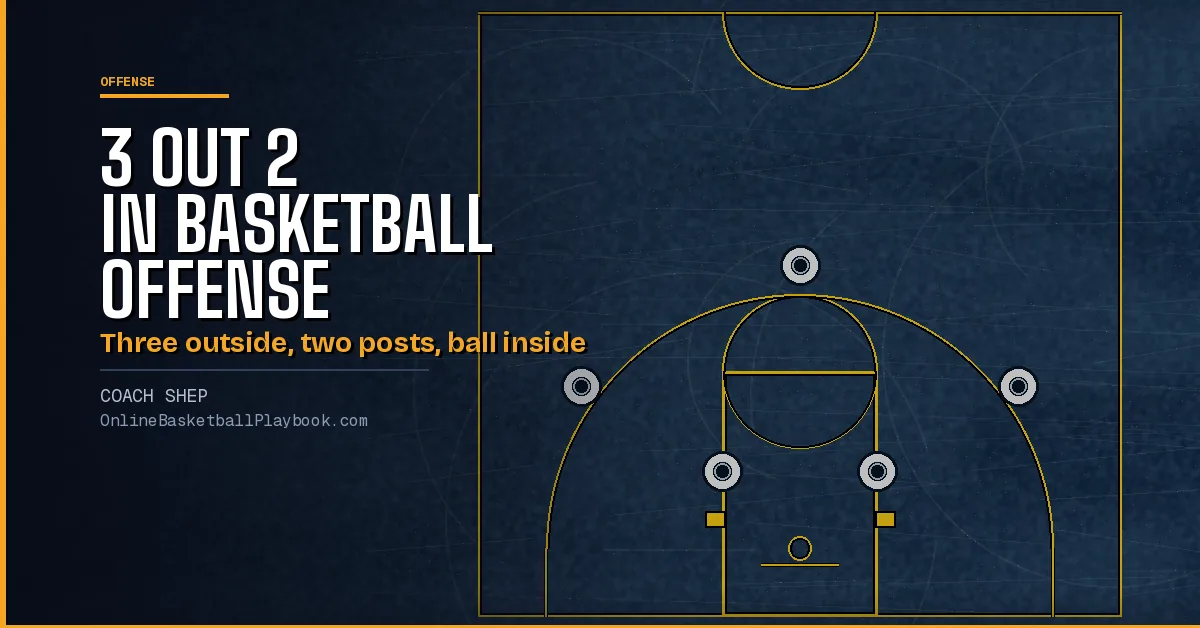
3 Out 2 In Basketball Offense: Spacing, Actions and Reads
The 3 out 2 in basketball offense explained: alignment, actions off every pass, the high-low counter, drive rules for the posts, add-on plays and who fits it.
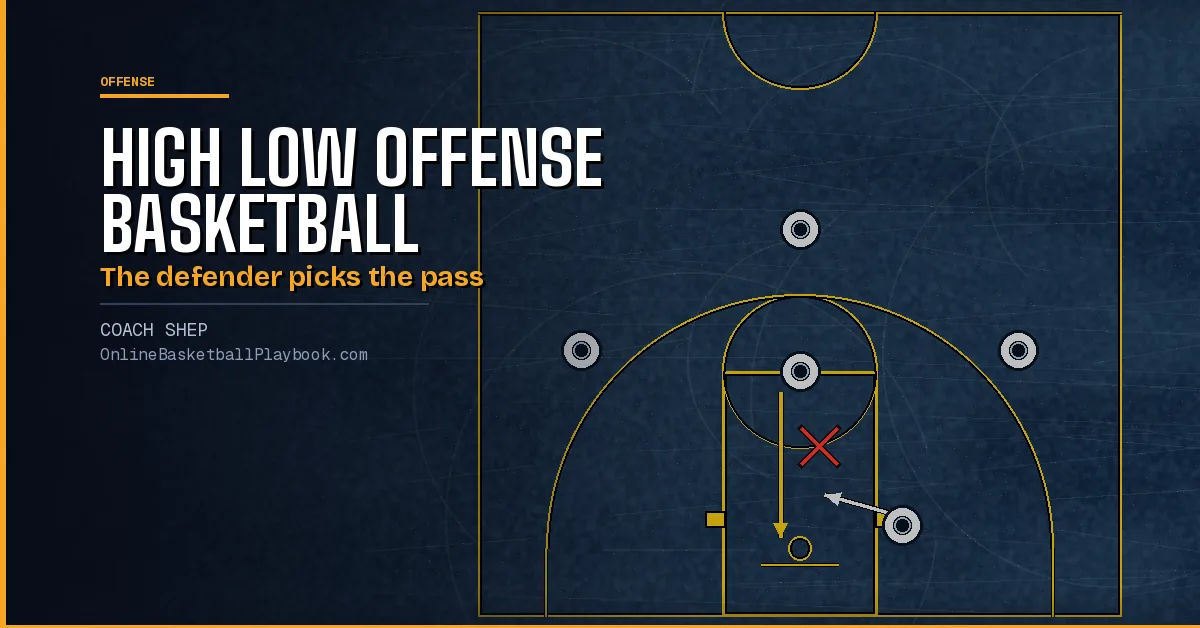
High Low Offense Basketball: Reads, Counters and Zone Rules
High low offense basketball explained: the two-post shell, the lob and bounce reads, answers to a front, down-screen reads, 1-4 low sets and the hi-lo against zones.
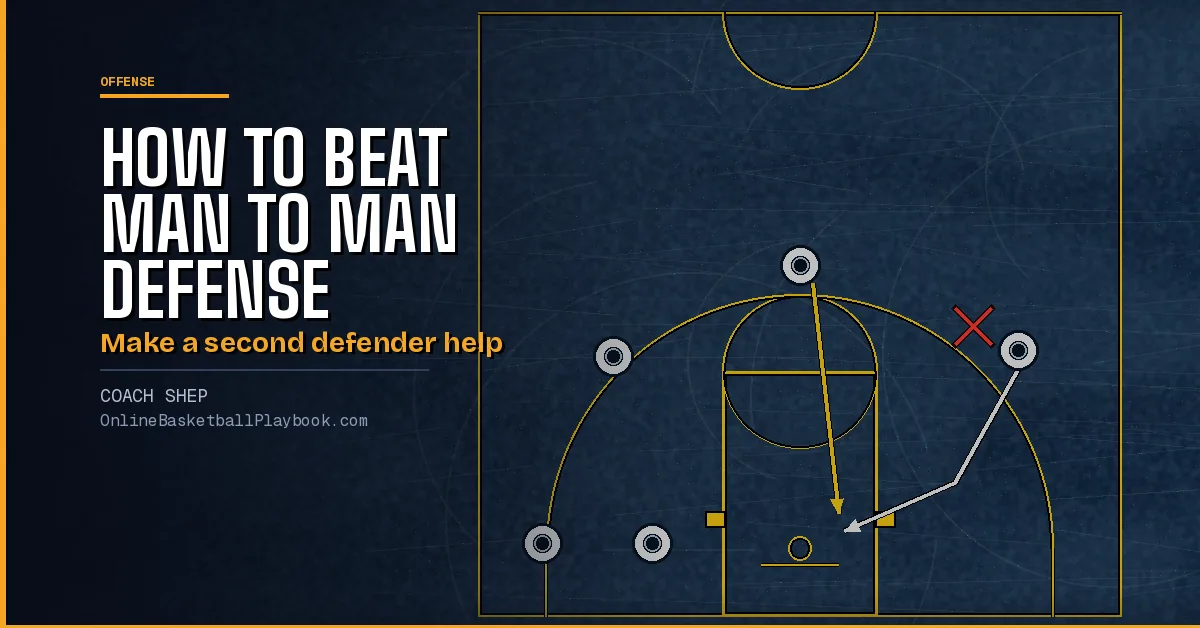
How to Beat Man to Man Defense in Basketball: Reads and Drills
How to beat man to man defense in basketball: spacing, catch reads, beating denial, drives, off-ball and ball screens, post feeds, the Pack Line and drills.