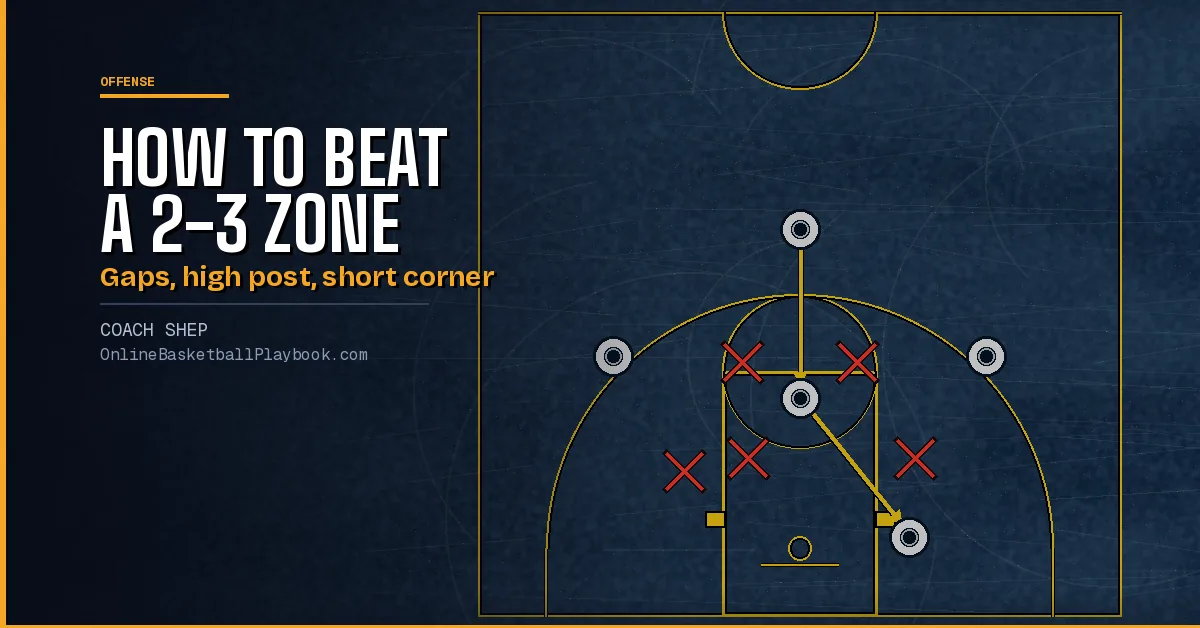
How to beat a 2-3 zone comes down to what the zone gives up. The 2-3 is the most common zone at the high school level. Two guards guard the top of the zone and three defenders guard the paint, the blocks and the baseline. It protects the rim and asks the offense to win from the outside. The gaps between the guards and the wings, the short corner and the skip pass are where it leaks. This guide shows the alignment, the entries, the reads and the drills.
The 2-3 Zone at a Glance
| Weak spot | Why it is open | The offense's answer |
|---|---|---|
| The elbow and high post | The guards cannot pressure the ball and cover it at once | Flash as the wing catches, then shoot, high-low or skip |
| The short corner | The ball-side back defender has the wing and the corner | Fill it early and dive the high post |
| The baseline | The two bottom defenders cannot guard it without leaving the post | A runner slides along the baseline |
| The far corner | The zone must shift across the whole floor | Skip pass, then reverse again |
| The glass | No defender owns a box-out assignment | Send players to the boards |
How to Beat a 2-3 Zone: Start in the Gaps

A 1-3-1 alignment puts every player in a gap, so a catch on the perimeter often has a lane in front of it. A 1-4 high alignment also works. It stretches the two top defenders and fills the short corners. Either way, each player reads the gap before the catch and goes on the catch, so the offense either splits the zone and scores or pulls a collapse and kicks to a shooter.
Keep the spacing honest. Hold the corners wide and keep the high post at the elbow. A wing who drifts toward the corner hands his defender a free assignment. Beat the zone down the floor too, so you face it on fewer possessions.
Flash the High Post

The elbow is the most exploitable spot in the 2-3. A pass from the guard to the high post can split the whole zone. The guards start close together to deny that pass, so the offense works for it. Flash from the weak side as the ball reaches the wing, or get the ball there with a screen followed by dribble penetration, a wing flash into the middle or a direct dribble into the space.
Flash into the space just inside the free-throw line and not onto the line itself. It is open more often and lowers the risk of a three-second call. A decision maker at the high post can shoot the short jumper, hit the low post on the high-low, shot-fake into a drive or swing the ball to the wing or point for an inside-out three.
Some 2-3 defenses cushion the high post on purpose and give up the ten-foot jumper to take away the corner three. If the catch is cushioned, look at the corners before you shoot. If the low middle defender steps up into a 2-1-2 look, the middle pass is still there and the high-low gets easier. Keep the two posts close enough that one pass connects them before the zone can shift. Once the low defender cheats toward the corner shooters, the high post fakes to the corner and goes high-low.
The Short Corner and the Baseline Runner

The short corner sits between the block and the corner. The ball-side back defender has the wing above it and the corner below it, and a player standing there forces him to pick one. A runner who moves opposite the ball and floats between the two short corners, nearly out of bounds and out of the defenders' sight, is hard to find. When the ball is on the wing, a baseline cutter can run the gap between the two bottom defenders. Neither can guard the baseline without leaving the post.
A catch in the short corner gives four choices. Hit the diving player from the free-throw line, shoot, kick the ball out or shot-fake and drive. The runner is also the drop-off target when the low defenders step up to stop a drive.
Skip to the Corner and Reverse

The 2-3 has to shift sideways on every pass, and its weak-side wing starts a step outside the lane, well away from the corner. A skip from one wing to the other, or from one corner to the other, asks that wing for a long closeout. The half-second after a reversal is the zone's weakest moment. Rotations have started and have not finished, so a player who catches before the zone is set has time.
The best looks come on the second or third side, after one or two reversals when the zone is tired and late. The corner shooter has to be set before the pass. When the wing defender runs at him, the catch turns into a drive along the baseline or a kick to the opposite corner.
Attack the Seam on the Dribble
The two guards stay close to deny the gap between them. A dribble at that seam forces one of them to choose. If one follows you, pass to the opposite side. If he passes you off, keep going. A gap drive pulls two defenders together, and the pass out of that double gives a 4-on-3. The first dribble challenges the zone. The pass or the reversal beats it.
Screen the 2-3
A ball screen on one of the top two defenders is underused against a 2-3. Nobody hedges or helps the way a man defense would, so the screen gives a shot or a forced rotation. One example is a high post who screens the top defender, seals him and cuts for the return pass. If the ball does not come, he resets to the opposite elbow and repeats. Another form is to swing the ball to shift the zone, pin the shifted top and low defenders and skip to a shooter.
After any screen, the screener seals and dives. Reversal alone does not beat a zone. Stretch every defender to the limit of his area and get the ball inside.
Get the next coaching guide in your inbox
One email when a new guide or diagram set goes up. Free.
Offense Against a 2-3 Zone for Youth Teams
A youth team needs a short list of rules. Beat the zone with quick passing and movement, avoid extra dribbles, and treat offensive rebounding as a ground rule because zone defenders rarely have clear box-out assignments.
Teach the gaps before the play. Set a 2-3 on a clipboard with coins, put the offense in a 1-3-1 and find the gaps together. Then mark the gap spots on the court with hoops or mats and walk the same reads.
- Set up. A 1-3-1 with the high post starting on the lane and flashing to the free-throw line as the point brings the ball up. The wings stay high and wide so the pass to them is hard to intercept.
- Pass to the wing. The high post fills the ball-side lane, the opposite post drops to the corner and the weak-side wing fills inside the arc.
- Elbow read. A wing pass to the high post gives three choices. Shoot, pass to the open wing or pass to the corner.
- Attack the middle by passing. The point passes to the high post, who faces the rim. If the middle defender helps up, a bounce pass goes to the weak-side post who has been hiding behind the defense.
- Rules for the posts and wings. The low post runs the baseline to the short corner and ducks under on a high post catch. The high post points at the ball. Wings limit their dribbling and fill the gap the high post left.
- Timeout rule. If the team is settling for outside shots, require a post touch before any shot.
2-3 Zone Offense Drills
- Posts cutting and passing. Both posts start on the low block against two coaches on the wings. On a pass to the short corner the high post dives for the high-low, then clears to the elbow.
- 3-on-2 guard drive and kick. The point dribbles at a top defender to force a kick-out, and the guards rotate through every spot.
- 3-on-2 triangle. Look inside first. If the wing defender sags on the post, the wing steps into the lane for the return pass.
- 4-on-3 short corner and high post tandem, run from four different entry points.
- 5-on-3 high post drill. Both wings can slide to the corners, which is a hard cover for the low defender.
- Scrimmage against a scout 2-3 in short blocks early in the season, with a post touch required before any shot.
- Shoot every shot with a crasher on the glass.
Questions Coaches Ask About Beating a 2-3 Zone
What is the best offense against a 2-3 zone?
One that puts players in the gaps, gets a touch at the high post and short corner, and skips to the corner. A 1-3-1 or 1-4 high alignment starts every player in a gap.
Where is a 2-3 zone weakest?
At the elbow, in the short corner and on skip passes to the far corner. It is also weak on the glass because no defender has a box-out assignment.
How many times should you reverse the ball against a 2-3?
The best shots often come after one or two reversals, when the zone is late. Patience matters more than a fixed number.
Should you shoot from the high post?
Shoot if it is open. Some defenses give up that jumper on purpose, so look at the corners and the low post first.
What is the best 2-3 zone offense for youth?
A 1-3-1 set with a high post, a short corner runner and wings who fill gaps. Teach gaps on a clipboard first and require a post touch before any shot.
Every offense page sits under the Offense hub. The principles for every zone are on How to Beat a Zone Defense. For a set offense see Zone Offense vs 2-3 Zone and Attacking the 2-3 Zone. To see the zone from the other side read 2-3 Zone Defense. Drills are on Drills to Teach Zone Offense, and the other zones are on How to Beat a 1-3-1 Zone Defense and How to Beat a 3-2 Zone Defense.
Want the printable playbook packs?
OBP Pro members get the premium playbook packs: the zone attack, out of bounds and practice plan PDFs, plus each new pack as it is finished. The membership page lists what is in each one. Or draw your own version free in PlayDraw.
See what OBP Pro includesMore Zone Offense Guides
Back to How to Beat a Zone Defense and every Offense page.
Keep Building
Related breakdowns
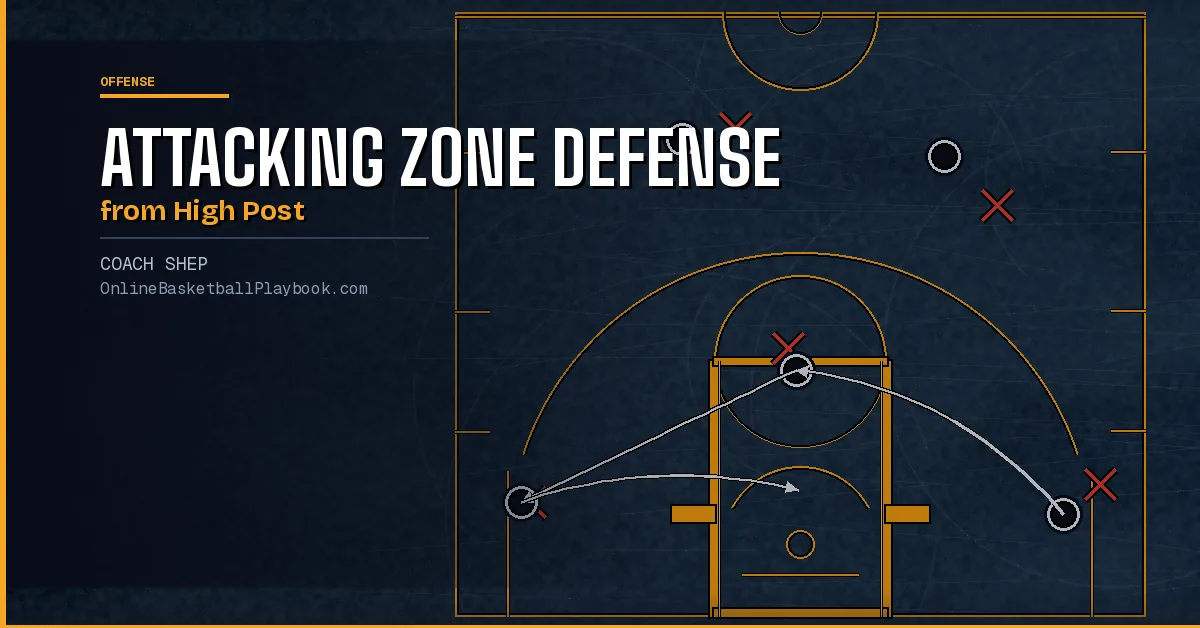
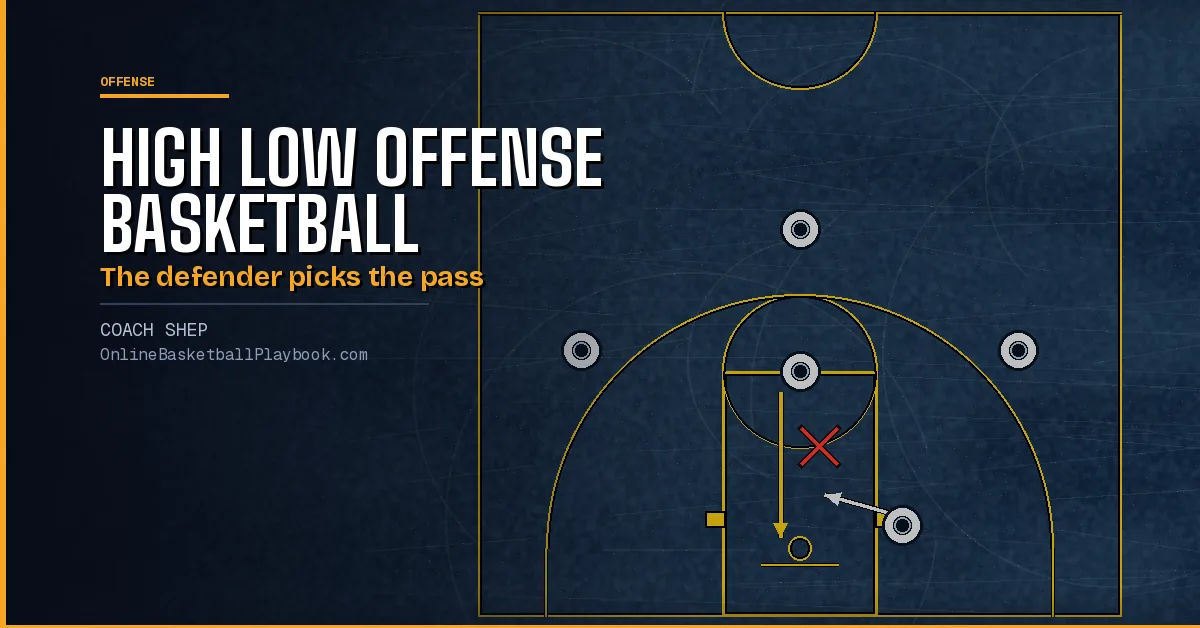
High Low Offense Basketball: Reads, Counters and Zone Rules
High low offense basketball explained: the two-post shell, the lob and bounce reads, answers to a front, down-screen reads, 1-4 low sets and the hi-lo against zones.
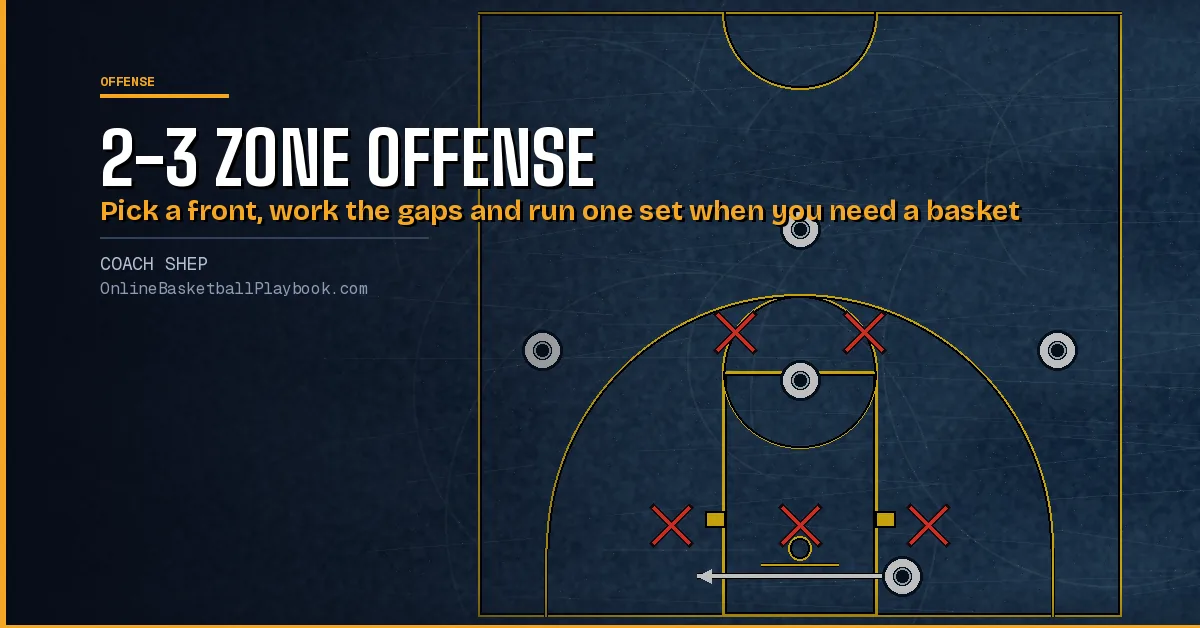
2-3 Zone Offense: Sets, Plays and Continuities to Run
2-3 zone offense with the fronts coaches start from, the continuities they run, quick-hitter plays for a basket, how to choose and where coaches disagree.