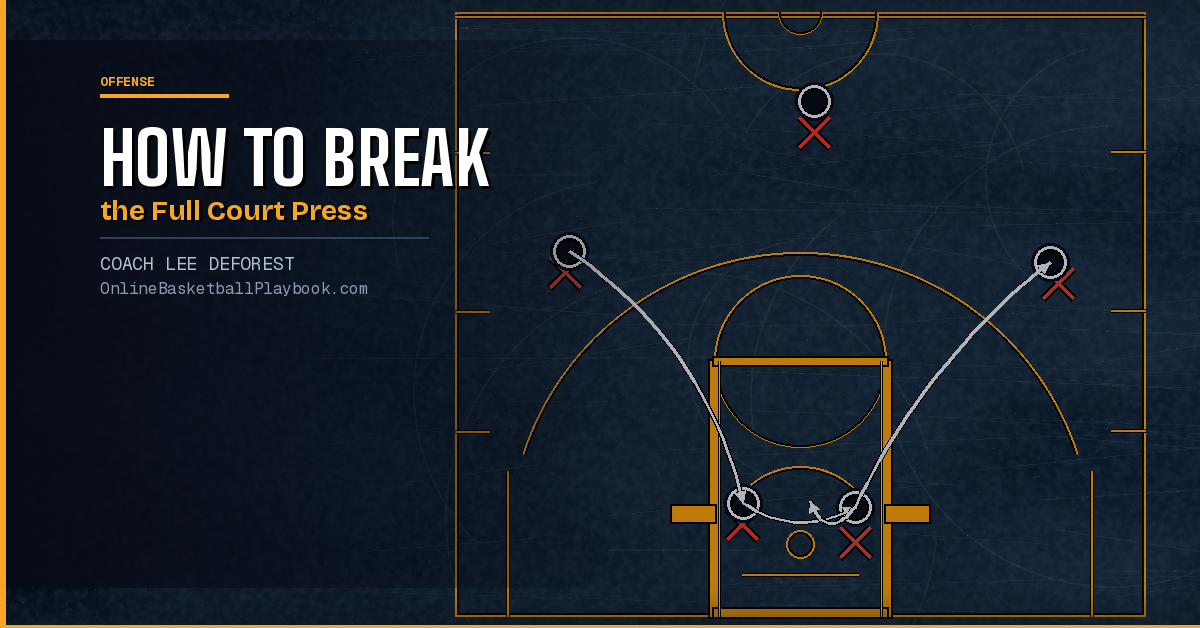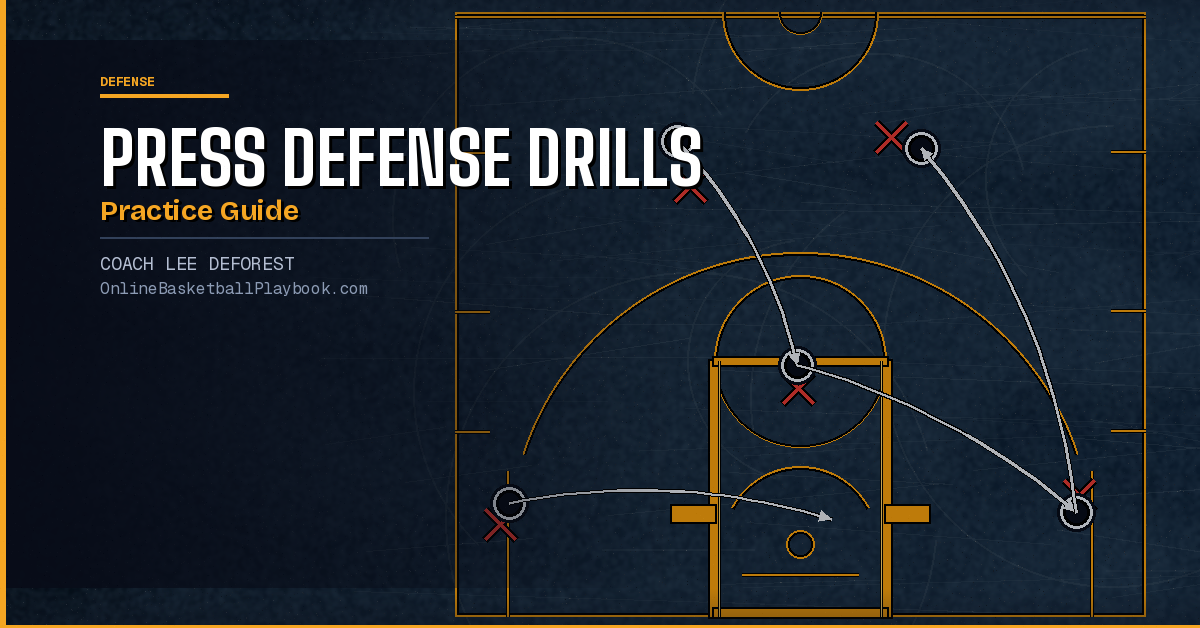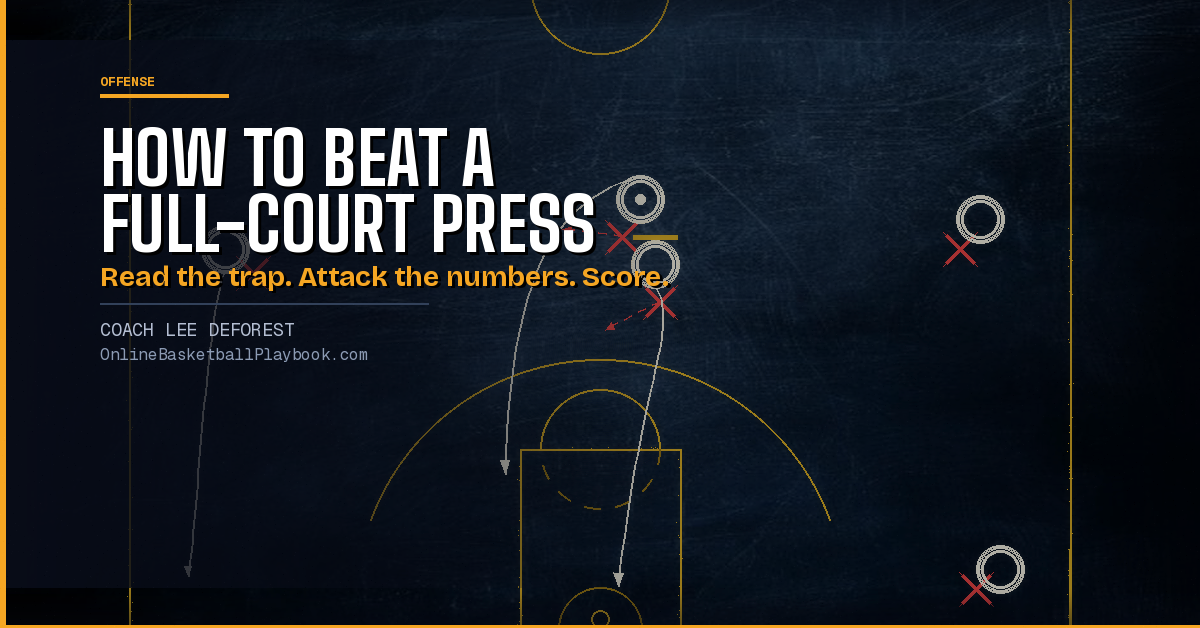

A full-court press is designed to make your team panic — and panic is the only thing that makes a trap work. Master the spacing, poise, and decision rules in this guide and the press becomes a scoring opportunity.
The Right Mindset: Attack, Don't Survive
The single most damaging adjustment a team can make against a full-court press is also the most common one: slowing down to be "safe." A conservative, careful press break is the press's best friend. It removes all risk from the defense, signals to the pressing team that their plan is working, and invites more pressure.
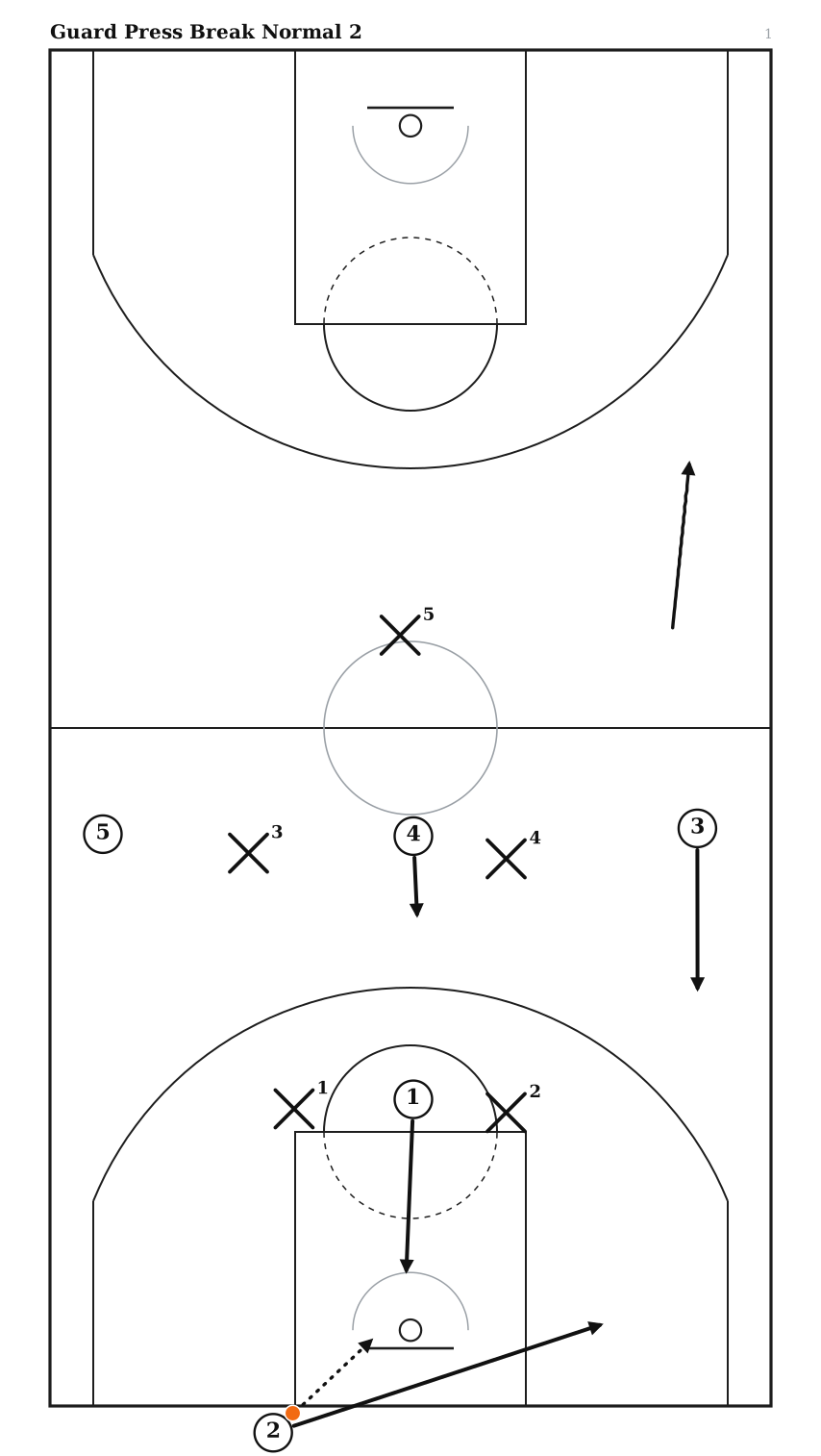
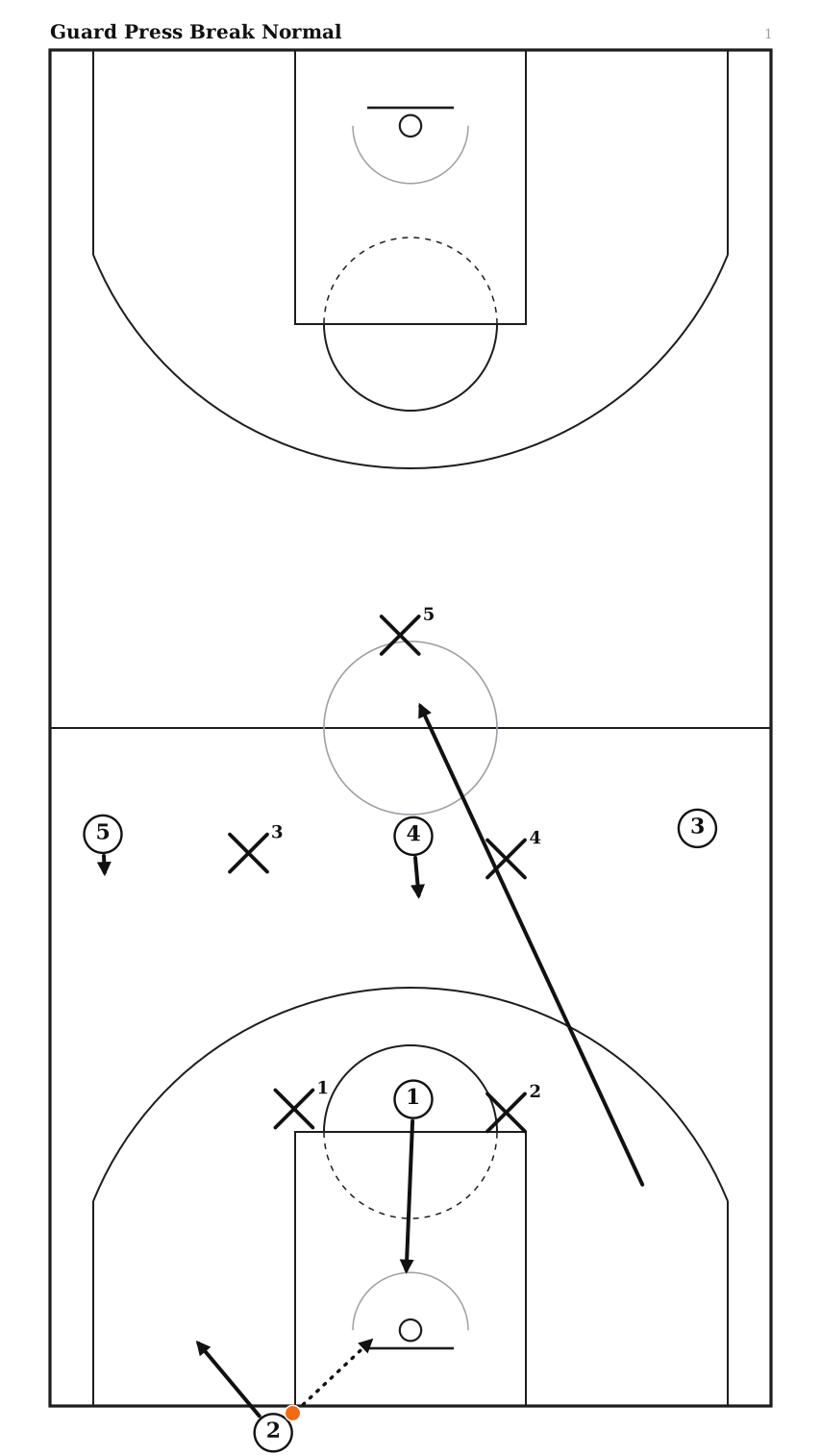
The correct mindset is the opposite. Every competent press-break system is built around the same idea: the press is an opportunity, not a threat. Two defenders trapping one ball handler cannot simultaneously cover every outlet. The numbers are behind the ball, not against it — the offense has a 3-on-2 or 4-on-3 advantage behind every trap. The job of the press break is to read those numbers and score.
This framing changes everything. Instead of advancing the ball to safety, the question becomes: where is the layup? The offense that hunts the layup first forces the press to play defense. The offense that merely advances the ball gives the press a free possession to gamble again.
"The receiver who catches and holds becomes a new trap target. Catch, turn, face, and immediately read or advance — zero hesitation after the catch."
The Spacing Law: Sideline–Middle–Reverse
Every press system — man, zone, trapping, run-and-jump — functions by taking away angles. A trap puts two defenders on one ball handler, which means two passing lanes are covered. The law of sideline–middle–reverse ensures a third lane is always open.
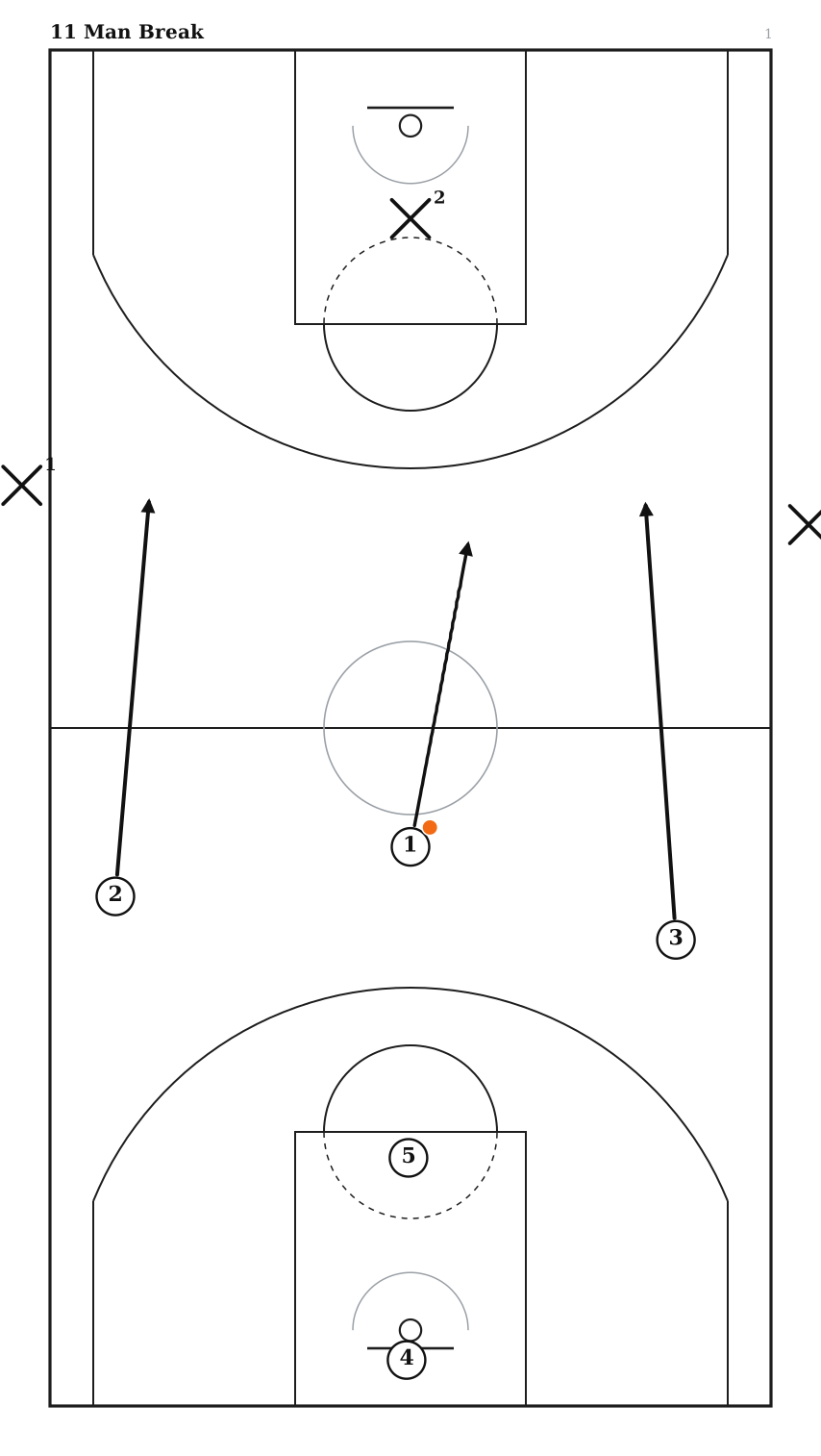
When the ball can be trapped, the ball handler must have three outlets available simultaneously: a player on the sideline, a player in the middle, and a player behind the ball for a reverse. Two defenders cannot cover all three. As long as the spacing is right, the ball handler's job is simply to stay poised and find the open man — the defense has already committed to leaving someone open.
The spacing breakdown that creates turnovers is almost always a failure of the middle outlet. Teams run players to the sidelines instinctively, but leave the center of the floor unoccupied. A zone press is specifically designed to funnel the ball to the sideline, where the trap forms with the boundary acting as a third defender. The middle lane — kept open by a player near the center of the floor — is the one lane the zone press cannot cover while also trapping the sideline.
Reading the Numbers Behind the Trap
Once a trap forms, the action shifts from escape to attack. The advanced read is not just which outlet is open — it is where that outlet pass leads two passes later, and whether it flows into a 2-on-1 finish. That is the difference between a press break that just gets to half court and one that scores.
A two-man trap leaves the rest of the floor with a 3-on-2 or 4-on-3 situation behind it. The trap's weakest point is not the immediate pass out — it's what happens two passes later, when the initial kick leads to a 2-on-1 against a slow center who has been dragged full-court. Pressing teams typically have their least athletic big at the basket as the last defender. That player defending on an island against two attackers in space is the press's structural failure point.
The read is sequential: escape the trap → attack the outnumbered defenders → finish the 2-on-1. Teaching this three-step picture changes how players receive the outlet pass. Instead of catching and freezing, they catch with a plan already formed — advance past the recovery and attack the 2-on-1.
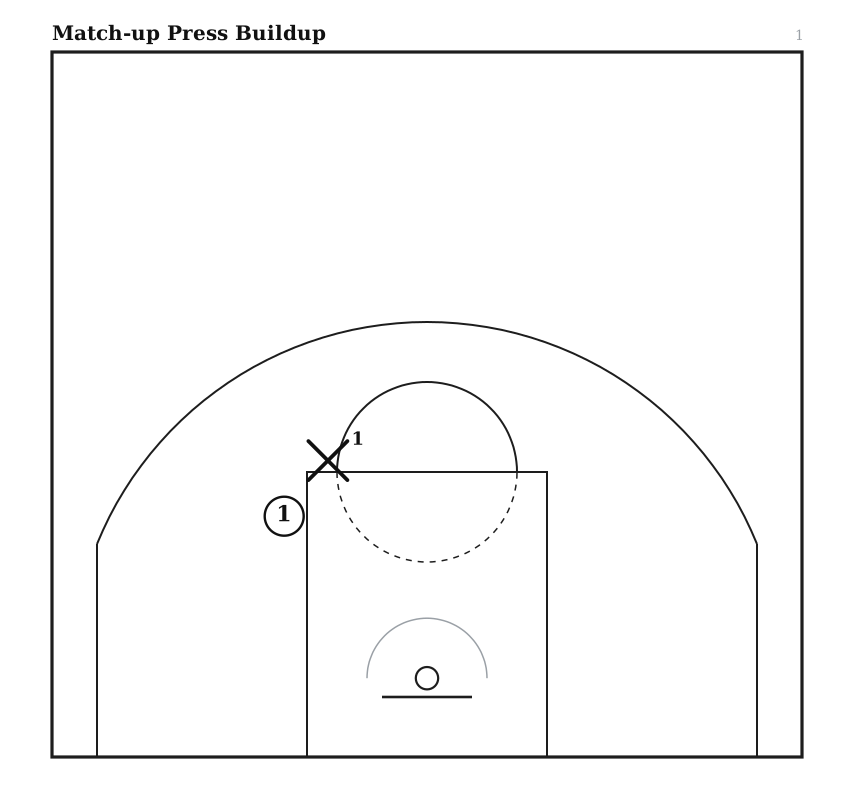
Against a man press, the opponent's center (X5) is defending full-court. That player is almost always the slowest on the floor in open space. Use a running dribble hand-off or a pop-and-catch to put the ball in front of a guard who can attack X5 in space — the athletic mismatch is guaranteed, and X5 has no help behind them.
The 1-4 Alignment: One Look Against Everything
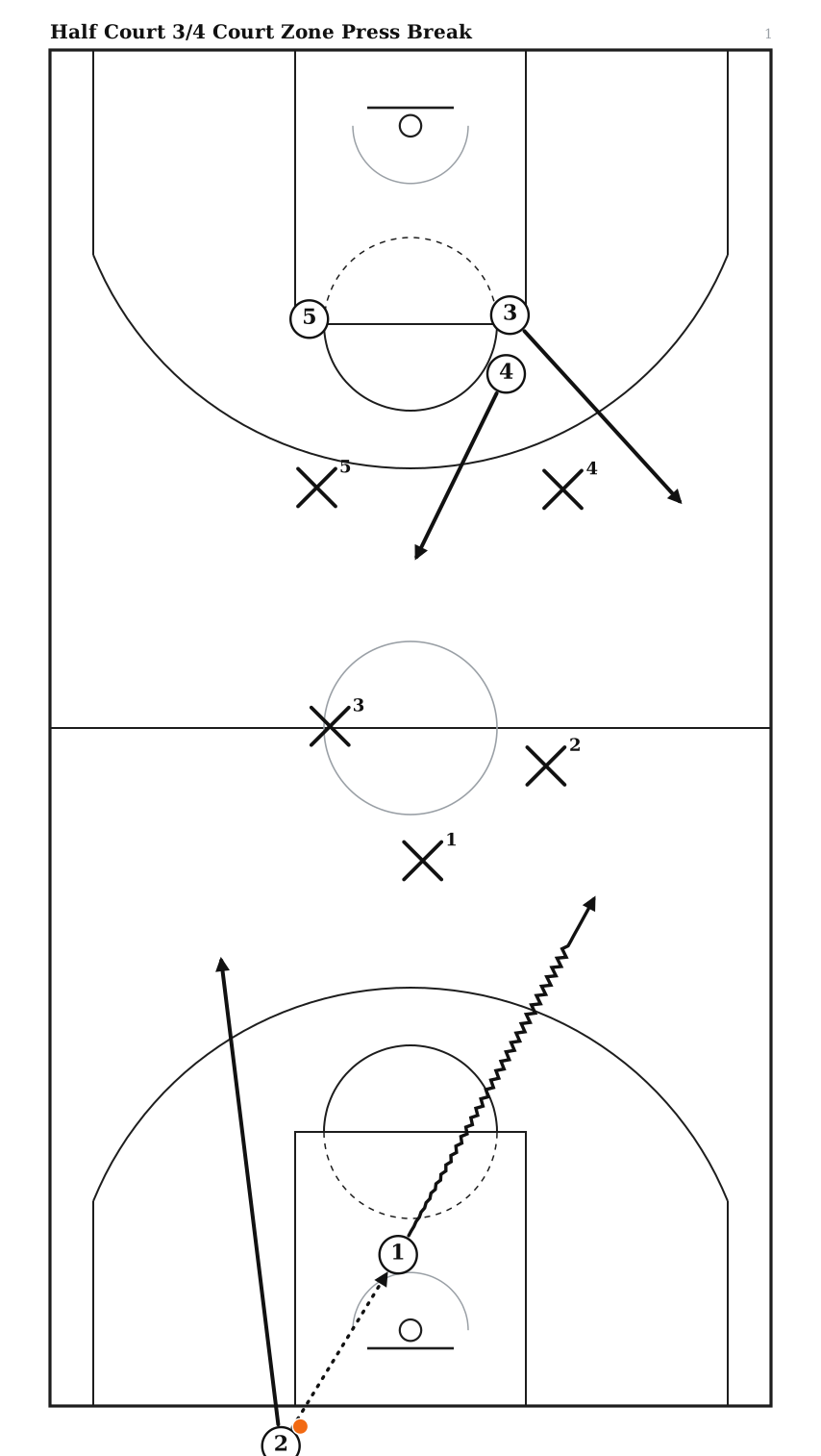
The most practical press-break alignment for teams that face multiple press types is the 1-4: one ball handler at the back, four players spread across the 3/4-court line simultaneously. The design has two key advantages.
First, it forces every press — man or zone — to match up across the full width of the floor before the ball is even inbounded. There is no preset "press look" the defense can key on; the offense starts from the same spot every time. Second, bringing everyone high removes any weakside help for the press. When players are stationed deep, they occupy space the defense can ignore. When they come high, the defense must account for them — and a guard trying to deny full-court has a much harder assignment than a guard playing the back half of the floor.
Against man pressure, the 1-4 works by starting high, then breaking one player deep just before the inbound. The timing of that deep cut — after the defense has committed to the high alignment — is what forces a denial error. Against zone presses, the 1-4 floods all four trap zones before the ball comes in, and the inbounder reads which of the four is unguarded.
The 4-Across System (Peters)
Coach Phillip Peters' 4-across alignment is a specific, high-efficiency version of the 1-4 designed to run three distinct plays off the same formation. All four non-inbounder players spread horizontally across the 3/4-court line: the point guard and second guard near the lane, the wings at the sidelines. One look — three reads — and the defense cannot prepare for all three simultaneously.
Option 1 (Double Screen for the PG): The far wing fakes long to pull the defense deep. The guard and the near wing set a double screen. The point guard rubs off the screen to the opposite elbow. After the catch, the PG immediately reads the far wing and the near wing advancing.
Option 2 (Baseline Runner): The inbounder runs the baseline to receive from a teammate who has already advanced. This creates a second inbound look — the defender must honor both the primary formation and the baseline cut.
Option 3 (Back-to-Top Safety): A wing comes back toward the top of the key as the safety outlet. After receiving, that player reads the two advancing cutters — this is the reset valve when the first two options are covered.
The bonus concept built into 4-across is the "Four Fly": the same double-screen formation, but the point guard cuts over the top. The instant the PG rubs the screener's shoulder, the second guard takes off on a fly pattern for the long pass. One cue, one read, one layup. Because it uses the same base look, it costs nothing to install — use it at end-of-half when the defense is sleeping on the double screen.
Man Press vs. Zone Press: Two Different Attacks
The press break's decision-making changes based on what coverage the defense is running. Running the same response to both is a common mistake — each has a specific structural weakness that requires a different attack.
Against a man press: the defense is committed to individual matchups. The first task is simply winning your own matchup — get past your individual defender before the help trap arrives. Screens are high-value early: a screen on the ball handler's defender, a screen for the outlet receiver, or a screen on the receiver's defender all create the initial catch. Ball fakes are also high-value — individual defenders react to one-on-one, and a fake that freezes one defender opens a whole lane without requiring the ball to move.
Against a zone press: the structure matters more than the individual matchups. Zone presses are designed to funnel the ball to the sideline — so the primary attack is the middle. A middle catch disrupts the entire zone rotation because no trap zone is built for a catch in the center of the floor. Reversal is the secondary weapon: the trap forms on one side, and a quick ball reversal reaches the opposite side before the zone can rotate. The defensive rotation in a zone press is a footrace — the pass wins.
- Both: sideline–middle–reverse spacing on every possession, no exceptions
- Man press: attack your own matchup first; use screens and ball fakes early
- Zone press: attack the middle gap; use reversal to beat rotation
- Both: never catch and hold — catch, turn, face, read immediately
- Both: find the 2-on-1 against the slow deep defender; that's the finish
Beating Inbound Denial
When the defense face-guards all outlets and denies every inbound pass, the standard spacing rules don't apply — a different counter is needed. Three options work:
Backdoor the inbounder: the inbounder passes to a teammate, immediately cuts hard down the baseline, and receives the return pass inside. The timing window is tight, but the inbounder's defender almost always relaxes the moment the pass is made — exploit that moment.
Long throw and trail: designate one receiver to streak the full sideline. The inbounder throws over the denial for a catch-and-go. This requires the fastest player as the designated receiver and the inbounder having a strong arm — but no defense can full-face-guard a sprint cut and also stop the long ball.
Flip the inbounder (Peters' third variant): put the two best ball handlers at the free-throw line (not as the inbounder), and use a third player to inbound. The two handlers are now positioned to attack immediately after catching — they are not locked into outlet duties. Against a defense trying to deny the primary ball handlers, this repositioning forces the defense to reassign coverage in real time.
Three Essential Press-Break Drills
Press-break habits are built in practice — no whiteboard session installs them in games. Three drill formats cover the full range of situations:
Outlet-and-Go (2 players): inbounder passes to the outlet, outlet catches and immediately turns and faces the basket — not the passer, not the sideline. Takes two dribbles and attacks. Drill this reflex in isolation until the turn-and-face is automatic. This single habit eliminates the most common catch-and-hesitate turnover.
Trap-and-Kick (3 on 2): three defenders trap a ball handler; two offensive players are in kick-out positions. The ball handler drills the pull-back dribble, the sideline–middle–reverse spacing rule, and the open-man kick. Rotate after five reps. Builds poise inside the trap before live play.
Live 5-on-5 Full-Court: one team presses every possession, no exceptions. The only real simulation of press-plus-decision-making under full defensive pressure. Score it: award a point for every time the break group advances and scores before the press recovers; charge a point for every turnover in the back half of the floor.
Common Mistakes That Give the Press Its Points
Catching and holding. The receiver who catches and holds becomes the next trap target. Every defender on the pressing team is sprinting toward any stationary player with the ball. The rule is absolute: catch, turn, face, and advance — zero hesitation.
Running everyone to the sideline. Teams instinctively clear to the sidelines, leaving the middle lane empty. This is the zone press's design goal — the boundary becomes the third trapper. Keep someone in the center of the floor at all times.
Slowing down after the press is broken. The worst moment to slow down is right after crossing half court. The press is broken, the defense is scrambling to recover, and the advantage is at its peak. Walking the ball into a half-court set lets every defender get back and the advantage disappears. Push it — finish the break before the defense is set.
Throwing blind reversal passes. Against a good pressing team, a rushed reversal without seeing the floor is the highest-turnover play in basketball. Poise the ball handler. Create the angle with a pull-back dribble. See the floor before throwing back.
Breaking the Press, Then Flowing Into Offense
A successfully broken press is not a possession that ends at half court — it is a possession that is already in progress. The correct mindset is that the press break flows directly into early offense or a secondary break, without stopping.
The worst thing an offense can do after breaking the press is slow down and reset. The safety player in the press break — the one positioned behind the ball as a reset option — doubles as a skip-pass outlet for an opposite-corner three if the defense collapses to protect the rim in transition. That player should never stand still; they sprint to a position that keeps them available for both a reset pass and a transition catch-and-shoot.
Teaching cue: the press break mentality is "early offense first." If the defender ahead cannot get back, the layup is owed. If they do recover, flow into early pick-and-roll or a motion entry — never let the press force a dead-ball reset that gives the pressing team time to regroup and press again.
Get Free Coaching Notes
Join the Online Basketball Playbook newsletter for new playbook breakdowns, drills, and practice-ready install ideas.
Get Free Coaching NotesSee it drawn up
Related diagrams
Keep Building
Related breakdowns
Nolan Richardson 40 Minutes of Hell: Teaching the Full-Court Press
Nolan Richardson 40 Minutes of Hell: Teaching the Full-Court Press