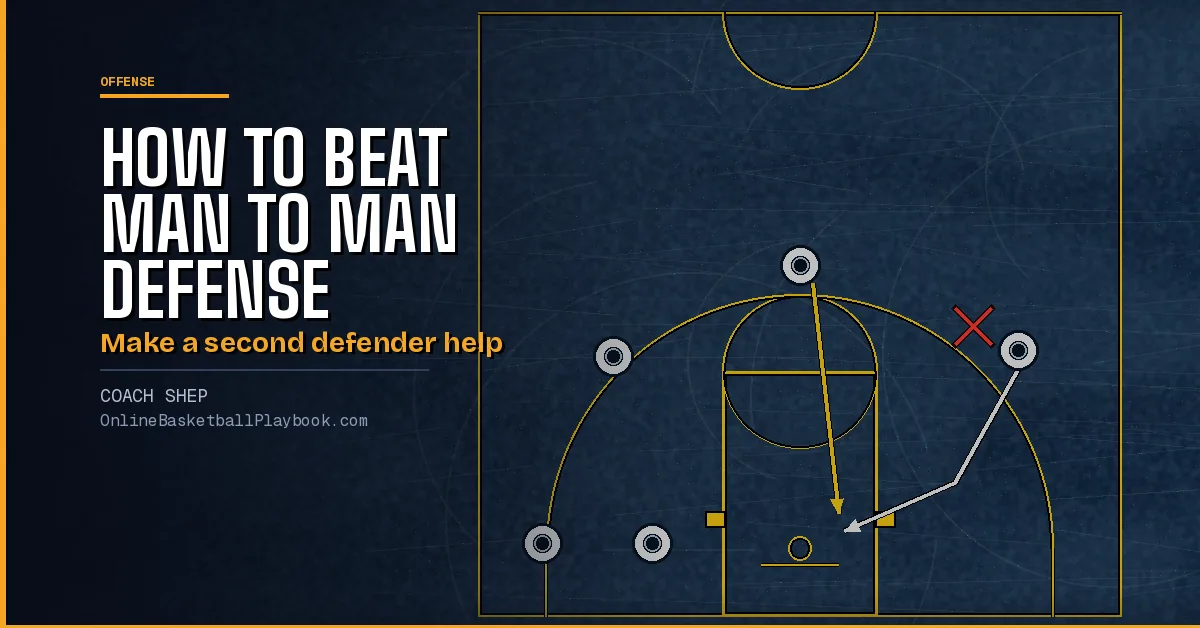
How to beat man to man defense in basketball comes down to one job: make a second defender help, then score where that helper came from. Man defense gives each defender one player, so a single defender who stays with his man takes away very little on his own. The aim of man offense is exactly that, forcing help and pulling a second defender out of position.
Ettore Messina shows the same math from the European game: every helper who leaves his man opens a gap somewhere. This guide covers the paths to that second defender (spacing, catch reads, cuts against denial, drives, off-ball screens, ball screens and the post), what changes against a packed defense like the Pack Line, and the drills coaches use to build each one.
The defensive side is on man-to-man defense, and the whole offensive section is on offense.
Space the Floor First
Every path below depends on spacing. Messina says that when the four players without the ball keep the right distance from each other, defensive rotation becomes almost impossible, because each helper who leaves his man opens a gap the offense can reach. Isolation plays fail without the same discipline: if the other four crowd the ball, help collapses on the driver before he gets going.
Coaches give different numbers for the right distance:
- About 15 to 17 feet. The distance in feet.
- At least 4 meters. Keep 4 meters between the outside players at all times, from a European 3-out, 2-in motion. Closer than that means fewer driving lanes and easier help.
Fix the spacing before you teach anything else.
The full spacing picture, gaps and all, is on spacing in basketball, and drills for it are on basketball spacing drills.
Read Your Defender on the Catch
Messina builds half-court offense on four principles: 1-on-1 in motion, the use of screens, penetration and the outlet pass, and the low-post game. Every play combines two or more. The first one starts before the ball arrives. The receiver catches with his eyes on the basket and uses his peripheral vision to see his defender during the catch, not after it. That gives three answers:
- Shoot. The defender is very late.
- Shot-fake and drive. The defender is recovering off balance.
- Pass, without pressure. The shot space is gone or a teammate is open.
The European motion adds a rule for the receiver of a kick-out: if his defender is sagging, he shoots. Putting the ball back on the floor from a spot where the defense gave up the shot wastes the advantage.
Messina also says a quick-passing team beats a moving team with one player always holding the ball, and that a player who holds the ball over his head hands the initiative to the defense. The stance behind a good catch is on triple threat position. Catch ready, read the defender, then decide.
How to Beat Man to Man Defense That Denies
A defense that overplays the passing lane gives up the space behind it. The answers differ by what the coach wants to protect:
The backcut
It is among the first cuts every perimeter player needs.
- Fake out, plant, cut. When the defender over-plays the passing lane, fake to the outside as if cutting out for the pass, plant the outside foot, push off it and cut quickly to the hoop.
- Build it into a swing continuity. The continuity carries one backcut counter for a denied wing entry and another for a denied reversal.
- Open with a hard backcut. A stagger quick hitter opens with one that also clears the side for a 1-on-1 drive if the pass is not there.
- Step toward the arc, then backdoor. Step toward the arc first, then reverse into the backdoor for a bounce pass.
More on the read is on cutting in basketball.

The V-cut
When the defender is not over-playing, the receiver makes space instead. Do not stand still waiting for the pass. Take a few steps in toward the basket, plant the inside foot, push off and cut back out. Jump behind the pass and catch in a jump stop in triple threat.
The shallow cut and the dribble entry
If the pass to the wing is denied, the ball does not have to be passed there. In the shallow cut, the ball handler dribbles the ball to the wing while the wing cuts out to the top of the key. The cutter keeps the spacing and the floor balance, and he pulls his defender away from the wing, which avoids a possible trap. The swing continuity also offers a dribble entry in place of the denied pass.

Step out and flow
Treat the entry as optional. If the first pass is denied, step out and flow into motion instead of forcing the called entry. A 3-out, 2-in reverse starts the posts on the wings, which helps a point guard who struggles to make the wing pass, because a cutting receiver is easier to hit than a standing one.
Cut hard and move the ball
Messina's timing rule for the give-and-go: the first step of the cut happens as the pass is released. Moving after the pass gives the defender time to recover. The European motion wants the basket cut at full speed with a change of pace. Hold three covenants: cut hard, ball movement and transition.
Read the overplay and pick the cut that answers it.
Drive, Kick and Move Opposite the Help
Messina names three ways to create penetration: be quicker than your defender, catch ahead of him, or use a teammate's screen to delay him. When the drive comes, all four other defenders move toward the line of the ball to form a wall. Spacing is the counter.
Three of his rules decide what happens next:
- The first drive is pressure. At a high level the first penetration forces help and rotation but rarely produces the shot. The second or third penetration finds the open man, so patience and rhythm matter. He credits the Yugoslav and Russian teams with the pattern of penetrate, kick out, penetrate again.
- The driver keeps cutting. After the kick-out, the driver does not stop in the paint. He runs to the corner, and the defense is often so focused on the first receiver that he gets a second catch for an open shot.
- Someone stays behind the drive. Every drive keeps a player behind the penetration line, on the three-point line if he shoots, at the top of the elbow if he is a big. He is almost always open for a shot or a quick reversal.
The clock rule, a name Messina credits to an earlier coach, tells the players without the ball where to go: move opposite the defensive rotation.
- On a baseline drive. The player on the opposite side moves away from the drive line to open a passing lane.
- On a middle drive. Players move toward the baseline behind the beaten defenders.
- When the post's defender helps. On a middle drive, the post slides along the baseline behind the defender who was beaten and the one helping.
The mistake to avoid is what he calls the border problem: young players flood the baseline and the corner, which packs three or more defenders into a wall and makes recovery easy.

How the stop is taught splits four ways:
| Approach | The stop |
|---|---|
| Messina | A strong jump stop, which he calls the third dimension after the set shot and the layup, giving an almost always clean choice between shot and pass |
| Inside foot forward | The inside foot forward, not a two-foot jump stop, because the two-foot stop gives the defense an angle on the pass |
| Power layup first | The jump-stop power layup installed first, before any team reads |
| Jump behind the pass | The receiver jumps behind the pass and catches in a jump stop in triple threat |
The read chain off every drive is on teaching dribble penetration reads, and the system built on it is dribble drive motion offense. Pick one way to stop and rep it until it is automatic.
Off-Ball Screens
Off-ball screens make a second defender deal with the cutter. The read belongs to the cutter, and it comes from where the screened defender goes.
Kansas-style weak-side down screen. With the ball on the strong side, a post sets a down screen for a guard on the weak side, around the elbow, where the screen's location and angle take away help. Three reads:
- Straight cut: the guard pops off the screen looking for the shot.
- Fade cut: the defender plays inside the screen, so the guard fades away and gets a skip pass to shoot or drive the closeout.
- Curl cut: the defender is behind or tight, so the guard sets up wider, the post sets a hard screen, and the guard curls into the lane for the pass.

One call, two reads. The stagger quick hitter runs a cutter off a double staggered screen. If the defender chases, the cutter curls. If he waits in the paint, which clogs the curl passing lane, the cutter flares to the weak-side corner. With smart players both plays sit under one call and the cutter reads the defender live.
The European motion adds the cue for every off-ball screen: walk your man into the screen. Its screener must also be ready to catch and shoot off one motion. Read the screened defender, then cut. More reads and drills are on down screen basketball, flare screen basketball and drills to teach off-ball screens.
Get the next coaching guide in your inbox
One email when a new guide or diagram set goes up. Free.
Ball Screens
The pick and roll forces two defenders to deal with the ball at once. Messina adds a case: when a big man is outside his shooting range and his defender is not guarding him closely, he can pass and set the pick, because his defender sits between the ball and the basket and cannot help easily. That is a moment of 2 on 1.
A Kansas-style ball-screen continuity gives the screener four rules:
- Create separation. Get separation from the defender.
- Do not release early. Hold the screen.
- Change the angle late. A late change of screen angle causes a bad hedge.
- Know when to slip. Slip when the read is there.
Teach the timing through repetition and patience, with the handler waiting for the screener to set his feet.
The handler reads the coverage. Each row is the common answer, with the split noted where there is one:
| Coverage | Answer |
|---|---|
| Under | Shoot behind the screen. Attack the rim in two dribbles instead, or have a non-shooter re-screen. |
| Over or trailing | Turn the corner and attack downhill, with a drop pass if a baseline defender helps |
| Hard hedge | Split it, hesitate and go, cross over, or retreat and re-screen. None is ranked first. |
| Trap | Get the ball out of the two defenders fast and play four on three |
| Switch | The screener seals and rolls on the smaller defender, or a shooting big pops |
| Ice or denial | Refuse the screen, or flip it into a screen the other way |
Every coverage, read by read, is on how to attack every ball screen coverage, and the screener's options are on pick and roll. Read the coverage, then pick the answer.
The Post Against Man
Feeding the post makes the defense decide whether to double. Against a three-quarter front, the European motion passes to the high post, who feeds the low post, and the low post uses body contact to gain position. If the defender recovers over the high side, the low post pivots along the baseline for a bounce pass from the high post.
After any pass into the low post, the passer cannot stand still:
- Move toward the top of the key.
- Move to the corner.
- Basket-cut.
Otherwise his defender helps in the post and recovers easily.

Line the low post up directly between the ball and the basket so the defender has to commit to front, behind or side, and each choice opens a different pass.
Against a packed man defense, expect a big-to-big trap on the post entry and train the post as a passer: check the middle on the catch, see where the trap comes from, and hit the diving weak-side post or the skip. The cue is "middle to explore, baseline to score." Messina warns that drive-and-kick teams play too much on the perimeter and should mix in passes to the bigs when defenders spread.
Coaches differ on what the post does when he is not catching:
- Clear the lane. The post stays opposite the ball and clears the lane for the driver.
- Run a high-low pair. One post high and one sealed low, built for the high-low pass in a 3-out, 2-in.
- Screen and rebound. Inside players do not demand the ball unless their defender has helped and there is a clear path. They screen, clear out and rebound.
- Mix it in. Messina mixes inside passes with the kick-out game.
Decide what your post does without the ball before you run the play.
Post scoring itself is on post play basketball, and the two-post system is on high low offense basketball.
Beating a Packed Man Defense
A Pack Line defense does not deny the perimeter. It pressures the ball, keeps four defenders inside a line a few feet inside the arc, jumps to the ball on every pass, helps and recovers on the air time of the next pass, and traps most post entries big to big. The seven answers:
- Reverse the ball. Make the defense guard actions on the third and fourth side. Attacking a loaded first side is a long night.
- Create double gaps. A blur screen has the passer cut right by the receiver, who drives into the space the cutter left and bumps his defender on the cutter, which turns a single gap into a double gap.
- Drive in straight lines. Go immediately and straight, clipping the defender's hip, before the help loads.
- Flare screens. For the passer, and on a teammate's help defender on the weak side, so the closeouts get longer.
- Skip passes. Keep the defense in closeouts until one breaks. Treat the weak side like a zone.
- Posts as passers. Expect the trap and pass out of it.
- Be shot-ready. Help comes even from one pass away, so the open jumper has to fall.
Pick the answers that fit your players and rep them against the pack line. The defense these answers attack is on how to coach pack line defense, and the denial and pack styles are compared on pack line vs pressure man-to-man.
Switches, Isolation and Pace
Switches. In a 3-out, 2-in reverse the posts screen, then pivot and seal, and the defense often switches, which puts a taller post on a shorter guard on the block. Most screens in a mismatch-screen offense are small on big or big on small.
Isolation. Pick the iso player with two questions: who is the best proven 1-on-1 scorer, and who has a size or skill mismatch on a defender right now.
Its gains:
- Feed the best scorer. The ball goes to the best scorer.
- Attack a weak defender. It attacks a known weak defender.
- Use it late in the clock. It works late in the shot clock.
- Bait a helper. It can bait a helper.
Its costs:
- It gets predictable. Overuse makes it predictable and lets the off-ball defenders load their help early.
- Teammates get frustrated. One or two players get every touch.
More is on iso basketball.
Pace. Flow into motion from every situation (a jump ball, an out-of-bounds play, a made or missed shot, a turnover, a press break) because the defense often relaxes or is still finding its matchups. Dribble-drive teams argue that a faster decision pace forces more mistakes, and that a recovering defender fouls more and gives up more offensive rebounds. Early offense is covered on how to run a fast break.
Junk defenses. When part of the defense is straight man on your best player, park a big at the high post purely as a screener so the denied star gets a catch near the free-throw line, and if the low defender cheats up, the screener seals and backcuts. The rule of thumb is regular man offense against a triangle-and-2 and regular zone offense against a box-and-1. See how to beat junk defenses.
Name your answer to each wrinkle before the game.
How Coaches Organize the Man Attack
Coaches name the building blocks of a man offense differently. None of these is the one right list.
| Frame | The parts |
|---|---|
| Ettore Messina | Four principles: 1-on-1 in motion, use of screens, penetration and the outlet pass, the low-post game |
| Spacing, pace, screening | Three concepts |
| Ball, people, screen | Three things the offense can do: move the ball, move people, screen |
| Two counters | Two counters to man: the pick and roll, off-ball screens |
| Dribble drive | Ten assumptions tied to the four factors, with attacking the basket aimed at free throws, field-goal percentage and offensive rebounds |
They also split on how much of the first action to call:
| Offense | Approach |
|---|---|
| Flow | Motion from any situation. Entries are optional first actions, not plays. |
| First action | Prefers not to call sets. Wants to score off the first action, a back cut, and keeps counters ready because opponents learn the plays by the third and fourth meeting. |
| Ball screens and set plays | Runs no motion. Lots of ball screens and set plays. |
| The European motion | Motion first each season, then short set plays with options around 8 and 12 seconds, back to motion if nothing comes |
| Drive base | A drive base with plug-in specials that keep the same spacing |
| Quick hitters | Sets with reads built in, such as a stagger quick hitter and a 3-out, 2-in reverse |
Systems built for man defense are compared on motion offense basketball and 5 out motion offense. Pick the frame that fits your players and teach it the same way every day.
Drills to Beat Man-to-Man
Messina gives four drills, each built so the player makes a decision instead of repeating a move.
- Two-line cut to the free-throw line. The ball-side player cuts to the free-throw line, catches, faces the basket and reads a coach playing passive defense, who steps up or steps back. The coach targets each player's weakness, so the player has to make the uncomfortable read. The passer then cuts up to the top of the key and gets the ball from the new line.
- Closeout, one dribble. In pairs, the defender has the ball, passes and closes out. The offensive player gets one dribble and chooses a shot, a drive and shot, or a drive, shot fake and drive, by the defender's distance and recovery. Five reps per player, so he focuses on the choice and not the make, and the defender changes his closeout from rep to rep.
- Central penetration help and recovery. A defensive drill on a middle drive in which the forward has to find an open spot for the outlet, catch in triple threat and read shot, drive or pass off his defender.
- Skip-pass closeout. The defender flies at the skip pass. The receiver catches, faces the basket and decides: shoot on a late defender, drive on an off-balance one. Driving before reading the distance draws a charge.

He also shrinks the floor on purpose to speed up decisions: 2 on 2 on a quarter court, where the passer has to spread right after the penetration so the small space does not jam, 3 on 3 on a quarter court, and a half court split on the diagonal to stress the pass behind the penetration line.
A cutthroat game adds a 3 on 3 quarter-court format: one side of a half court only, any screen except a ball screen, players must talk, a shot clock, and several teams playing cutthroat. It builds to 4 on 4 with an imaginary line down the middle of the floor as out of bounds. More practice ideas are on drills to teach motion offense. Make every rep a decision, not a memorized move.
Want the printable playbook packs?
OBP Pro members get the premium playbook packs: the zone attack, out of bounds and practice plan PDFs, plus each new pack as it is finished. The membership page lists what is in each one. Or draw your own version free in PlayDraw.
See what OBP Pro includesQuestions Coaches Ask
What is the best way to beat man to man defense?
Make a second defender help and score where he came from. The paths are spacing, cuts against denial, dribble penetration, off-ball and ball screens, and the post. Which one works depends on whether the defense denies, sags or switches.
What offense is best against man to man defense?
There is no single answer. Coaches run motion from every situation, ball screens and set plays, or motion first with short sets added. The common thread is spacing and reads, not a single system.
How do you beat a man to man defense that denies every pass?
Backcut behind the overplay, dribble the ball to the denied spot while the wing makes a shallow cut out, or step out and flow into motion instead of forcing the entry.
How do you beat a packed or Pack Line man defense?
Reverse the ball to the third and fourth side, drive straight lines before help loads, use flare screens and skip passes for long closeouts, make the posts passers and knock down the open shot.
How do you beat a switching man defense?
Have the screener seal the smaller defender and roll, or pop a shooting big, and look for a post-up when a guard switches onto a big.
More Guides From This Batch
- Baseline Out of Bounds Plays: Sets vs Man, Zone and for Youth
- High Low Offense Basketball: Reads, Counters and Zone Rules
- Four Corners Offense Basketball: Roles, Rules and Versions
- Princeton Offense Drills: Breakdowns, Shooting and Live Reps
Back to Offense and every Offense page.
Keep Building
Related breakdowns
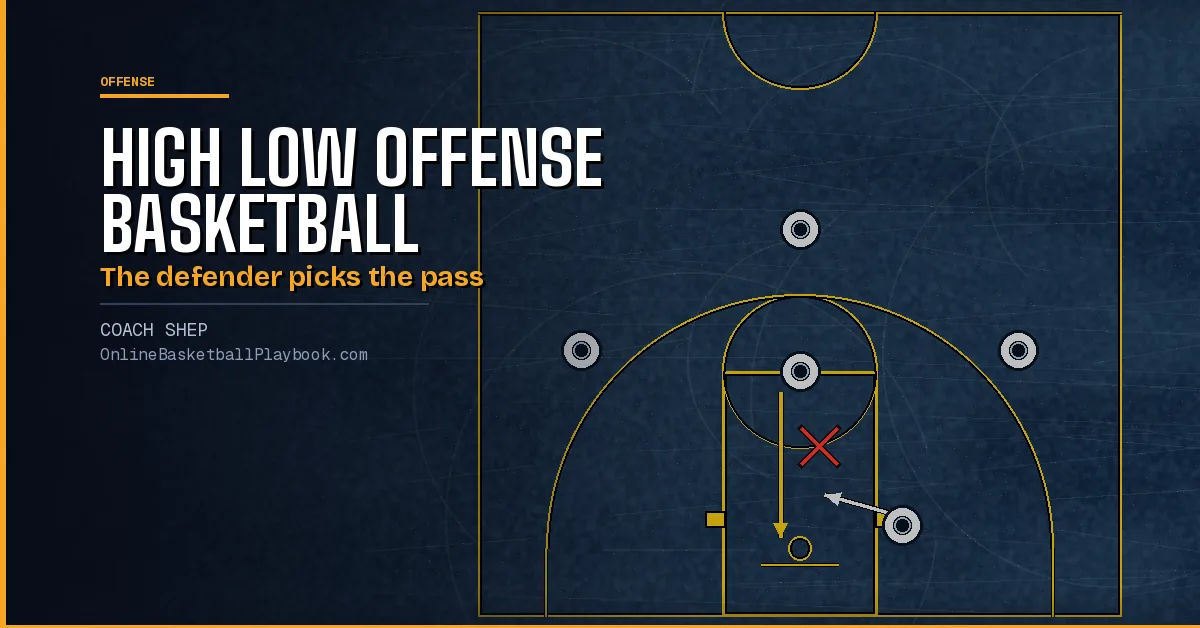
High Low Offense Basketball: Reads, Counters and Zone Rules
High low offense basketball explained: the two-post shell, the lob and bounce reads, answers to a front, down-screen reads, 1-4 low sets and the hi-lo against zones.
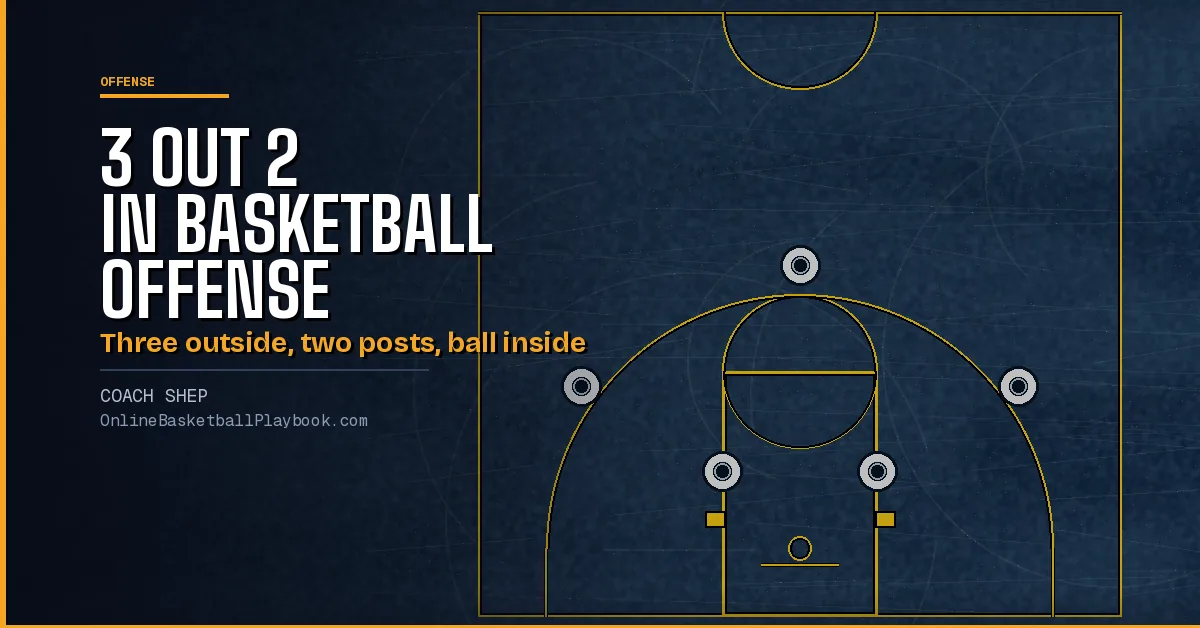
3 Out 2 In Basketball Offense: Spacing, Actions and Reads
The 3 out 2 in basketball offense explained: alignment, actions off every pass, the high-low counter, drive rules for the posts, add-on plays and who fits it.
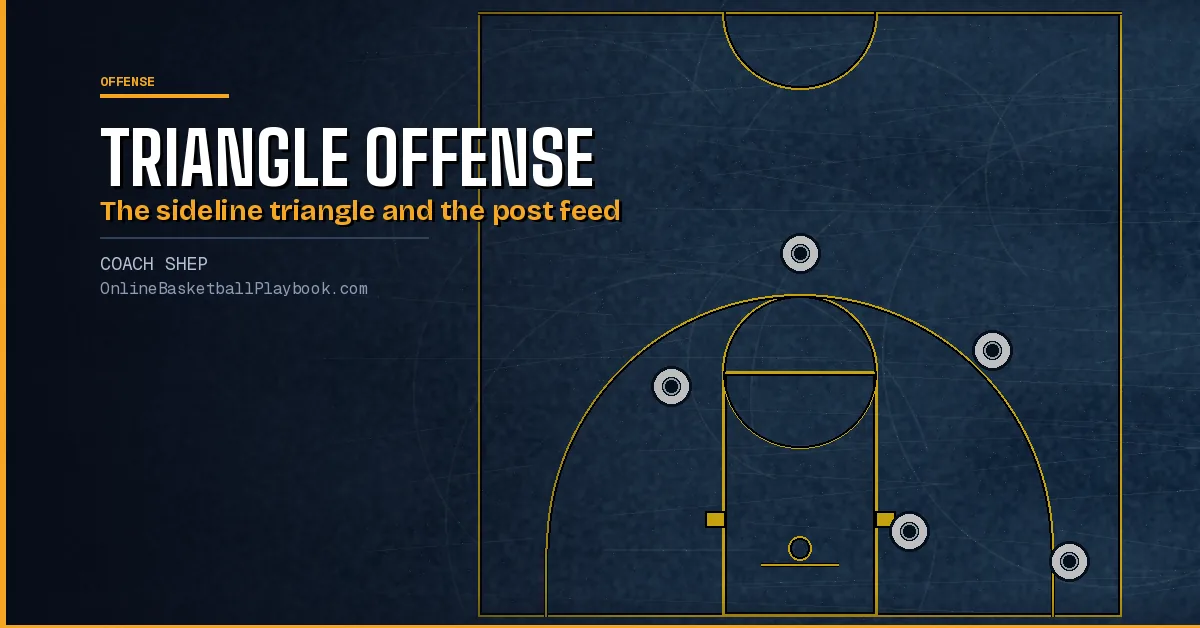
Triangle Offense Basketball: Reads, Spacing and Entries
How to run the triangle offense in basketball: the sideline triangle, spacing, entries, the four wing reads, post splits, counters and how to teach it in pieces.