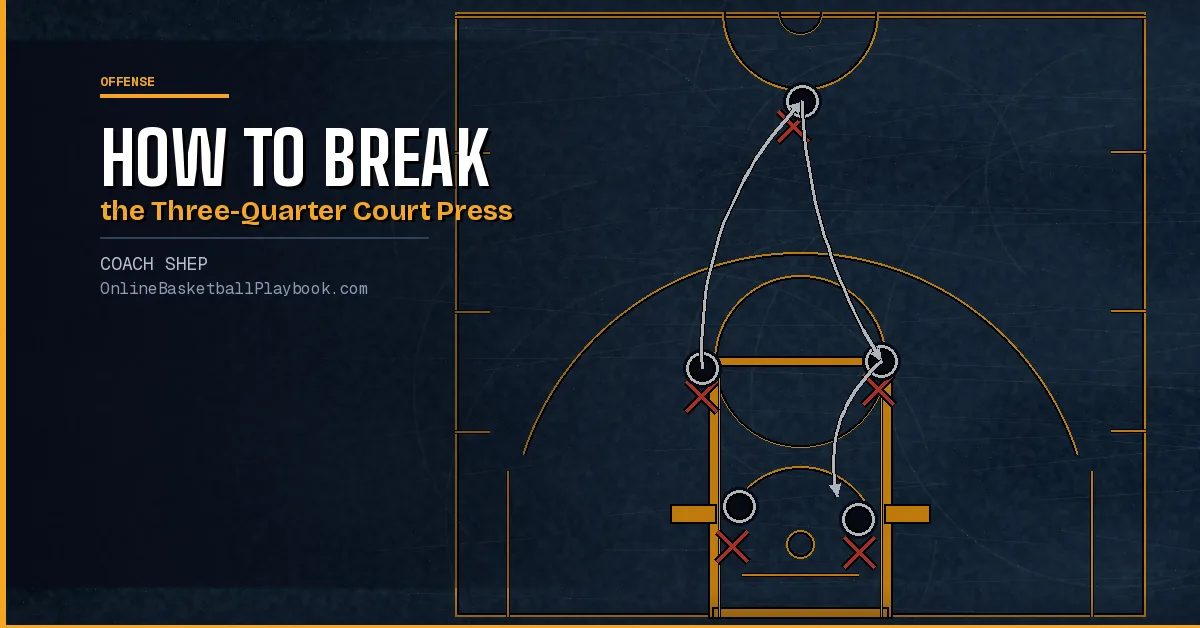
Most teams practice against full-court pressure. The three-quarter press exploits that preparation gap. It picks you up where you least expect it. Here is exactly how to read it and attack it.
What the Three-Quarter Press Actually Is
The three-quarter court press, sometimes called the 3/4 press or extended press, does not pick up the ball handler at the inbound. That is the full-court press. The 3/4 press lets the offense advance the ball comfortably, then engages somewhere between the offensive free-throw line extended and half court. The exact trigger varies by scheme, but the principle is universal: the defense waits in position at that line and springs the trap at the moment the ball handler crosses it.
This is not a compromise or a tired full-court press. It is a deliberate tactic with a specific weapon: it picks you up in the dead zone, the stretch of floor where ball handlers typically shift gears and relax, expecting clear sailing. The defense is already organized when you arrive. You are the one scrambling.
Understanding the structure from the defense's perspective is the first step to breaking it. The standard alignment uses two pressure defenders at the front of the 3/4 line, one on each side, one interceptor in the middle of the court, and two back defenders protecting the paint. When the ball handler crosses the trigger line, the two front defenders converge and try to force the ball to a sideline trap. The middle interceptor cuts off the reversal pass. The two back defenders protect the basket.
The defense wants to compress your decision window and force a hurried pass or a rushed dribble into a sideline trap. Your offense needs to make decisions before that trigger fires.
Why It Catches Teams Off Guard
Most press-break preparation focuses on breaking the press from the inbound. Teams practice the long outlet, the quick release from out of bounds, the sprint ahead of the press. Against a full-court press, those are the right instincts. Against a 3/4 press, that preparation creates the very problem the defense is exploiting.
When a team has successfully inbounded the ball and advanced it with a dribble or a quick pass, the ball handler's guard comes down. They have made it past the initial pressure. Their head drops into a speed dribble. They stop reading the floor and start running. That is precisely when the 3/4 press springs. Georgetown's system explicitly describes the pick-up happening at a moment of momentum. The ball handler is moving fast when defenders suddenly appear, and quick feet alone will not get you out of it.
The other reason it works is disguise. A team that runs both full-court and 3/4 press can change the pick-up point from possession to possession, live, with a call from the bench. Your ball handler practices reads at the inbound and reads in half-court. The 3/4 zone is the strip of floor between those two familiar spots, and it is where offensive teams have the fewest trained habits.
Add to that the structural advantage: the sideline becomes a third defender once the trap springs. There are only two directions to pass, forward or back, and the defense positions its interceptors to clog both. If your players do not have a plan before they hit the 3/4 line, they will be forced into a decision they have not practiced.
How to Read the Press Before the Pick-Up Point
The single most effective way to break the three-quarter press is to recognize it before it triggers. That means reading the defense as soon as the ball is inbounded or retrieved, not after pressure has arrived.
There are three reads your ball handler should make immediately upon catching the ball in the backcourt:
Read 1: Where Are the Front Defenders?
In a full-court press, the front defenders are in your face at the baseline. In a 3/4 press, the front defenders are stationed at the pick-up line. There is open floor between you and them. If you see open floor ahead and two defenders waiting at the 3/4 line instead of attacking, you are facing a 3/4 press. That recognition alone changes everything because it tells you the trap has not triggered yet. You have a brief window to make decisions before the pressure comes.
Read 2: What Is the Middle Defender Doing?
In most 3/4 alignments, the middle interceptor is shading toward one side of the court. That shading tells you where the defense wants to funnel the ball. If the middle defender is shading left, the defense is trying to push the ball handler to the right sideline for the trap. Read that early and either reverse the ball before reaching the line, or go directly up the middle of the court. A risk, but one that attacks the defense's weaker trap location.
Read 3: Is There a Trailer Behind You?
The most reliable counter to any press is the pass behind the trap. Before the ball handler crosses the 3/4 line, there should be a teammate trailing on the wing or at half-court. Someone who can receive a pull-back pass if the ball handler gets run at. This player is often a guard or forward who followed the ball up the floor. If there is no trailer, the ball handler is isolated and the press will have its way. Establish the trailer before you need it.
Ball-Handler Rules at the Three-Quarter Line
When the ball handler crosses the 3/4 line and the press triggers, the decision window compresses fast. The habits a player has at that moment determine whether the play ends in a turnover or a basket. The following rules are non-negotiable.
Rule 1: Never Lower Your Head at the 3/4 Line
The defense is trained to trap the uncontrolled dribble, which is the ball handler who drops their head into a speed dribble and stops reading the floor. Pitino's core risk-control principle, repeated across multiple systems, says it plainly: if the ball handler is head-up, looking to pass, and in a controlled dribble, the defense backs up and waits. It is the lowered head that triggers the trap. Your ball handler must stay head-up from the moment they sense pressure until the ball is out of their hands or they are cleanly into the frontcourt.
Rule 2: Use the Pull-Back Dribble
When two defenders converge, the instinct is to split them or fire a pass through the trap. Both are low-percentage plays. The better option, and the one that most teams do not practice enough, is the pull-back dribble. Step back toward half court, reset direction, and either reverse the ball to a trailer or reorganize and attack a different gap. The pull-back forces the two trappers to recover, which opens passing lanes they had closed. It is not a retreat. It is buying one full second of decision time, which at this level is everything.
Rule 3: Make the Short Pass, Not the Long Pass
Under pressure, ball handlers instinctively look for the receiver furthest down the floor, which is the player closest to the basket. That long skip pass is exactly what the goaltender and the deep interceptors are positioned to intercept. The safe pass is the short one: back to the trailer, sideways to a player coming to meet the ball, or diagonally to a receiver who can attack fresh. Short passes completed under pressure are worth far more than long passes deflected or picked off.
Rule 4: Attack the Middle When the Trap Over-Commits to the Sideline
A properly-set 3/4 press prefers the sideline trap because the boundary acts as a third defender. But when the trap over-commits to the sideline (both front defenders pinching early), the middle of the floor opens. A ball handler with the composure to attack straight up the middle in that moment gets into the frontcourt cleanly. This is a high-skill read and should be practiced explicitly, but it is the most explosive counter to a press that is too eager to run the sideline trap.
How to Space Behind the Trap
Beating the 3/4 press is not solely the ball handler's job. The other four offensive players determine whether there are passing options to use. Poor spacing behind the trap is why good ball handlers still turn it over. Here is how your team should position to give the ball handler places to go.
The Trailer Rule
Every press-break possession should have a designated trailer, a player who stays between the ball and half court until the ball is through the press. This player does not sprint ahead. They follow the ball up the floor at a controlled pace so they are always available as a pull-back target. When the ball handler is trapped, the trailer steps back toward them and catches the pull-back pass with room to pivot, reset, and attack. This is the single most undercoached position in press-break offense.
Two Players Behind the Trap Line, Two Players Ahead
A simple spacing rule that covers most 3/4 press scenarios: two offensive players position behind the trap line (including the ball handler and the trailer), and two position ahead of the trap line to receive a forward pass if one comes. The fifth player, often a post, trails wide and deep as a safety valve. This 2-2-1 offensive structure mirrors what the defense is running and gives the ball handler an answer in every direction: backward to the trailer, sideways to the wide player, or forward to the two receivers already in the frontcourt.
Come to Meet the Ball
Receivers who stand and wait get covered. Receivers who take two steps toward the ball handler make the pass shorter, easier, and faster. Every player in the press-break scheme should have the habit of stepping toward the ball when their teammate is under pressure. That single movement habit (two steps to meet the ball) converts low-percentage trapped passes into clean, controlled ones.
No Two Players on the Same Side
When two offensive players end up on the same side of the floor, the defense covers them both and eliminates one passing lane with one defender. Spread your players across the full width of the floor. If two teammates are bunching near the right sideline, one of them needs to move to the left side of the floor immediately. Width forces the defense to choose which receiver to cover and opens gaps in the trap coverage.
Run your press-break spacing drill without any defenders first. Walk the five players through their positioning at each moment: ball inbounded, ball at 3/4 line, trap springs, trailer receives the pull-back. Players need to understand the spatial logic before you add defensive resistance, or they will revert to habit under pressure and bunch up on one side of the floor.
Turning a Broken Press Into a Fast Break
Breaking the press should not just be a way to survive pressure. Against a team that presses with four players up at the 3/4 line, a clean press break creates a numbers advantage on the other end. The moment the trap is beaten (whether by a pass through it or a pull-back and reset), every offensive player should be running.
Here is why the numbers advantage exists: the two trappers who spring the 3/4 press commit their positions to the trap. When the ball escapes (either through the trap or via the trailer), those two defenders must sprint back toward the basket. They are behind the play. If the ball gets to a receiver in the frontcourt cleanly and quickly, the two trailing defenders are not going to recover in time to prevent a two-on-one or a clear look at the basket.
The key is pace after the pass. Receivers in the frontcourt should attack the basket immediately when they catch the ball on a clean press break. Do not reset into a half-court offense. The moment you slow down and reorganize, the recovering defenders catch up and the advantage disappears. Two dribbles toward the basket after catching the ball from a press break is almost always the right read.
At the same time, the trailer who catches the pull-back pass should release the ball quickly and follow the play up the floor rather than standing and watching. The press break is only complete when all five players are moving toward the basket together and the defense has no recovered position to fall back to.
The fastest teams in the country run dedicated press-break-to-fast-break drills. Five offensive players, three defenders who drop into 3/4 press coverage. Break the press, convert to fast break. The habit of attacking after the break is a trained skill, not a natural instinct. Most players will slow down after escaping pressure rather than attacking into the open floor.
How to Install Press-Break in One Practice
Teams that face the three-quarter press without a prepared answer lose possessions they should keep. Teams that have a clear scheme (even a simple one) handle the pressure cleanly. You do not need a complicated system. You need one practiced structure and disciplined habits. Here is how to install it in a single 90-minute practice.
Start with a five-minute walk-through of the 2-2-1 offensive spacing at the 3/4 line. No defense, no pressure. Walk through the positions: ball handler at the 3/4 line, trailer at half court, two receivers spread wide ahead of the line, one safety deep. Name the positions so players can call them. Spend two minutes identifying what the defense is trying to do (sideline trap, middle interceptor cutting off the reversal, two defenders back) so players understand what they are reading against.
Then run a drill called "three-man through." Ball handler, trailer, and one defender who applies passive pressure. Ball handler crosses the 3/4 line, defender engages, ball handler pulls back and hits the trailer. Trailer attacks. No traps, no interception. Just training the pull-back habit under contact. Twenty reps in ten minutes.
Next, add the second defender and run the full sideline trap scenario. Ball handler is forced to the sideline, two defenders trap, trailer and one receiver are available as outlets. The ball handler must make the correct read (pull back to the trailer or fire across to the open receiver) under live trap pressure. Another fifteen minutes.
End the installation with five-on-three press-break-to-fast-break. The defense applies the 3/4 press with three players; when the press is broken, two of the defenders sprint back to convert to five-on-five. This trains the habit of attacking immediately after breaking pressure rather than resetting, and it shows players where the fast-break opportunity lives.
If your team already runs a full-court press on defense, the installation is even faster. The five roles (Controller, Gapper, Taker, Reader, Goaltender) map directly from the press vocabulary your players already know. The 3/4 press-break uses the same spatial logic in reverse. One focused practice session is enough to have a functional answer ready for the next game.
- Designate a trailer on every possession: one player always follows the ball up the floor between ball and half court, available as the pull-back target if the trap springs at the 3/4 line.
- Train the pull-back dribble in isolation: ball handler at the 3/4 line, one defender applying pressure. The only answer is a controlled pull-back and a pass to the trailer. Repeat until it is automatic.
- Spread the floor to full width: no two offensive players on the same side of the floor at the same time; width forces the defense to split coverage and opens passing lanes through and around the trap.
- Attack the basket immediately after breaking pressure: frontcourt receivers should take two dribbles toward the basket the moment they catch a clean pass out of a broken press, before the two trappers recover their defensive positions.
- Read the middle defender's shade before the pick-up line: if the interceptor shades left, the defense wants a right-sideline trap. Adjust your approach angle or hit the trailer early before the trap has a chance to set up.
- Keep your head up through the pick-up zone: a ball handler who drops their head into a speed dribble at the 3/4 line gives the defense the exact trigger it is waiting for; the trap springs on the uncontrolled dribble, not the controlled one.
Want more basketball coaching strategies, drills, and tools?
Join the Online Basketball Playbook newsletter →
Draw this play free in the play drawer →
Membership: the full library, playbook packs, and Pro drawing tools →
Keep Building
Related breakdowns
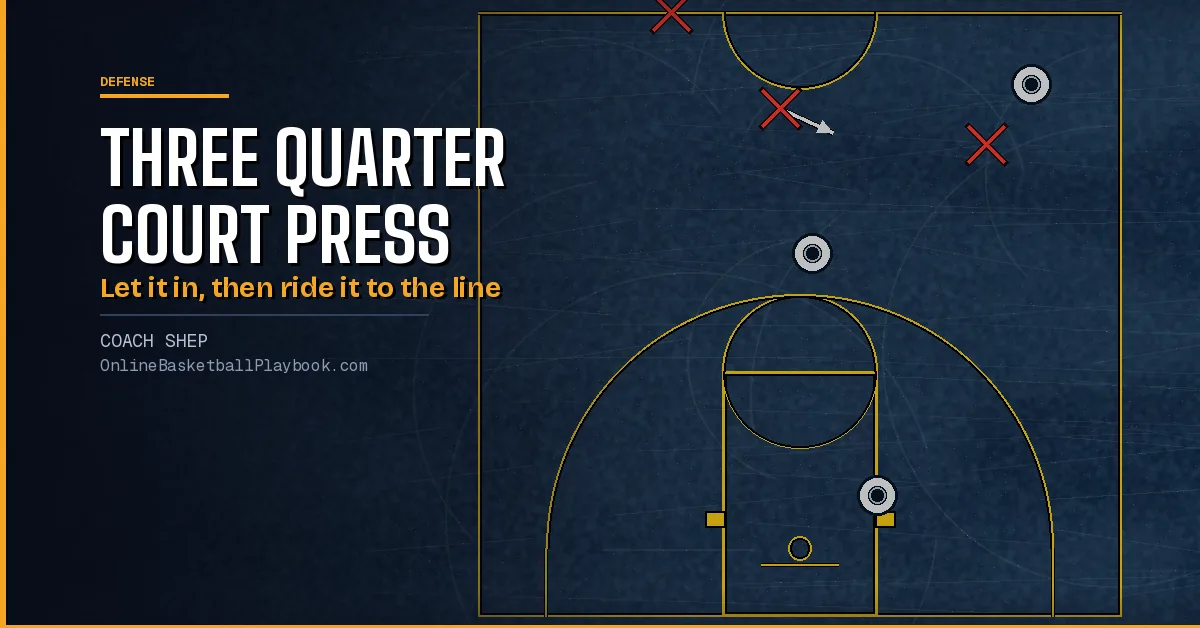
Three Quarter Court Press: Pickup, Traps and Rotations
Three quarter court press explained: where the pickup line sits, the 2-2-1 and 1-2-2 shapes, trapping near half court, the rotation behind it and the exits.
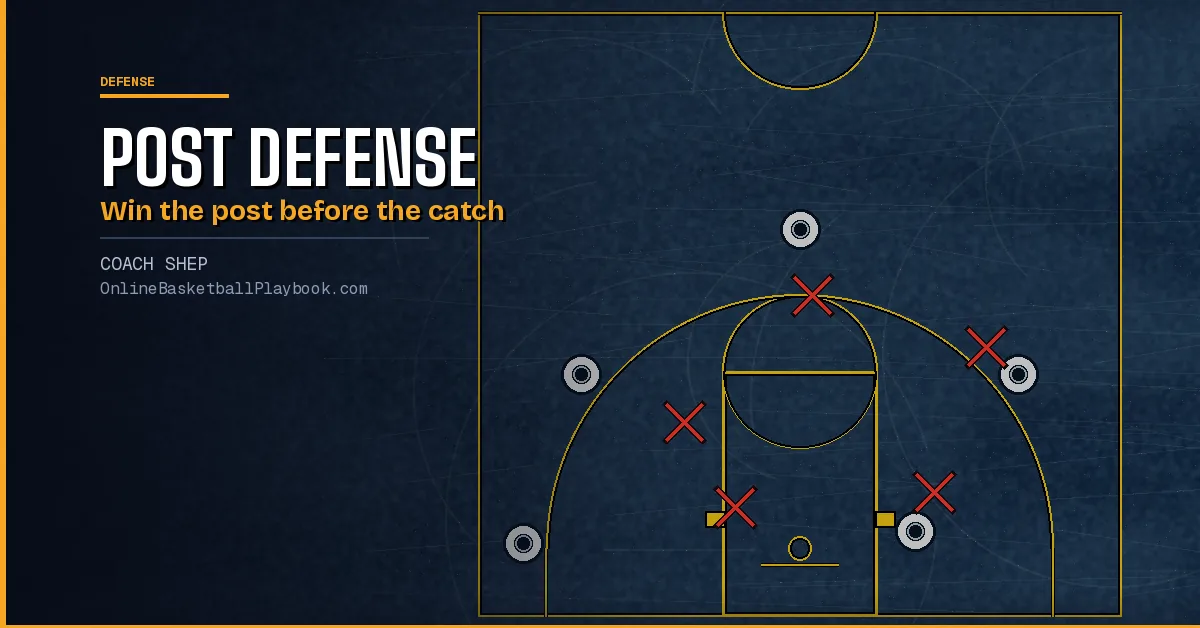
Post Defense in Basketball: Front, Three-Quarter or Behind
Post defense in basketball: winning before the catch, where to stand by ball spot, fronting, three-quarter, behind, changing sides, the lob and the double.
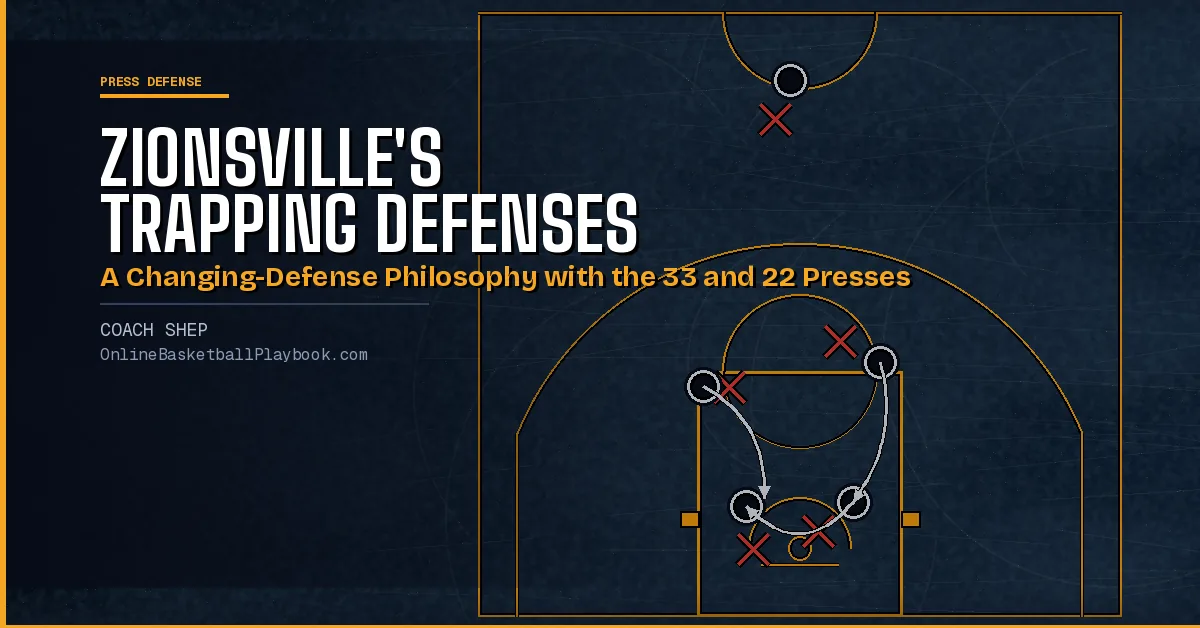
Changing Defenses in Basketball: Three-Quarter and Half-Court Traps
A changing defense taxes an opponent's prep time: a three-quarter 1-3-1 trap, a half-court trap, and a Run & Jump variant that ends in deny-everywhere.