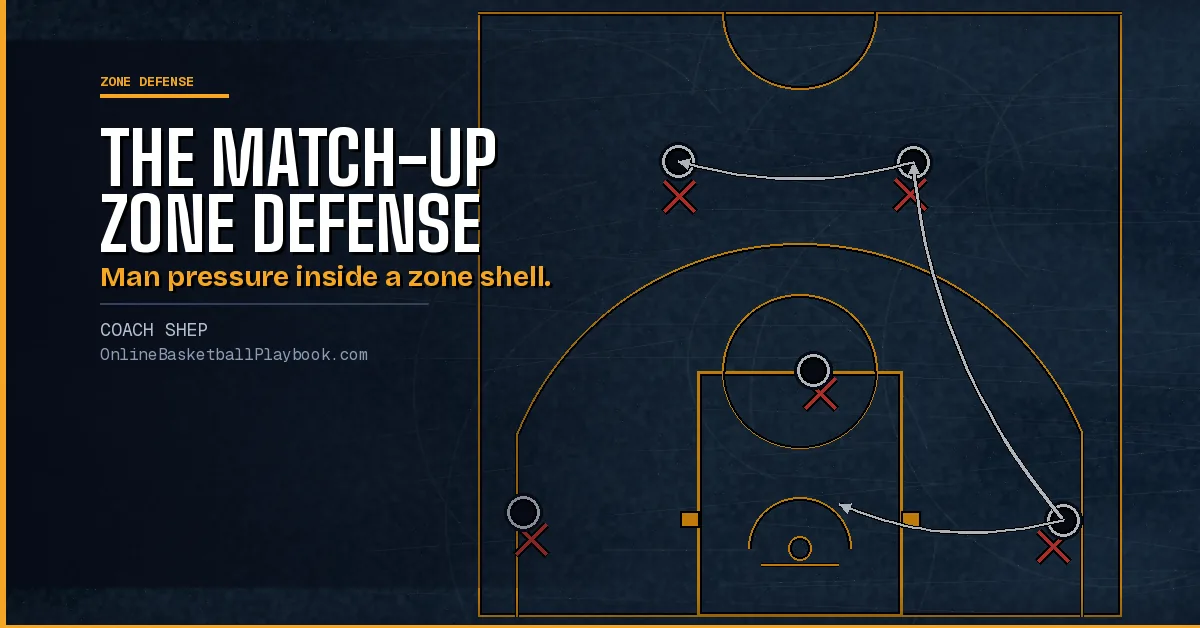
Here's the premise: what if you could guard the ball with man-defense pressure and still get all the cover-and-rotate benefits of a zone? That's the matchup zone. It looks like a zone on film (similar shape, similar spacing), but up close every defender is locking onto a man and pressuring the ball. It's not a trick. It's a real defensive system, and when you teach it right, your opponents spend three timeouts trying to figure out what they're seeing.
Picture this: you're playing a team that has done their homework. They know you run man defense. They've got their dribble-drive counters ready, their corner cuts scripted, their best player prepped to isolate your weakest defender. Then you drop into a matchup zone at the start of the third quarter. Their pace evaporates. Their sets don't work because nobody can find a mismatch. Their coach calls timeout. You've seen it. One defensive wrinkle and a prepared offense turns confused. That's what the matchup zone does when you teach it correctly.
This guide covers all of it: what the matchup zone actually is, why coaches reach for it, what the base alignment looks like, the matching rules that make it run, how your defenders pass off cutters, the variations worth knowing, where the offense can crack it, and the drills that wire it in. Work through this in order and you'll have a system your team can actually play, not just line up in.
What the match-up zone actually is
The matchup zone is a hybrid defense: Zone structure on the outside, man principles on the inside. Defenders start in a zone alignment and pick up whoever enters their area, but once they have a man they guard him with man-defense intensity: pressure the ball, deny the post, contest every shot.
The critical piece (the thing that makes it different from plain man) is how defenders handle cutters. Nobody chases a man across the half-court. Instead, defenders physically and verbally hand off cutters as they cross from one area to the next. You're guarding space with man pressure, and the handoff is the seam that holds it together.
It is not one fixed defense. Coaches run versions that start from a 1-2-2, a 2-3 or a 1-3-1, and some versions play so aggressively that they end up close to a switching man-to-man, while others are a change-up shown for a few possessions. The rules change from version to version. What they share is one defender on the ball and the other four helping like a zone. Hard to scout because it's neither one thing nor the other.
Why coaches run it
- It's hard to scout. An offense that prepares for your man defense walks into a zone look. An offense that preps for zone finds man pressure at every catch. The preparation problem alone is worth the installation cost.
- It reinforces your man principles. Unlike a traditional zone, the matchup doesn't let defenders zone-out. They're pressuring the ball, denying the post, contesting every shot, all the same habits you're building in your man defense. One system strengthens the other.
- It keeps you out of foul trouble. Zone structure means you're not chasing men into traffic. Fewer reach fouls, fewer bonus situations late in games.
- It's an equalizer. Got a team with one dominant scorer you can't match athletically? The matchup lets you front him, surround him, and keep fresh defenders on the ball, all while protecting the rest of the floor.
- It's good against three-point heavy teams. Push the ball to the corners, one man on ball, four with a foot in the paint. You're not giving up anything easy at the rim, and the corner catch is contested.
Zone does NOT mean rest. That's the culture problem coaches fight every time they install a matchup zone. Say it out loud on day one: this is a zone that plays as hard as man. One player on the ball, four locked in with a foot in the paint. The second your players think zone equals a breather, the whole thing falls apart.
Where it's soft, be honest
The matchup zone gives things up. Know the holes before your opponents find them:
- Communication breakdowns. This defense runs on talk. Silent confusion is the number one way matchup zones die. Two defenders step toward the same cutter and nobody covers the man who just cut behind the action. If your team won't talk on defense, this is the wrong defense for you right now.
- Continuous screening. A well-run ball-screen continuity offense stresses the handoff rules every possession. Each screen tests whether your defenders actually pass off or get caught in the action. The more screens, the more chances for a breakdown.
- Hard cuts through the seams. A player who sprints through the gap between two defenders at exactly the moment the ball is moving can cause either no-man's-land (two defenders let him go) or a collision (both step to him and leave someone else open).
- Against elite athletes. The man-coverage piece means your defender has to stay with whoever catches in their area. If an offense has one player who can just beat any individual defender off the catch, the matchup zone can get exploited the same way man defense does.
The base alignment
The most common starting point is the 1-2-2: one defender at the top of the key, two on the wings, two across the baseline. From that shape, every defender picks up whoever enters their area as the ball moves.
A few coaches run it from a 2-3 or 1-3-1 base, but the 1-2-2 is the cleanest starting alignment for teaching it: the triangles are natural, the responsibilities divide evenly, and the top-of-the-key defender's role as the "boss" is clearest from that shape.
The "boss" rule
This is the organizing principle. The point defender is the boss. Everyone else matches up based on his position. When he pressures the ball, the wings tighten toward the men in their areas. When he sags back, the wings sag with him. The top-of-the-key defender's location is the compass for the other four players, which means when he's confused, everyone is confused. Put your best communicator there.
Teach it in triangles
The farther you are from the ball, the flatter your triangle. The nearest defender pressures the ball. The next layer is one pass away, close enough to stop the drive and still close out. The back layer is in help, two passes away. That triangle shifts on every pass, same as any good zone or man-defense rotation. "Home" is the reset call: when anyone gets confused, they call "Home" and all five snap back to the 1-2-2 base.
The matching rules: who picks up whom.
Match when they enter your area
Every defender owns a territory. When an offensive player walks, cuts, or receives the ball in that territory, that defender takes him. Full man-defense pressure, right away. If no offensive player is in your area, back up toward the nearest open man and look to help. You're never just standing on a spot.
Passing off cutters
This is what separates the matchup zone from every other defense, and you have to teach it until it's automatic. When a player cuts from one area to the next, the first defender calls it out and physically passes him to the next defender. The handoff happens at the boundary between areas, and the next defender takes him live.
Two rules cover most cuts:
- Kick-down: if the cutter comes in front of you (between you and the basket), you kick him to the next defender below you. The cutter goes down the lane, you pass him off.
- Kick-back: if the cutter goes behind you (away from the basket, back toward the perimeter), you kick him back to the defender above you.
Call it out. "I got 24!" as you take him, "Switch!" as you hand him off. The handoff only works if both defenders know it's happening. A silent handoff is a missed handoff.
Never cross over
Defenders do not chase their man across to the other side of the floor. They hand him off and rotate. If two defenders cross paths trying to follow the same cutter, both areas are open for a beat. The discipline of staying in your area and communicating the handoff is what keeps the zone from unraveling.
Never get screened
Many matchup coaches make this a non-negotiable rule, and the answers vary. Some switch the cutter to the defender who had the screener. Some sit on the high side of the screen. Some make the guards get over the top of every ball screen. Pick one answer, teach it, and expect it to be tested every possession by a team that screens a lot. Teach your players to call "screen!" before it happens, not after they get locked up in it.
How it plays out as the ball moves
The matchup zone is fluid, not static. Here's the movement on a basic ball-reversal:
- Ball is at the top of the key. Point defender (boss) on the ball. Both wings one pass away, in the gaps. Baseline pair with a foot in the paint, ready to help.
- Ball reverses to the right wing. The right wing defender closes out. The top-of-the-key defender drops and seals the gap at the high post. The left wing rotates to protect the middle. The ball-side baseline defender gets ready for the corner entry. The weak-side baseline defender is still in the paint, covering the weak-side block.
- Ball goes to the corner. The baseline defender on that side takes the corner man. The center rotates over to cover the block. The weak-side baseline defender hits up toward the ball to protect the gap. The top-of-the-key defender and weak wing stay home in case of reversal.
On every single pass: one on the ball, four with help. That's the rule regardless of where the ball goes. The shape shifts, but the ratio never does.
Front the post. This is non-negotiable in the matchup zone. Three-quarter denial or belly-to-belly fronting, whichever your baseline defender is comfortable with. A clean, easy entry to the post collapses the rotation and makes everything else harder. Take that pass away before it happens.
The main variation: post traps and corner traps
Once your team has the base communication and the cutter rules down, you can add wrinkles.
The corner trap ("55")
When the ball goes to the corner, the baseline defender and the wing defender double it together. The center stays home and doesn't come to the corner. That's the trap's weakness and your opponent will look for it immediately. The weak-side defenders rotate to take away the reversal and the lob over the top. This creates turnovers against teams that aren't comfortable in the corner under pressure, but your rotations have to be sharp or you give up an easy kick-out three.
Post traps from the top of the key
You can also trap the post from the top of the key using your point defender (three variations depending on which top defender comes). One comes from the left elbow, one from the right, one straight down the middle. The language ("X1," "X2," "X3") tells your other four who's trapping and who's rotating to cover. Trap to your teammate's leg, make sure the post player can't see the weak side, and get a hand in the passing lane fast.
The "Scarecrow" disguise
Start in a zone stance: knees locked, hands up, five players in a static-looking zone shape. Hold it until the offense gets comfortable. Then, on a signal, drop into the matchup with full man pressure. The offense catches the ball thinking they have a zone read, and there's a man in their face. It's a cheap, low-risk way to disrupt timing and steal possessions. Your players need to know the call and snap into it. If they're slow, the window closes.
How the offense attacks it. So you can fix it.
The matchup zone has two main pressure points, and good offenses will find both.
Ball-screen continuity. Run a pick-and-roll or dribble-handoff every possession. Each action forces a handoff decision and tests your communication. The cumulative stress of five or six screen actions in a row finds the defender who isn't calling it out, or the pair who are crossing instead of switching. If your zone is giving up open looks off screens, your kick-down / kick-back calls are breaking down somewhere.
Hard cuts through the seams. A backdoor cutter who sprints the gap between two defenders right as the ball is moving is the classic matchup-zone beater. The timing matters. The cut has to coincide with a pass so the defender is split between following the ball and picking up the cutter. The fix is calling the cut out loud before it gets deep: "Cut! I got him!"
A team that overloads one side and then skips the ball also stresses the matchup zone, the same way it stresses any defense. The difference is whether your weak-side help is already a foot in the paint (where it's supposed to be) or sleeping on the weak side. Foot in the paint, every possession.
The fastest way to coach this defense is to show your team how it gets beaten. Rep the seam cuts and the screen actions in practice, then let your defenders figure out the handoff in real time. The fix almost always comes down to one thing: who didn't call it.
Drills to teach it
- Overplay-and-Sag. One offensive player, one defensive player, a coach moving the ball. The defender practices match-up on catch, deny on the skip, and sag toward help when the ball is two passes away. Simple, repetitive, builds the habit of adjusting to ball position without a man to chase.
- Full-Court Scramble. Five on five, full court. The focus is cutter communication only. Every time a player cuts, the handoff has to be called out loud before the cut completes. Stop play when a handoff is silent or late. The goal is five players talking on every possession without being told to.
- Screen-Down drill. Two defenders, a screener, and a cutter. Run a screen-down action and make the two defenders switch it cleanly every time. Add a ball so one of them is on-ball while the other takes the cut. This is where the "never be screened" rule gets tested. And where it breaks down if you don't drill it.
Is this defense right for your team?
Be honest with yourself here. The matchup zone rewards teams that talk. If your group is quiet on defense (if you're still fighting for communication in your man shell), the matchup zone will be a mess, not a weapon. Build the talking habit in man defense first. Once your players are calling out every cutter in your man shell, they're ready to add the matchup.
For experienced groups with good communicators, the matchup zone is one of the best things you can add to a program. It makes your man defense better, it gives you a look that's genuinely hard to prepare for, and it gives you a place to hide an athletic mismatch without putting your weakest defender in an island situation.
Reserve it for your older or more experienced teams. The youngest groups need simpler rules, not more vocabulary. One defense done well at the youth level beats three defenses done poorly.
The bottom line
The matchup zone is not a gimmick. It's a real defensive system that demands the same discipline as man defense. Maybe more, because the communication requirement is baked in. Teach it with the 1-2-2 alignment, build everything off the boss rule, drill the kick-down and kick-back cutter handoffs until they're automatic, and make "one foot in the paint" a non-negotiable for every defender who's not on the ball.
When your team plays it right, the offense can't figure out whether they're playing against a zone or a man. That confusion is the whole point. And when the handoffs are clean and the communication is loud, it's a defense that genuinely wins games you wouldn't win with straight man or a static zone.
Thanks for the work you put in for your players. If you've got questions about installing the matchup zone or running any of the drills above, feel free to reach out. Always happy to help.
Keep Building
Related breakdowns
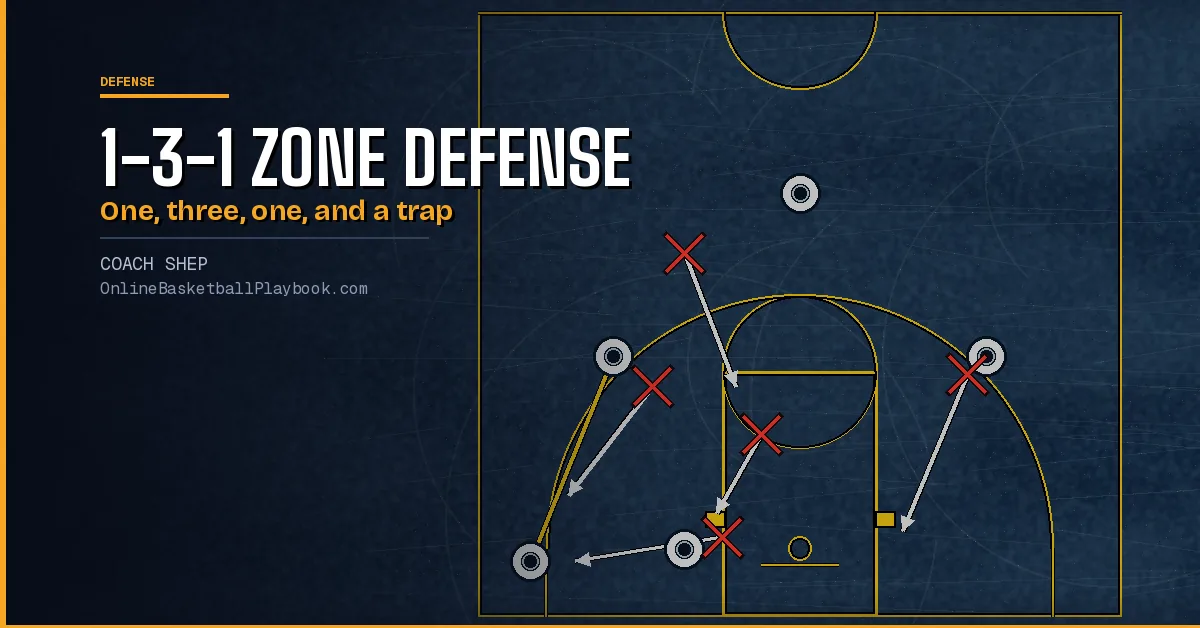
1-3-1 Zone Defense: Traps, Rotations and Drills
How to run the 1-3-1 zone defense: the five roles, the corner and wing traps, the skip pass that beats it, loose and tight depth, and the drills to install it.
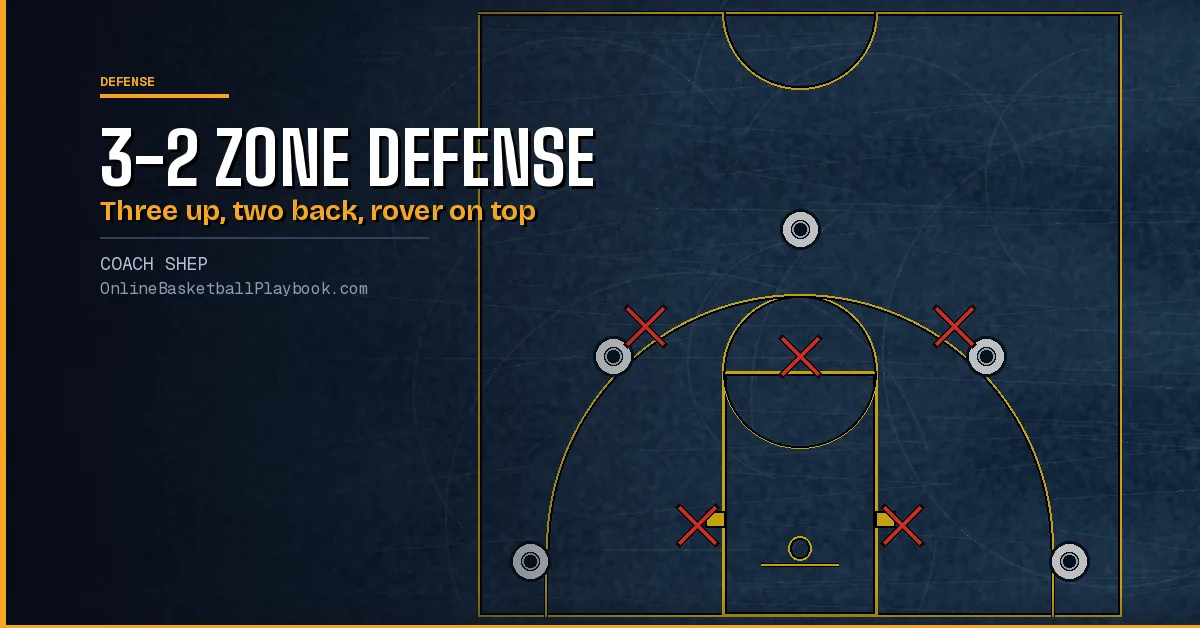
3-2 Zone Defense: Rotations, Weak Spots and Drills
How to run the 3-2 zone defense: the alignment, the rover, every rotation, the weak spots, the 3-2 matchup zone and the drills, plus when to pick it over a 2-3.
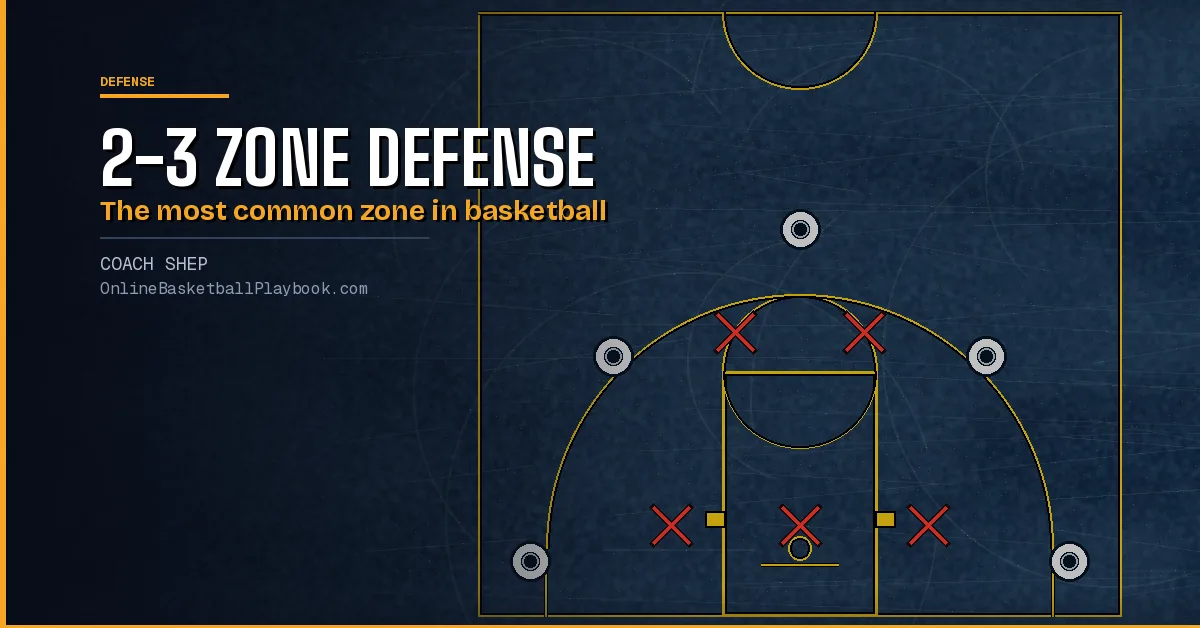
2-3 Zone Defense: Rotations, Weak Spots and Drills
How to play the 2-3 zone defense: the starting positions, how it shifts to the ball, where it leaks, when to trap, and the drills that install it.
More from Online Basketball Playbook
How to Beat the Matchup Zone
See exactly what offenses try to do against you. Know the attacks before they come.
How to Build a Defensive Identity
The matchup zone only holds if your players believe in the system. Build the identity first.
How to Coach Defensive Rotations
Matchup zone rotations are faster than man. Drill them until they’re automatic.