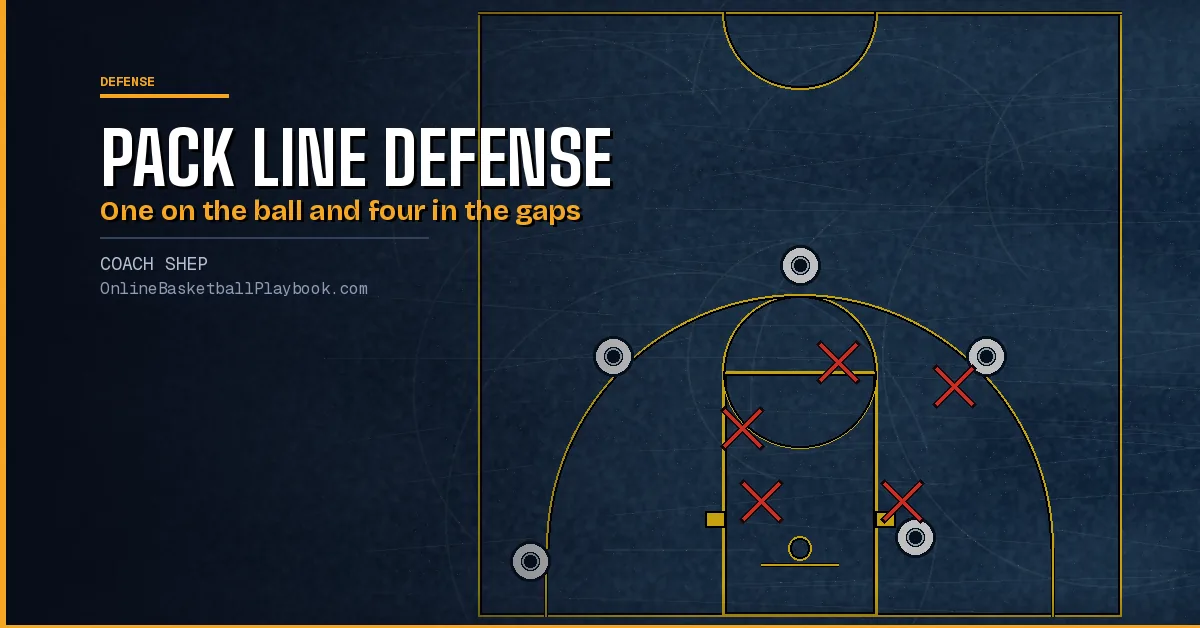
Pack line defense is a half-court man-to-man system built on one idea. One defender guards the ball and the other four stand inside an imaginary line in the gaps, so there is no straight path to the rim.
This guide covers the rules in the order a defense uses them, and where coaches who run it disagree, on the distance of the line, the baseline, the post, ball screens and the dead ball. It ends with the costs and an install order. For how it compares with pressure man-to-man, see pack line vs pressure man-to-man.
Pack Line Defense at a Glance
The system comes down to one rule. At all times one defender is on the ball and four are inside the 16-foot line in gap and help positions. The one exception is a dead ball.
- Credit Dick Bennett. Dick Bennett at Washington State, with Tony Bennett, Sean Miller and Chris Mack among later users.
- Know the name. The name came from a marketing person for an instructional video and not from Bennett.
- Know his stops. Dick Bennett coached at Wisconsin-Stevens Point, Green Bay, Wisconsin and Washington State.
| Part | What coaches teach |
|---|---|
| Off the ball | Both feet inside the line, or at least one foot, in a gap about halfway between the ball and the player |
| On the ball | Pressure and contain, no straight-line drive, no baseline drive |
| Closeouts | Sprint, chop the last steps, high hands |
| Post | Three-quarter front from the high side, no feed from the top of the key, a double decided in advance |
| Dead ball | Everyone steps out to deny |
| Transition | The first principle and the top priority |

Where the Pack Line Sits
Coaches draw the line in different places.
- One step inside the three-point arc. Tape it on the floor in early practices.
- Two feet inside the arc.
- 16 feet from the basket.
- At least one foot inside the line. No distance is given, and the rule asks for one foot inside, not both.
- About 17 feet.
- A 16-foot circle around the basket. This runs Bennett's system for players who are not quick enough to overplay. One defender pressures the ball, the other four stay inside and nobody chases the ball outside the circle.
Any of these works once it is taped and drilled. Pick one distance and mark it.
On-Ball Defense and the Baseline
Put the pressure on the ball and build the rest of the defense behind it.
- Tight, harassing pressure. Make the ball handler uncomfortable.
- Heavy pressure, no fouls. The wall behind the on-ball defender gives him license.
- Guard your yard. Never get beaten to the outside and never get beaten in a straight line.
- Pick up at half court. It is a myth that the pack line does not pressure the ball. The footwork is a step with the toe, a push with the other foot and never closer than about 12 inches between the heels.
Coaches split on the baseline.
- Force the middle. Never give up the baseline and force the ball to the middle, into the help.
- Deny the baseline, force nowhere. The baseline is denied and the ball is not forced anywhere.
- Hold the baseline, force no direction. Do not give up the baseline and do not force a direction.
- Tie it to the bigs. Do not force a direction and tie the no-baseline rule to big players playing three-quarters in the post, who cannot help baseline easily.
Choose your baseline rule before the game.
Gap Positions and Help
Positioning is your help.
- Halfway between. Place the off-ball defender about halfway between the ball and the player, a step off the line that joins them, where he sees both.
- Toes on the line. Put the toes on the pack line in a slightly closed stance. With the ball lower than the free-throw line, one foot goes on the lane line. A great post player or a non-shooter is an exception.
- Fake the trap, then recover. The gap defender fakes a trap on a drive only to stop the dribble, then recovers to his player when the ball is picked up or passed out.
- Always see your player. If he does not, a back cut or flare cut goes uncontested.

- Recover, do not help. There is no help mode, only a recovery mode, since the defenders are already in help.
- Only help and recover. Denying, helping and recovering all at once is hard, so gap defenders only help and recover.
- Mack's golden rule. Keep two feet inside the line whenever the player does not have the ball, except when he becomes a cutter or a ball screener.
- Never beaten. The on-ball defender must never be beaten baseline or in a straight line after a poor closeout.
Stay in the gap and see the ball and your man.
Closeouts
Because the defense allows perimeter passes, closeouts happen constantly.
- Move on the air time of the pass. On a pass to your player, sprint, chop the feet and go from high hands to active hands. On a pass elsewhere, sprint to the gap.
- Keep the feet on the floor. Do not fly at the shooter.
- Catch-and-shoot player. Go up under the catch to force a put-down dribble.
- Player who shoots and drives. Close within a finger's touch.
- Marginal shooter. Think shot but play drive and close hard and short.
- Driver. Close with the toes pointed to the pack.
- Drill them daily. Mack's Vegas Closeouts run every day, even in pre-game warm-ups, and the defender yells "shot" early.
The closeout technique page and the closeout and recover page cover the footwork.

The Dead Ball
The gap rule stops when the dribble does.
- Jump out and hunt the steal. Everyone jumps out to deny.
- Call "dead." Every defender calls "dead, dead, dead" and denies the next pass while hunting a five-second violation.
- Call "five." The ball defender calls "five" when the dribble is used.
- Leave the pack. The defense leaves the pack and denies the other four players.
When the dribble dies, deny.

Post Defense and the Double
How you defend the low post dictates everything else you do.
- Tape the post area. It is a step outside the lane and a step above the second free-throw spot, and the rule is no catch with two feet inside it.
- Chin on the top-side shoulder. Pop back to a spot between the player and the basket if the ball arrives, and dig with the arm nearest the post player if he dribbles, not a double.
- Mack's post box. Mack tapes a post box before every practice, defends three-quarters on the high side with an arm bar, then pops back and walls up with the hands showing.
Coaches differ on fronting.
- Full-front by the ball. Full-front a post when the ball sits in a corner or at the top of the key and three-quarter front from the top side when the ball is on the wing, which works because the wing defenders deny the baseline.
- Bennett's three-quarter front. Three-quarter front from the high side and never full-front because of offensive rebounds.
- Front below the free-throw line. Use a three-quarter denial on the high side, no feed from the top of the key and a slide behind the post on the air time of the pass.
After the catch the coverage is a choice.
- Decide in advance. Double every post, the traditional approach that needs no thinking, or only the best one or two players.
- Bennett's two doubles. Choke the post with the nearest perimeter player or go big to big.
- Three doubles. Big to big, low man and double off the cutter, plus a crowd and dig option with no double.
- Choke and fire. A choke and a fire, which is a big-to-big trap.
In the big-to-big double:
- Weak-side big. He sprints in on the air time and takes the high side with high hands.
- Post defender. He takes the low side and cannot allow baseline.
- Feeder's defender. He locks up the pass back out.
- Weak-side guard. He is the low man at the rim.
- Defender at the top of the key. He sinks to the elbow.
Decide the double before the game.

Get the next coaching guide in your inbox
One email when a new guide or diagram set goes up. Free.
Screens and Ball Screens
The gap rules match across these defenses, and screen coverage does not.
- Fight through everything. Do not switch. The one exception is weak-side screens, where a defender may cheat over or under.
- No switch except by scouting. The cutter's defender follows tight and the screener's defender jumps to the ball.
- Four ball screen coverages. A hard show, a soft show, a slide and a flat show.
- Hard show or hedge by default. A trap for an elite handler, a soft show for a slow big and a switch of the bigs only for certain matchups.
- Hedge, plug, jam or trap. A hedge, a plug, a "fourth" jam of the screener or a trap, chosen by who the shooter is.
- Over the top. The on-ball defender shows over the top of a wing screen with the nearest gap defender helping on the roll.
- Blitz the pick and roll. This is the base.
- Switch. Switch off-ball screens and, by default, ball screens.
See how to defend the pick and roll. Pick the coverage before the game.
Transition First
Transition defense is the first principle.
- Two guards back, three to the glass. The three sprint to half court before finding their players.
- Lane defender and ball. Two guards go back, one as the lane defender and one on the ball, and the other three sprint to the paint with no vision for the first three steps.
- Slow the ball at the timeline. Form a tandem or a triangle, with no matchups for the possession.
See transition defense. Get back first and match up second.
How to Install It
Three orders for installing it:
- Language first. Teach the language and the two court areas on the first day, then run Shell 4 around 0, Shell 3 around 1, Chair Closeouts and Vegas Closeouts, and use the calls ball, gap and help in shell.
- Closeouts, then shell. Run 3 line closeouts, 4-on-4 shell, a 4-on-4 change drill, 3-on-3 closeouts, transition defense, defending actions and a diamond drill.
- Build from one-on-one. Move from a 1-on-1 where the offense gets three dribbles to 2-on-2 gap positioning from four spots and 3-on-3 with a coach who can freeze play.
- Score the post box. Score a 3-on-3 and 4-on-4 drill and add two points whenever the ball touches the post box, so players feel what a paint catch costs.
Every drill named here, with setups and diagrams, is on pack line defense drills. See the shell drill page, the defensive drills page and the help and rotation drills.
Add a discipline rule. A player who loafs or is out of stance comes out of the game immediately, because a wrong position is forgivable while learning and a lazy stance is an attitude. The stance itself is on the defensive stance page. Teach one layer at a time and keep the standard high.
Costs and Who It Fits
The weaknesses:
- Hot three-point shooting.
- No shot clock. It lets an offense pass as long as it likes.
- Impatient young players.
- Trailing late. It is a problem when you trail late because the offense can run the clock.
The strengths:
- No penetration, no backdoor cuts. A lower opponent field-goal percentage and better rebounding position follow.
- Helps less talented teams compete. It slows dribble-drive teams and fast-tempo teams.
A team that wants to run needs a half-court plan.
- For young teams. The pack line is an acceptable step toward man-to-man principles, and a tight 2-3 zone is the common win-now tactic that hurts development.
- To attack it. Seven methods: reversals, blur screens that make a double gap, straight-line drives, flares, skips, posts as passers and shot readiness.
Tony Bennett's own offense, covered on the Blocker-Mover page, is built around flare screens. For the wider picture see man-to-man vs zone defense and how to build a defensive identity. Know what the pack line costs before you commit to it.
Want the printable playbook packs?
OBP Pro members get the premium playbook packs: the zone attack, out of bounds and practice plan PDFs, plus each new pack as it is finished. The membership page lists what is in each one. Or draw your own version free in PlayDraw.
See what OBP Pro includesQuestions Coaches Ask
What is the pack line in basketball?
An imaginary line inside the three-point arc. When the player a defender guards does not have the ball, he keeps both feet inside it.
How far is the pack line from the basket?
It depends on the coach: 16 feet, about 17 feet, two feet inside the arc or one step inside the arc.
Does the pack line pressure the ball?
Yes. The pack line pressures the ball, and the idea that it does not is a myth.
Who invented the pack line defense?
Dick Bennett is credited, and Tony Bennett, Sean Miller and Chris Mack later ran it.
Do you double the post in the pack line?
Coaches choose in advance. Options are double every post, double only the best one or two, a big-to-big double, a low-man double, or crowd and dig without a double.
What are the weaknesses of the pack line?
Hot three-point shooters, no shot clock and young players who lose patience. It is also hard to use when trailing late.
More Guides From This Batch
- Defensive Stance in Basketball: Weight, Feet, Hands and Drills
- 1-3-1 Full Court Press: Roles, Traps and Rotations to Install
- Fun Basketball Drills for Kids: Team Games, Relays and Contests
- Basketball Agility Drills: Cone, Reaction and Ladder Drills
Back to Types of Defense and every Defense page.
Keep Building
Related breakdowns
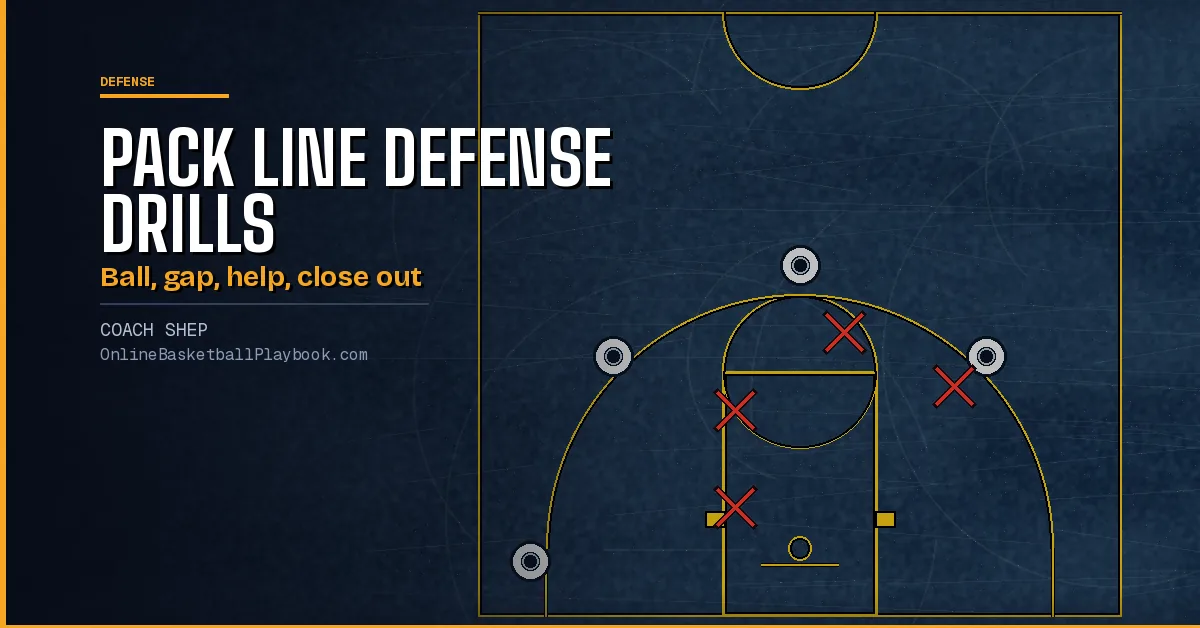
Pack Line Defense Drills: Closeouts, Shell, Post and Scored Games
Pack line defense drills for every habit: on-ball containment, 2-on-2 gap work, Vegas closeouts, Blackhawk, shell, post wall-ups, scored games and transition.
Full Court Press Defense: Types, Rules and How to Install It
Full court press defense pressures the ball for 94 feet. See the press families, shared rules, trap mechanics, the cost, the install order and drills.
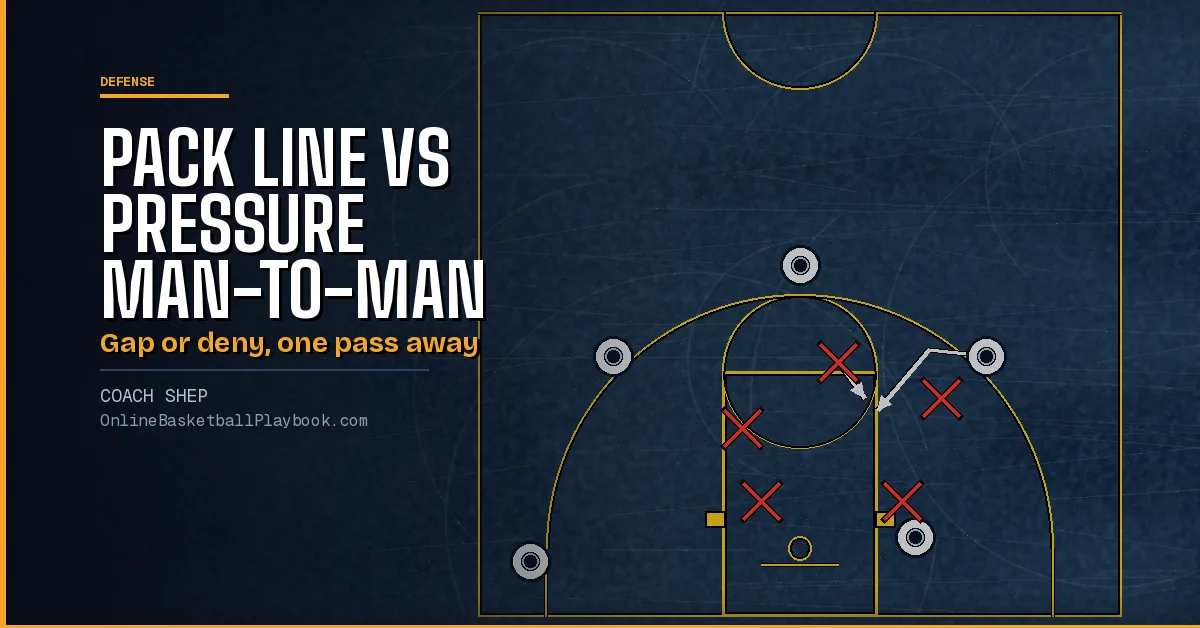
Pack Line vs Pressure Man-to-Man
Both pressure the ball. They split on the defender one pass away, and that one choice decides drives, backdoors, screens and fouls.