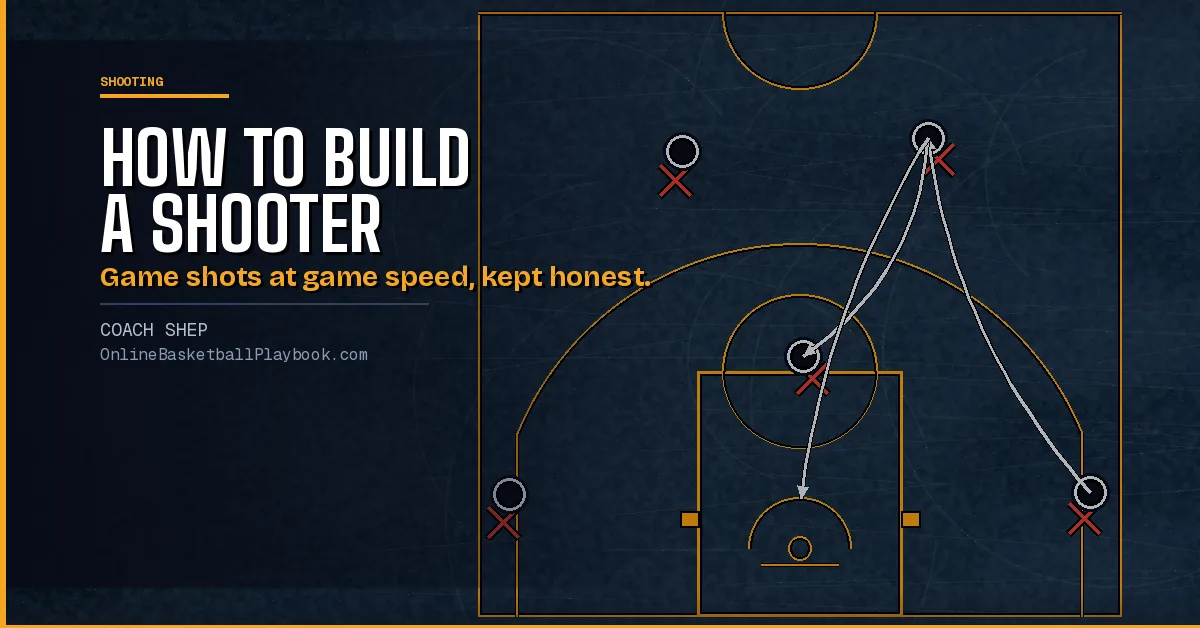
Most players who call themselves shooters aren't shooters. They're good at shooting around. There's a difference. "Shooting around" is aimless: no plan, no pressure, no tracking. You feel good while you're doing it and then you miss three open looks in Tuesday's game and wonder what happened. A real shooting workout is different. It has a structure, a standard, and a score. It makes you shoot the shots you'll actually get in a game, and it makes you earn the makes instead of just counting the shots.
Picture this: your best shooter comes in an hour before practice, every day, works up a sweat, and leaves happy. But his shot percentage in games is going nowhere. You watch him work one afternoon and you see the problem immediately. He's starting five feet from the basket. Standing still. Catching clean passes from himself off the wall. Making them easily. His form looks beautiful. And none of it looks like basketball. The catch off a curl. The pull-up off two dribbles. The spot-up after a skip pass when his feet have to be right. That's what he never practices, because aimless reps don't demand it.
This guide lays out how to build a shooting workout that actually develops shooters, from the form foundation through spot shooting, movement, off-the-dribble work, and competitive pressure. We'll cover what makes reps count, how to structure a workout, how to make every session competitive, and what to track. There's also a sample 20-minute workout at the end you can hand to a player right now.
What makes shooting practice actually work
Three things separate a useful shooting session from an hour of shooting around. Get these right and everything else is a detail.
- Have a plan before you walk in. Know what you're working, in what order, for how many makes. "I'll just go shoot" is how players get worse. A plan takes three minutes to write and turns an hour of gym time into purposeful reps.
- Work at game speed. The body learns what it rehearses. If a player catches the ball slowly, sets his feet slowly, and rises slowly every rep in practice, his shot will always lag in games. Game speed from the first movement drill.
- Track makes, not shots. Build workouts around made shots, not attempts. "Make 14 in 90 seconds" is a standard. "Take a bunch of shots from the wing" is not. When the standard is makes, the player has to focus. Aimless volume doesn't.
Frequency matters as much as the workout itself. A player who puts in five quality sessions per week will outgrow a talented player who shows up twice. Good habits compound. Set the expectation clearly: three times a week is the floor to improve; five times a week is how you become a real threat.
A quick word on mechanics
Before drilling volume into a bad habit, spend time on form, but keep it brief. The foundation is: balanced stance with feet shoulder-width, shooting hand under the ball like a pizza waiter carrying a tray, elbow under the hand and over the knee, eyes on the rim, and a high follow-through with fingers pointing down at the finish (reaching into the "cookie jar" above your head). That's all five pieces. You don't need a 45-minute breakdown. Run the player through form shooting with one hand, no jump, close to the basket. Then add the jump, then back up.
The warm-up of any workout is the place for this. Every rep before the player gets five feet from the basket is a form rep. Once form is established, get to game shots fast. Form is the on-ramp, not the destination.
Game shots at game speed
This is the most important idea in shooting development. The player who shoots thirty straight catch-and-shoot threes from the same spot off a ball rack is not preparing for basketball. He is preparing for a very specific shooting contest that doesn't exist.
In a game, the shot comes after movement. After a cut. After a screen. After one or two dribbles. After a pass from the other side of the floor that arrives a half-step before a defender. The feet are already in position or they aren't, and if they aren't, the shot doesn't go. The player who only ever catches the ball standing still has no idea how to get his feet right coming off a screen. The player who only shoots stationary will always be a beat late when the catch requires footwork.
The antidote is simple: mix movement into the workout from the first rep of game-speed shooting onward. Catch off a step. Catch coming around a cone. Catch after a change of direction. One dribble pull-up. Two dribble pull-up. The exact actions the player will see in a game. Not all reps. Start stationary to build confidence and feel, but the heart of the workout should be moving.
The pull-up jumper off one or two dribbles around the foul-line area is undervalued and undertrained. A player who can pull up at 15–17 feet is one of the hardest players to guard in any system. Don't let "shooter" only mean "catch-and-shoot three-point shooter." Train the pull-up deliberately.
How to structure an individual workout
A good workout moves through five phases in order. You don't have to run every phase in every session, but the order matters. Each layer builds on the last.
Phase 1: Form work (3–5 minutes)
One-handed makes at close range. No jump. Get the wrist, elbow, and follow-through right. Then add the jump. Then step back to the paint. This is the warm-up, the body getting right before volume starts. Never skip it, but never let it eat the whole session.
Phase 2: Spot shooting (5–7 minutes)
Five spots around the arc: left corner, left wing, top of the key, right wing, right corner. Make a target number at each spot (start with makes-in-a-row or a flat number like 5 makes before moving on). Both feet set before the catch. This is the volume layer that builds confidence and grooves the release. Stationary, but purposeful. Chase the target, move on, track it.
Phase 3: Off-movement shooting (5–7 minutes)
Now add footwork before the catch. Step into the catch. V-cut to a spot. Come off a cone or a chair. Catch off a curl. Catch off a fade. The ball can come from a partner, a ball rack with a roll, or a self-toss. The point is that the feet have to move before every rep. Start at game speed immediately in this phase. No warm-up mode.
Phase 4: Off-the-dribble shooting (5 minutes)
One dribble pull-up from the wing. Two dribble pull-up from the top of the key. Step-back off a dribble. Euro-step to a finish. The pull-back crossover to create a shot off separation. These are the hardest reps in the workout and should be in the middle. The player is warmed up and still fresh enough to do them with real quality. Don't just mindlessly jack pull-ups; make the dribble move earn the shot.
Phase 5: Competitive pressure (5 minutes)
The last layer. Make the final section of every workout competitive. This is where a player either has a mental gear or discovers they don't. Run a makes-in-a-row target under time. Run a "Beat the Pro" scoring game. Set a personal record to chase. The player should finish the workout having either hit a target or missed it and wanting to come back tomorrow. That feeling, the wanting, is what builds shooters.
Making it competitive, scoring formats that work
The easiest way to ruin a shooting workout is to let it drift. Competitive formats prevent drift. They put a number on the board and ask the player to beat it. Here are four that travel well.
Makes in a row
Simple, effective, and brutally honest. The player shoots from a spot until he makes five in a row (or three, or ten, pick the target). Miss one and he resets to zero. No faking it, no estimated counts. The standard is clean or it isn't. This format builds concentration because one lapse ends the streak. Advance to the next spot only when the target is hit.
Make X in Y seconds
Set a time limit and a make target: "14 makes in 90 seconds," "10 makes in 60 seconds." The clock creates urgency without making it chaotic. This teaches the player to shoot with purpose instead of deliberating after every miss. Track the result: did he hit the target? By how much? What's the personal record?
Beat the Pro
The player shoots from a spot. A make is 1 point for the player. A miss is 2 points for "the pro." First to 11 wins. The format is punishing enough that it simulates the feeling of falling behind. The player has to make two in a row just to keep pace after one miss. It's a mental drill as much as a shooting drill. Run it from three or four different spots and track wins versus losses.
Streak Shooting (timed)
Set a 90-second clock. The player shoots from a spot and must make three in a row to advance to the next spot. Once he advances, the clock is the only thing that stops him. Track how many spots he reaches. That number is the record to beat next session. A Charlotte Hornets assistant coach named Jay Hernandez uses a version of this drill. The record at NBA range gives younger players something to eventually chase.
Post a record board in the gym. Five named drills, blank lines under each one for a player's name and number. When a player breaks the record, he erases the old name and signs his own. It takes ten minutes to set up and creates more competitive energy in individual workouts than any practice speech. The most dangerous person in the gym is the one who is continually improving. Give players something to improve against.
Tracking makes
You can not build something you are not measuring. Shooting is no different. At the end of every workout, the player writes down what he did, what he made, and whether he hit his target. That's it. No complicated spreadsheet. A folded piece of paper in the gym bag works fine.
What tracking does: it gives the player a record to beat. It reveals whether the workout is getting easier (it should, over weeks). And it holds the player accountable to the standard instead of the feeling. A player who keeps a log can't lie to himself about whether he did the work. He either hit the targets or he didn't, and the number is right there on the page.
For team settings, collecting the tracking sheet after individual workouts is a two-minute task that tells you which players are actually working and which ones are going through motions. The data doesn't lie.
A sample 20-minute workout
Here's a complete session a player can run alone with just a ball and a basket. The whole thing takes about 20 minutes and hits all five phases. Print it out and hand it over.
Warm-Up: Form Shooting (3 min)
- One-handed makes from 4 feet, make 10 in a row
- Two-handed, no jump, from 8 feet, make 8 in a row
- Full shot, inside the paint, make 6 in a row
Spot Shooting (5 min)
- 5 spots around the arc
- Make 3 in a row at each spot before advancing
- Track how long it takes to finish all 5 spots. That's the time to beat next session.
Off-Movement: Step-Into-the-Catch (4 min)
- Self-toss the ball out to each of the 5 spots; step into the catch and shoot
- 8 makes from each wing and the top of the key (24 makes total)
- Game speed: no slow catches, no re-setting after the toss
Off-the-Dribble: Pull-Up Pairs (4 min)
- Left wing, 1-dribble pull-up, make 5
- Right wing, 1-dribble pull-up, make 5
- Top of key, 2-dribble pull-up left, make 4
- Top of key, 2-dribble pull-up right, make 4
Competitive Finish: Beat the Pro (4 min)
- Pick two spots (wing + top)
- Your make = 1 point for you. Your miss = 2 points for "the pro." First to 11 wins.
- Play two rounds. Track wins/losses.
Total time: ~20 minutes. Target makes: 60+. Log it.
Common mistakes that kill shooting workouts
These four habits show up everywhere, and all of them are fixable once you know to look for them.
- Starting too far from the basket. Players drift to the three-point line before the form is solid. Start at two feet. Earn your way back. A player who can make ten in a row from five feet is more ready to shoot threes than a player who jacks up twenties from behind the arc.
- Counting shots instead of makes. "I shot 200 shots today" tells you almost nothing. "I made 130 of 200 from the spots I'll actually shoot in a game" tells you everything. Build the workout around makes.
- No movement, ever. The stationary catch is one tool. It's a good tool for form work. But if that's all a player ever does, he becomes a good form-drill shooter, not a real one. Movement has to be in every workout.
- Skipping the pressure phase. This is the easiest phase to cut when time is short. Don't. Five minutes of competitive shooting at the end is where mental toughness gets built. The player who never shoots under any kind of pressure always misses the big one. Make the last minutes of every workout count.
The bottom line
Shooters are made, not born, but they're made in the right kind of gym sessions, not just a lot of them. The player who walks in with a plan, works at game speed, chases a make target, and ends every session with pressure on the line is going to outgrow the player who just "shoots around," every time. Give your players the structure, hold them to the standard, and put a record board on the wall. You'll be surprised how quickly the culture changes when there's something to beat.
Keep Building
Related breakdowns
Basketball Footwork Drills for Teams and Individual Workouts
Basketball footwork drills for stops, pivots, cuts, jab moves and defensive slides, from the box drills to 30-minute workouts and where coaches differ.
Individual Basketball Workouts Mid Season
Individual Basketball Workouts Mid Season
Basketball Player Development: Workouts and Skill Progressions
Basketball player development runs on a plan, game speed and a make count. Learn the skill progression, scoring, error fixes, drills and how to program a season.
More from Online Basketball Playbook
Developing Your Shot in the Off Season
Off-season structure for players who want to come back a different shooter.
Shooting at Game Speed
Practice shots that actually transfer to games, not just open-gym repetition.