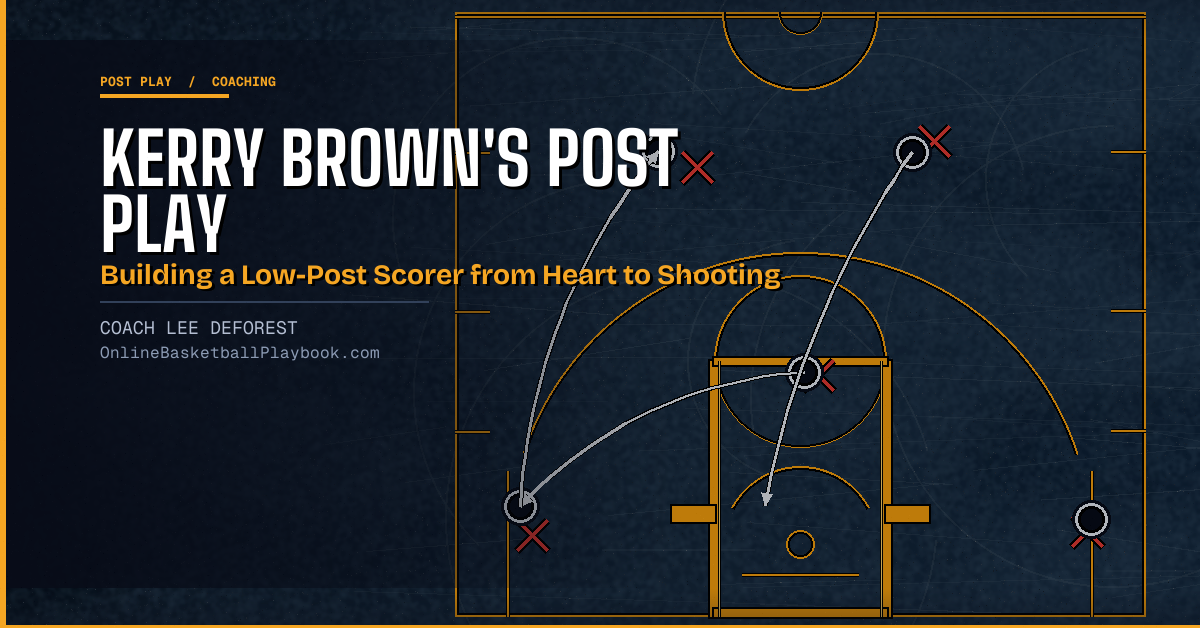
Most teams say they want an inside game and then never build one. They drop the ball into the post, it gets stripped, and the coach decides the kid can't play. The truth is simpler — nobody taught him how.
Kerry Brown, who coaches the Rushville Lions at Rushville Consolidated, gave a clinic on post offense that fixes exactly that. His message: a low-post scorer is built, not born. You develop the player, then design the actions that feed him — and most programs skip the first half entirely.
Every offense has three components — an inside game, an outside game, and a penetration game — and a complete offense attacks all three. The one coaches neglect is the inside game, because building it is slow, unglamorous work. This is that work.
"Take a little from the clinic, not everything. Try to correlate ideas with your personality and program."
Coach's Cheatsheet
- Use this when: you want a real inside game and a post who can score, not just occupy the block.
- Core teaching point: develop the player in five areas — Heart, Head, Hands, Feet, Shooting — before you worry about the play that feeds him.
- Get open: sprint block-to-block in four seconds or less, V-cut high and low, and time the cut to the ball.
- Stay open: seal with the feet — step over, pin and spin — in a wide, low, arms-out stance.
- Catch it: six steps — call for it, hold the seal, move and jump-stop, catch with the eyes, block and tuck, then chin and read.
- Finish it: shoot closer to the basket than where you caught it; never settle for a jumper if it can become a power move.
The Five Areas: Heart, Head, Hands, Feet, Shooting
Brown breaks a post player into five areas. The first two are mental — Heart and Head. The last three are physical — Hands, Feet, Shooting.
Heart is the willingness to do the dirty work — go get position every trip and hold it after three straight times the guard didn't throw it. Head is the IQ of the spot: read the defense, know when to seal in and when to seal out. Hands catch everything near them and finish through contact. Feet get open, seal, and execute — footwork is the engine of post play. Shooting is the finish, from the turnaround to the jump hook to the touch off the glass.
The Key Principle: the first two areas are mental, the last three physical — and most coaches only practice the physical three. A post with great feet and no heart gets pushed off the block; a post with heart and a head for the game finds a way to score even when his technique isn't perfect.
Getting Open in the Post
A post move is useless if the player can't get the ball. A defender fronts a passive post man all day, so the post has to move.
Ways to get open
- Block-to-block sprint — cross the lane in four seconds or less so the defender can't get set to front you.
- High and low V-cuts — step the defender one way, break hard the other.
- I-cuts and step-outs — cut up the lane line, or step out to widen the entry angle.
- Time the cut to the ball — getting open early is the same as being covered; break to the spot as the passer is ready to deliver.
That last point is the one young posts miss — they get open two seconds too soon, the defender recovers, and the window closes. The post who times his cut and talks gets fed; the silent one stands there.
Sealing to Stay Open
Getting open is the first half; staying open until the pass arrives is the second, and it is all about the seal. Brown is specific: seal with your feet, not your back. The two techniques are the step over and the pin and spin — both put your body between the defender and the ball.
The sealing stance
- Feet wide — a narrow base gets moved; spread out to own the ground you've taken.
- Knees bent, back straight — sit into the seal so a bump can't tip you over.
- Arms wide — create space, give a target, and feel where the defender is so you can react.
Sealing changes with the situation. The post reads whether to seal his man in and catch in the middle or seal him out and catch baseline, sets up for the lob when the defender plays high, and relocates when the pass isn't there.
The Key Principle: the seal is feet, not back. Lean backward into your man and the first bump knocks you under the rim. Step over and pin with a wide, low stance, and you keep the position you fought for — giving the passer a target that holds.
Six Steps to Safely Receive the Ball
Here is the part that turns post position into post points: catching it. Brown's six-step sequence ends with the most important word in post play.
- Call for it — demand the ball out loud and show a target hand.
- Hold the seal — keep the defender pinned until the ball is on the way; don't release early.
- Move toward the ball and jump-stop — land on two feet so either can be the pivot.
- Catch with the eyes — watch it all the way in; most post turnovers are catches the player never looked at.
- Block and tuck — two hands, tuck it tight, protect it before a digger can swipe it.
- Chin and read — ball to your chin, elbows out, read the defense to pick your move.
"Catching the ball on the perimeter with a jump stop is important; but it is critical in the post."
The jump stop is the hinge. Catch on two feet and you keep both pivots and never travel deciding which move to make; catch on one foot in traffic and you've handed the defense a free strip or a walk.
Low-Post Moves and Scoring Principles
Once the ball is chinned and the defense is read, the post needs a menu — not twenty moves, a handful he owns cold. Brown's core list covers every look the block throws at you.
The core moves
- Baseline turnaround jumper — turn baseline and shoot over him when he plays the middle.
- Drop step baseline — feel him high, drop step baseline, finish at the rim.
- Drop step middle — feel him on the baseline side, drop step middle to the jump hook.
- Jump hook — the high-percentage finish, nearly unblockable off both feet.
- Step-through — the counter when he bites the first fake.
- The Sikma — face up, shot-fake, and rip through to the shot or drive.
The scoring principles keep a post efficient. Brown's are blunt: shoot closer to the basket than where you caught it; don't bounce it with a foot in the lane; one dribble at most if both feet are outside the lane; dunk or use the glass on power moves; and never settle for a jumper if it can become a power move.
Drill the closer-than-you-caught-it rule until it's reflex. The most common post mistake is fading away from the rim under pressure — a contested turnaround when a drop step gets a layup. Teach that every catch ends with a shot nearer the basket, and their field-goal percentage climbs without a single new move.
Every piece of this exists to get the post a finish at the rim, where the math favors him.
"One person can not guard you in the low post."
Progressions and Drills to Build It
None of this lives without reps. Brown's drill menu builds the post from warm-up to live reads — run it small-to-big, like our Greenwood defensive drill progression on the other end.
- Warm-up and hands. Fundamental-lines warm-up, then Mikan, two-ball, and jump-rope work for soft hands and touch.
- Getting open, 1-on-1. Pin and spin, step across against a live defender — grade whether he gets to the spot and holds the seal.
- Air-dummy moves. Rep drop steps, jump hook, step-through, and Sikma until the footwork is reflex.
- Denial and live reads. 3-on-1 post denial, 2-on-0 post-and-perimeter reads for timing, then spot shooting from game spots.
Variations and Progressions
Pin-and-spin series
Once the base seal is solid, let the post read the defender and choose to seal in, seal out, or set up for the lob off the same contact. Same footwork, three outcomes — the defender picks the move for him.
Two-side reads
Run the 2-on-0 post-and-perimeter read from both blocks so the post never gets comfortable on one side. Pair it with real entry actions — our breakdown of the five-man open post offense shows how a continuity keeps feeding the block all game.
Finish through contact
Add a pad to the air-dummy and spot-shooting work so every finish comes through contact — the power-move rules only stick once players rep scoring while getting bumped. For more, browse the full drills library.
Get Free Coaching Notes
Join the Online Basketball Playbook newsletter for new playbook breakdowns, drills, and practice-ready install ideas.
Get Free Coaching NotesDraw this play free in the play drawer →
Membership: the full library, playbook packs, and Pro drawing tools →
Final Thoughts
A low-post scorer is a project, not an accident. Brown's blueprint gives you the whole arc: develop the five areas, teach the player to get open and seal with his feet, drill the six-step catch until it's automatic, and hand him a short menu of moves governed by principles that keep every shot near the rim.
Do the unglamorous part and the inside game follows. Build the player first, design the actions that feed him second, and trust the math — one defender can't guard a post who gets open, holds his seal, and finishes closer to the basket than where he caught it.
Keep Building
Related breakdowns
More from Online Basketball Playbook
10 Keys for Finishing at the Rim
From the post entry to the finish — what separates post scorers from post players.
Pivot Foot in Basketball
Post play is a footwork game — master the pivot before mastering the post moves.
Hook Shot in Basketball
The most unblockable post finish — footwork, release, and when to use it.