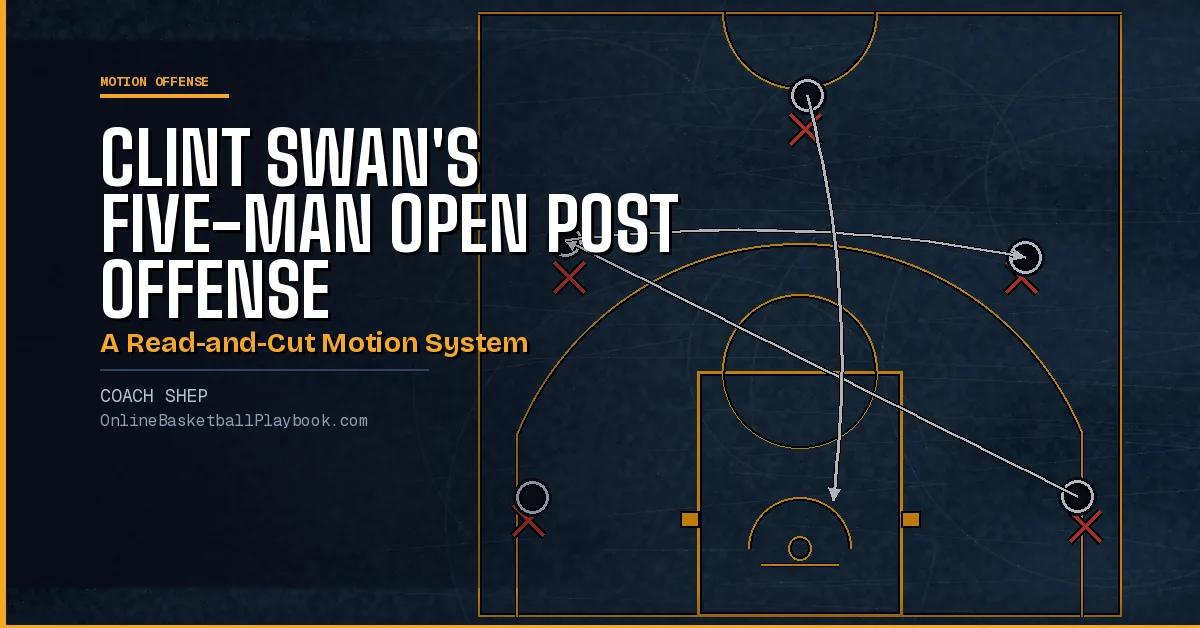
Most motion offenses fall apart because players stand and watch. The ball reverses, nobody cuts, the spacing collapses, and the possession dies on a contested jumper. This five-man open post offense is built to fix that.
The premise is simple enough to teach a middle school team and deep enough to run against a varsity man-to-man. There is no true post player parked on the block. Instead, five interchangeable spots stay filled, and every player reads the ball, makes a cut, and replaces a teammate who vacated. It is continuity, not a set of one-shot plays.
What makes it coachable is the numbered menu of cuts. Every action gets a number, 6, 7, 7-up, 8, 9, 10, 11, 12, so a player can call his own cut out loud and the rest of the floor knows exactly how to react. That shared vocabulary is what turns five individuals into one moving offense.
"Reverse the basketball and be patient. Don't worry about missed open cutters."
This breakdown gives you the philosophy behind the five spots, the full numbered cut menu and what each one does, how the offense flows into continuity, why it travels against both man and zone, and a Monday practice plan to install it from scratch.
Coach's Cheatsheet
- Use this when: you have five interchangeable players, no dominant low-post scorer, and you want a continuity offense that creates layups through cutting instead of isolations.
- Core teaching point: keep the five spots filled and cut hard all the way to the basket, every cut finishes at the rim, not halfway.
- The cut menu: 6 = hard line cut, 7 = screen away, 7-up = back screen, 8 = pick and roll, plus 9 (hand back), 10 (interchange), 11 (slip), 12 (screen to re-screen).
- Spacing rule: one pass away from the ball, you may cut. Two passes away, prepare to fill a vacated spot. Nobody stands still.
- Correction cue: "Carry it to the rim". Kill the lazy cut that dies at the elbow, because a soft cut clogs the spot the next man needs to fill.
- Practice install: walk the five spots, drill flash-and-fill, then layer the numbered cuts one at a time before going live three-on-three from the top of the key.
The Philosophy: Five Spots, Always Filled
The first rule is the whole offense in one line: keep the five spots filled. The floor is divided into five perimeter and baseline positions, and the job of all five players, together, is to make sure those spots never sit empty. When a cutter leaves a spot, someone fills it. When the ball moves, the shape stays intact.

The second rule is what gives the offense its teeth: cut hard and all the way to the basket. A cut that stops at the foul line is a wasted cut. It doesn't threaten the rim, it doesn't move a defender, and it clogs the very spot a teammate is trying to fill. Every cut is carried out to the basket, the cutter opens up under the rim to see both corners, then fills the open spot on the baseline.
- Open up under the basket. When you finish a cut, turn and see both corners so you can read where the next pass and the next open spot are.
- Fill the open baseline spot. If your cut isn't rewarded, you don't drift back out to the top of the key. You fill along the baseline and keep the shape balanced.
- Fill next to the ball, then above you. If a spot opens next to the ball, fill it. If a spot opens above you, fill it. The offense self-repairs.
The hardest habit to build is the unrewarded hard cut. Players want to cut at full speed only when they expect the ball. In this offense, the cut that doesn't get the ball is just as important. It drags a defender to the rim and opens the spot the next teammate fills. Reward effort cuts in film, not just baskets.
The Key Principle: the offense lives or dies on filled spots and finished cuts. Keep all five spots occupied and carry every cut to the rim, and the continuity feeds itself without a single called play.
Know the Cuts: The Numbered Menu
Here is what makes the five-man teachable instead of chaotic. Every action has a number, so a player calls his cut out loud and the floor reacts. Calling out cuts loudly is its own rule. The number is the trigger that tells teammates whether to fill, replace, or screen.
- 6. Hard line cut to the basket. A straight-line basket cut after a pass. The simplest read and the one every player must master first.
- 7. Screen away from the ball. You screen away. The receiver of the screen curls to the basket while the screener flashes back to the ball. Two threats off one action.
- 7-up. Back screen. Instead of screening away on the perimeter, you set a back screen for a teammate cutting to the rim.
- 8. Pick and roll. A ball screen for the player with the ball. The screener rolls hard to the basket while the ballhandler reads penetrate-and-pitch.
- 9. Hand back. A dribble hand-off: you pass, the receiver hands the ball back and runs his own cut (often a 6) off the exchange.
- 10. Interchange screen. Two off-ball players swap spots off a screen to relocate a shooter and keep the defense moving.
- 11. Slip the screen. The screener fakes the screen and slips to the rim before contact. The counter when defenders jump the screening action.
- 12. Screen to re-screen. You set a screen, then immediately re-screen for the same cutter, punishing a defense that recovers too quickly.
Notice the menu builds in layers. The 6 and 7 are the backbone. The 7-up, 8, and 9 add on-ball and back-screen actions. The 10, 11, and 12 are counters, answers for a defense that has started to anticipate the base cuts. You install them in that order, not all at once.
The 7 cut is the heart of the offense, and it's the one players butcher most. The receiver must curl all the way to the basket, not pop out, while the screener flashes back to the ball. If the receiver fades instead of curling, the action loses its rim threat and the two-man game flattens into a swing pass.
How It Flows: Flash, Fill, and Reverse
Once players know the cuts, the continuity comes from three connective rules: always flash and fill, reverse the basketball, and stay patient. The offense is a loop. Ball reversal creates a new strong side, a cutter empties a spot, a teammate flashes to fill it, and the read starts over from the new angle.
The spacing discipline keeps the loop clean. If you are one pass away from the ball, you may make a cut. If you are two passes away, you don't cut. You prepare to fill a vacated spot. That single distinction stops two players from emptying the same side at once and protects the floor balance the whole offense depends on.
"Watch the cutter all the way through the cut."
That rule is for the passer. The ball never reverses if the man with it looks away from his cutter too early. Watching the cut all the way through is how the offense converts a hard basket cut into a layup instead of a missed window, and it's why patience and ball reversal matter more than forcing the first read.
Why It Works vs. Man and Zone
Against man-to-man, the five-man is a problem because there is no one to help off of. Every defender is attached to a cutter who is sprinting to the rim. Help one cut and you give up another. The constant filling and screening means a defense never gets a clean possession to reset its matchups.
Against zone, the same spacing rules turn into gap-filling. Cutters flash into the seams of the zone, the ball reverses to shift the defense, and the open baseline spot gets filled behind the zone's bottom line. Because the offense is read-based rather than scripted, it doesn't matter much whether the defense is man or zone. The players are reacting to the ball and the open spot, not to a memorized play.
The patience rule is what beats a good defense over a full game. "Don't worry about missed open cutters" tells your team not to force a pass into a closing window. You reverse the ball, you run another cut, and you make the defense guard four, five, six actions in one possession. Most defenses break before the offense does.
Practice Install: Your Monday Plan
Here's how I'd install the five-man with a team that has never run it before. One offensive block, about 30 minutes, built so each piece stacks on the last.
Block 1 (6 min), Walk the Five Spots, No Defense
Set the five spots and have players rotate through every one. Walk a ball reversal: cutter empties a spot, the nearest player flashes and fills, the shape stays intact. Nobody learns a cut until they can keep the five spots filled at a walk.
Block 2 (8 min), Flash and Fill Live
Add a ball and reverse it side to side. Drill only the connective rules: one pass away you may cut, two passes away you fill. Your only corrections are "carry it to the rim" and "fill the open spot." No numbered cuts yet, just the loop.
Block 3 (10 min), Layer the Numbered Cuts
Install the menu one number at a time. Start with the 6, add the 7 (curl to the basket, screener flashes back), then the 8 pick-and-roll. Players call the number out loud before they cut so the floor reacts. Add the 7-up and 9 only once the first three are clean.
Block 4 (6 min), Three-on-Three from the Top of the Key
Play it live, three-on-three from the top of the key, using only the cuts you've installed. The rep teaches the read and the patience at the same time. Reverse the ball, run a cut, and don't force the first open window.
Variations and Progressions
Progression 1: Counter Pack, 10, 11, 12
Once the base cuts are automatic, add the counters. The 10 interchange relocates a shooter, the 11 slip punishes a defender who jumps the screen, and the 12 screen-to-re-screen beats a quick recovery. Install these only after the defense has started anticipating your 6 and 7.
Progression 2: Score the Hard Cut
Score scrimmages by finished cuts, not just baskets. Award a point every time a cutter carries it all the way to the rim and opens up under the basket. It makes the unrewarded effort cut a habit instead of a slogan.
Progression 3: Chain the Two-Man Games
String actions together so one cut flows into the next. A 7 into an 8, or a 9 hand-back into a 6. Chaining forces the defense to guard multiple reads in a single possession and is where the continuity earns its baskets against a prepared team.
Get Free Coaching Notes
Join the Online Basketball Playbook newsletter for new playbook breakdowns, drills, and practice-ready install ideas.
Get Free Coaching NotesDraw this play free in the play drawer →
Playbook packs: printable PDFs for zone attack, press break, out of bounds and more →
Final Thoughts
The five-man open post isn't complicated. Five spots, always filled. Every cut carried to the rim. A numbered menu so players can call their own action and the floor reacts. What makes this version work is the discipline around it: hard cuts, patient ball reversal, and the trust to keep running even when the first open cutter gets missed.
Install the spots and the flow first, then layer the cuts one number at a time. Do that, and you'll have a continuity offense your whole roster can run, one that creates layups through movement instead of asking one player to make a play. Keep the spots filled, cut hard, reverse the ball, and let the offense feed itself.
Keep Building
Related breakdowns
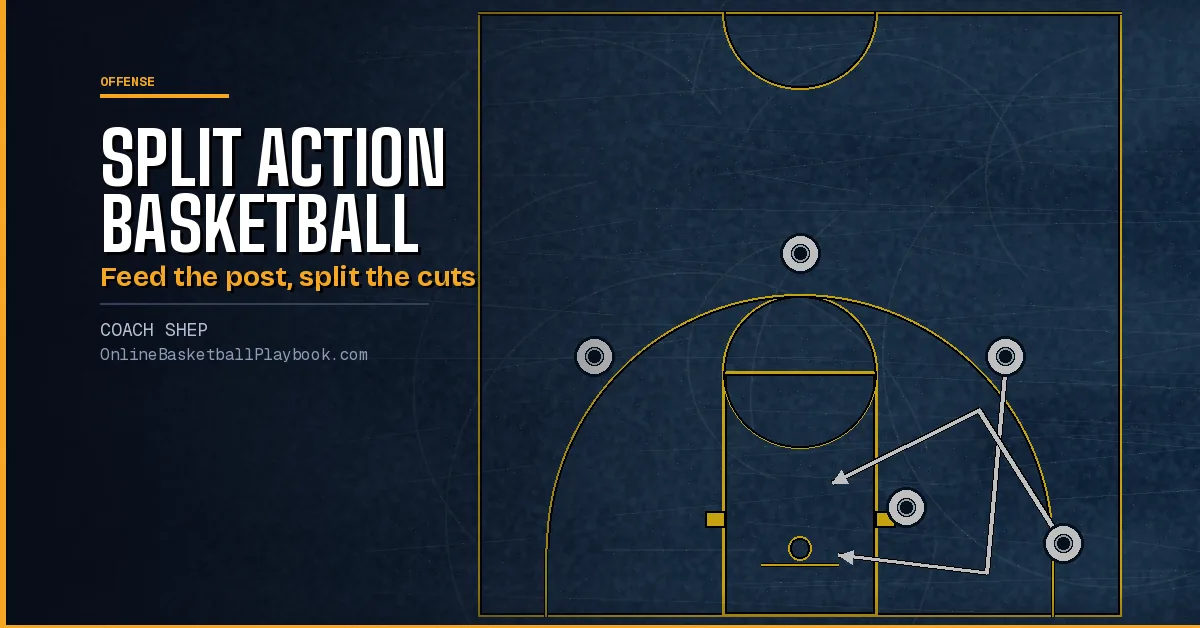
Split Action Basketball: Post Splits, Cuts and Reads
Split action basketball explained: the post feed and the two cutters, straight and reverse splits, the high post split, the reads and counters, and how to defend it.
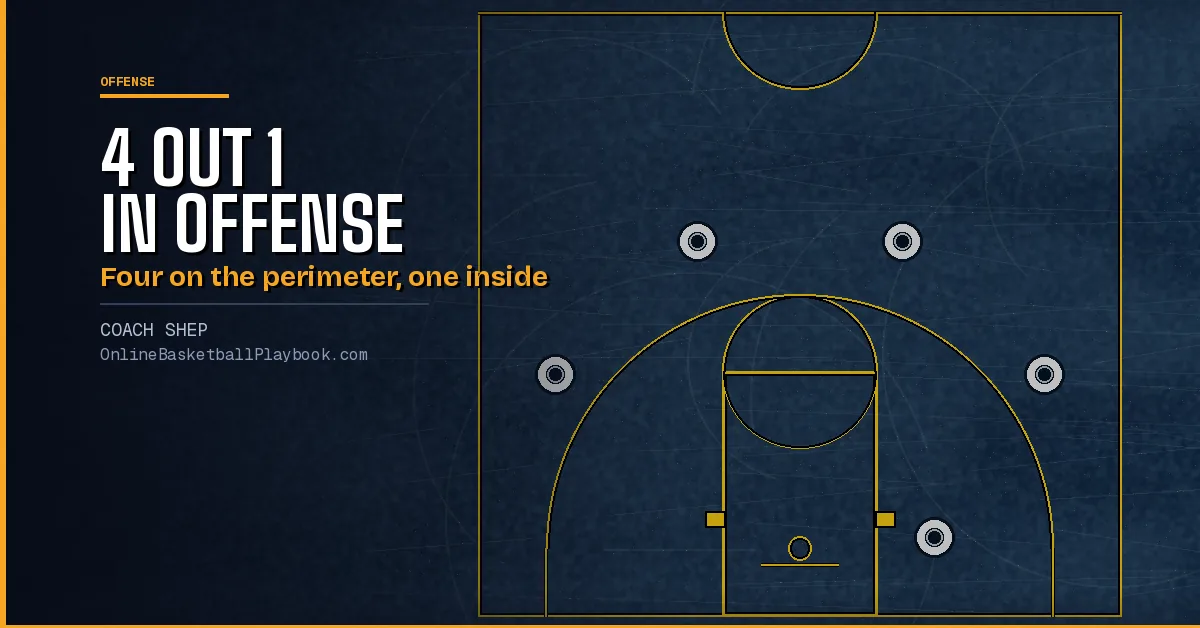
4 Out 1 In Motion Offense: Rules, Spacing and Sets
How to run the 4 out 1 in motion offense: spacing, the six rules, what the post does, pass-cut-fill, screens, quick hitters, zone adjustments and how to install it.
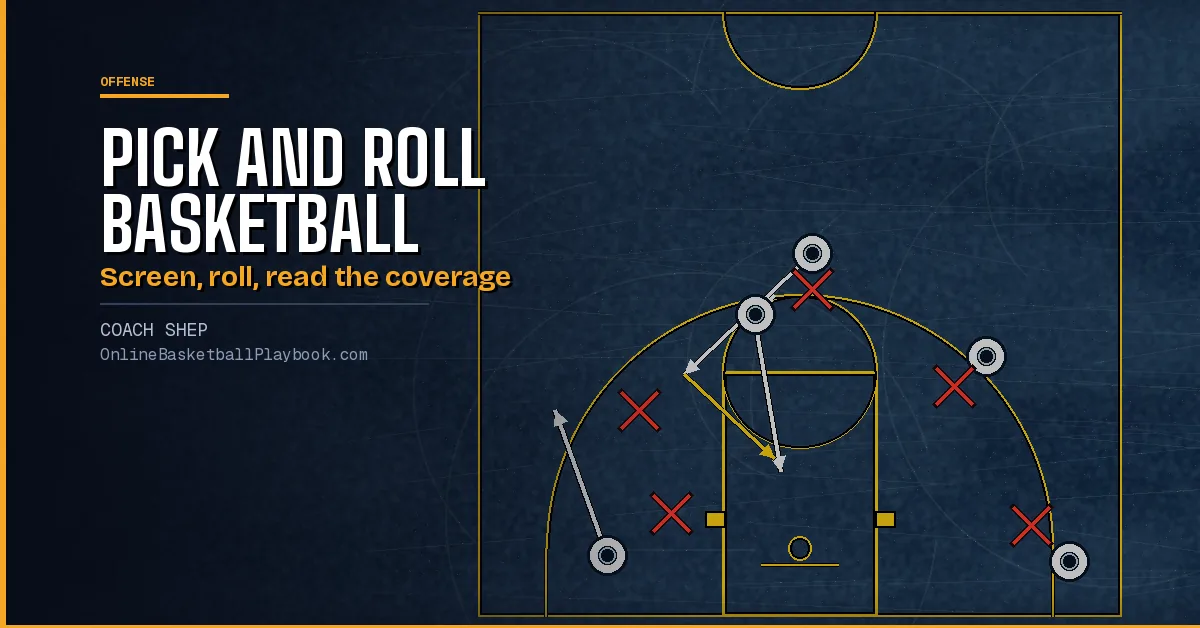
Pick and Roll Basketball: How to Run It and Read It
How to run the pick and roll in basketball: the screen and its angle, the handler's reads, roll, pop, slip and short roll, spacing, and a youth teaching order.
More from Online Basketball Playbook
Basketball Pace & Tempo Strategy
The open post controls tempo naturally. Pair it with a pace philosophy.
How to Teach Basketball Decision-Making
Open post reads happen in one second. Players need the decision framework before the reps.
How to Score Against Junk Defenses
Junk defenses disrupt continuity offenses. Here’s how the open post handles them.