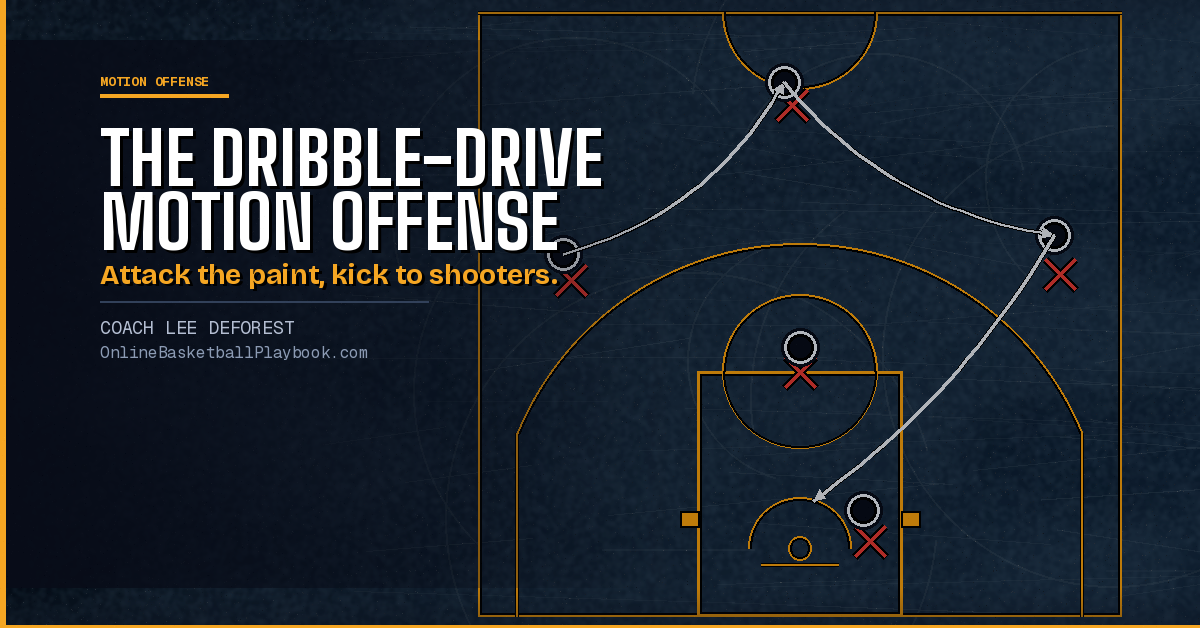
The best basketball offense is often the simplest one your players will actually run. The dribble-drive motion offense — the system Vance Walberg built and John Calipari carried to Memphis — is about as close to that as it gets. Empty the middle, spread the floor, attack the gap, and either score at the rim or kick it out for an open three. That's the whole thing. No thirty-play catalog, no complicated triggers. Four players spread wide, one post player who clears to the opposite block, and a ball-handler who reads what the defense gives. Simple in theory. Devastatingly hard to stop when your players actually understand the reads.
Picture this: your guards are quicker than the other team's defenders, but you don't have a post player who can demand a double-team. Your guys want to attack — they just end up dribbling into traffic or pulling up for mid-range jumpers nobody is comfortable shooting. So the defense relaxes, packs the paint, and makes you beat them from outside. Now flip that around. What if the very thing that's been a problem — your guards dribbling — was actually the weapon? That's the dribble-drive motion. It's built for exactly that team. It turns penetration into points, and it forces the defense to make a decision it can't win.
This guide covers everything you need to install it: the system's philosophy, the spacing, the core drive-and-kick actions, what the off-ball players read and when, how to build it in practice, and where it's going to hurt you. Learn all of it and you'll coach the offense. Skip the reads and you'll just have five guys dribbling.
What the dribble-drive motion actually is
The dribble-drive motion is a 4-out, 1-in motion offense. Four perimeter players spread the floor wide, one post player stays near the rim — but not where you'd expect. Instead of parking in the block and demanding the ball, the post clears to the opposite block, away from the ball. This does one thing: it empties the lane and gives the ball-handler a straight path to the basket with no teammate in the way.
The offense does not use the mid-range jump shot as a primary weapon. That's not a side note — it's the whole design. Walberg built this system to hunt layups and free throws at the rim, and spot-up three-pointers off kick-outs when the defense collapses. The mid-range pull-up is treated as a bad shot, a result the offense failed to produce something better. Teach that to your players before anything else. It reframes what good offense looks like.
What makes it a motion offense rather than a set play is that it runs off reads, not predetermined cuts. The ball-handler reads the defense and decides to drive or kick. The off-ball players read their own defenders and decide to stay wide, cut backdoor, or relocate. No one is calling out a play — they're all reading the same picture and making decisions. That's why this offense is a legitimate player-development tool. It teaches the game, not a script.
Why coaches run it — and what it does for your players
Let's be straight about why this offense has spread to every level of the game. It works for teams without a dominant post player. If you've got four athletes who can dribble, pass, and shoot from outside, this offense gives them structure around those tools. You don't need a 6-foot-9 post player to make it go. That's a real advantage at the high school level, where post players with size and skill are rare.
Beyond winning games, the dribble-drive motion teaches things that transfer to any offense:
- Ball-handler decision-making under pressure. Every drive ends with a read. Your players learn to see the floor while moving at pace, which is the hardest skill in basketball to develop.
- Spacing discipline. Staying wide, not drifting toward the ball, not collapsing the lane — your players learn exactly why spacing matters because they feel what happens when they violate it.
- Shot diet awareness. Teaching players that the mid-range is a bad shot and the rim or the corner three is a good shot reshapes how they see the whole game. That thinking stays with them.
- Reading defenders, not plays. Off-ball players learn to watch their own defenders and make cuts based on what they see. That's basketball IQ, not play execution.
If you have a guard-heavy roster and no reliable post scorer, the dribble-drive motion is probably the most honest fit you can find. It's built for that team. Don't try to force a post-heavy offense when you don't have the personnel — build the system around the players you actually have.
The spacing and alignment — every spot matters
Spacing in the dribble-drive motion isn't just "spread out." There are specific reasons for every position on the floor, and when your players understand those reasons, they defend the spacing instead of drifting out of it.
The four perimeter spots
Two players occupy the wings, positioned with their inside foot roughly even with the front of the rim. Two players occupy the corners, deep in the corner near the baseline. All four stay wide — about 15 to 18 feet from each other — wide enough that one defender can't guard two of them, but close enough that the ball-handler can actually make the kick-out pass.
The Calipari-Memphis version calls this the double driving gap: the perimeter players don't fill their spots too early or drift toward the ball. They stay "wide and hard" in their lanes so the ball-handler always has a clear driving lane between him and the nearest teammate. The moment a wing or corner player drifts toward the ball, that gap closes. The defense doesn't have to help — they just stand still and the offense collapses on itself.
The post player — the opposite block
The post player's base position is the weak-side block — opposite the ball, away from the action, essentially out of the play unless the ball comes to that side. When the ball-handler drives into the drop zone (more on that below), the post slides up toward the opposite elbow, clearing the lane completely and opening the backdoor cut for the ball-side corner player.
This is counterintuitive for post players who are used to calling for the ball on the strong side. The discipline here is that the post creates value by staying out of the way. His job is to keep the lane empty. When the ball reaches the rim, he finishes dump-offs. When the ball kicks to the perimeter, he rebounds offensively from the weak side.
The court vocabulary — Drop Zone, Drag Zone, and the Rack
One of the most useful things any DDM coach can give their players is a vocabulary for the court zones. Without it, "drive and kick" is vague. With it, players know exactly where to stop, what to look for, and what their job is at each spot.
The Drop Zone
The Drop Zone is the free-throw-line elbow area — the area where the ball-handler stops when help defense arrives before he reaches the rim. This is the most important zone in the whole system. When you reach the drop zone and the defense closes, you jump-stop and read. You don't barrel through — you gather, pivot, and find the open man. The reads here are: kick to the wing, hit the corner, drop to the post sliding up the lane, or drag the trailer.
Walberg's discipline on the jump-stop matters here. Pass off a jump stop — not off a dribble, not off a step-through — because a jump stop gives you better balance and more passing angles. The jump-stop is a skill you need to drill until it's automatic.
The Drag Zone and the Rack
If the ball-handler gets past the drop zone with the defense still on their heels, they're in the Drag Zone — between the elbow and the basket. Here, the offense is pulling the defense to the rim, and the read shifts: look for the trailer coming behind you, or turn the corner and go to the Rack. The Rack is the rim itself. When you're there, there are only two acceptable outcomes: score or draw a foul. No pull-ups, no bail-out passes across the lane. Finish or get fouled.
Teach these zone names before you ever play 5-on-5. Walk the floor with your players — "this is the Drop Zone, this is where you stop and read." Once they can name it, they can think about it. Once they can think about it, they start making the right decision under pressure.
The core actions — drive-and-kick, drop pass, and the backdoor
Every possession in the dribble-drive motion flows from three primary actions. Your players need these wired before you add anything else.
The drive-and-kick
The ball-handler attacks a tight defender. If the defender sags and gives room, pull up and shoot — that's a simple read and the defense paid for it. If the defense stays tight, drive. Drive past your defender, get into the paint, and when help rotates, find the open man and kick it.
The key rule here is the positive pass: off-ball players must come behind the ball for kick-outs — not straight-line passes across the lane that defenders can read. They slide toward the corner or step behind the line to give the driver a clear, catchable angle. A straight-line pass across the key is the easiest pass in basketball to deflect. Kick it back behind where you drove from.
The drop pass
When the ball-handler stops in the drop zone and the defense over-rotates, the post slides up the opposite elbow — and that creates a dump-down to the post in the lane, or a kick-out to the weakside wing who relocates behind the drive. The post getting the ball in the drop zone is an advantage look because he's receiving it with no one between him and the basket.
The backdoor cut
This is what happens when the defense adjusts. If a wing player's defender starts cheating toward the lane to help stop drives, the wing reads that and cuts back-door — behind the defender, straight to the rim. The ball-handler sees the cut and throws a lob or a bounce pass on the cut's line. The rule: if you're denied (defender between you and the ball), cut back-door. If you're helped (defender sagging toward the paint), stay and be a kick-out target.
Reading the defense off the drive — the full decision tree
This is where most coaches undercoach the dribble-drive. The drive-and-kick sounds simple, but the specific read changes based on exactly who helps and from where. Teach your ball-handlers to identify who left their man and find that man's man.
- Help comes from the wing defender. Kick it to the wing. That's the open man — their defender just ran at you.
- Help comes from the corner defender. Kick it to the corner. Same principle.
- Help comes from the post defender. Drop it to the post in the lane. They abandoned the rim and you have a post player at the basket with no one between him and the backboard.
- No help arrives and you're at the rim. You're at the Rack. Finish.
- Double-team in the drop zone. Somebody had to leave someone. Jump-stop, pivot, find the open man. The throw to the weakside shooter coming behind the drive is usually the answer.
The Calipari-Memphis rule of thumb: when help comes, find the man the helper just abandoned. It's basketball at its most logical. Teach your players to read the defense rather than stare at the rim, and the offense opens up on its own.
For younger players, simplify the hierarchy to three reads, in order: (1) can I score at the rim? (2) where did help come from? (3) find that defender's man. Three steps, every time. Don't give them a six-option decision tree on day one — they'll freeze. Start simple and add complexity as they get comfortable.
How to teach it — the layered progression
The dribble-drive motion fails when coaches install it all at once and ask players to make six decisions at full speed the first week. Build it in layers, make each layer automatic, and only add the next one when the previous one is solid.
Layer 1: 5-on-0 spacing
Before you ever put a defender on the floor, walk your five players through their positions and the zone names. Pass the ball around the perimeter in 5-on-0. Every time the ball moves, check: Is the post on the opposite block? Are the wings wide and inside the three-point line? Are the corners deep? Freeze it on every pass and correct. The habits built here survive into live play — or they don't, and everything breaks down later.
Layer 2: 1-on-1 drive reads (Blood drills)
The core breakdown drill in this system is called the Blood drill. A ball-handler attacks one defender in a lane, reads the help, and makes the correct pass or finish. Start with 1-on-1 drives to the rim with no other offense — just teach the attack. Add a second defender and a kick-out receiver. Then add the corner. Build the reads one defender at a time so your players can identify who helped before you put a full five on the floor.
Layer 3: 3-on-3 and 4-on-4 reads
Move to partial court work before going live 5-on-5. Three-on-three half-court lets you install one side of the offense — one wing, one corner, the ball-handler — and focus on the drive-kick reads without everything happening at once. Four-on-four adds the post. By the time you go 5-on-5, your players have already made every read individually. Full-speed live play is just connecting the parts.
Layer 4: Shot diet discipline
This is the hardest habit to build and the most important. Walberg's rule is stark: spot-up threes and layups only. No contested pull-ups, no side-step mid-range shots. Some coaches use a call — "Black down" — to signal a possession where the offense passes until they get a layup, no threes at all. Running this occasionally in practice resets shot-selection habits and forces patience. You'll also want a minimum-pass rule early in the installation — require two passes before a shot attempt so your players don't default to first-drive-and-shoot. Let the offense breathe.
Layer 5: Quick hitters and series plays
Once the base reads are automatic, the offense gets more versatile. You can layer in a ball-screen series (the pick-and-roll fits naturally off the base spacing), a backdoor series for teams that cheat hard, and isolation sets for your best driver. These aren't abandoning the system — they're built on top of the same spacing and reads your players already know. The vocabulary and the floor look the same. The action is just triggered differently.
Where the dribble-drive motion struggles
Be honest about this with yourself before you install it. Every offense has holes and this one is no different.
- Teams with a shot-blocking rim protector. A true shot-blocker who won't leave the paint takes away the whole premise. If the defense can wall off the lane without sending help, your kick-out threes are still there but your layup diet disappears.
- Teams that can't shoot from outside. Walberg's offense trades mid-range jumpers for corner threes. If your players can't make open corner threes, the defense learns to sag and load up against the drive. You need at least two or three perimeter players who earn defensive respect from outside.
- Players who love the pull-up. Shot discipline is a culture fight. If your best player wants to pull up at the free-throw line every possession, you're going to have a conflict. The offense requires buy-in at the decision-making level, not just the skill level.
- Switching defenses. A defense that switches every screen and ball-handler action takes away the initial read. Good DDM teams counter with patience — wave through the switch, reverse the ball, and attack again from a new angle — but your players need to know how to respond rather than forcing the first drive anyway.
- Zone defense. The conventional wisdom says zones hurt dribble-drive offenses because they pack the paint. The counters that work: dribble on every catch (the ball-handler attacks the zone seam before defenders can reset), and skip passes to overload one side. Both of those are skills your players build in the base offense anyway — zones aren't as brutal as they seem once your players know to attack with the dribble rather than holding it.
Drills to build the system
- 5-on-0 spacing walk-through. Ball moves around the perimeter, all five players move on every pass. Call out zone names as the ball reaches each spot. Freeze it and check alignment before moving on. This is a weekly drill, not just a Day 1 drill.
- Blood 1 (1-on-1 drive to finish). A ball-handler and one defender. Drive, finish at the rim, no kick-out. Teaches the attack habit and finishing under contact before the reads get complicated.
- Blood 11 (drive and kick). Add a kick-out receiver in the corner. Ball-handler drives, finishes or kicks, corner player shoots. Now the ball-handler has to read whether to score or pass — the core of everything.
- Scramble drill (live reads, half-court). Three-on-three half-court, offense can reset and drive again after a kick-out. Forces multiple reads in one possession and builds the read-and-react habit at tempo.
- Full-court pace drill. Inbound the ball and push it past halfcourt in three to five seconds, attack before the defense sets. This is the Memphis pace principle — condition your players to push the tempo on every possession, not just in transition.
The bottom line
The dribble-drive motion is one of the most honest offenses in basketball. It takes what guards already want to do — attack the lane — and builds a system around that instinct instead of fighting it. It's not complicated. Four players spread wide, one post out of the way, drive the gap, read where help came from, find the open man. That's it.
The offense gets hard when coaches skip the reads. If all your players learn is "drive and kick," they'll make one read and stop thinking. Teach the full decision tree, teach the zone vocabulary, and build the shot discipline — then this becomes an offense your players understand and own, not just run. That's when it gets fun to coach.
Thanks for the work you put in for your players. If there's anything I can do to help you get this installed, let me know.
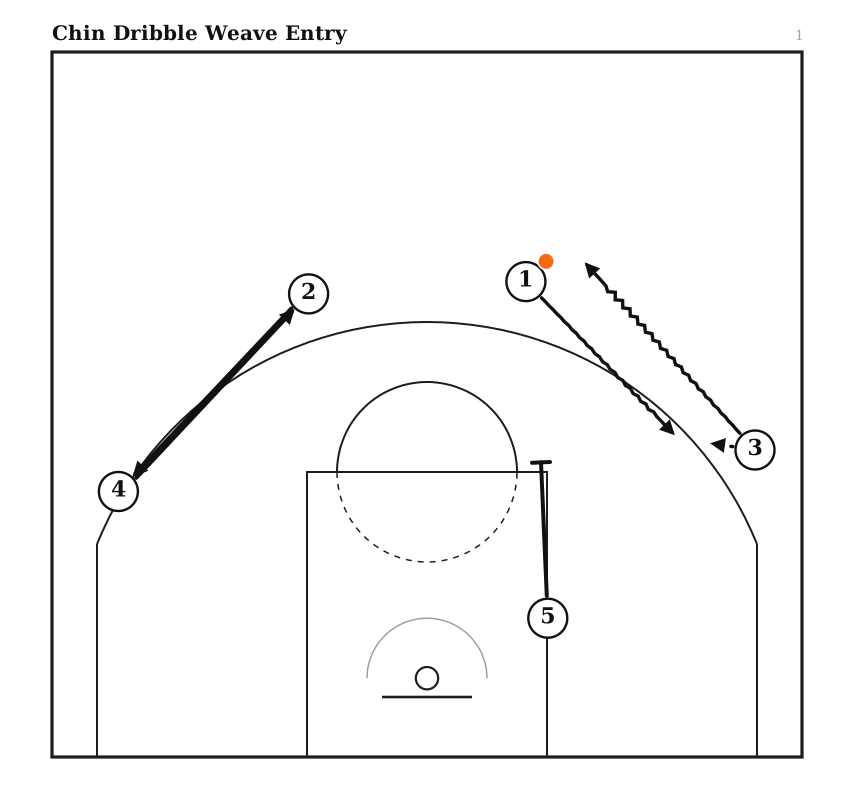
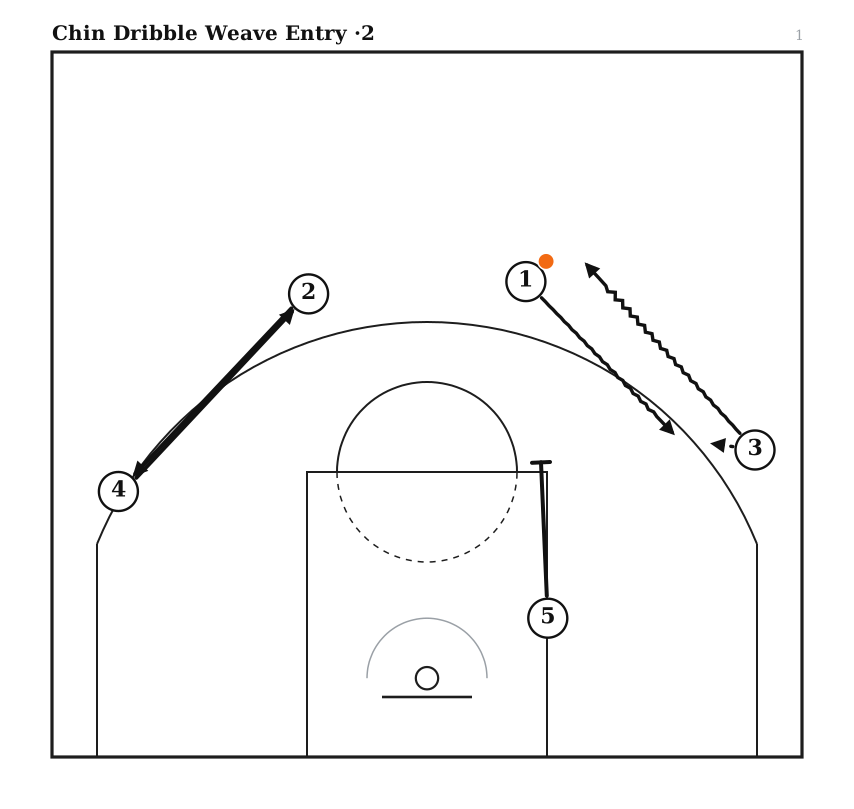
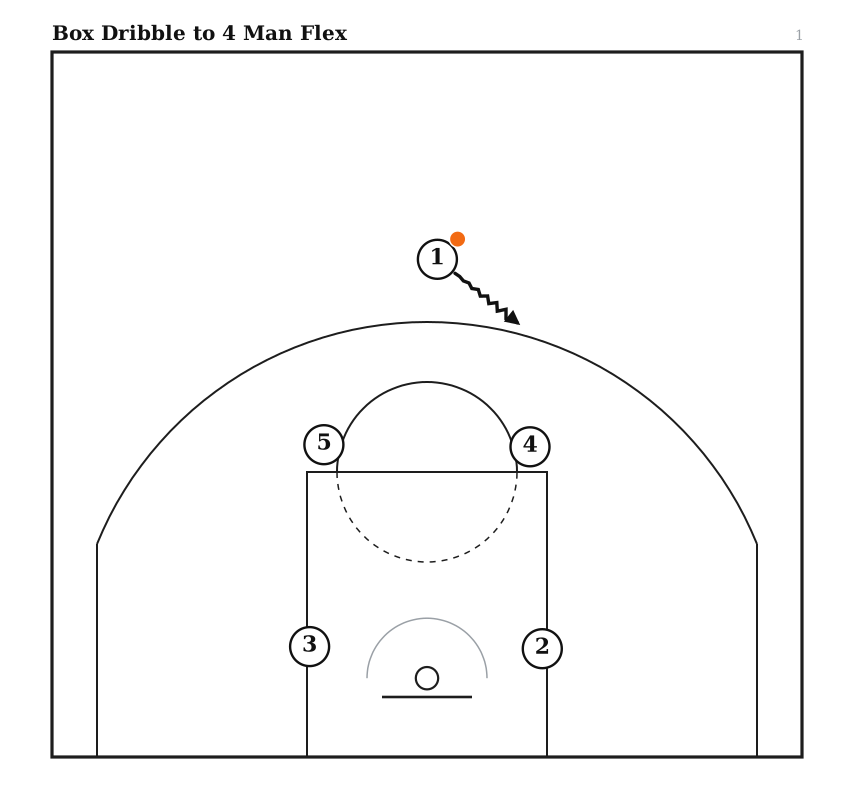
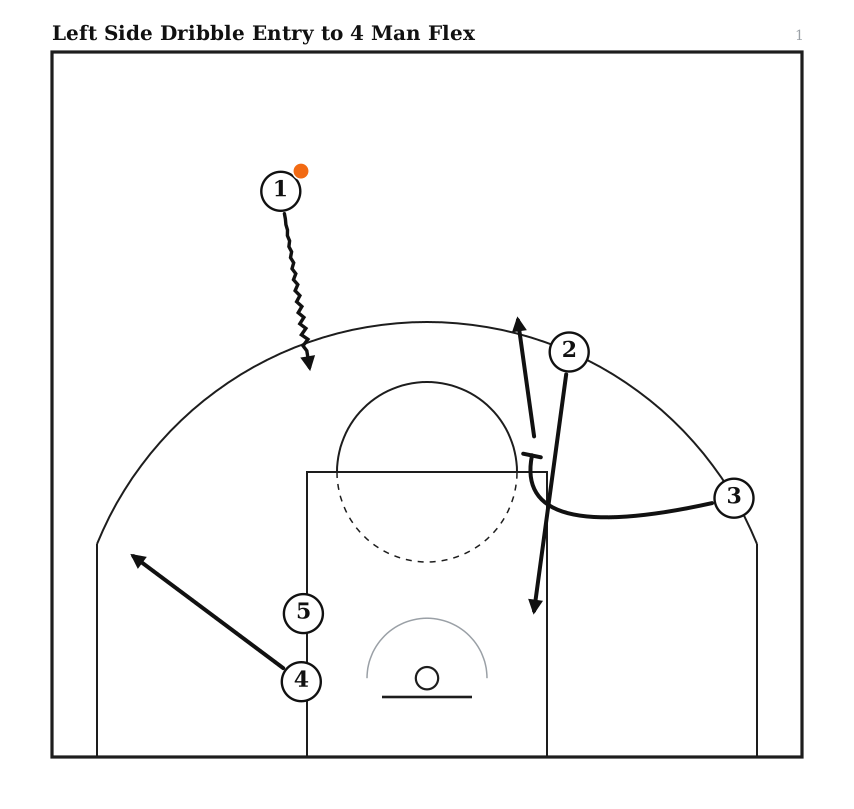
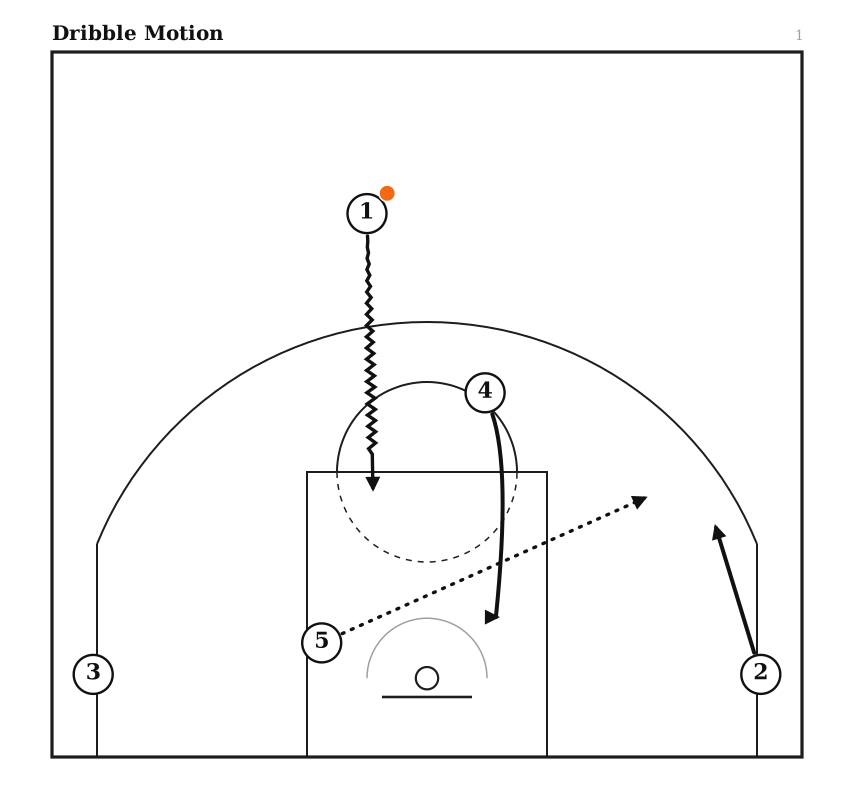
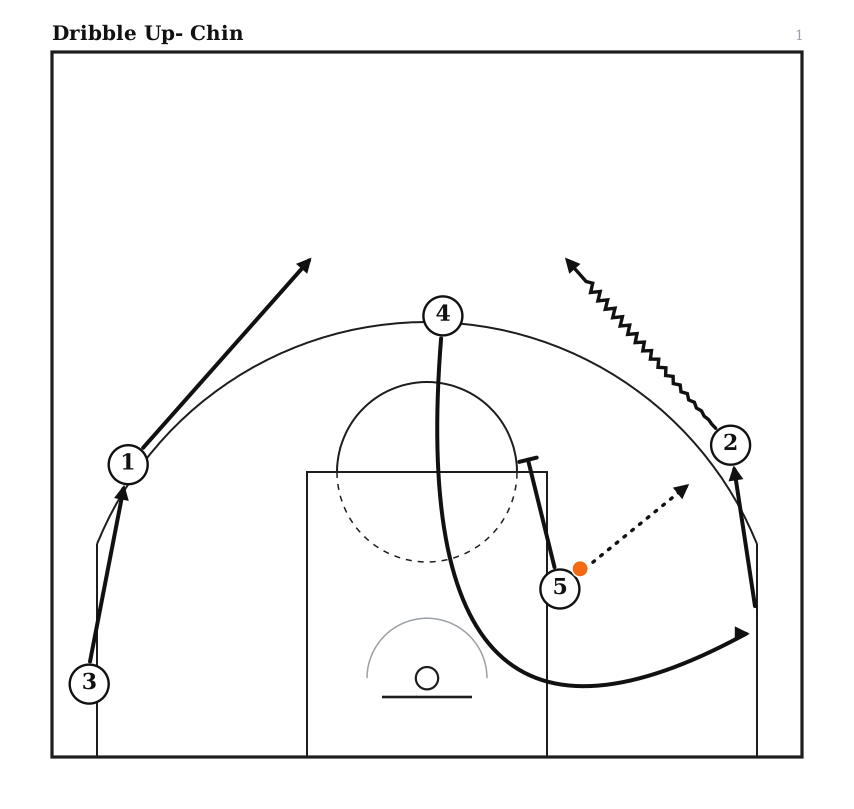
See it drawn up
Related diagrams
Keep Building
Related breakdowns
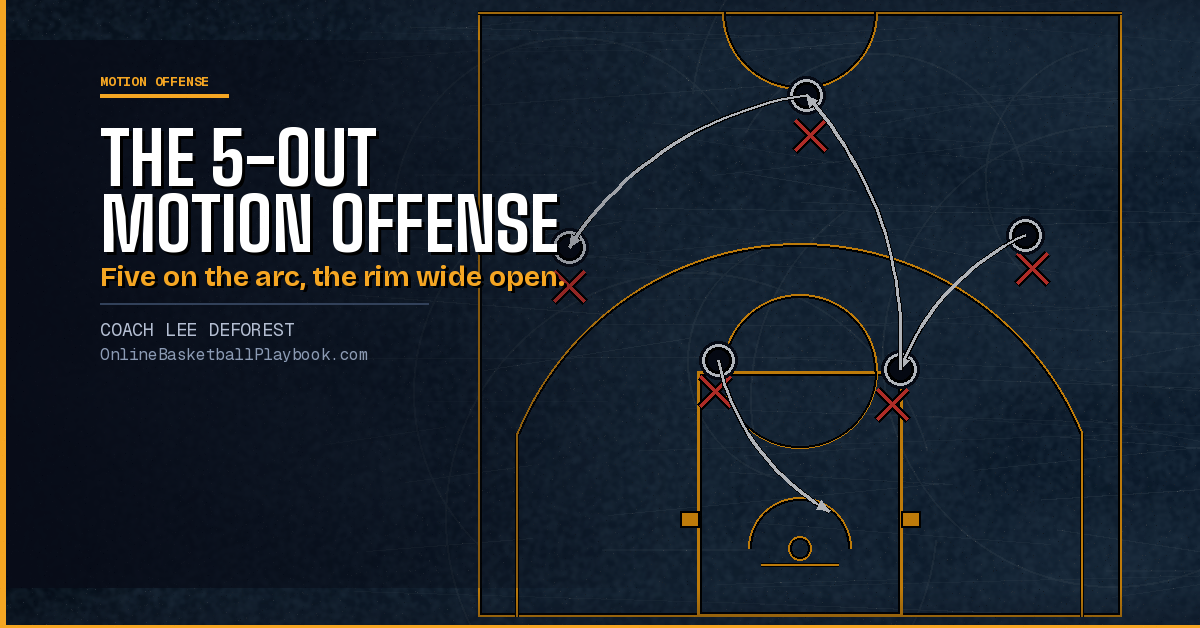
How to Coach the 5-Out Motion Offense (Complete Guide)
All five players spread outside the arc, the paint completely empty, and your players making reads — not running plays. Here's how to build it from scratch.
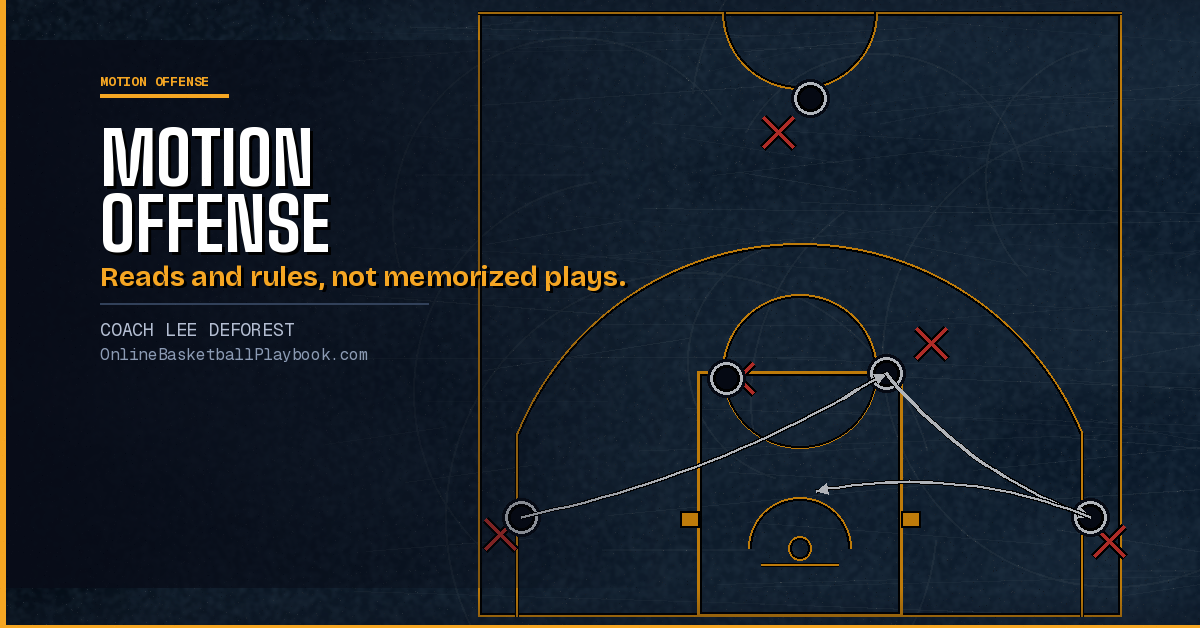
How to Coach a Motion Offense (Complete Guide)
Spacing, cutting, screening, reading the defense — how to build an offense built on rules, not memorized plays, that develops players and can't be scouted.
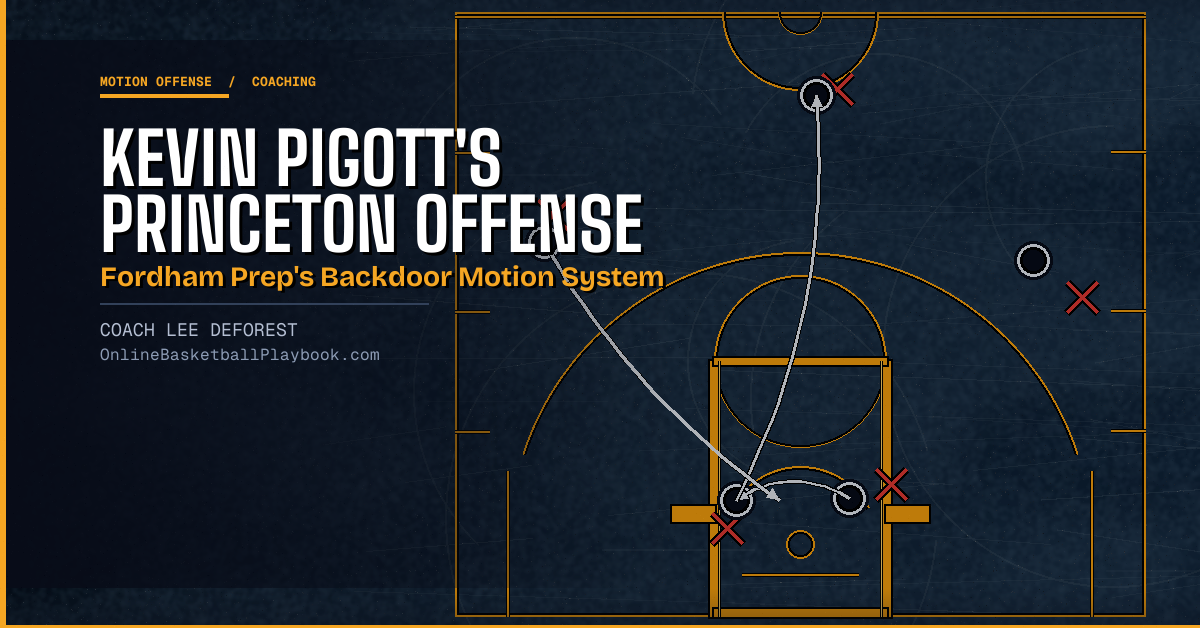
Kevin Pigott's Princeton Offense: Fordham Prep's Backdoor Motion System
Kevin Pigott's high-school Princeton Offense at Fordham Prep — a patient half-court motion system built on backdoor cuts, spacing, post reads, and named automatics that turn patience into easy layups.
More from Online Basketball Playbook
Drills to Teach the Dribble Drive Motion
The progressive drill work that gets your guards attacking and your shooters reading kicks.
Dribble Drive Offense Overview
The full system — spacing rules, kick-out reads, and transition into the DDM.
How to Do a Euro Step
The finisher that makes DDM guards nearly impossible to stop in the paint.
10 Keys for Finishing at the Rim
The DDM is a layup system — make sure your guards can convert.