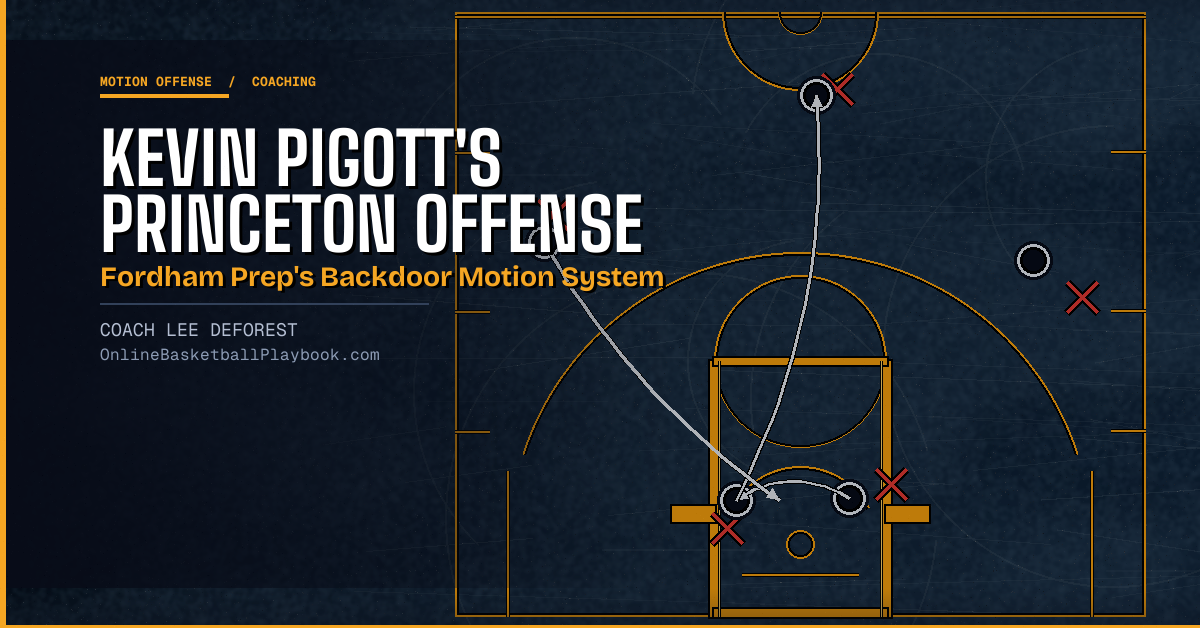
Every coach loves the idea of the Princeton Offense. Then their guards stand around, throw the ball away, and quit on it by Thanksgiving. The fix is not more sets — it is one cut, drilled to a reflex.
Kevin Pigott runs his version at Fordham Prep, and he is honest about what it is: an adaptation of what Princeton does, scaled down for high-school players. It is a motion offense that asks your team to dribble, make layups, throw a backdoor pass on time, and defend — and it only works if your players commit to the off-season skill work that makes those things automatic.
The trade is worth it. When the backdoor cut is real, the defense cannot overplay you, and an offense that cannot be overplayed gets clean looks every trip. That is the whole promise: make the defender choose between giving up the catch and giving up the layup, then punish whichever one he gives.
"Most of us refer to this as the Princeton Offense."
Coach's Cheatsheet
- Use this when: you have skilled, unselfish players who can pass and finish, and you want a patient offense that breaks down an overplaying, pressuring defense.
- Core teaching point: the backdoor cut is the crux — drill it every day with a defender denying, and let the cutter read the overplay.
- Personnel rule: two guards and two wings set wide, one post at the foul line or low; your best ball-handler and shooter plays the high post, your shooters play the wings.
- The pass to throw: a bounce or air pass off the read — the passer reads the defender, and the cutter uses the backboard and yells glass to build confidence.
- Communication cue: backdoor is called the instant a defender overplays, and the cut is on; a quiet Princeton offense is a stuck Princeton offense.
- The automatics: simple named actions — Dribble Reversal, Wing Flash, the Double Backdoor — that trigger when the ball hits a spot, so players react instead of think.
Who This Offense Is For
Pigott is blunt about the buy-in this offense demands, and you should be too. The Princeton is not a scheme that hides a weak skill set — it exposes one. Your players have to dribble under control, make layups through contact, throw an accurate backdoor and bounce pass, and defend well enough that you are not trading every patient possession for a run-out the other way.
That means the real installation happens in the off-season, not in October. If your guards cannot pass on time and your wings cannot finish a backdoor layup, the offense will look exactly like the broken version every coach fears. Sell your team on the skill work first.
Be honest with your roster about the commitment before you commit to it. The Princeton rewards skilled, unselfish players and punishes everyone else. If your team is athletic but raw, a simpler continuity look may serve you better first — then grow into the backdoor reads once the passing and finishing are dependable.
The Alignment and the Five Spots
The alignment is wide and simple on purpose: two guards and two wings spread the floor, and one post plays at the foul-line-extended area or down on the low block. Every gap you create is a backdoor lane waiting to open the moment a defender cheats up to deny.
Where you put people matters as much as the shape. Put your best ball-handler and shooter at the high post — that spot touches the ball constantly and has to pass, drive, or shoot off the catch. Put your shooters on the wings, where the threat of the catch-and-shoot is exactly what tempts a defender into the overplay you want.
The five jobs
- Guards (1-2): set wide, keep the ball moving, and read your defender — when he overplays the next pass, you are going backdoor.
- Wings (3-4): your shooters live here; the more dangerous you are catching and shooting, the more the defense overplays and the more backdoor layups you get.
- High post: your best decision-maker; he can hit a cutter, drive a closeout, or shoot, and he is the hub of the whole read.
- Low post: a one-on-one scoring threat if he is guarded alone, and a screener and passer when the defense helps.
The Key Principle: spacing creates the backdoor, and the backdoor protects the spacing. The wider and more honest your alignment, the longer the close-out the defense has to run — and the easier it is to read the overplay and cut behind it.
The Backdoor Cut: Your Bread and Butter
This is the heart of the offense, and Pigott does not hedge on how central it is. The backdoor cut is the staple, drilled constantly with a defender denying so the cutter learns to read him in real time. You do not run a play to get a backdoor — the backdoor is the play, triggered any time a defender steps up to take away a catch.
"The backdoor cut becomes the crux of the offense."
The mechanics live in the read and the pass. The cutter watches his defender; the moment that defender overplays the lane, the cut is on and a teammate calls backdoor out loud. The passer reads the same defender and delivers a bounce or air pass on time — early enough that the cutter catches it in stride going to the rim, not late and contested.
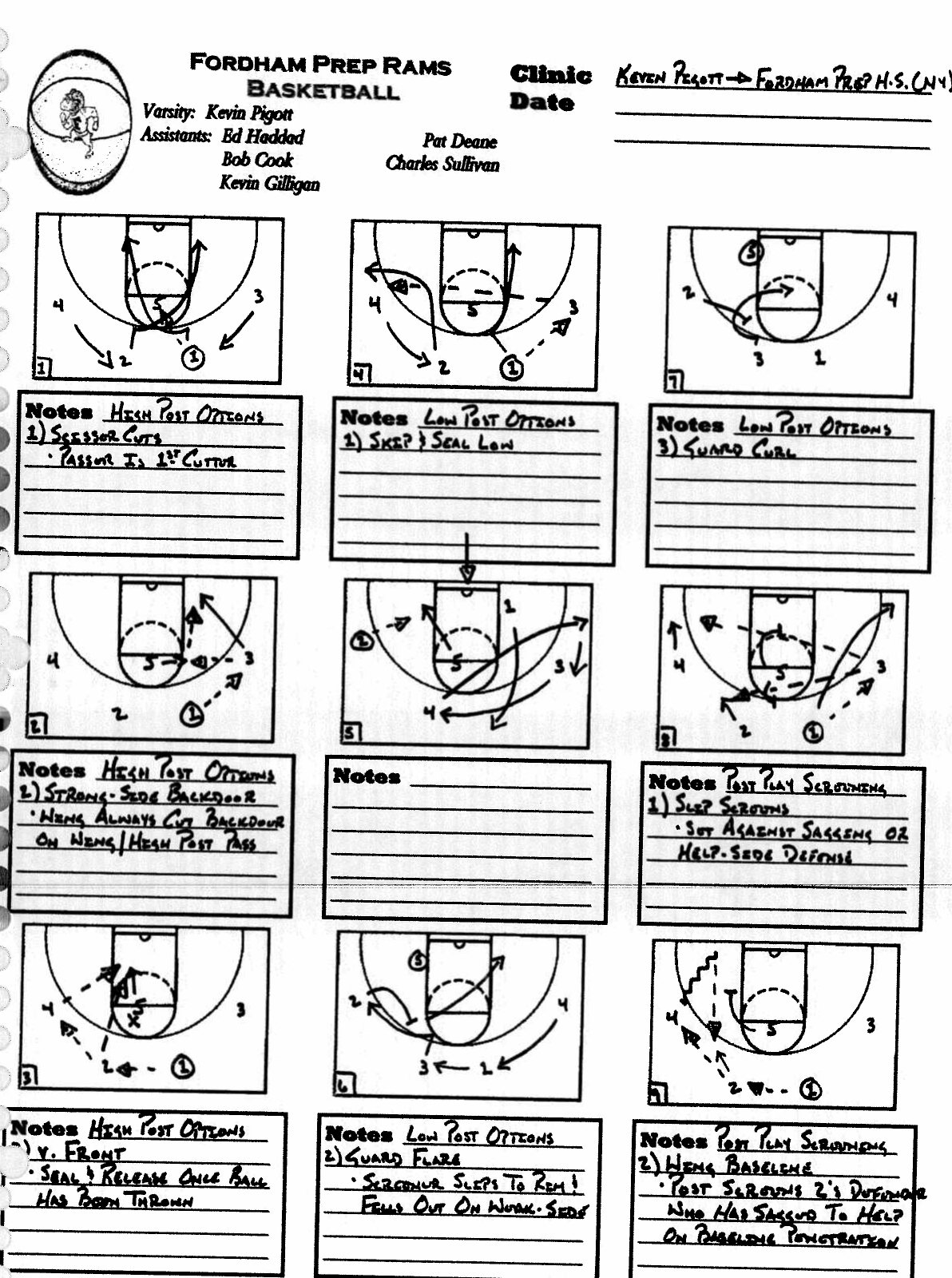
Two details separate a backdoor that scores from one that clanks. First, finish off the glass — Pigott has cutters use the backboard on the layup and yell glass so the habit becomes confident, not tentative. Second, vary the cutters and the shots so the defense never knows which gap is coming, which keeps the overplay honest across all four perimeter spots.
"Whenever they use the backboard on their shots they must yell 'glass.' This instills confidence."
Make backdoor a permanent part of your daily individual work, not a once-a-week install. Put a denying defender on the cutter every rep, and grade two things only: did the cutter read the overplay, and did the passer deliver an on-time bounce or air pass. Everything else in the offense flows from this one cut, so it earns daily reps the way free throws do.
Weak-Side Action and the Post
The backdoor is the threat; the weak side is what keeps the defense from loading up to stop it. Pigott uses off-ball action to hold the help defenders' attention away from the ball, so the strong side stays one-on-one and the cutter stays uncovered.
The wrinkle is that Pigott often does not screen in the traditional sense. Instead of a hard screen that invites a switch, he sets up the post or uses a false screen — one the cutter shows but does not deliver — to move a defender without trading assignments. On the strong side, the scoring options come off the post or off a simple pick-and-pop that frees a shooter at the top.
The Key Principle: the weak side is not idle — it is bait. Every cut and false screen away from the ball is there to keep a help defender from sinking, so the strong-side read stays clean and the backdoor lane stays open.
Post Reads and Ball Reversal
The high post is the engine of the offense, and his read tree is short. On the catch he can pass to a cutter, drive a closeout, or shoot — three options that force his defender to honor all of them and create the indecision the backdoor feeds on. When both the high post and the low post are overplayed at once, the answer is the lob over the top, because a defense that fronts everything has nothing left to protect the back of the rim.
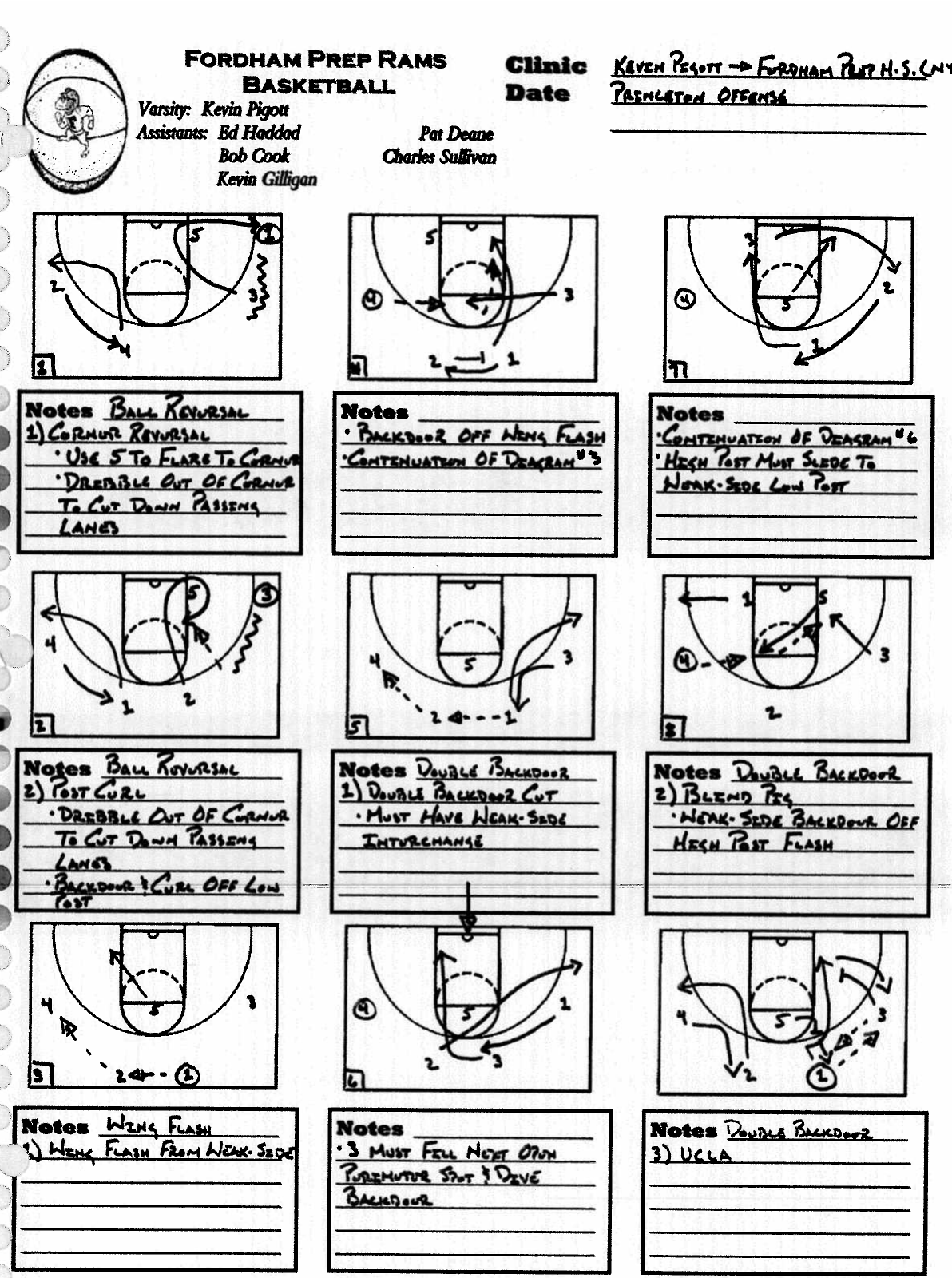
The low post is a weapon when the defense guards him with one man — that is a one-on-one chance you take. The way you get him that look is ball reversal. Swinging the ball side to side forces the defense to shift and stay honest, and a defense that has to keep rotating cannot sit on the post or the backdoor. Reverse it enough and the weak-side layup appears on its own.
For a defensive counterpoint to study alongside this, look at how the Tri-West diamond press tries to speed an offense up and take away the very reads the Princeton depends on. Seeing the pressure from the other side sharpens what your spacing and reversal are really for.
Treat ball reversal as a rule, not a suggestion. Young teams catch the ball, hold it, and let the defense set. Demand that the ball touch both sides of the floor before a shot goes up, unless a clean backdoor or post catch shows first. The reversal is what tires a defense out over a game and turns a contested possession into an open weak-side layup.
Practice Install: Your Monday Plan
Here is how I would install Pigott's Princeton with a team that has the skill but has never run it. Build it small-to-big so the backdoor read is a habit before you play it five-on-five. Three blocks, about 30 minutes, with a denying defender on every rep.
Block 1 (10 min) — Backdoor Read, 1-on-1
Start where the offense lives. One passer, one cutter, one denying defender. The cutter reads the overplay, calls and breaks backdoor, finishes off the glass, and yells glass. Grade the read and the on-time pass — nothing else. Run it from both wings and both guard spots until the cut is a reflex.
Block 2 (10 min) — Add the Post and the Pick-and-Pop
Now layer in the strong-side options. Two perimeter players and a post: work the post catch, the false screen, and the pick-and-pop that frees a shooter. Keep the defense live so players feel when the read is there and when to swing it. Take the layup or the post one-on-one, otherwise reverse it.
Block 3 (10 min) — Live Reversal and the Automatics
Finally, play it four-on-four or five-on-five and add the named actions. Trigger Dribble Reversal, Wing Flash, and the Double Backdoor off the ball hitting a spot, so players react to a cue, not a call. Require a ball reversal before a shot unless a clean backdoor or post catch shows first. End any possession that stalls, and reset.
Variations and Progressions
Progression 1: The Named Automatics
Add the simple automatics one at a time so they become triggers, not plays. Dribble Reversal swings the ball and the action to the other side; Wing Flash sends a wing into the high post for a quick read; the Double Backdoor stacks two cuts to break a defense that has started cheating the first one. Each fires when the ball hits a spot, so players react to a picture instead of waiting for a call.
Progression 2: Beating the Zone with a 1-3-1
When a team drops into a 2-3 or 2-1-2 zone, the offense shifts without scrapping anything. Have the post step out and the alignment becomes a 1-3-1 against the zone — the same spacing, the same reads, now aimed at the gaps and the high post a two-front zone leaves open. It keeps your players in one vocabulary against man or zone.
Progression 3: Rebounding and Transition Defense
A patient offense has to be ready for the long rebound and the run-out. Pigott's rule is simple: the posts crash the offensive glass, and the guards get back to stop the break. Drill it until it is automatic, because the one risk of a backdoor offense is the missed layup that leaks out the other way. The same balance shows up in a hard-cutting continuity like the five-man open post offense, where posts crash and guards protect the floor.
Get Free Coaching Notes
Join the Online Basketball Playbook newsletter for new playbook breakdowns, drills, and practice-ready install ideas.
Get Free Coaching NotesDraw this play free in the play drawer →
Membership: the full library, playbook packs, and Pro drawing tools →
Final Thoughts
Pigott's Princeton is not a magic set of plays — it is a patient motion offense that rises or falls on one cut and the skill behind it. Space the floor wide, put your best passer at the high post and your shooters on the wings, drill the backdoor every day against a live deny, and let ball reversal pull the defense apart until the easy layup shows up. The named automatics just give your players a cue to react to.
Commit to the skill work first, then trust the reads. When your team can pass on time, finish off the glass, and reverse the ball without being told, the backdoor becomes unguardable and the patient possession turns into the best shot on the floor. For more half-court sets built on spacing and reads, the playbook breakdowns library is a good next stop.
Keep Building
Related breakdowns
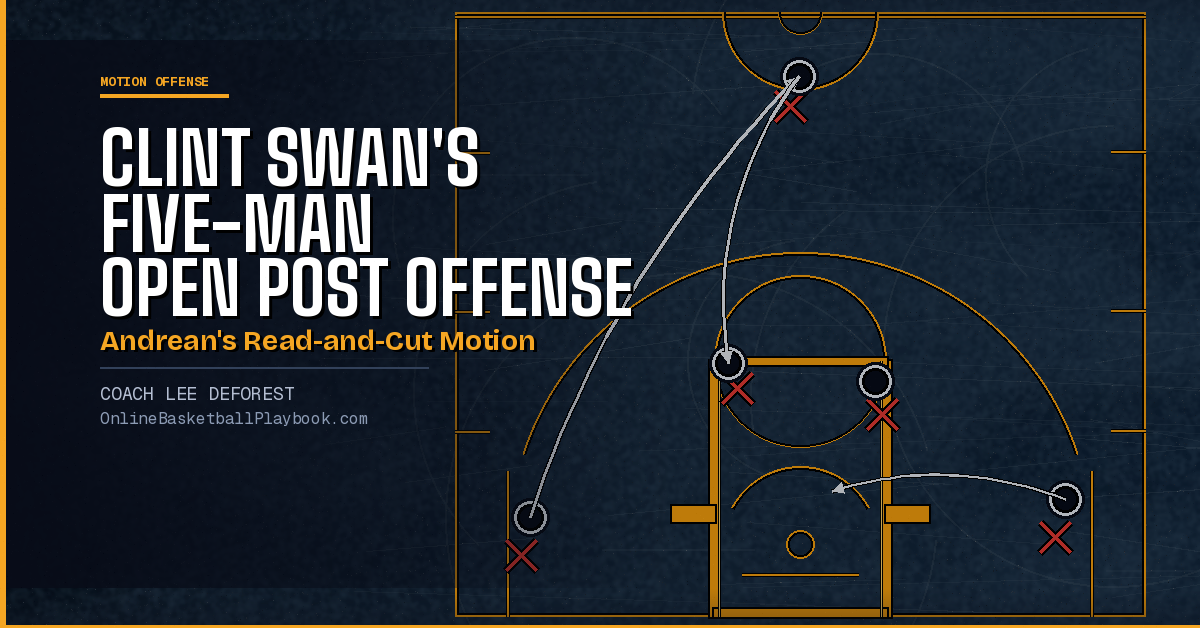
Clint Swan's Five-Man Open Post Offense: A Read-and-Cut Motion System
Andrean's continuity offense — keep five spots filled, cut hard to the rim, and run a numbered menu of cuts and screens any team can learn.
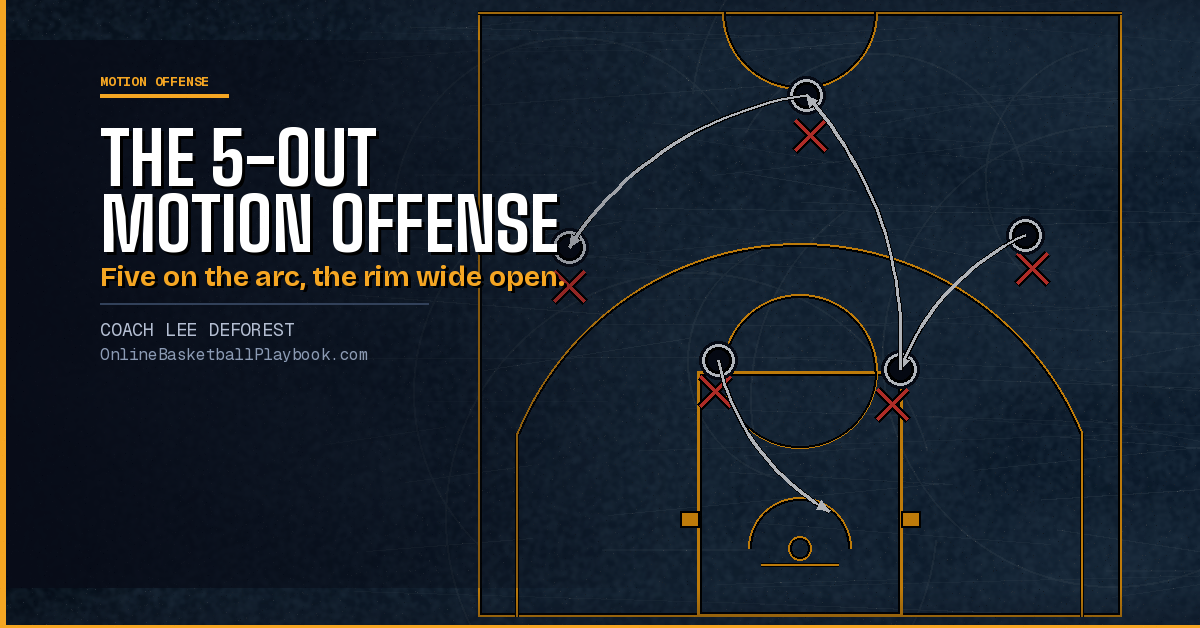
How to Coach the 5-Out Motion Offense (Complete Guide)
All five players spread outside the arc, the paint completely empty, and your players making reads — not running plays. Here's how to build it from scratch.
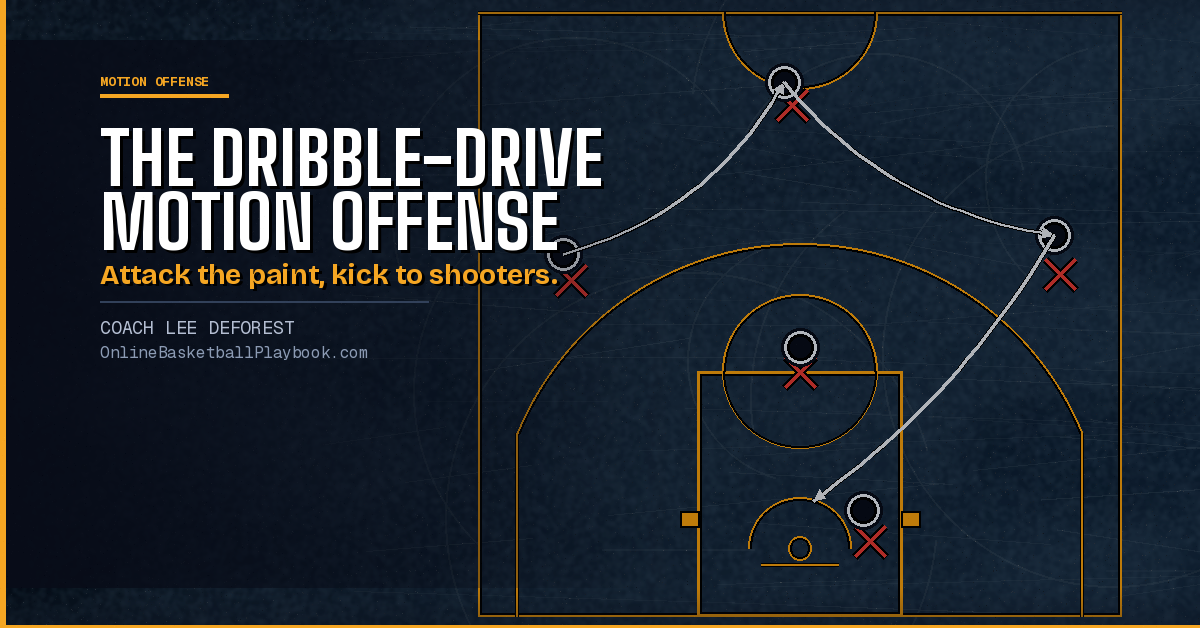
How to Coach the Dribble-Drive Motion Offense (Complete Guide)
A spread, attack-the-paint system built on dribble penetration, wide spacing, and kick-out threes — and why it might be the best offense for a guard-heavy team.
More from Online Basketball Playbook
Drills to Teach the Princeton Offense
The teaching progressions that install Pigott’s backdoor reads and automatics.
How to Teach Basketball Decision-Making
Princeton lives on reads — players need the decision framework before they run the plays.
Basketball Pace & Tempo Strategy
Princeton is a tempo-control system — understand how to dictate pace with it.