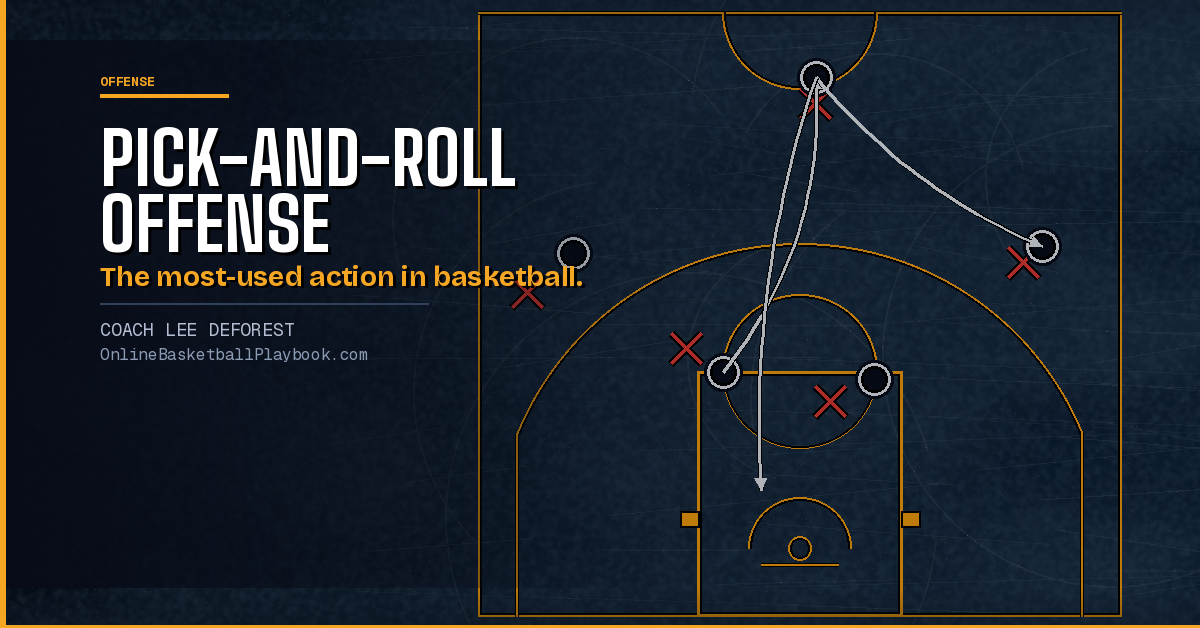
If you coach basketball long enough, you'll figure out that the pick-and-roll isn't a play. It's a conversation between two players and three defenders, and the team that understands the conversation better is going to win the exchange. It's the most common action at every level of the game — high school, college, the NBA, international basketball — because it genuinely is the hardest thing to defend. Two players coordinating puts the defense in conflict. Every time. The roll man's defender has to decide whether to help on the ball handler. The on-ball defender has to fight through the screen or get help from somewhere. Everybody on the defense is making a choice, and the offense gets to read those choices and attack them.
Picture this: You're a point guard. You cross halfcourt with the ball, your big man sets his feet at the elbow, and your defender's about to run full-speed into a screen he didn't see coming. For just a moment — that half-second right off the screen — you have an advantage. The question is whether you've been taught to read it. Do you turn the corner and attack the paint? Do you reject the screen and pull up? Does your big man roll or pop? Does the defense switch, and if they do, can you make them pay? The coaches who can teach their players to answer those questions quickly — not memorize plays, but read and react — are the ones who get the most out of a pick-and-roll.
This guide covers the whole action: what it is and why every offense runs it, how to space the floor around it, every read available to the ball handler and the screener, the four defensive coverages and exactly how to attack each one, how it flows into a continuity, and how to teach it from the ground up.
What the pick-and-roll is — and why it's everywhere
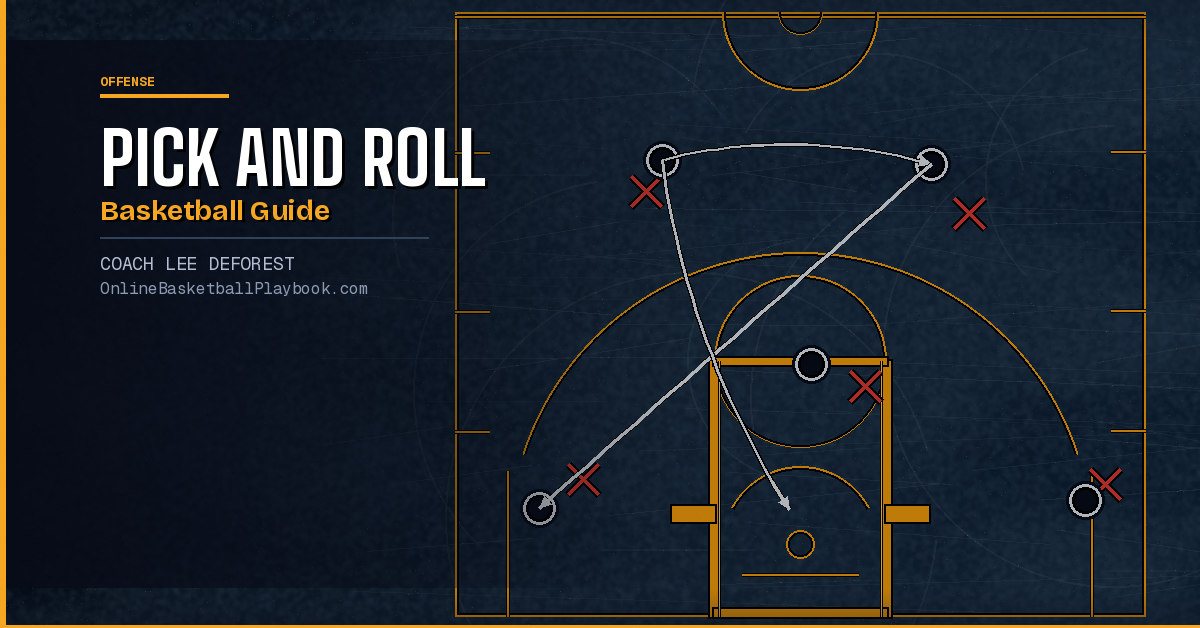
The basic action is simple: an offensive player without the ball (the screener) sets a screen on the defender guarding the ball handler. The ball handler uses the screen to gain a step on his man. The screener then either rolls to the basket or pops out to space. Two players, coordinated — and the defense has to make a choice it doesn't want to make.
Why is it everywhere? Because it puts the defense in genuine conflict every single time. You can scout a set play and have an answer for it. You can't completely solve a two-man game where the ball handler has eight options off the screen and the screener has six. Lason Perkins, who's written some of the most detailed ball-screen material available, describes the ball handler's read tree this way: shoot off the catch, drive middle, reject the screen, hit the roll, hit the pop, reverse to the opposite post, reverse to the opposite wing, or reverse to the corner. That's eight reads on one action. Now multiply that by every coverage the defense might play. You can see why coaches at every level build their offense around it.
The short version: it's the hardest action in basketball to guard, so build your offense around it and keep running it until the defense breaks.
Spacing around the ball screen — get this right first
The pick-and-roll lives or dies on spacing. A screen with four defenders clogging the paint is just a traffic jam — nobody can go anywhere. A screen with four defenders spread across the three-point line creates a situation where the defense is stretched and the roll lane is wide open.
The basics:
- Protect the screen lane. The two corner players stay in the corners when the ball screen is being run on the wing or top. If a corner player drifts in, he brings his defender — which shrinks the driving lane and the roll lane. One rule covers it: the corner stays in the corner until the ball needs him.
- The weak side stays spread. When the ball screen runs on one side, the two players on the far side stay at the wing and slot, or the wing and corner. Their defenders can't help if they're standing on the three-point line with a shooter behind them.
- The screener's dunk-spot rule. After any kick-out pass, the screener drops to the dunk spot — the area just inside the three-point line on the strong side. This keeps driving lanes open for any secondary action and sets up the screener's next move.
- Empty-side ball screens. The modern approach — and UConn under Dan Hurley is one of the best examples of it — clears the strong-side corner before running the ball screen. No help defender near the rim. Maximum room for the roll. It's harder to teach because it asks a player to vacate his spot, but the payoff is a cleaner look every time.
One phrase worth installing in your vocabulary: "protect the screen lane." Every player who stands in the wrong spot when a ball screen is being run is clogging a driving or rolling lane. Give your players that phrase and they'll self-correct in games once they understand what it means.
The ball handler's reads
This is what separates a team that runs pick-and-rolls from a team that uses them. The ball handler has to learn to read the defense and make the right choice — not memorize the sequence, but react to what's in front of him. Here are the primary reads he needs to own:
Turn the corner (attack downhill)
The most common read, and the one that creates the most problems for a defense. The ball handler uses the screen and drives hard to the basket, putting the on-ball defender on his back. The screener's defender has to make a choice — stay home on the roll, or step up and help. If help comes, the ball handler kicks to the open man. If it doesn't, he's at the rim. Teaching cue: get into the "scoring area" — the paint or the mid-lane — and be a threat before you decide whether to finish or kick.
Pull-up jumper
Right off the screen, in the pocket — the ball handler catches the hedge recovering and fires a mid-range or a three. This is the read that punishes a defense that hedges hard or switches. Brad Stevens built a lot of his offense at Butler around this: the screen, the hedge, and the pull-up in the space the hedge creates. Requires a ball handler who can hit that shot, but when he can, the defense has no clean answer.
Reject the screen
The ball handler reads his defender shading to the screen side and cuts back the other way — using the screener's body as a piece of cover without actually running off the screen. This is the countering move that keeps defenses from loading up on one side. After a reject, the off-ball action picks up: typically a flare screen for the ball handler on the weak side, or a pin-down to reset.
Snake dribble (or pull-back)
The ball handler comes off the screen, sees help closing hard, and snakes back between the screener and his own man — reversing direction using a between-the-legs or behind-the-back dribble to cut back to open space. It's a counter to aggressive hedges or hard shows. Harder to teach at the high school level, but worth introducing to any ball handler who can execute it — it turns an aggressive hedge into a turnover for the defense.
Split the hedge
When the hedge comes high and the on-ball defender goes underneath, the ball handler threads the needle between the two defenders — splitting the gap that the hedge created. It requires quickness and tight ball control, but it punishes a sloppy hedge better than almost anything else. Teaching cue: split is always available when you see daylight between the hedger and the recovering on-ball defender.
The screener's options
The screener's job doesn't end when the ball handler catches the screen. In fact, what he does after the screen is often where the real advantage is created. Here are his options:
Roll to the rim
The primary action. After the screen, the screener rolls hard to the basket — inside pivot foot, seal the defender on his back, and get to the rim. Against a hard hedge or a switch, the roll man is open because his defender had to step up. Teaching cue from Brad Stevens' Butler system: the screener's first look is the roll man, and the "lifted" weak-side big dragging his defender away from the rim is what creates the open lane. When a big hedges on the ball handler, he's vacated space — and the roller is running into that space.
Pop to the three-point line
When the screener is a shooting big (a "stretch four"), he sets the screen and fades back to the arc. His defender has to follow him — which clears the lane for the ball handler. Against a switch, the popped big catches and shoots. Against a drop, the pop creates a two-on-one situation: the ball handler attacks the drop, and the pop man stretches the defense horizontally. The pick-and-pop is the action that changed modern NBA offense and filtered down to every level.
Short roll
The screener rolls partway — to the elbow or the high post — and holds. He's not going all the way to the rim. Instead, he creates a triangle with the ball handler and acts as a decision point: attack the defender who came to help, or kick to one of the perimeter players whose defenders have sagged. The short roll is one of the most underused actions at the high school level and one of the most effective. A screener who can short roll is a playmaker, not just a screener.
Slip the screen
Before the screen is set, the screener reads his defender cheating to get over the top, and instead of setting the screen, he cuts hard to the rim — "slipping" before the contact. The defense was anticipating the screen; the slip beats them to the basket. Teaching the slip makes your screener unpredictable. Even if he never slips in a game, the threat of a slip makes the defender hesitate, which makes the screen better.
Teach the slip even if your screener can't execute it reliably yet. The threat is worth as much as the execution. When a defender knows the screener might slip, he can't commit to cheating over the top — which means he's slower getting to the ball handler. The read is always worth teaching, even before it becomes a weapon.
Reading the defense's coverage
Here is where pick-and-roll offense gets genuinely interesting. The defense has a handful of ways to guard the ball screen, and each one creates a different advantage for the offense. A ball handler who can identify the coverage at the point of the screen and react appropriately is the heart of any ball-screen offense.
Drop coverage
The on-ball defender fights over the screen while the screener's defender drops — sags back to protect the paint and take away the roll. It's the most common coverage in modern basketball, and it's specifically designed to take away the drive to the rim.
How to attack it: The pull-up is the answer. The drop gives the ball handler a clean catch in open space — shoot it. Against a ball handler who can't make that shot, the drop works perfectly. Against one who can, it's an invitation. The other counter: the pick-and-pop. When the big pops to the three-point line and the defender is dropping, the ball handler kicks to the pop man for a wide-open three. If the defense corrects and stops dropping, the drive opens up again.
Hedge (hard show)
The screener's defender jumps out aggressively — "shows" to slow the ball handler and buy time for the on-ball defender to recover. Done right, it shuts down the turn-the-corner read. Done poorly, it leaves the roll man wide open.
How to attack it: Three answers. First, the pull-up in the space the hedge creates — the hedger is a step off the three-point line for a reason, and that reason is because there's space behind him. Second, the snake: use the hedge as a wall and snake back through between the two defenders. Third — and this is the punishing read — recognize that the hedger left his man (the roll man) to show, and find the roll man before the hedger can recover. Brad Stevens' Butler offense was built around this third read: the screener's first look after a hedge is the roll, because the hedge is an admission that the roll man is open.
Switch
Both defenders trade assignments — the screener's defender takes the ball handler and the on-ball defender takes the screener. Clean in theory. In practice, it either creates a mismatch (a smaller defender on a big, or a bigger, slower defender on a guard) or it buys a half-second of confusion the offense can exploit.
How to attack it: The mismatch is the gift. Post the bigger switched-on defender immediately if you have a player who can score in the post. Attack the smaller switched-on defender with the dribble or the isolation — he doesn't want to be on your big. The "boomerang" is the other option: the ball comes back to the original ball handler (who now has a cleared side because the big's defender has followed the big) and attacks a mismatch of his own. The switch needs a counter named and practiced — most high school teams don't have one, which is why switching teams can hide in high school basketball where they couldn't in college.
Ice (blue) coverage
The on-ball defender positions himself to force the ball handler away from the screen — usually toward the baseline or the sideline — before the ball screen is even set. The screener's defender sags toward the paint and digs at the dribble. The screen is supposed to be irrelevant because the ball handler was rerouted before he got to use it.
How to attack it: Force the issue anyway. The ice coverage sends the ball handler toward the sideline, where the screener is now in a bad position to set the screen cleanly. Counter: run the "reject" and attack in the opposite direction of the ice — the defense just gave you the middle. The other answer is reversing the ball to the weak side quickly, before the defense can reset. Ice is beatable, but it requires your ball handler to recognize it early and not just run into a covered screen.
Teach your ball handlers to identify the coverage by the time they catch the ball in pick-and-roll. "What is the big doing?" is the first question. If he's dropping: pull up. If he's hedging: roll man or snake. If they switched: find the mismatch. If they iced you: reject and read. One question, four answers — that's a framework your players can actually use.
Ball-screen continuities — keeping the action alive
A pick-and-roll that dies after one screen is a limited weapon. The offenses that get the most out of the ball screen build it into a flow where one screen leads to the next and the defense never gets to settle.
The cleanest example of this is what Brad Stevens ran at Butler: two bigs alternating. The ballside big sets the screen while the weak-side big "lifts" — pulls his defender away from the rim. The screener's first look is the roll. If the roll isn't open, the ball is thrown ahead to the weak-side big, who is already sprinting into the next ball screen. The defense just recovered from one screen and now there's another one coming. The action recycles down the floor until it produces a good look.
The corner "lift" is the mechanism that makes it work. The player whose spot the ball handler vacated fills back into the action, and the offense flows into a second screen instead of going stagnant. Teach that one movement — the lift — and you've given your offense a second gear.
From the European tradition, Lason Perkins describes what he calls Step-Up Continuity: the screener steps up to meet the ball handler rather than waiting at a fixed spot. The screen arrives before the defense is organized. After one step-up screen is used, the next screener immediately steps up on the opposite side. The continuity reloads itself and chains indefinitely until a clean look comes out of it.
The simplest two-action continuity to install at the high school level:
- Ball handler uses the ball screen on one side.
- If nothing is there, the corner player on that side lifts up to replace the ball handler.
- The screener sprints — on a two-second count — into the next ball screen on the other side.
- The offense has reset, the screen is coming again, and the defense hasn't had a moment to breathe.
How to teach it — a progression that actually works
The biggest mistake coaches make with the pick-and-roll is running it whole before the pieces are there. Players who haven't been taught what to do off the screen end up just running through it, taking whatever comes out, and calling it a "pick-and-roll." That's not a pick-and-roll. That's a screen-and-see.
Here's the teaching order that works:
1. Screener's technique first
Before anything else, teach the screen. Wide base, bent knees, arms across the chest. The screener doesn't move until the ball handler has used the screen. No rolling early, no leaning — just a legal, solid screen. This sounds obvious. It isn't — most high school big men set soft screens because they haven't been coached otherwise.
2. Two-man game in isolation
Ball handler and screener, no other defenders. Walk through the reads: drive middle, pull-up, reject. Walk through the screener's reads: roll, pop, short roll. Then do it against token passive defense, then live two-on-two. This is where the reads get installed — not in five-on-five.
3. Add the spacing
Five-on-zero with three perimeter players standing in their spots while the two-man game runs. No defense yet — just the shape. Then walk-through defense. The goal: players see what an open floor looks like and understand where the kick-out passes go.
4. Live five-on-five with a defense rep
Now you run it against a defense that's been told which coverage to play — "play drop" or "play hedge" or "switch everything." The ball handler's job: identify the coverage and make the right read. Freeze the play and ask "what coverage was that?" before he made his decision. If he doesn't know, he's guessing. If he knows, you can build from there.
5. Mixed coverages
Finally, the defense mixes its coverages without telling the offense what's coming. The ball handler has to recognize and react in real time. This is where a ball-screen offense becomes a decision-making offense — and decision-making beats any scheme, because schemes can be scouted and decisions can't.
The over-reliance trap — what to watch for
There's a version of ball-screen offense that I'd steer you away from: the team that runs a pick-and-roll on every single half-court possession, regardless of what the defense is doing. Defense scouts it, goes under every screen with a drop, and suddenly your ball handler is pulling up from the mid-range on every trip because the lane isn't there and the big man isn't a threat to pop.
Lason Perkins makes the point well — and it's a point worth taking seriously — that the pick-and-roll works best as part of a full offense, not the whole thing. Complement it with off-ball screens to keep the defense from loading up. Use transition and the secondary break to attack before the defense is organized. The pick-and-roll should be the engine of your half-court offense, not the only thing in the car.
The other trap: running it before your ball handler knows how to read it. A guard who takes two dribbles and throws it back out every time is giving the defense a break. Run the action, then hold the ball handler accountable to the reads. If he doesn't know what the defense gave him, the answer is more two-on-two work, not more five-on-five.
The bottom line
The pick-and-roll is the most-used action in the game because it creates a genuine conflict for the defense every single time. Two players coordinating, four options off the screen for the ball handler, four options for the screener, four defensive coverages to read — the team that understands that conversation wins the exchange.
Teach the spacing first so the screen has room to work. Teach the reads second — ball handler and screener both, not just the guard. Teach the defensive coverages third so your players know what they're seeing and can make the right choice in the moment. Then build it into a continuity so the action keeps flowing instead of dying on the vine.
Do all of that in the right order — screen technique, two-man game, spacing, reads, coverages, continuity — and you've given your team the hardest offensive action to defend in the game. That's worth the work.
Thanks for what you put into your players every day. If there's anything I can do to help you build this out for your program, let me know.
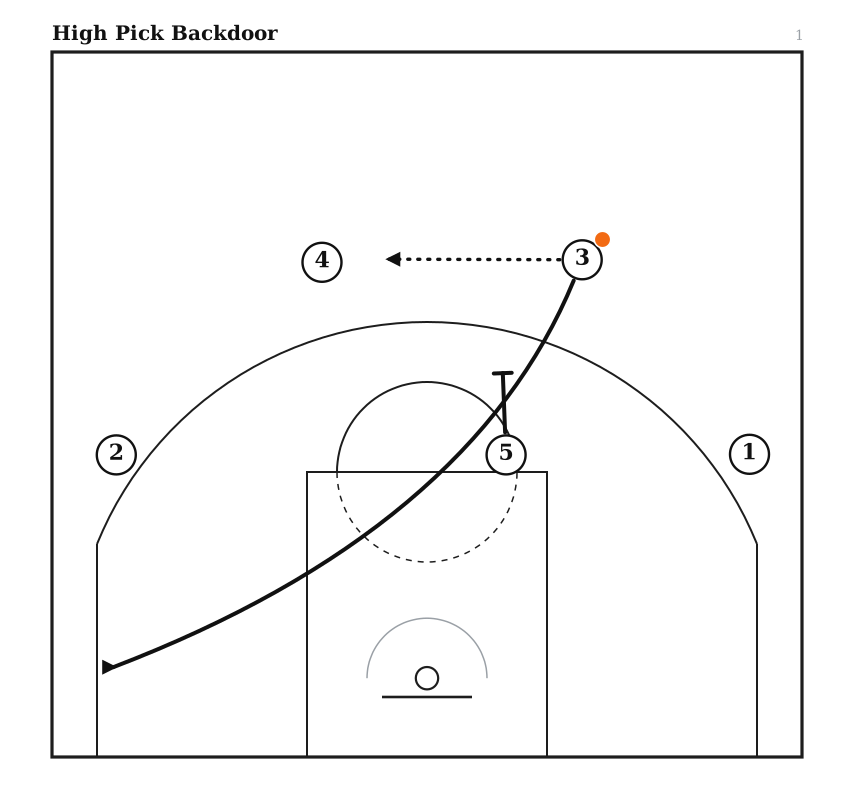
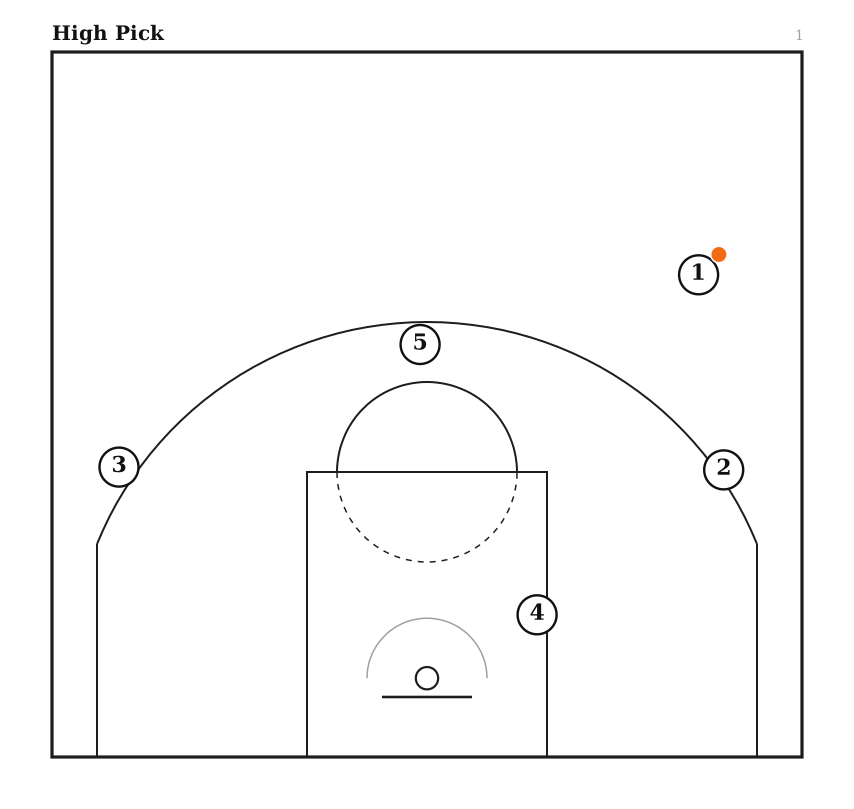
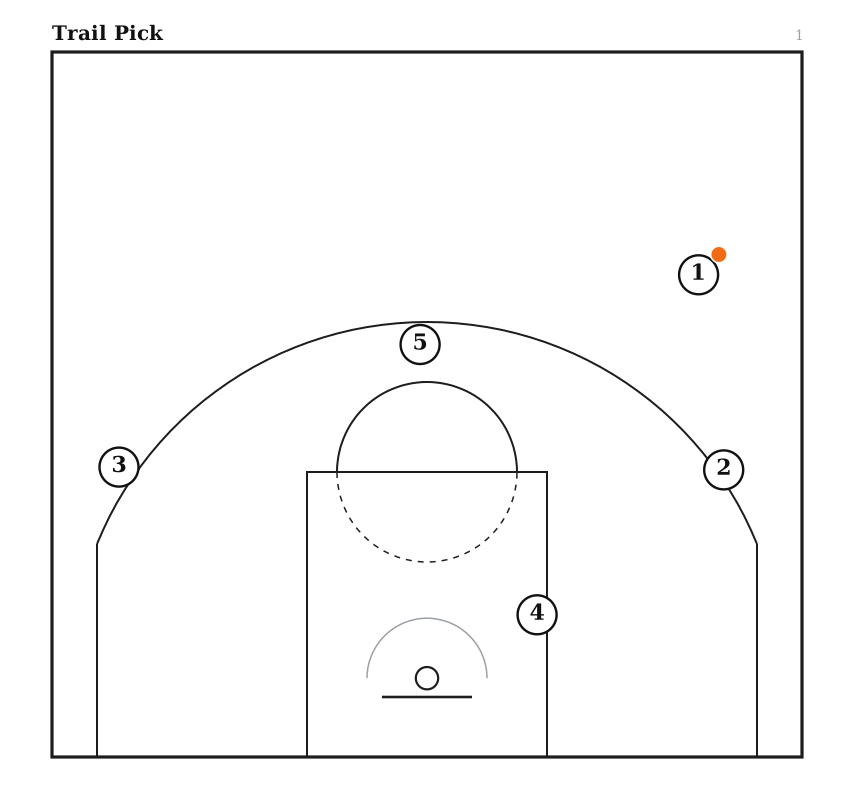
See it drawn up
Related diagrams
Keep Building
Related breakdowns
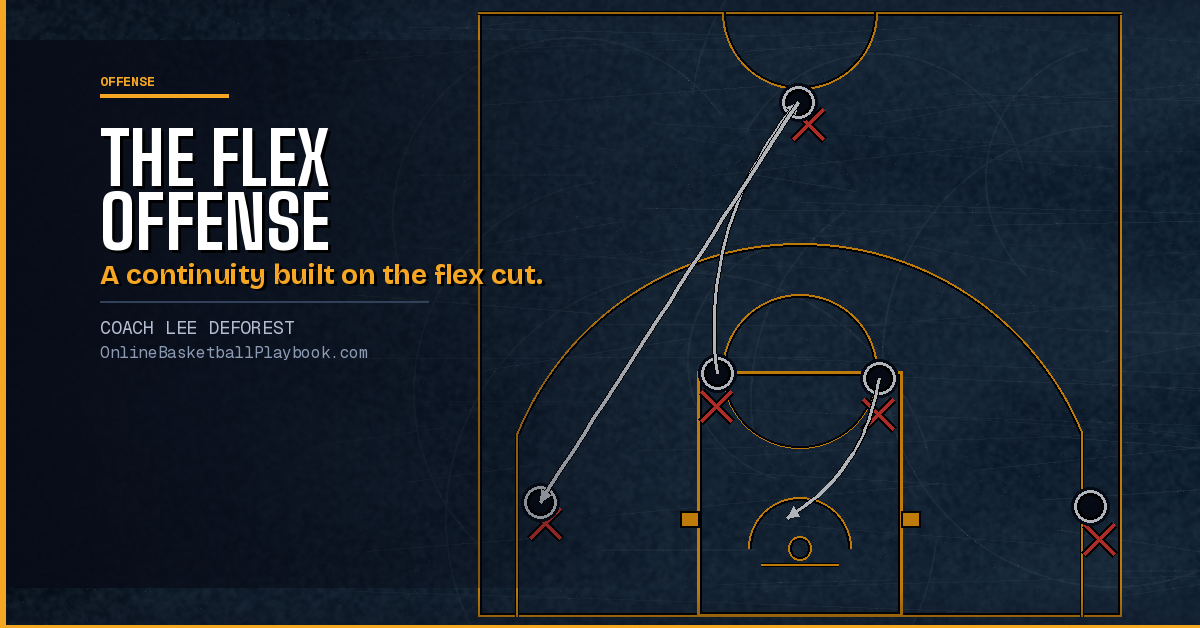
How to Coach the Flex Offense (Complete Guide)
The continuity that never dies — what makes it go, where it's vulnerable, and how to teach it from day one to game night.

Triangle Offense: Complete Coaching Guide
The triangle offense is a read-based system built around a sideline triangle of post, wing, and corner. Here's the base alignment, the core reads, and the tradeoffs of installing it.

How to Beat a 3-2 Zone Defense
The 3-2 zone protects the perimeter with three defenders up top but leaves only two underneath. Here's how to establish post position, attack the short corner, and force the defense's hardest rotation.
More from Online Basketball Playbook
10 Keys to Setting & Defending Screens
The screening rules that create and stop the pick-and-roll.
5 Keys to Defending Screens
How to stay in front of the screener and keep your coverage.
Basketball Pace & Tempo Strategy
Control the speed of the game so your ball-screen offense runs on your terms.
How to Teach Basketball Decision-Making
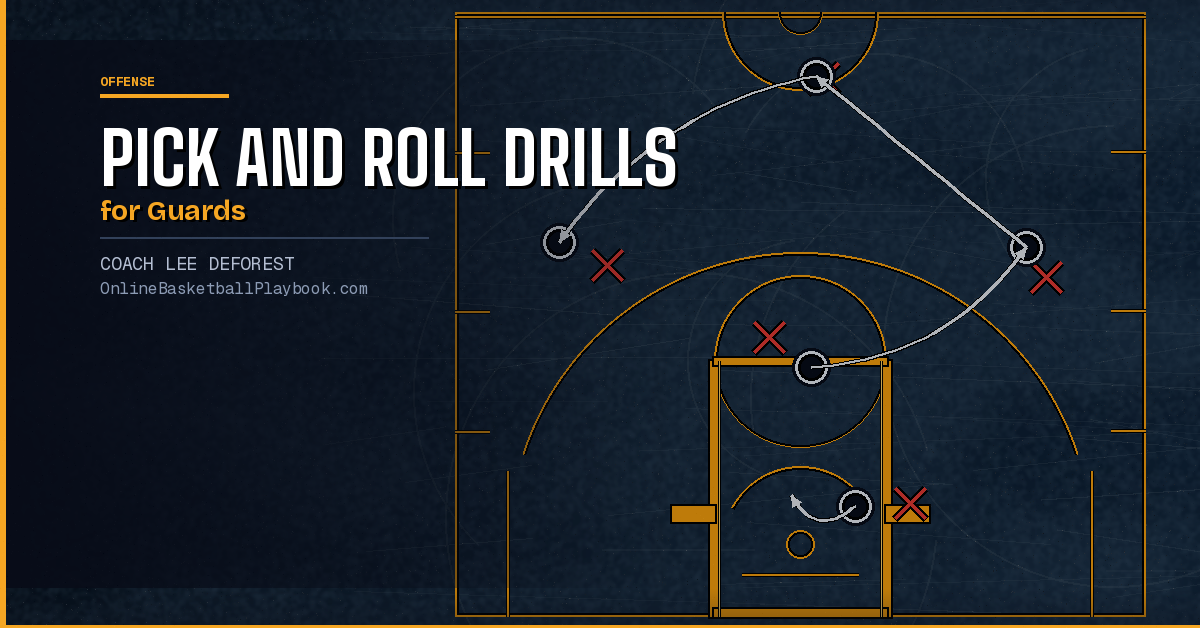
Teach guards to make the right read out of the ball screen, not just run the action.