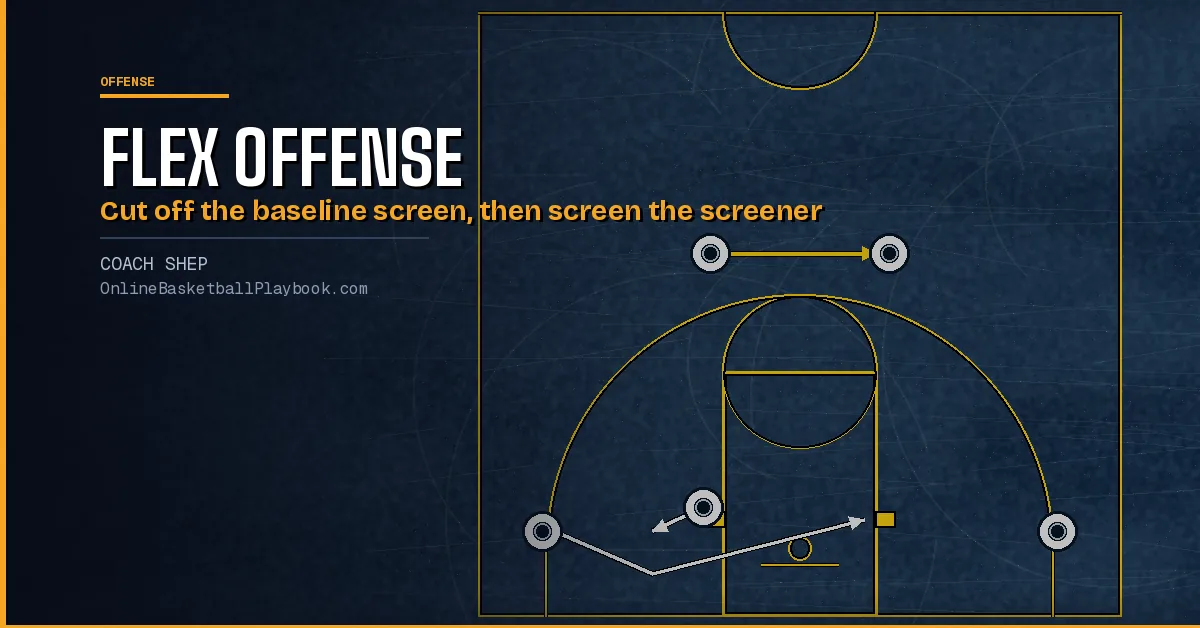
Flex offense basketball is a patterned continuity that wins most of its shots from two actions. On a pass from one guard to the other, a baseline player runs off a teammate's baseline screen toward the rim (the flex cut).
Then the passer sets a down screen for the player who just screened, who comes up for a jumper or the reversal pass. The cutter becomes the next screener, the ball goes back across, and the same two actions run on the other side.
Coaches run it as a whole offense, as a second man-to-man offense, as a fallback when a set play breaks down, or as a delay. This guide lays out every form of the base action, the starting sets, the counters, the drills and the teaching orders, side by side.
What Is a Flex Offense in Basketball?
The flex is a continuity offense, meaning a set sequence of passes, cuts and screens that flows from side to side and repeats without a reset. It is most effective against man-to-man defense. Its defining action is screen the screener: a player sets the baseline screen for the flex cut, then receives a down screen himself. The defense has to guard two screens in a row.
The problem is plain: the cutter's defender needs help from the screener's defender, and that helper is being screened at the same moment. The offense forces that decision three or four times a possession. Run the two actions and let the defense make the choice.
Because the cutter becomes the next screener, every player passes through every spot. Guards post up and posts handle the ball on the perimeter. The flex sits in the same family as the swing offense, the shuffle and the Princeton offense, all compared on continuity offense basketball. It differs from motion offense in that the cut on each pass is scripted, where motion gives players rules and lets them choose.

| Piece | What happens | Shot it looks for |
|---|---|---|
| Flex cut | A baseline player runs off the post's baseline screen into the lane | A layup or a quick post-up |
| Down screen | The passer screens down for the flex screener | A jumper at the elbow or the top of the key, or the reversal pass |
| Reversal | The ball swings back and the same two actions run on the other side | The next flex cut |
| Counters | Corner options, backdoors and read counters | Answers to denial, switching and scouting |
The Base Rules of the Flex Offense
The base boils down to a short rule list, written two ways.
| Rule set | The rules |
|---|---|
| Two rules | 1. On a guard to guard pass, the weak-side corner player runs the flex cut off the post, and the passer then screens down for that post. 2. On a guard to wing pass, the passer screens away toward the baseline. A team can run the base after 10 to 15 minutes of teaching. |
| Four rules for youth | Set a screen and you get one. Get a screen and you either set one or get a pass. Pass and you set a screen. Catch and you shoot or pass. Run from a 2-3 set, and the offense resets itself when no pass or shot comes. |
The two-rule offense adds a third habit that every player keeps: nobody stands on the perimeter. A player with no pass coming screens away at once, and a denied player goes away and screens for a teammate. Re-screening is what keeps the pattern from stalling under pressure. The same offense passes only to players who are moving.
Whichever rule set you use, nobody stands still.
The Flex Cut and Where the Cutter Ends

The guard to guard pass triggers the cut. The post on the side the ball just left screens on the baseline, and the corner player on that side cuts off him toward the new ball side. The cut itself is agreed on. Where it ends is not.
| Finish | Where the cutter ends |
|---|---|
| Lane or block finish | In the lane or on the ball-side block, going over or under the screen depending on how his defender plays it. The power-triangle offense has him stop in the lane just past the rim on the far side so the passer can see him, then clear out if no pass comes. |
| Corner finish | In the ball-side corner, with the screener cutting to the high post |
| Pop-out for front-court mismatches | He pops to the top of the key instead of cutting through, and the weak-side forward seals for a high-low look |
Reading the screen is the cutter's job. He goes over or under the screener based on his defender. Gary Williams lists reads by defense: roll back, switch, or go over the top.
A defender who rides over the top is why the two-rule offense has the screener step one step up and one step off the block before screening, which leaves the cutter room to back-cut. Named answers to a defender who cheats under the screen early, Go and Bump, are drawn on flex basketball plays. Read the defender first, then pick the side of the screen.
Seven Options After the Flex Cut
What follows the cut is where coaches split. Here are all seven next to each other.
| Option | After the flex cut |
|---|---|
| 1. Elbow down screen | The passer screens down and the flex screener comes to the elbow or free-throw line area for a jumper or a drive. In two plans the down-screener then steps out to the corner. |
| 2. Pop to the top of the key | The down screen brings the screener out to the top of the key to shoot on the catch or swing the ball. |
| 3. Corner fade | The passer fades to the corner instead of down-screening, which gives better spacing in the corner-fade offense. The flex screener pops up for the reversal. |
| 4. No down screen | Gary Williams is quoted saying not to down screen because it turns the flex into a jump-shooting offense, though the same talk is also reported listing a down screen for a curl on the reversal. His counters include a back-cut exchange and a flare back to the corner. |
| 5. Pick the Picker | A post clears to the corner, then the baseline screen and down screen come together, giving the receiver four reads. |
| 6. High post or roll | After the baseline screen, the screener cuts to the high post, or rolls to the rim in a Flex Screen and Roll. |
| 7. Flare instead of down | In a back-screen series there is no down screen from the guard. The screen-the-screener action moves up and becomes a flare screen. |

Options 1 and 2, the down screen. The two differ only in where the screener lands.
- Elbow finish. The screener goes to the free-throw line area. If he comes off before the down screen is set, he will not get open until he is above the top of the circle.
- Pop out. He comes out to the top of the key, where he can shoot on the catch.
The 4-out offense calls this a two-shot design: a layup or post-up on the flex cut, then a jumper off the down screen, because the screener's defender is often caught helping on the cutter.

Option 3, the corner fade. Dropping the down screen leaves the area above the screener open, and the same offense ties that space to its backdoor counter against a team that denies the reversal pass.

Option 5, Pick the Picker. This early offense starts with two posts. As the guard to guard pass is made, the ball-side post steps out to the corner, and the receiver has four choices: shoot, hit the flex cutter, pass to the corner, or hit the screener popping off the down screen.
Because shooters here usually catch moving away from the basket, offensive rebounding has to be anticipated rather than waited for. The continuity keeps two players on the weak side as the ball swings.
Pick the finish that fits your shooters, then rep it from both sides.
Eight Starting Sets for the Flex
The flex can start from at least eight shapes. Each lands in the same continuity once the first guard to guard pass is made.
| Start | Starting set |
|---|---|
| 1-4 low start | The point guard at the top of the key and four players low across the floor |
| 4-out 1-in start | 4-out 1-in: two in the slots, two wings, one ball-side post |
| Power triangle start | Point in the middle, posts just above the blocks, wings a step above the posts and a step off the sideline, with a Power Triangle of 1, 2 and 5 filled on one side |
| Overload start | Two-guard front, an overloaded strong side and one flex player alone on the weak side |
| 2-3 start | A 2-3 set, in the four-rule youth offense and the 2-3 low offense |
| 5-out start | 5-out open post with no post players |
| High flex | The whole set raised to the free-throw line extended |
| Corner post start | 1-2-2, with a big moving to the corner |

1-4 low. The point guard picks a side, and the post on the far side pops to the other slot. If that post is overplayed on the pop, he has room to cut backdoor, and the corner player fills the slot behind him. The other answer to the overplay is to screen away. The two-rule offense notes that starting from 1-4 low asks the point guard to handle pressure reasonably well.

Point in the middle. The power-triangle offense calls the Power Triangle the heart of the flex: the point, the wing and the post on one side, which must be filled for the flex to begin. The point has four first passes: to the off post cutting high, to the ball-side wing, a skip to the weak-side wing, or to the strong-side low post. It teaches the post entry first.

5-out. With no post, the point passes to a wing, cuts to the basket and screens for the far corner player, who flex-cuts. If that pass is not there, the wing returns the ball to the player at the top of the key, and the flex cutter back-screens for that wing, who cuts around the screen. The cycle rotates all five through every perimeter spot.
It works as a bench or timeout call for a 5-out team, and as a delay when the spacing is pushed higher. Starting in 5-out is also an answer to a switching defense, covered below.

High flex. Same rules, raised spacing. Two plans run it.
- Raise the baseline players. Bring them up to the free-throw line extended and move the guards back about 8 to 10 feet, which puts the offense about 15 feet from the basket and opens room for back cuts, curls and slipped screens. This is called Princeton and is used against pressure and switching.
- Run it as a delay. The same idea sees less use now that many states have a shot clock, and it adds a slip by the down-screener and a back-screen pick and roll.

Corner post start. From a 1-2-2, the low post on the side of the wing pass moves to the corner and becomes the player the offense is trying to free. The point screens for the opposite wing, who flexes. If that is not open, the far post pops up for the reversal and the flex screen is set for the big in the corner.
Timing there needs practice, and the series suits big players who do not play well away from the basket.
Disguise and entries. Beyond the starting set, coaches change the first look.
- Five formations. The 4-out offense runs the flex out of 1-3-1, double stack, box, 1-4 low and 1-4 high, and separates these disguised entries from quick hitters that end in a shot.
- Ten entries. The corner-fade offense lists ten entries, including inbound plays from the baseline and the sideline.
Pick the start your players handle best, then let every start flow into the same continuity. Entries that flow into the flex are also listed on baseline out of bounds plays and sideline inbounds plays.
Get the free flex offense playbook (PDF)
Every flex cut, starting set, counter, special and drill from this guide and the flex plays page, with all 30 diagrams, in one printable PDF. Free.
Screening, Cutting and Timing in the Flex
The flex runs on screen and cut technique, and each offense names its own points.
- Two-rule offense. The post steps one up and one off the block before screening. The cutter takes two steps toward the baseline to set up his defender, then changes speed and direction. The cutter rubs shoulders with the screener. Screeners hunt a defender, never an empty spot.
- Power-triangle offense. The cutter fakes one way and goes the other, then stops in the lane for the pass. The screener stays still until the cutter goes by, feet no wider than his shoulders, then steps toward the ball in case his defender picked up the cutter. It adds that a late cutter is better than an early one.
- Power-triangle down screen. The screener goes straight at the defender and jump stops, and he takes a step toward the pass receiver first for a better angle.
- Corner-fade offense. Catch in triple threat with ball and shot fakes, cutters show hands, screeners step out on every screen, and the tempo is quick without hurrying.
- Name-the-screen offense. Its general screening rules call every screen by name, set it on the defender's numbers and hold it for a two count.
Timing has five written cues, and they do not agree on who waits for whom.
| Offense | Timing cue |
|---|---|
| 4-out down-screen drill | The shooter waits until the down screen is set solidly before moving |
| Power-triangle offense | The screener holds until the cutter passes him |
| Five-setup rotation | The cutter cannot leave before the wing has the ball |
| Gary Williams | Go when your defender jumps to the ball, step up and show, and cut as the ball leaves the passer's hand |
| Name-the-screen offense | The player using the screen waits for the screener's jump stop and the name before he cuts |
A screen set too early or too late lets the defense recover. Wait for the screen, then cut. More on the mechanics is on basketball screening technique and down screens.
Posting Up in the Flex
The screener is often the scorer. A two-ball drill gives the cutter and the down-screened screener a shot on every rep. The code-word offense has the flex screener duck in with high hands when the post defender helps, and in the 2-3 low offense the back-screener seals and shapes up to the ball for a post-up after every flex cut.
Who posts is a choice, with six answers on record:
- All five post. Each has at least a drop step and one counter (jump hook, up-and-under or dribble spin) with both hands. The same offense attacks from the block, the high post and the short corner, which it calls the most underrated area, fed after a fake down screen that pops back to the top of the key.
- Guard mismatch. A guard with a post mismatch gets his own post-up call.
- Push. Push keeps a guard you do not want on the low block off it.
- Big to the corner. The big goes to the corner in the corner post start, for bigs who do not play well away from the basket.
- The Hold call. Gary Williams uses a "Hold" call to get a great center the ball.
- Swap the screener. Change who sets the flex screen, or put your best players in set spots.
Where the post feed comes from also splits:
- Feed the foul line. Gary Williams calls the flex an inside offense built to reach the foul line: pass to the wing so the post can be fed, and lead the post with a bounce pass.
- Feed after a corner pass. The code-word offense avoids feeding from the slot, with the post posting up for one or two seconds on every corner pass.
- Feed from the slot or the corner. In the delay offense a fronted post can seal for a curl bounce pass from the corner or the ball can be skipped back out.
After the feed, the two-rule offense's passer reads which way his own defender turns and cuts away from that defender's line of sight. Feed the post on purpose, not by accident. Post moves themselves are on how to post up.
When the Guard Pass Is Denied
The guard to guard pass is the trigger, so it is the pass defenses take away first. The answers come in two groups: pressure releases on the denied player, and corner options that move the ball through the corner instead.

Pressure releases.
- Backdoor and fill. The power-triangle offense calls the backdoor against denial the number one release to master. The denied guard cuts to the basket and out to the corner, a wing fills the slot, and the flex starts from there. The other answer is to dribble the ball over.
- Go without hesitation. The code-word offense says go backdoor without hesitation and never fake it, with the corner rotating up. Its alternative is a dribble exchange with the denied player banana-cutting underneath, which it prefers to a cross screen.
- Fist signal. The corner-fade offense's backdoor uses a fist signal. If no pass comes, the cutter clears to the corner and a teammate cuts to the slot for the reversal.
- Elbow flash. The early offense has the weak-side corner break high to the elbow for a pass so the overplayed guard can back-cut, with a lob if that flash is denied.
- Dribble at him. The delay offense dribbles at the denied receiver, who back-cuts through and fills the weak side.
- Raise the set. The two-rule and delay offenses both raise the whole set to open room for back cuts.

Corner options.
| Offense | Corner options |
|---|---|
| Code-word offense | Six: give and go (a pressure release only), a UCLA cut off the post, a dribble entry with the corner player curling up to the slot, a single screener (cross screen then down screen), a staggered screen for the weak corner, and horizontal cross screens by both ball-side players. Pick two or three and give each a code word. |
| 4-out offense | Three: Single Screen (the passer cross-screens, then down-screens, and the flex resumes), Double Screen (both players in the slots set a staggered screen for the far corner, screening a man and not an area) and UCLA Pick (the post posts up for two seconds, then screens at the high post, giving the cutter a post-up and a catch-and-shoot in one trip). Any corner pass is also a chance to jam the post. |
| Delay offense | The passer sets two screens and ends in the far corner, a give and go, and a double screen for a cutter to the ball-side slot with the screeners rotating back into flex spots |
| Power-triangle offense | A special double screen and a staggered screen for a shooter |
| Overload offense | A corner series: the center sets a UCLA screen for the ball-side guard, then steps out for the pass while the weak-side forward seals for a high-low look, and a down screen on the weak-side block frees the forward for the reversal |
| Early offense | On any corner pass, the two players in the slots screen away and the corner looks to feed the post |
The power-triangle offense also drills a strong-side dribble out: when the next guard receiver is overplayed, the wing with the ball dribbles out to the slot and the others rotate into flex cut position. Backdoor cutting itself is on cutting in basketball. Whatever release you pick, rep it until it is automatic.
Counters for a Switching Defense
Switching is the defense the flex has to answer most. It is the biggest challenge, especially for young teams, and many coaches switch everything as soon as they see the flex.
The three reasons: switching takes away the effect of the flex screens and down screens, lets defenders get out and deny passing lanes, and keeps their posts defending block to block. The counters vary by offense.

| Offense | Switch counter |
|---|---|
| 4-out offense | Backdoor when the down-screen receiver is overplayed, slip the screen when the defense switches early, post up your point guard so their smallest defender guards the post, and start in 5-out so there are no early switches |
| Code-word offense | Seal and duck in, plan the mismatches before the game, down-screen your own man or flare and flash, be patient, and start the point guard in the post |
| Corner-fade offense | Duck In: the flex screener ducks into the paint right after screening |
| Two-rule offense | Three switching specials: Pin, Reverse and Princeton |
| Power-triangle offense | The down-screener calls a verbal key such as "Switch," "Post" or "Cut" |
| Delay offense | Attack the big-little mismatch from switched down screens |
| Gary Williams | Against a switch, go straight to the ball rather than worrying about screening, and the cutter still cuts |
The corner-fade offense teaches its four counters, Backdoor, Duck In, Go and Pass Off Elbow, as reads triggered by a defensive mistake, not as calls from the bench.
Pass Off Elbow is the one not covered above: any pass from the elbow down to the corner sends the two players in the slots into a double stagger away for the corner man, with a high-low look on the post seal. Teach the read, not the call. Defensive switching itself is on how to coach defensive switching.
Personnel Swaps and Named Specials
Full flex playbooks add named plays on top of the base.
- Personnel swaps. Four swaps, three of which flow back into the continuity: Curls (the big curls into the paint instead of parking at the elbow), Flare (a flare screen for a shooter after the reversal), Push (a forward replaces the post so a guard stays off the block) and Stagger (staggered screens for a jump shot instead of the flex cut).
- Eleven specials. Deep, Stack, UCLA, Push, Down, a baseline double for the shooter, Pin, Reverse, a post-flash backdoor, Transition and Princeton. Carry the ones that fit your league's defenses, not all eleven.
- Seven overload series. Basic, corner, pop-out, back screen, a two-screen corner entry, corner post and transition.
Names such as Push, Go and Bump mean different actions in different playbooks, with two or three meanings each. Every special is drawn and the same-name actions are set side by side on flex basketball plays, along with flex actions used inside other offenses and pro sets. How coaches package calls like these is on how to run quick hitters. Carry only the specials your team can run cleanly.
Flowing the Break Into the Flex
Offenses skip the reset between the fast break and the half court and land straight in flex spots.
- Entries off the break. Gonzaga's staff ran three entries straight off the break, Regular Break, Double Down and 90, that flow into the flex. Its most common half-court entry, Crackdown (BIG when the posts start low), starts from a box and flashes the best big.
- Numbered break. The corner-fade offense runs a numbered break (5 to the rim, 2 and 3 to the corners, 4 trailing, 1 pitching ahead) into the flex, with four transition counters for one of the corner players, two of them read off his defender.
- Secondary breaks by name. The power-triangle offense traces its numbered break through college coaches and shows a turnout secondary credited to Pat Riley's Lakers, a Tom Davis secondary and a Gonzaga secondary, each flowing into the flex.
- Guard-through entry. The overload offense uses it.
- Transition special. The two-rule offense's special has the wing who catches the secondary-break pass flatten the defense with a dribble toward the baseline, then reverse the ball straight into a flex cut.
- No reset. The early offense flows into a half-court set without backing the ball out, with the flex as one of its fallback continuities.
Flow from the break into the spots and skip the reset. Secondary breaks are covered on secondary break basketball.
Flex Against a Zone
Coaches disagree on the flex against a zone, and the adjustments are not diagrammed.
- Works against both. The 4-out offense lists the flex as one of the few offenses that can work equally well against man-to-man or a zone.
- Odd-front zone. The overload offense says it can be used against one.
- Man first. The power-triangle offense calls it most effective against man-to-man, usable against matchup and combination defenses with adjustments.
- Youth set. A youth flex set is offered against man, zone or a box-and-one.
- Adjust for a zone. The code-word offense calls the flex mainly a man-to-man offense that can be adjusted for a zone, and lists a zone as one of the easiest ways to defend it, warning that many teams will switch to one early in a game.
Decide your zone plan before the game. Zone-specific attacks are on drills to teach zone offense.
How Defenses Play the Flex
A defensive plan treats screens in sequence as their own problem, because the second screen keeps the weak-side defenders busy and removes help. Its plan for the flex:
- Pressure the ball. Pressure it toward a sideline, and force the next receiver away from the basket before the base screen starts.
- Switch low only. On the baseline screen, switch only if the cutter goes low along the baseline. If he goes over the top, there is no switch.
- Jump switch. Jump switch the down screen: one defender steps into the screener's path while the other steps over into a hard denial on the screener.
The other defenses to expect are switching everything (above), denying the guard to guard pass (above), and a zone. Know how the defense will play the second screen. More on guarding sequences of screens is on drills to teach off-ball screens.
How Teams Teach the Flex Offense
Four installs are on record, listed as written.
| Offense | Teaching order |
|---|---|
| Power-triangle offense | Run the pattern 5 on 0 with no defense, starting with the post entry before the wing or dribble entry, and turn the ball several times before shooting. Then add defenders who are not allowed to deflect or intercept, so screens can be practiced. Then let the defense become active. After about a week, cycle offense, transition and live defense between two teams, with corrections after each cycle. |
| Gary Williams | Show the five-man offense first, then go back and work the pieces in smaller groups: 2 on 2, 3 on 3 and half court. Play 3 on 3 in half the court every day to teach post feeding, and go 5 on 5 on the first day of practice. |
| Corner-fade offense | Teach counters as reads. Its Cutter 3 x 3 runs first with no switching, then allows switches to force the read. |
| Two-rule offense | The two rules can be taught in 10 to 15 minutes. Its Perimeter Screens drill runs often early in the season, again when screening gets sloppy, and again at playoff time. |
The 4-out offense adds a practice amount: 10 to 20 minutes a day on one or two of its shooting drills, with guards and posts working the same drills together. Teach it slowly, then make it live. Practice structure for any offense is on offensive breakdown drills.
Flex Offense Drills
The drills below come from five flex offenses. Each is listed under its own offense.
| Offense | Drill | What it trains |
|---|---|---|
| Two-rule offense | Curl Drill | Pairs curl across the lane and shoot from the layup, mid-post, high post and top of the key, catching high on layups |
| Two-rule offense | V-Cut and L-Cut | A coach passes only to moving players, so a player who has cut and stopped must cut again |
| Two-rule offense | Elbow Jumpers | Two lines at the elbows shooting, often as a team count of makes |
| Two-rule offense | Perimeter Screens | Pass and screen away, with a basket cut, curl, fade and slip added |
| Two-rule offense | 2-Ball Shooting | One ball to the flex cutter and one to the screener off the down screen, so both shoot |
| Two-rule offense | Quickpass and Quick Possessions | Running the flex for a set number of passes, then the specials one unit at a time |
| Two-rule offense | Passing Possessions | No-dribble 5 on 5, scored by passes completed over three possessions. A catch out of position or a five-second count ends the possession, and defenders may not switch. |
| Two-rule offense | Quickbreak | Passing Possessions with a fast break for the defense at the end of every possession |
| Corner-fade offense | Pivoting | Inside pivots into triple threat on the guard to guard pass, with the passer fading to the corner |
| Corner-fade offense | Backdoor | A coach denies the pass and the cutter back-cuts on a fist signal, progressing to 2 on 2 |
| Corner-fade offense | Pull Thru | Rip the ball through and finish a left-handed layup off two feet, with an optional pad |
| Corner-fade offense | 5 on 2 and 5 on 3 | The defense guards any two and denies, five passes before a shot. The 5 on 3 starts from Pass Off Elbow. |
| Corner-fade offense | Cutter 3 x 3 | Score on the flex cut, first with no switching, then with switches allowed |
| Corner-fade offense | 5 on 0 Drive and Kick | Five flex passes, then a drive and kick until all five have had a shot |
| Corner-fade offense | Scramble to Flex | A coach drops the ball and players sprint from random spots into flex positions |
| 4-out offense | Flex Screen Drill | Skip pass to a coach, set up the defender, cut off a chair or a live screener and finish with a drop step, jump hook or up-and-under |
| 4-out offense | Down Screen Drill | Read the defense and choose a straight, curl or flare cut off the down screen, waiting for a solid screen |
| 4-out offense | Top Spot Drill | After reversing the ball, fake the screen and basket cut, fake the cut and pop, or screen and roll back |
| Power-triangle offense | Baseline cut and elbow shooting drills | Two-ball drills for the shot off the flex cut and the elbow jumper off the down screen, run almost daily |
| Power-triangle offense | Backdoor and Fill | The denied guard backdoors and the next player fills his spot, rotating through every position |
| Gary Williams | 3 on 3 triangle | Half-court 3 on 3 every day to teach the post feed |
Choose a few drills and rep them until the cuts are automatic. For general off-ball screen work, see drills to teach off-ball screens.
Who It Fits and What It Costs
Five profiles describe the right team, and they do not fully agree.
- Code-word offense. Any team from about age 11, best for a team without height, a team of shooters or a high-IQ team.
- Corner-finish offense. High school teams without a dominant scorer.
- Gary Williams. Very good structure for high school.
- Delay offense. Teams without strong inside posts may prefer patterns, but patterns can keep young players from learning to read a defense and take practice time.
- Name-the-screen offense. A structured second man-to-man offense and a teaching offense for young players.
The power-triangle offense adds its own profile: an average-size team, players who can play inside and out, good 15 to 17 foot shooters and good passers. The overload offense suits teams of average ability, and the 4-out offense suits teams without a true point guard or a true post.
The costs on record:
- Predictability. The two-rule offense admits the flex has few reads, and the delay offense names predictability as its main drawback, warns that a pattern without counters and options gets predictable, and answers it with extra plays.
- Robots. The code-word offense warns that players go through the motions and forget to score.
- Many passes. The same offense flags the number of passes as a turnover risk for youth teams.
- Non-shooters. If players cannot shoot from outside, the defense sags into the lane and closes the cuts.
- Unset screens and early cuts. The five-setup rotation names a screen not set and used as the main reason the play fails, and forbids cutting before the wing has the ball.
Know the cost before you install it.
Origins and Who Has Run It
The origin is told several ways.
- A shuffle variation at Santa Clara. Carroll Williams built it there in the 1970s as a variation of the shuffle.
- Father of the Flex. Carroll Williams is called the "Father of the Flex", and his assistant took it to Gonzaga when he became head coach there.
- Out in 1970. It came out in 1970, derived from an earlier shuffle cut offense.
- Forerunner of four offenses. The shuffle, from Bruce Drake at Oklahoma, is called the forerunner of four offenses: Princeton, flex, Hawk and Reverse Action.
- Reverse Action. Pete Newell's Reverse Action from the late 1950s is called the forefather of the triangle and the flex.
Gary Williams won the 2002 NCAA title at Maryland with the flex. Others have run it too:
- College adaptations. Bo Ryan, Mark Few and a Boston College staff each adapted it.
- Utah Jazz. Jerry Sloan ran variations.
- Boston Celtics. They used a form of it in their 2008 title run.
Bo Ryan's own swing offense uses a flex screen on the slot to slot pass. Other continuities are compared on continuity offense basketball, and every system is listed under offense.
Questions Coaches Ask About the Flex Offense
What is a flex offense in basketball?
A continuity offense built on a flex cut off a baseline screen and a down screen for the screener, repeated from side to side until a good shot appears. Every player rotates through every spot.
What is a flex cut?
A cut by a baseline player off a teammate's baseline screen toward the rim, going over or under the screener depending on how his defender plays it. He usually ends in the lane or on the ball-side block.
What is screen the screener?
The player who sets the baseline screen for the flex cut then receives a down screen himself, so the defense has to guard two screens in a row.
Is the flex offense good for youth basketball?
Coaches split. Any team from about age 11 can run it and the four-rule youth offense writes it as four simple rules. Others warn about the number of passes for young teams and that patterns can keep young players from learning to read a defense.
How do you run the flex against a switching defense?
Options include ducking the screener in, slipping screens, back-cutting the overplayed receiver, posting up the point guard, starting in 5-out, and the Pin and Reverse specials.
What is the difference between flex and motion offense?
The flex scripts the cut on each pass. Motion gives players rules and lets them choose.
Does the flex work against a zone?
Coaches disagree. The 4-out offense says it works equally well against man or zone, the overload offense says it works against an odd-front zone, and the code-word offense calls it a man-to-man offense that needs adjustments.
Want the printable playbook packs?
OBP Pro members get the premium playbook packs: the zone attack, out of bounds and practice plan PDFs, plus each new pack as it is finished. The membership page lists what is in each one. Or draw your own version free in PlayDraw.
See what OBP Pro includesMore Continuity Offense Guides
- Flex Basketball Plays: Specials, Counters and Named Sets
- Shuffle Offense Basketball: Shuffle Cut, Rotation and Counters
- Ball Screen Continuity Offense: Pick and Roll Rules and Reads
- UCLA Offense Basketball: UCLA Cut, High Post Series and Counters
Back to Continuity Offense and every Offense page.
Keep Building
Related breakdowns
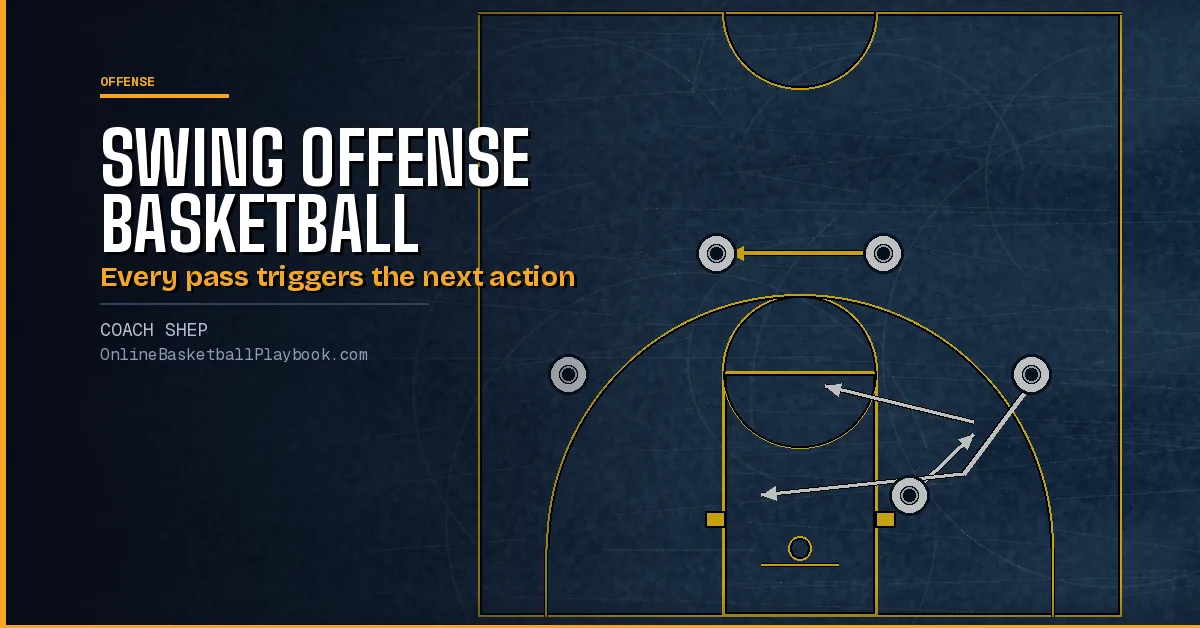
Swing Offense Basketball: Rules, Cuts and Counters
Swing offense basketball explained: the 4-out 1-in set, the pass triggers for the UCLA, flare and flex screens, post entries, pressure releases and drive rules.
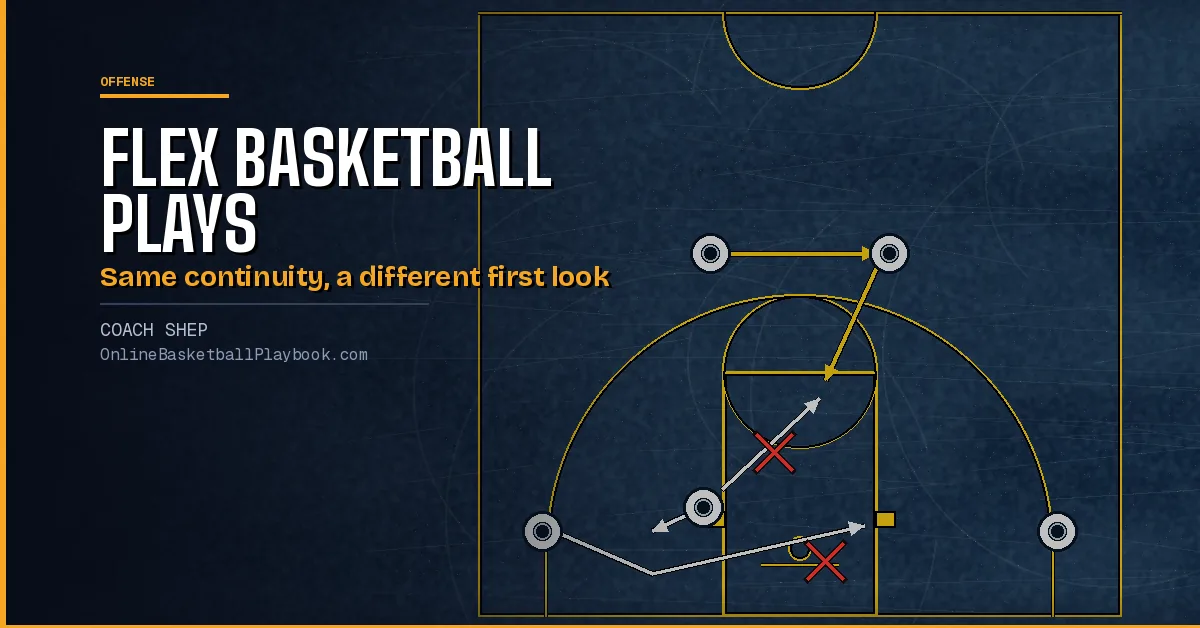
Flex Basketball Plays: Specials, Counters and Named Sets
Flex basketball plays drawn and explained: the eleven specials, Push, Go and Bump in each version, read counters, personnel swaps and flex actions in other offenses.
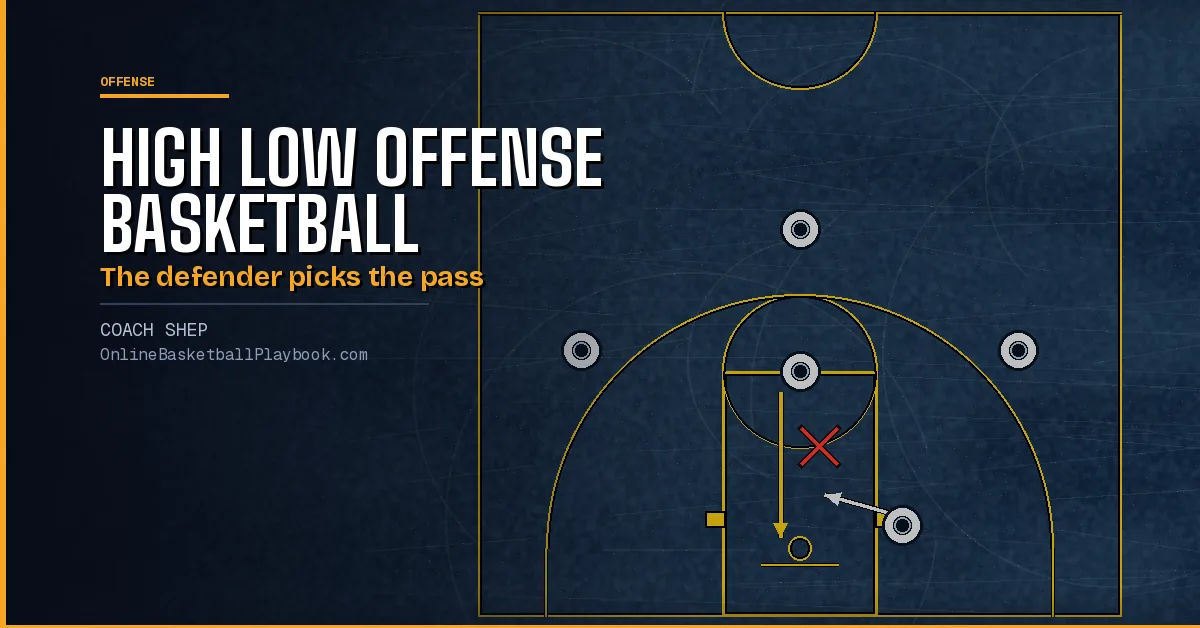
High Low Offense Basketball: Reads, Counters and Zone Rules
High low offense basketball explained: the two-post shell, the lob and bounce reads, answers to a front, down-screen reads, 1-4 low sets and the hi-lo against zones.