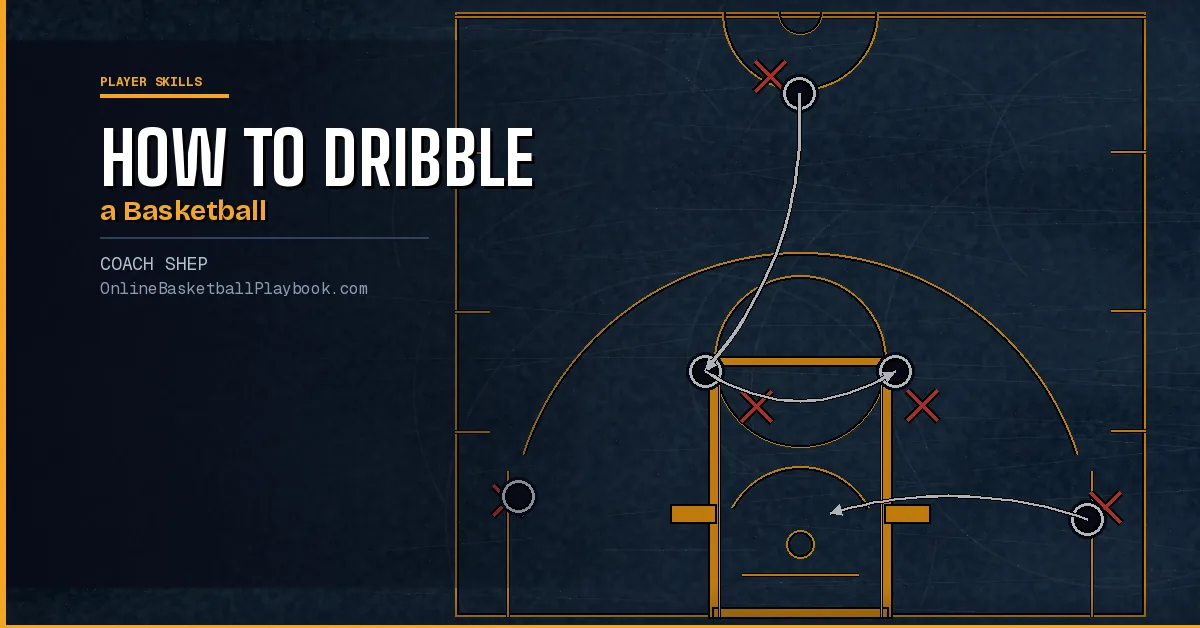
Dribbling is the first skill every player learns and the last one most coaches feel confident they've actually taught. This guide covers mechanics, drills, and coaching cues that hold up from middle school to the varsity level.
Hand Position and Body Posture
Before a player can learn any dribble move, they need the right starting position. The fundamentals here are non-negotiable, and getting them wrong early creates habits that are painful to break at the high school level.
The athletic stance. Feet shoulder-width apart, knees bent, hips low. The ball should be dribbled to the side of the body, never directly in front of the body where a defender can easily strip it. Weight stays on the balls of the feet, not the heels. The moment a player stands straight up, they've given the defense a free play.
Hand position on the ball. The pads of the fingers contact the ball, not the palm. A palm dribble is a carrying violation waiting to happen, and it eliminates all feel and control. Spread the fingers comfortably. The thumb points back toward the dribbler's body. On the push phase of each dribble, the wrist snaps downward, not just the arm. This wrist snap is what separates a controlled dribble from a slap-and-hope.
How low should the dribble be? It depends on context. A stationary, protected dribble while reading the defense should be low, below the knee when possible. A speed dribble in transition can be higher (around mid-thigh) because height generates more power for each stride. Players who dribble at one height regardless of game situation are easy to guard. Teaching them to modulate dribble height based on speed and threat level is an early step toward real ball-handling.
Protect the ball with your body. The non-dribbling arm is not a decoration. It should be extended at a natural angle to create space between the player and the defender. Coaches sometimes call this "the shelf", a forearm barrier that keeps the defender from reaching across cleanly. This is legal as long as the arm doesn't push or shove. Teaching it early saves countless turnovers later.
Types of Dribbles Every Player Needs
There are four dribble types that every player, regardless of position, should be able to execute reliably. A player who has all four can handle most defensive schemes they'll encounter from youth basketball through varsity.
The Crossover Dribble
The crossover moves the ball from one hand to the other in front of the body. The key teaching point that most players miss: the ball should cross low, near the shoe tops, not high across the thigh or waist. A high crossover is easy to steal. A low crossover that also involves a shoulder dip and a change of direction is extremely difficult to defend.
Teach the crossover in two steps. First, stationary crossovers: just getting the feel of transferring the ball cleanly from hand to hand at shoe-top level while staying balanced. Second, add the footwork: the plant foot opposite the direction of travel, the drop of the shoulder, and the simultaneous crossover. The footwork and the dribble should land at the same time.
The Behind-the-Back Dribble
Behind-the-back gets a bad reputation as a showboat move, but at the guard level it is genuinely useful when a defender is overplaying the strong hand in transition. The ball sweeps behind the back in a low arc and lands cleanly in the opposite hand. The biggest mechanical error is letting the ball bounce too high behind the back, which slows the move and makes the ball easy to poke away. Keep it tight.
The Between-the-Legs Dribble
Between-the-legs is the most reliable way to change hands when a defender is in front and both sides are contested. The step corresponding to the dribbling hand goes forward, creating the gap for the ball to pass through cleanly. This is a timing dribble. It only works if the step and the release happen together. Players who do it correctly look fluid. Players who get the timing wrong hit their own foot or bobble the transfer.
The Pull-Back Dribble
The pull-back is underused at every level below college. When a player drives and the lane closes, most players try to force a layup or pick up their dribble. The pull-back resets the possession. The player dribbles the ball hard backward while stepping back, creating separation from the defender who was closing. From there, the offense can reset or the player can attack again with a fresh angle. This is the hesitation's escape valve, and it is worth drilling explicitly because players don't naturally reach for it under pressure.
Change of Pace and the Hesitation
Dribble moves don't beat defenders on their own. Change of pace beats defenders. The move is just what triggers the reaction. A player who always dribbles at the same speed is one of the easiest offensive players to guard, even if they can do every fancy crossover in the book.
The speed-up-slow-down principle. Attack at full speed until the defender commits to matching that speed, then slow down abruptly. The defender's momentum carries them past the play. Then attack again. This is a rhythm that players develop, not a trick they memorize. It requires that players are comfortable with at least two speeds and able to shift between them without telegraphing the change.
The hesitation move. The hesitation is a momentary pause while still in motion (a stutter step, a knee-up, a pump fake while dribbling) that causes the defender to stop or straighten up. The best guards in the world use this move constantly. It doesn't require athleticism. It requires timing and the confidence to slow down when every instinct says to go fast.
The read off the hesitation: if the defender freezes or straightens, attack immediately off the hesitation. If the defender stays low and locked in, use the pull-back and reset. The hesitation with a pull-back creates a pull-up opportunity if the player is a reliable shooter, which is why guards who can shoot make the hesitation twice as effective as guards who cannot.
The body fake. Related to the hesitation but distinct: the ball stays in front, the shoulders fake one direction, and the player attacks the other way. The key is that the ball never goes wide. It stays in front of the body the entire time. A body fake with a wide ball is just a slow crossover that defenders can cut off. A body fake with a tight ball is a genuine deception that attacks the defender's eyes.
Two-Ball Drills and Ball-Handling Circuits
The fastest way to develop ball-handling is to make one hand do the thinking while the other hand is forced to work on autopilot. Two-ball drills accomplish this at a level that one-ball drills simply cannot match. If a player can handle two balls simultaneously, one ball in a game situation feels much easier.
Stationary Two-Ball Progressions
Start stationary. Dribble both balls simultaneously, same height, same rhythm. Then alternate: right down while left comes up, and vice versa. Then add shoulder-height (higher, more controlled), then lower toward the floor (faster, less controlled). Each variation stresses a different part of the motor skill. Eyes stay up throughout. If a player has to look down to keep two balls going, they are not ready to add movement yet.
Add complexity gradually: dribble both balls around the head (challenging coordination), around the legs (tests flexibility and ball control at awkward angles), behind the back (high difficulty, both balls pass behind the body in sequence). These movements feel impossible the first time and routine after a week of consistent work.
Non-Stationary Two-Ball Work
Once the stationary progressions are clean, add movement. Dribble two balls from baseline to half court, changing dribble moves at each hash mark, from simultaneous to alternating, or from regular to crossover. The challenge: keep both balls going through the transition between moves without killing one dribble to adjust the other.
The 1-on-3 full-court ball-handling drill takes this further. One ball handler faces three defenders in succession, each positioned a third of the court apart. The handler must get past each defender using only their dribble: no screen, no teammate, no escape route. It's a pressure-handling staple that forces players to use every tool they have in a sequence rather than a vacuum.
Speed Dribble and Breakdown Moves
Pair the two-ball work with a speed-dribble series: push the ball out ahead in transition, one dribble per stride, eyes forward. Then add a breakdown move at a cone (inside-out, crossover, pull-back) before attacking the basket. The sequence mirrors real game actions and builds conditioning into skill work simultaneously.
Eyes-Up Dribbling: The Real Goal
Every dribbling drill worth running should end with the same standard: eyes up. Not glancing up occasionally. Not looking up when convenient. Eyes on the defense, reading the floor, while the ball handles itself below knee level.
This is harder to teach than any specific move because it requires trust. Players look down at the ball because they are afraid of losing it. The only cure is enough repetition that losing control feels impossible. That is what ball-handling volume builds. Not just a skill, but confidence that the ball will be there when they push it down.
Coaching cue: the rim test. During stationary ball-handling drills, have players pick a spot on the rim and stare at it for the entire drill. If their eyes drop to the ball, they reset the drill. This seems harsh at first, but players adjust within one practice. The cue gives them a visual anchor that makes the habit stick faster than just saying "eyes up" repeatedly.
Reading defenders while dribbling. Once a player can dribble eyes-up, start adding decision-making to drills. Flash a hand signal. They read it and call it back while continuing to dribble. Then advance to reading a live defender's stance and calling out the correct attack (left or right) while the dribble continues. This bridges the gap between isolated ball-handling skill and real basketball decision-making.
A practical progression: stationary eyes-up drill (week 1) → moving eyes-up drill (week 2) → eyes-up with signal reading (week 3) → eyes-up with live defensive read (week 4). This four-week arc is enough to change the habit in players who are committed to the repetition.
Run two-ball and eyes-up ball-handling for just six to eight minutes at the start of every practice. Not as a warmup afterthought, but as the first real teaching block of the session. Players who get this volume four times a week for a full season look like different athletes by January. Consistency beats any single fancy drill by a wide margin.
Common Mistakes and How to Fix Them
The same mistakes show up at every level. Knowing the fix before you see the error makes coaching faster and less reactive.
Palming the ball. Players who dribble with their palm have no feel and no wrist snap. Fix: place a piece of tape across the player's palm and tell them to keep it dry (no ball contact on the tape). This forces finger-pad contact instantly. Reinforce with wrist-snap repetitions. Dribble from the elbow down, isolating the wrist action.
Dribbling in front of the body. This leaves the ball exposed to every defender who's in front. Fix: use a cone or teammate as a "defender" positioned directly in front. The player must keep the ball to the side to protect it. Over-correct first. Get the ball almost to the hip. Then settle to a natural protected position.
Dribbling too high under pressure. Players who are scared of a defender raise their dribble, which makes the ball easier to knock away. Fix: have a defender apply mild pressure (no stealing, just presence) while the ball handler practices keeping the dribble below the knee. The psychological adjustment, staying low when someone is in your face, is as important as the physical adjustment.
Stopping the dribble too early. Players who pick up the dribble under mild pressure have essentially surrendered the possession before anything bad happened. Fix: teach the pull-back explicitly as an option. When pressure comes, dribble backward to create space rather than picking up the ball. Drill it live: offense dribbles, defense applies pressure, offense must use the pull-back before they're allowed to pick up.
The same speed all the time. Easiest mistake to spot, hardest for players to feel in themselves. Fix: use a "speed call" drill. Coach calls "fast" or "slow" randomly while a player dribbles coast to coast. Players must respond within one step. Doing this for five minutes makes change of pace feel natural rather than deliberate.
Building It Into Your Practice Plan
Ball-handling skills don't develop in a single dedicated block once a week. They develop through consistent daily volume, even in small doses. The best programs thread dribbling into every part of practice rather than siloing it into a single station.
Pre-practice routine (5–8 minutes). Every player arrives and starts a personal ball-handling circuit (stationary two-ball work, crossovers, between-the-legs) before the team gathers. This is autonomous work that players own. Post the circuit on the gym wall. Rotate the moves monthly. Players who do this 160 days a year put in more ball-handling volume than any practice drill can replicate.
Embed handling into transition drills. Every coast-to-coast drill can require a specific move on the wing. Turn what would be a simple layup line into a ball-handling repetition by naming the move at each station: hesitation at the near elbow, crossover at half-court, pull-back at the far elbow. This adds zero practice time and doubles the volume.
Make-11 conditioning circuit. End practice with a competitive shooting/handling circuit where each station requires reaching a make threshold before moving on. "Make 11 on tired legs." This ensures the skill is trained under fatigue, which is when it breaks down in games. Players who only handle the ball fresh develop a fragile skill. Players who handle it tired develop a durable one.
Competitive constraint games. Drills that score based on dribble quality rather than just makes teach decision-making without stopping play. The No Paint Drill (1 point for two feet in the paint, 2 points for penetrating to the charge circle) tells guards when to drive and when to kick out. Without a single word of instruction. The scoring system is the teaching. Guards learn shot diet through competition, which sticks faster than a whiteboard explanation.
Named move library. Give each move a name, a player's name if possible. Nash hesitation. Bodiroga body fake. Parker pull-up off the screen. The name gives players a film-study assignment (they go find the player and watch the move), gives coaches a one-word cue during live play, and gives the program a shared vocabulary that builds culture. Install one named move per week during pre-season. By the time the season starts, players have a library they own.
- Dribble with finger pads, not the palm. Wrist snaps down on every rep, not just the arm
- Keep the ball to the side of the body, not in front, with the non-dribbling arm creating a legal barrier against defenders
- Modulate dribble height: low and tight under pressure, higher and longer in open-court transition
- Run two-ball stationary progressions before adding movement, eyes up throughout, using the rim as a fixed focal point
- Teach the pull-back explicitly as a pressure escape. Players who pick up their dribble early have run out of options prematurely
- Change of pace beats defenders, not individual moves. Drill speed transitions (fast-to-slow, slow-to-fast) as a separate skill
- Embed ball-handling into transition drills and pre-practice routines so daily volume compounds without eating into practice time
Want more basketball coaching strategies, drills, and tools?
Join the Online Basketball Playbook newsletter →
Draw this play free in the play drawer →
Membership: the full library, playbook packs, and Pro drawing tools →
Keep Building
Related breakdowns
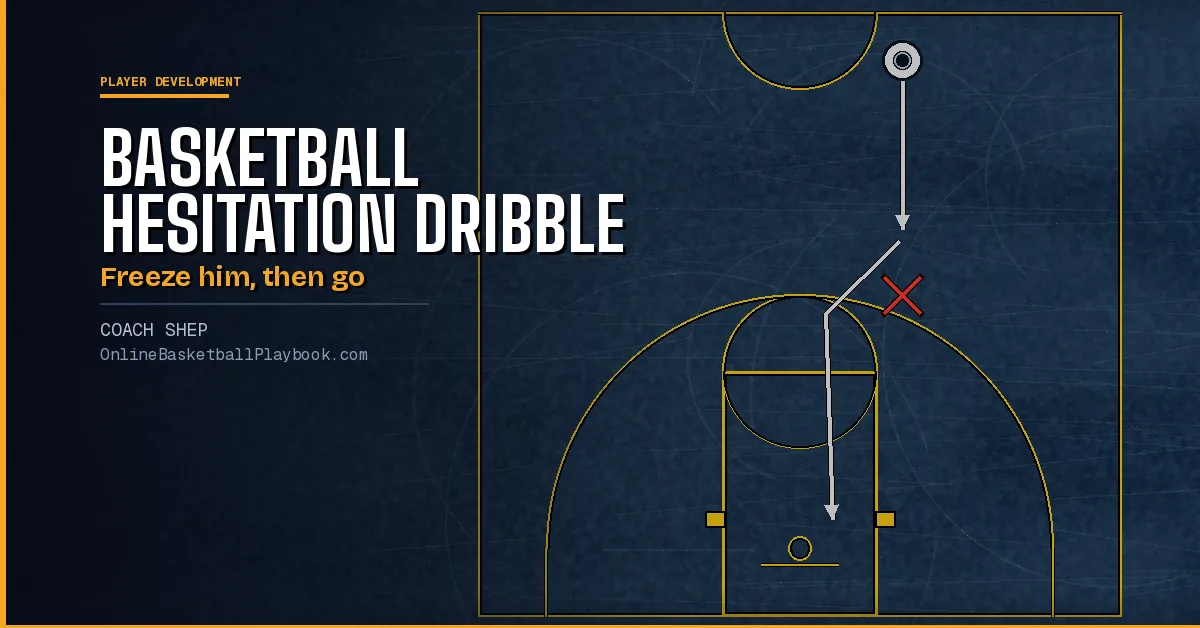
Basketball Hesitation Dribble: How to Do the Hesi Move
The basketball hesitation dribble step by step: the stop and rock back, selling it, when to use it, its crossover and pull-up counters, the hedge read and drills.
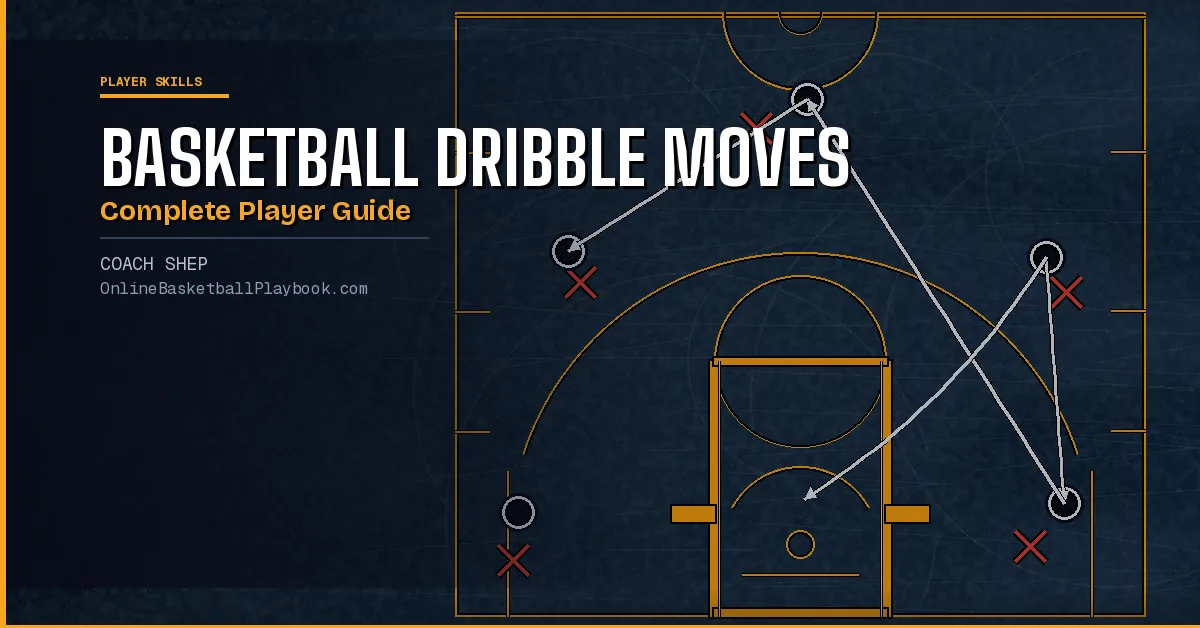
Basketball Dribble Moves: Complete Player Guide
Basketball Dribble Moves: Complete Player Guide