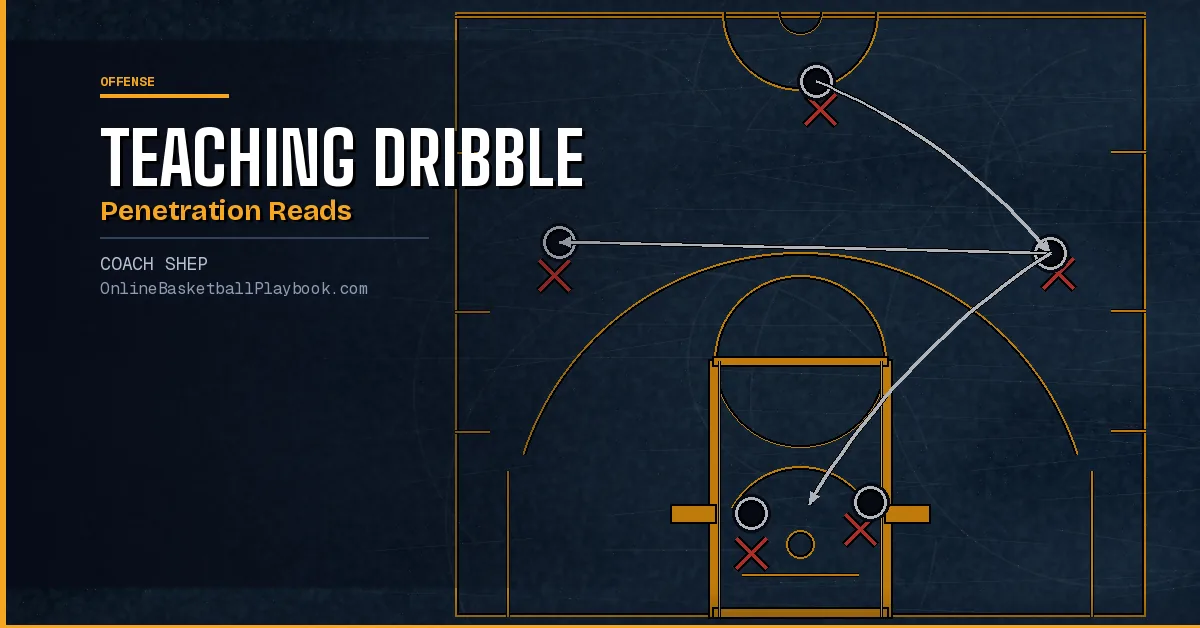
Most guards attack the rim without reading what the defense gives them. Teach them to see the coverage first, then drive, and every dribble becomes a decision that puts the whole offense in motion.
Why Reads Come Before Moves
Most skill development work teaches guards what to do with the ball. Very little teaches them what to look at first. The difference between a guard who creates easy baskets and one who creates traffic for himself usually comes down to this single habit: does he read before he moves, or does he decide what he's doing before the defense gives him any information?
The penetration read is not an advanced concept. It's the first one. A guard who attacks without reading is guessing. A guard who reads first is playing the percentages. The defense tells you where to go. Your job is to listen.
That principle is the backbone of everything this skeleton-offense approach is built on. The individual moves (the hesitation, the body fake, the change-of-angle dribble) only matter once a player understands that those moves exist to create or respond to a read, not to look impressive. "Train reads, not just moves" means every drill should teach a decision, not just a skill.
For coaches, this changes how you run skill work. Instead of drilling a specific move over and over in isolation, you build the drill around a problem: what does the player do when the defender goes under? What happens when the show comes hard? What's the read when two defenders collapse on the drive? Once guards understand that the move is the answer to a question the defense is asking, skill development accelerates because every rep has a decision attached to it.
The Change-of-Angle Dribble
One of the most underused tools in a guard's arsenal is what one guard coach describes as the change-of-angle dribble, what he compares to "parallel parking in reverse." The concept is straightforward: stop, fake forward, go backward, open the lane, then attack.
What makes this move so effective is that it doesn't require elite athleticism to execute. It requires patience and timing. The guard who has learned to stop and reset (rather than keep driving into a collapsing defense) will consistently find lanes that simply aren't there for a guard going at full speed in one direction.
The teaching progression for the change-of-angle dribble starts with the stop. Most guards can't stop. They've been trained, through years of AAU ball, to keep moving. Teaching the change-of-angle dribble is partly a lesson in deceleration: you create space by stopping, not by speeding up. Once a guard trusts that the stop creates the advantage, the fake and the re-attack become natural.
In practice, run this out of two situations: first, off the dribble-drive when a help defender cuts off the lane; second, off the ball screen when the coverage jumps out and the drive is taken away. In both cases, the stop is the read. The defense showed you something, so you stopped. Then you take what opened up.
Footwork That Makes Penetration Work
Every dribble-penetration move is built on a footwork foundation. Coaches who skip the footwork layer and jump straight to the drive end up with guards who lose the ball, pick up bad charges, or can't finish. One guard footwork framework makes this explicit: the mechanics beneath the moves are what make them repeatable and legal.
The two most important footwork concepts for penetration are the blast step and the front crossover drive. They are not interchangeable. Which one a guard uses depends on what the defender's lead foot is doing at the moment of attack.
On the blast move, the defender's lead foot matches the guard's free foot. The instruction is simple but counterintuitive: step almost directly at the defender's lead foot, scraping off their shoulder. "Stepping laterally gives the defender recovery space; stepping into them takes it away." Guards who learn to step north instead of east are almost impossible to cut off because they remove the defender's angle of pursuit before it develops.
On the front crossover drive, the defender's lead foot is on the guard's pivot side. The guard rips the ball low and hard across the shoe tops, protecting it beside the free knee, and the free leg front-pivots across and scrapes off the defender's shoulder as the dribble starts. Same scrape principle, different entry point.
A related footwork detail that coaches routinely overlook is the pull-up jumper stop. The cue: "Your last dribble down, your inside heel down, same instant." The inside heel fires into the floor at the exact moment the last dribble hits, stopping lateral drift and generating upward energy. Guards who pull up and drift are missing this mechanic, not missing effort. It's coachable with a simple two-part cue and a few minutes of work without a basket.
The Three Core Penetration Reads
When a guard attacks the rim, the defense has three common responses: stay in front and contest, show hard off a screen, or collapse with help from the weak side. Each response has a corresponding read. Teaching all three, in order, gives guards a complete decision tree for every drive they take. The system reads of the dribble drive offense are on dribble drive reads.
Read 1: Come to a Stop and Create Contact
When the primary defender stays in front, the guard's first read is whether to stop and create contact rather than keep forcing. The instruction is specific: "lean on the defender. Don't fear contact." Guards who have been coached to avoid defenders end up driving into traffic they created by taking the wrong angle. Guards who understand that contact is a tool (that it creates fouls, disrupts timing, and earns free throws) drive with more authority and draw more calls.
This is a mindset read as much as a technical one. In practice, pair a ball handler with a passive defender and reward the ball handler for making contact on the drive, not for avoiding it. The contact stop is also the setup for the pull-up jumper. A guard who creates contact and then stops becomes an extremely difficult assignment.
Read 2: Hesitate Off the Show, Attack the Recovering Defender
When a defender shows hard off a ball screen (jumping out to take away the drive), most guards pull up immediately or reverse direction. The better read is to hesitate, let the show defender begin to recover, and then attack the space he just vacated. Tony Parker built a career on this read, and one guard program codifies it directly: "go-under vs. go-over off the screen" plus the hesitation off the show as the third option that most defenses aren't built to stop.
The hesitation here is not a ball-handling move for its own sake. It is a timing read. The guard is reading the defender's recovery step. When that step comes, the attack comes. Teaching this read requires putting a defender who actually shows (not a passive cone) in the drill so the guard develops real timing.
Read 3: Kick to the Open Man When Help Collapses
When help defense rotates to cut off the drive, the read is to find the open man before the rotation finishes. This is where penetration becomes team offense. A guard who can consistently make this kick-out pass on the drive forces defenses to choose: either commit to stopping the drive (and give up open threes) or sit back (and let the guard finish). Neither option is good for the defense.
Building this read in practice requires live defenders who actually rotate, not players standing in position waiting to be passed to. The drill has to simulate the timing problem: the kick-out window closes fast, and a guard who hesitates a beat too long turns a wide-open corner three into a contested one. Run small-sided games (3-on-2 or 3-on-3 half-court) with a bonus point for kick-outs off the drive that lead directly to a score.
Drilling Reads Under Pressure
The Florida individual-skill development approach makes one structural principle explicit that many programs miss: every drill needs a progression built in, from simpler form-work to live defensive pressure within the same session. You don't run a drill until guards can do it cleanly in isolation and then retire it. You run the clean form, then add a passive defender, then add a live closeout or show. One drill, three stages of pressure.
Constraint games apply a different version of this principle. Instead of adding defenders, they change the scoring system to coach shot diet and decision-making without stopping play. The No Paint Drill scores one point for two feet in the paint and two points for penetrating to the charge circle. Guards learn when to drive and when to kick based on the score, not from a lecture, but from the drill's own reward structure.
The Get Open Drill teaches the off-screen read the same way: if the defender goes over the top, fade to the corner; if under, curl. Running this in live 2-on-2 before teaching the move name locks in the decision faster than chalk-talk does. Guards make the read in a competitive context, and the right choice becomes muscle memory.
The practical takeaway for coaches is to avoid building drills that only reward a specific action. If your penetration drill has one correct answer (drive left, kick to the corner), guards will run the drill without actually reading the defense. Build the drill so two or three answers are correct depending on what the defense gives. That is what read-based practice actually looks like.
Finish Menus: Floaters and Layups
A guard who can read the penetration situation correctly still needs a finish menu, a set of finishing options matched to what the defense presents at the rim. Teaching only one finish (the right-hand layup, the standard reverse) produces guards who get their reads right and then turn the ball over or get blocked because they have no answer when the defense takes away their go-to move.
The floater is the primary finish tool for guards who attack bigs in the paint. The proper foot to leave off is specified to leave off (not a detail coaches should leave to chance) and includes the surprise one-step, the run-around hook, and the reverse layup that uses the rim as a protector. Each of these has a situation where it's the highest-percentage option. Teaching guards to identify that situation is the same skill as teaching the penetration read itself: look first, then execute.
Reverse layups off the near side of the rim (where the body shields the ball from a chasing defender and the rim absorbs any block attempt) are particularly undervalued at the high school level. Most guards are taught to attack the near side of the basket. The reverse layup turns the help defender's angle into a liability, and it's learnable at any level. Include it in every finishing circuit.
For guards practicing finish menus, the "make 11" structure used in the all-game-shots circuit applies here too. Each finishing station runs until the guard makes eleven, not until the timer runs out, not until they get ten makes. The make count keeps standards honest and builds conditioning into the finishing work at the same time.
Building a Read-Based Practice Plan
Putting all of this together into a daily practice structure is simpler than it looks. The goal is to run guard skill work in a sequence that moves from technique to read to competition, not to run isolated skill drills and hope reads appear in games.
Start with footwork before anything else. Six minutes (the Offensive Pivoting and Passing Breakdown Drill, twelve players working simultaneously) covers jump stop, step-out, rip-through, and shooting footwork without needing a basket. This is not optional prep work. This is where the foundational mechanics get installed so the rest of practice doesn't spend time re-teaching them.
Move from footwork into the penetration-read skeleton, a passive-defender workout where guards run the three reads described above in sequence. Passive defenders give the guard time to make the correct read before adding pressure. This stage is where you name the reads, give them a vocabulary, and correct decision errors before they compete. A named-move library comes from the same discipline: a move with a name is a move a player can self-correct without a coach present.
Close with competition. Small-sided games (3-on-3 half-court or the constraint game formats) are where reads get tested at game speed under real defensive pressure. This is the stage where the drills earn their keep. If your guards are making the reads you taught in the skeleton phase, you'll see it here. If they're reverting to guessing, the competition stage shows you where the gap is and what to address in the next skill session.
The entire sequence (footwork, skeleton, competition) can run in twenty-five minutes with a full team. It does not require extra time on the practice schedule. It requires replacing isolated dribbling drills with a structure that actually teaches the decisions guards need to make when they drive the ball in a game.
Before you add a new penetration move to your guard workout, run the drill with a passive defender who gives one of three coverages: stay, show, or collapse. The move only earns a spot in the workout if it produces a clear correct answer to one of those reads. If your guards can do the move but can't tell you which defensive situation it answers, the drill is decoration, not development. Name the read before you teach the move, and make sure every rep in practice has a decision attached to it. That single habit is what separates skill work that transfers to games from skill work that only looks good in drills.
- Step north, not east on the blast move. When the defender's lead foot matches the guard's free foot, drive directly at their lead foot and scrape their shoulder. Lateral steps give the defense recovery space, north steps take it away.
- Fire the inside heel on every pull-up. The last dribble and the inside heel hit the floor at the same instant. This stops lateral drift and generates upward energy. Drill this without a basket using the Circle Footwork Drill so the whole squad can rep it simultaneously.
- Name every read, not just every move. Parker "never expose yourself" off the screen, Nash hesitation off the show, Al-cut seal on the catch. A named read is a one-word cue that replaces a two-sentence correction. Guards who have names for their reads self-correct without the coach stopping play.
- Teach the change-of-angle dribble as a stop, not a retreat. When help defense cuts off the lane, guards who stop and reset create new attack angles. Guards who retreat lose the initiative. Practice the stop itself as a skill. Deceleration is learnable and it unlocks the entire change-of-angle read.
- Build finish menus before drives, not after. Run each guard through a named finish circuit (floater, reverse layup, one-step pull-up, rim-protector reverse) using a "make 11" format so conditioning and finishing work are the same drill. Guards who have all four finishes available make better penetration decisions because they're not avoiding situations where they lack a finish.
- Use constraint games to coach shot diet without stopping play. No Paint Drill (1 point for two feet in the paint, 2 points for reaching the charge circle) and small-sided 3-on-3 with bonus points for kick-outs teach when to drive and when to pass through the scoring system with no lecture required.
Want more basketball coaching strategies, drills, and tools?
Join the Online Basketball Playbook newsletter →
Draw this play free in the play drawer →
Membership: the full library, playbook packs, and Pro drawing tools →
Keep Building
Related breakdowns
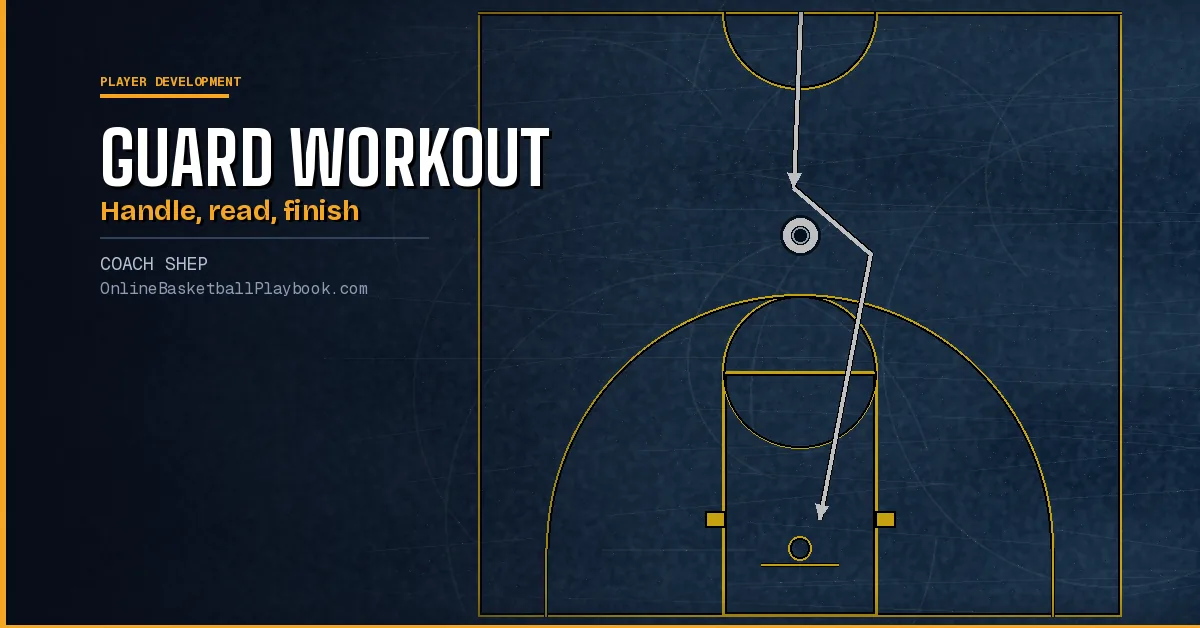
Guard Workout: Handles, Reads and Finishing You Can Print
A guard workout you can print: a full session with its standards, plus handle work, jab, closeout and ball-screen reads, finishing and shooting off the dribble.
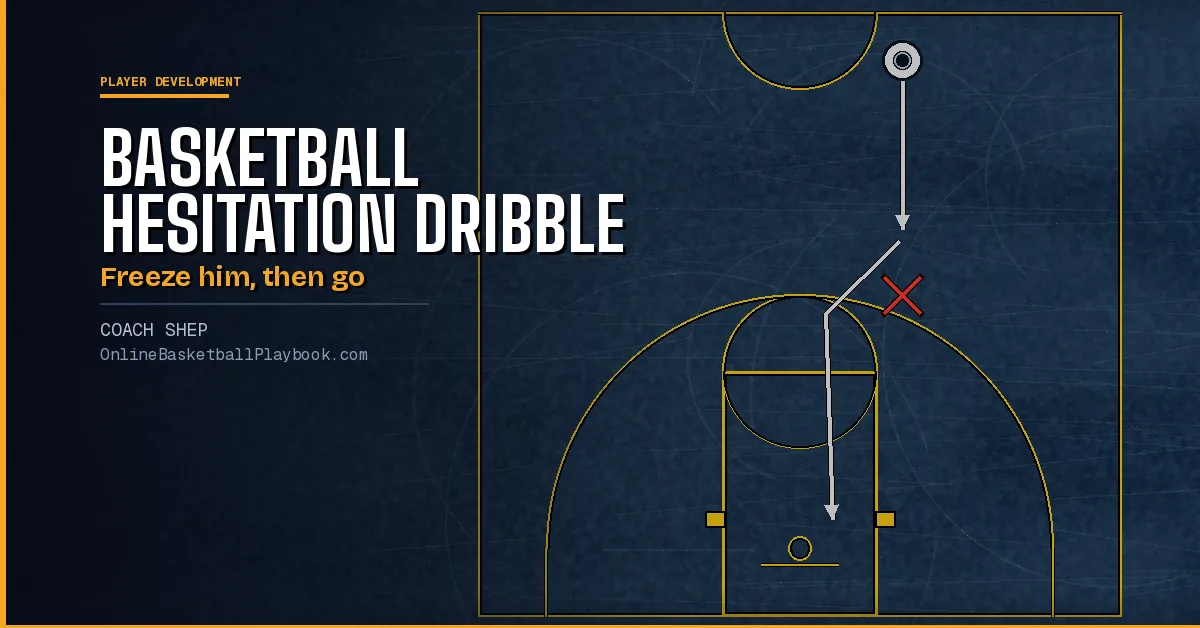
Basketball Hesitation Dribble: How to Do the Hesi Move
The basketball hesitation dribble step by step: the stop and rock back, selling it, when to use it, its crossover and pull-up counters, the hedge read and drills.
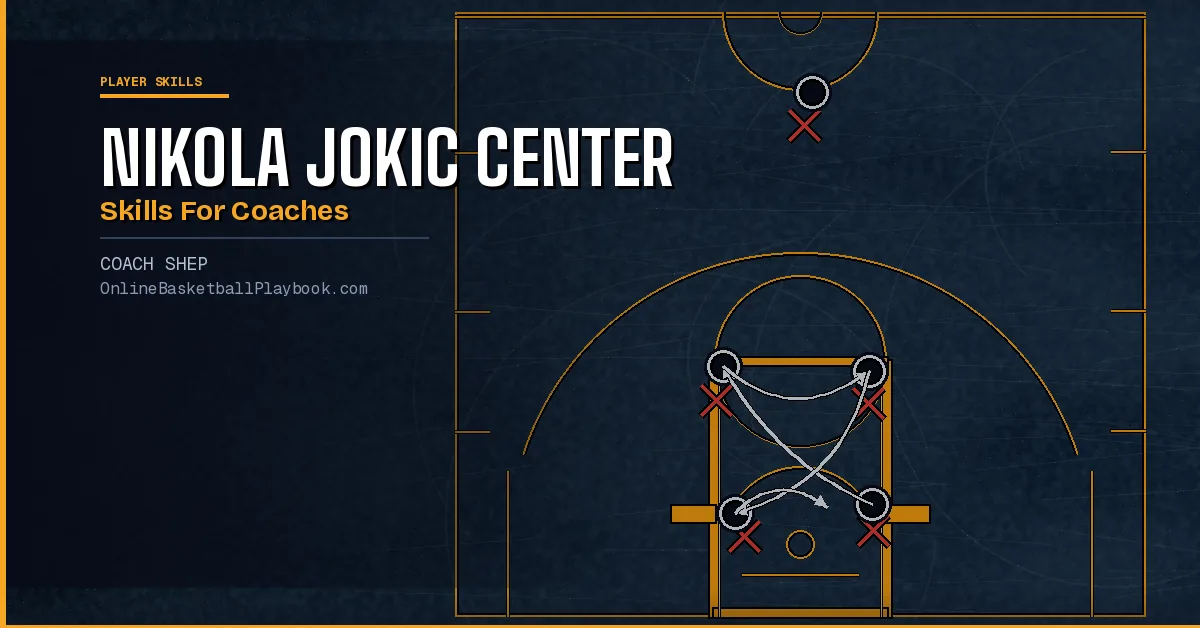
Teaching Nikola Jokic Big Man Skills to Your Centers
Teaching Nikola Jokic Big Man Skills to Your Centers