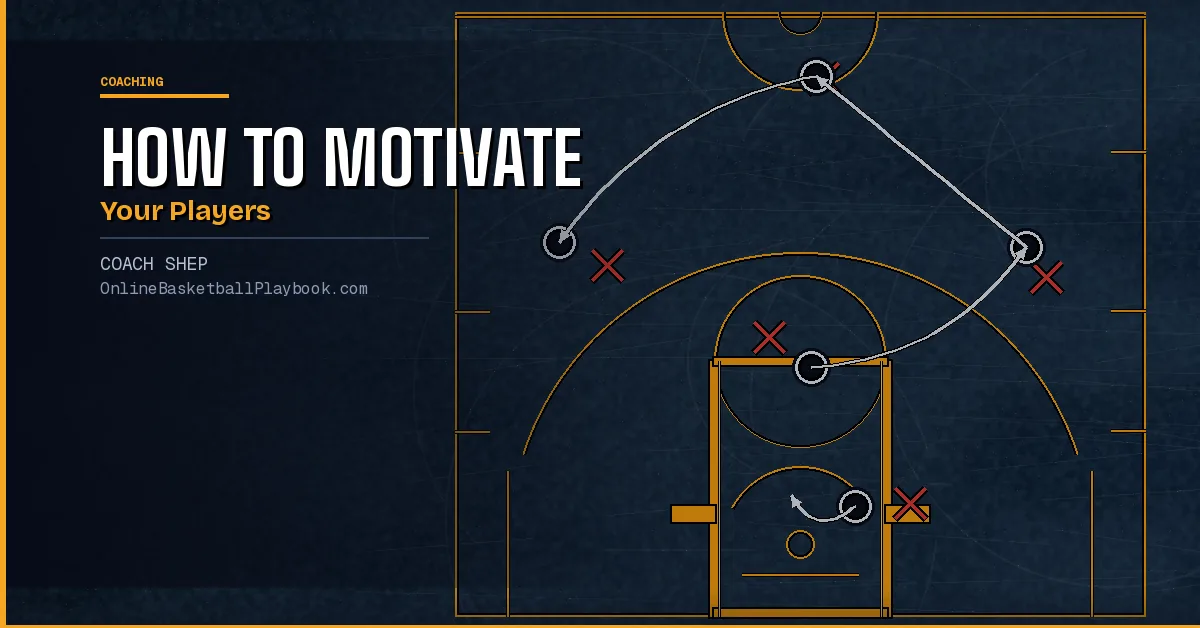
Motivation isn't a halftime speech. It's a system coaches build over months, through standards, relationships, and a team identity players genuinely believe in. Get that right and effort takes care of itself.
Build Identity First
The most sustainable motivation comes from belonging to something bigger than a win-loss record. When players understand what the program stands for (its values, its style of play, its expectations), they have a reason to push themselves that outlasts any single game.
Identity-first programs don't start from scratch each year. They establish a foundation with returning core players and a clear, public team philosophy that communicates "this is who we are." That identity becomes the magnet that attracts the right new additions and keeps veterans invested. Players who chose to be part of something meaningful don't need to be coaxed to compete because they want to live up to what the program represents.
This is directly tied to building basketball team culture. Culture is not a poster on the gym wall. It's the behavior you tolerate, the behavior you reward, and the stories you tell about past players who modeled the right way. Those stories are powerful motivational tools because they give current players a standard to measure themselves against and a legacy worth protecting.
Spend real time at the start of every season defining and re-defining what your program is. Hold a team meeting where players articulate the values themselves. When players co-author the identity, they own it. Ownership creates internal motivation that no coach's speech can manufacture from the outside.
Set Non-Negotiable Standards
Motivation collapses without structure. Players, especially competitive ones, need to know exactly what's expected, and they need to trust that those expectations apply to everyone on the roster equally. When standards are vague or inconsistently enforced, players lose confidence in the system and drift.
The most effective programs establish a preseason code that covers the basics: punctuality, rest habits, respect for teammates and staff, effort in practice. These rules are set early, before problems arise, and enforced immediately when broken. "Discipline is the key word," as elite coaches consistently say. Standards that are only invoked after someone falls short aren't standards; they're reactions.
Accountability and motivation are two sides of the same coin. When players see that their teammates are held to the same standard, regardless of playing time or talent level, it builds trust. That trust is motivating. Players sprint back on transition defense when they believe everyone else will do the same. They dive for loose balls when they know the coach notices and the team expects it.
Keep the rule set simple. A short list of truly non-negotiable items is more powerful than a handbook full of clauses. The goal is clarity, not control. When every player can recite the program's standards from memory, those standards become self-enforcing within the group.
Use Individual Conversations
Team speeches are visible, but individual conversations are where real motivation happens. A player who feels seen, who believes the coach knows what drives them, what scares them, and what they're working toward, will run through a wall for that coach. A player who feels like a uniform number will not.
Make it a habit to have repeated one-on-one conversations with every player on your roster. Not just the stars and not just the ones who are struggling. Everyone. The goal is to align each player's individual goals with the team's goals. When a player's personal ambitions (making varsity, earning a scholarship, improving their handles, developing into a leader) are woven into the team's mission, motivation becomes self-sustaining.
Ask specific questions: What do you want to accomplish this season? What do you think is holding you back? What does success look like for you by March? Then listen. Take notes if you need to. Revisit those conversations mid-season and show players the progress they've made. People are motivated by evidence of growth, and your job is to make that evidence visible.
Individual conversations also let you recruit character, which the best programs treat as a prerequisite. "Look for character (to survive a long season), genuine hard work, position-specific fundamentals, and 'hunger for titles.'" When you recruit and develop players with genuine internal drive, your motivation task becomes much easier. You're amplifying something that's already there rather than installing something from scratch.
Schedule a five-minute individual check-in with each player at least once every two weeks during the season. Keep notes on what they share and follow up. Players who feel heard push harder without being asked to.
Focus Players on Process
One of the fastest ways to undermine player motivation is to make outcomes the primary measuring stick. When winning is the only thing that counts, players who are working hard but losing start to question whether the effort is worth it. Process-focused teams are more resilient because players have clear daily wins to pursue regardless of the scoreboard.
Consistent improvement, not wins, is the metric that sustains effort through a long season. Define what improvement looks like in measurable, practice-level terms: shot attempts, defensive possessions graded, sprint times, turnover rate, screen grades. When players can see themselves getting better at a specific skill week over week, they don't need to be hyped up before practice. The progress is its own fuel.
This mindset connects directly to basketball IQ development. Players with high basketball IQ understand why they're doing what they're being asked to do. When players understand the purpose behind a drill or a system, not just the mechanics, they invest in it differently. Explain the "why" behind every major element of your program. Players who understand the reasoning become students of the game, and students of the game are self-motivated learners.
Celebrate process wins loudly and publicly. Call out the player who made the right read and got nothing for it. Recognize the screen that freed a teammate. Acknowledge the defensive rotation that prevented a basket. When players see that the coaching staff notices and values the right behaviors, not just the visible stat-line moments, they repeat those behaviors. That's how you build a motivated team at the process level.
Create a Motivating Practice Environment
Your players spend far more time in practice than in games. If practice is dull, punitive, or disorganized, motivation bleeds out quietly every day. If practice is competitive, purposeful, and structured for growth, players show up ready and leave better. The environment you build in the gym is the foundation of everything else.
Competition is the simplest motivational tool available. Everything that can be competed can be tracked, and everything that's tracked becomes a motivating force. Time drills. Post the results. Run bracketed shooting competitions. Grade defensive possessions against each other. Players want to know where they stand among their peers, and a healthy competitive environment channels that instinct toward improvement rather than jealousy.
A strong basketball practice plan is a motivational document as much as a logistical one. When practice has a clear structure (a warm-up purpose, a skill segment, a competitive team segment, a conditioning close), players know what to expect and can mentally prepare. Wandering, unplanned practices communicate that the coach hasn't prepared, and players respond to that signal by not preparing either.
Vary the drills enough to keep players mentally engaged without sacrificing repetition of core skills. Use small-sided games and competitive stations. Give players agency where you can. Let captains run a warm-up, let players vote on the conditioning drill for the week. Autonomy within structure is a powerful motivator. Players who feel some ownership over the environment take responsibility for it.
Sustain Effort Through a Long Season
Motivation at the season's start is easy. Sustaining it through a rough mid-season stretch, a losing skid, or the grind of a long schedule is the real coaching challenge. Teams that stay motivated through adversity have built something structural, not just emotional.
Protect chemistry above all else. Imbalance in how players are treated poisons a locker room faster than losses. Don't overpay or over-elevate one player relative to the group. Favoritism, real or perceived, creates resentment, and resentment is the enemy of collective effort. Fairness is a motivational tool. When every player believes the system is fair, they compete for the team rather than against it.
Use the concept of "no weak links" explicitly with your team. Make it clear that everyone on the roster has a role in the program's success, and that every player's behavior, their energy, their effort, their attitude, affects the group. Players who feel genuinely needed are harder to disengage. A player who believes their contribution matters will fight through fatigue and frustration in ways that a player who feels disposable will not.
Mid-season is also when individual conversations become most valuable. Check in on the players who are playing well. They need reinforcement too. Check in on the players riding the bench. They need connection most when they feel least visible. A coach who maintains relationships through the hard stretches earns a level of player commitment that carries the team when the talent alone won't.
Finally, keep the standards visible. Return to the preseason code. Read it in a team meeting. Ask players to self-assess against it. Standards that are stated once and forgotten don't hold. Standards that are returned to regularly become the backbone of a program's identity, and that identity, as discussed at the start, is the most durable motivational force a coach can build.
- Set a preseason code of ethics with specific, enforceable standards before problems arise
- Hold individual one-on-one conversations with every player at least twice per month
- Celebrate process wins (right reads, defensive rotations, unselfish plays) publicly and consistently
- Build competitive structures into every practice so players have measurable daily goals
- Align each player's personal goals with the team mission through repeated direct conversation
- Protect fairness. No player elevated above the standard. Imbalance poisons team chemistry fast
- Return to your program's identity statements mid-season when motivation is hardest to sustain
Get free play diagrams, drills, and coaching guides delivered weekly.
Draw this play free in the play drawer →
Membership: the full library, playbook packs, and Pro drawing tools →
Keep Building
Related breakdowns
Cutting Players: What to Say and How to Say It
Cutting players: what to say on day one, in the meeting and to parents, the words to use and avoid, what to hand the player, and how to keep the door open.
Coaching Communication: How to Explain Basketball to Players
Coaching communication for basketball: the teaching order, fewer and clearer words, how to correct a mistake, one team vocabulary and calls taught inside the drill.
Teaching Players to Adapt to Different Playing Styles
Teaching Players to Adapt to Different Playing Styles