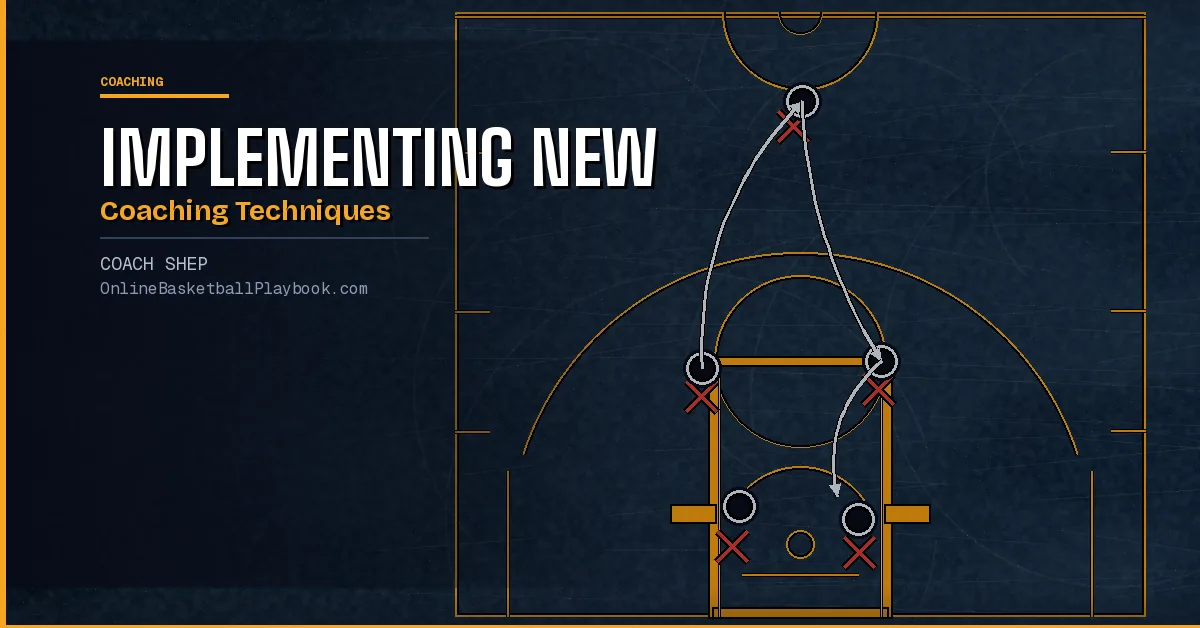
Introducing new techniques without losing your team is a skill most coaches never develop. Here is a practical framework for rolling out change, building player buy-in, and making it stick all season long.
Start With Identity, Not Technique
Most coaches make a critical mistake when they try to implement something new: they lead with the technique itself instead of leading with the reason behind it. Players do not resist new techniques because they are difficult. They resist them because they do not understand why the change matters to the team's identity and where they fit inside it.
Zbigniew Obradovic, one of the most decorated coaches in European basketball history, built his programs on a simple premise: identity comes first, and technique serves the identity. Before he introduced any new action or concept, his players already knew what kind of team they were. The technique was just the expression of that identity, not a disruption to it.
Before rolling out anything new, define your program identity out loud. What kind of team are you? What do you value above all else? How do you play? These answers need to be public, consistent, and talked about constantly. When your players know who you are as a program, new techniques land as natural extensions of that identity rather than as challenges to everything they already know.
Morgan Wootten coached 46 years at DeMatha Catholic High School and won more than 1,200 games. His program architecture started with five foundational questions about purpose and values, and he answered those questions before he ever built a practice plan. His system taught players that basketball was the medium, not the end. That reframe made players far more receptive to being corrected and to learning new methods because they trusted the larger purpose behind them.
If you want your new techniques to take hold, spend the first week of the season establishing identity. Let players articulate it back to you. Use the technique rollout as proof of the identity, not a departure from it.
Set Your Non-Negotiables Early
Kelvin Sampson has a phrase that transfers directly to technique implementation: "Every program must have non-negotiables: attitude and effort, held the same every day." That phrase sounds like it is about character. But it is also a structural coaching lesson about how change takes hold.
When you introduce a new technique, the players are watching two things simultaneously. First, they are watching whether the technique itself makes sense. Second, and this matters far more, they are watching whether you actually enforce it, or whether you drop it the first time a game gets tight or a star player ignores it.
The coaches who successfully implement new techniques are the ones who set the enforcement standard before the technique is introduced. They tell players: this is how we do it, this is why we do it this way, and this is what happens when we do not. Then they enforce it without exceptions from day one.
Hubie Brown's four rules are a useful model here. Be on time. Play hard. Know your job. Know when to pass versus when to shoot. Brown was meticulous about enforcing these rules identically for every player regardless of their status on the roster. That consistency is what gave the rules power. Players understood that the rules were not suggestions. They were the operating standard. When he introduced new techniques into that culture, they landed in a program that already knew how to hold itself accountable.
Set your standard for the new technique before you teach it. Tell players what a correct rep looks like, what an incorrect rep looks like, and what the consequence is for repetitive incorrect execution. That framing takes a technique out of the zone of "something we're trying" and puts it into the zone of "something we do."
Introduce New Techniques Gradually
Obradovic's preseason structure is one of the most underrated frameworks in coaching literature. He ran a seven-week phased preseason that shifted from 70 percent conditioning and 30 percent basketball in week one, to 20 percent conditioning and 80 percent basketball by week seven. Within that structure, he introduced only two or three new concepts per side (offense and defense) at the start of the preseason. He did not attempt to build the entire system at once.
That restraint is the technique. Most coaches lose players not because their new ideas are bad but because they introduce too many new concepts too quickly, before the players have enough repetitions to internalize even one of them confidently. Confidence in execution is the prerequisite for actual game deployment. Without it, players hesitate, which is worse than the mistake the technique was designed to prevent.
The practical application is straightforward. Pick one or two techniques you want to implement. Build every drill, every early practice segment, and every correction around those specific techniques. Hold off on the next layer until you can clearly see (not just feel) that players are executing the first layer without conscious thought. The test is whether they can do it correctly when the drill is competitive and the pressure is real.
Bob Hurley Sr. added a useful discipline to this framework: do not add supplementary techniques or defensive bailouts in the first ten games. Let the team discover who it is with the base. That restraint prevents you from layering complexity on top of uncertainty, which is the fastest way to produce a team that is technically confused and mentally fragile.
Bill Parcells put the same concept differently. He believed that a game plan can break down under maximum pressure, but habits built in practice cannot. His job was to make correct execution automatic through sheer volume of correct reps. He did not try to install multiple new systems at once. He drilled the same actions until there was no cognitive cost to performing them. That is the standard for technique implementation: enough reps that the player is reacting, not thinking.
Build Player Buy-In Through Ownership
Buy-in is not something you ask for once at the beginning of the season. It is something you rebuild constantly through the way you explain your decisions and the way you treat the people you coach. The coaches who build the deepest buy-in for new techniques share one habit: they explain the why, not just the what.
Erik Spoelstra's framework at the professional level applies directly to youth and high school programs. His "together, tough, trust" culture was built on radical honesty and the elimination of what he called elephants in the room. He did not allow separation or gurus. He made the whole team face problems together, and he explained his reasoning openly enough that players could internalize it rather than just comply with it.
At the practice level, that means when you introduce a new technique, you owe your players an explanation that gives them a mental model for it. Not a long lecture, but a concise answer to the question every player is already asking silently: why are we doing this instead of what we were doing before? When you answer that question proactively, you eliminate the rumbling resistance that kills new technique adoption before it even starts.
Tauer's opening-day question is a simple and powerful buy-in tool. On the first day of practice he asked every player to raise their hand if they were a role player. The room went quiet. The silence itself was the message: everyone has a role, and knowing your role is not a limitation, it is a clarity that sets you free to execute. When players understand that a new technique has a clear place in a system designed with their role in mind, they adopt it far faster than if they feel like they are just following orders from the whiteboard.
Mike Dunlap's approach to role declaration reinforces this. Before players execute anything, they need to know their specific role within it. Ambiguity about who does what is corrosive to technique adoption. Declare roles explicitly, tie each player's role to the new technique, and revisit those role declarations when something is not working. That level of specificity is what separates programs where new techniques genuinely take hold from programs where they fade out by the fourth game of the season.
Enforce the Standard Every Single Day
Obradovic's clinic on collective accountability contained one of the clearest statements on daily enforcement in the coaching literature: his non-negotiables were run every single practice, with no exceptions and no shortcuts, from game one to game eighty. The value was not in the complexity of the drills. They were deliberately simple. The value was in the unconditional repetition.
This is where most technique implementations fail. A coach introduces a new concept with energy and clarity in the first week. Players begin to learn it. Then a difficult game happens, or a key player struggles, and the coach quietly sets aside the standard for a few days to reduce tension. By the time the coach returns to enforcing it, the window has passed. Players have learned that the technique is optional under pressure, which is precisely when you need it most.
Dan Hurley's framing at UConn captures the enforcement discipline clearly: culture is the system, not the plays. His four core principles (no weak links, consistent improvement, relentless competitive effort, and mindful communication) were not enforced seasonally. They were enforced daily, and Hurley was the tone-setter who demonstrated those principles through his own behavior in practice before he demanded them from players.
John Tauer's INCHES framework gives coaches a concrete enforcement vocabulary that works at any level. Improvement, No Excuses, Communication, Health, Energy and Enthusiasm, Selflessness. When you tie your new technique explicitly to one of those character dimensions, you give players a reason to enforce it on each other. The technique becomes part of the program's character standard rather than a tactical preference the coach might change next week.
Hold your best players to the standard first and most visibly. Dean Smith's team unity doctrine was explicit about this: bench players stand and applaud effort plays, and substitution decisions are based on patterns of effort rather than isolated errors. When the best players in the gym are held to the same technical standard as everyone else (publicly and consistently), the standard becomes the culture rather than an aspiration.
Measure Practice-to-Game Slippage
Larry Eustachy's "game slippage" concept is one of the most practically useful diagnostic tools for coaches implementing new techniques. The question is simple: how much does your team's execution of a given technique degrade from practice to games? A coach whose team has less slippage has a measurable advantage, and slippage is a coaching receipt, not a player receipt.
Most coaches have a sense of whether a technique is working, but they measure it through outcome. Did we win? Did we score? Those are lagging indicators that tell you nothing about why execution broke down or where in the technique the breakdown happened. Slippage measurement forces you to track the specific actions in practice and compare them to the same actions on game film.
David Richman at North Dakota State built his entire program around a single measurable standard: win 65 of 100 possessions in a game. He drilled his players on the micro-fundamentals (catch with two hands, catch on two feet, catch with two eyes) because those atomic details compound under pressure. When you track whether players are executing the micro-fundamentals of a new technique in games versus practice, you know exactly where your reps need to go next week.
Set up a simple tracking system when you introduce a new technique. Pick two or three specific observable actions that define correct execution. Watch game film and count how often you see them versus how often you saw them in practice. If the gap is large, the technique is not yet automatic. You need more reps under pressure before the next competitive block. If the gap is small, your implementation is working and you can begin to layer in the next element.
Parcells' 4th-quarter role test is the simplest version of slippage measurement available. At the end of every practice week, ask each player to describe their specific assignment in a late-game scenario without prompting. If they cannot do it cleanly, the coach is not done preparing them. That test keeps the coaching staff honest about whether the technique is truly installed or just performed on cue during structured drills.
When you introduce a new technique, run it inside a competitive drill within the first two practices, not just a controlled walkthrough. Players need to feel what it is like to execute the technique when something is on the line. The faster you put the technique under pressure, the faster you find out which parts need more reps and which parts your players have genuinely internalized. Waiting too long to compete with a new concept creates a false sense of progress.
- Define your program identity publicly before introducing any new technique because players adopt change faster when it connects to something they already believe about who you are as a team.
- Introduce no more than two or three new concepts per side (offense and defense) in the first phase of the season; build enough reps on those before layering anything else on top.
- Set the enforcement standard for the new technique before you teach it. Tell players what correct looks like, what incorrect looks like, and what the consequence is for repeated wrong execution.
- Declare each player's specific role within the new technique explicitly and early; ambiguity about who does what is one of the fastest ways to kill adoption before it starts.
- Track practice-to-game slippage on two or three observable micro-fundamentals of the technique after every competitive block, and use the gap to direct your next week of reps.
- Run the 4th-quarter role test weekly. Ask each player to state their assignment from memory without prompting, and treat any failure to answer cleanly as a coaching task, not a player character verdict.
Want more basketball coaching strategies, drills, and tools?
Join the Online Basketball Playbook newsletter →
Draw this play free in the play drawer →
Membership: the full library, playbook packs, and Pro drawing tools →
Keep Building
Related breakdowns
Mentorship Program for Young Coaches: Match, Meet, Review
How to build a mentorship program for young coaches: set goals and a length, match on style and time, meet on a schedule, give one real job and review it.
How to Build a Basketball Program: Identity, Staff and Culture
How to build a basketball program: identity first, written standards, staff roles, the season calendar, feeder programs and recruiting players who fit.
Transition First Program Model: Push, Defend, Compete
Coach Shep's transition first program model: three core beliefs, push after every rebound, layups and threes, no called plays, one contested shot, scored practice.