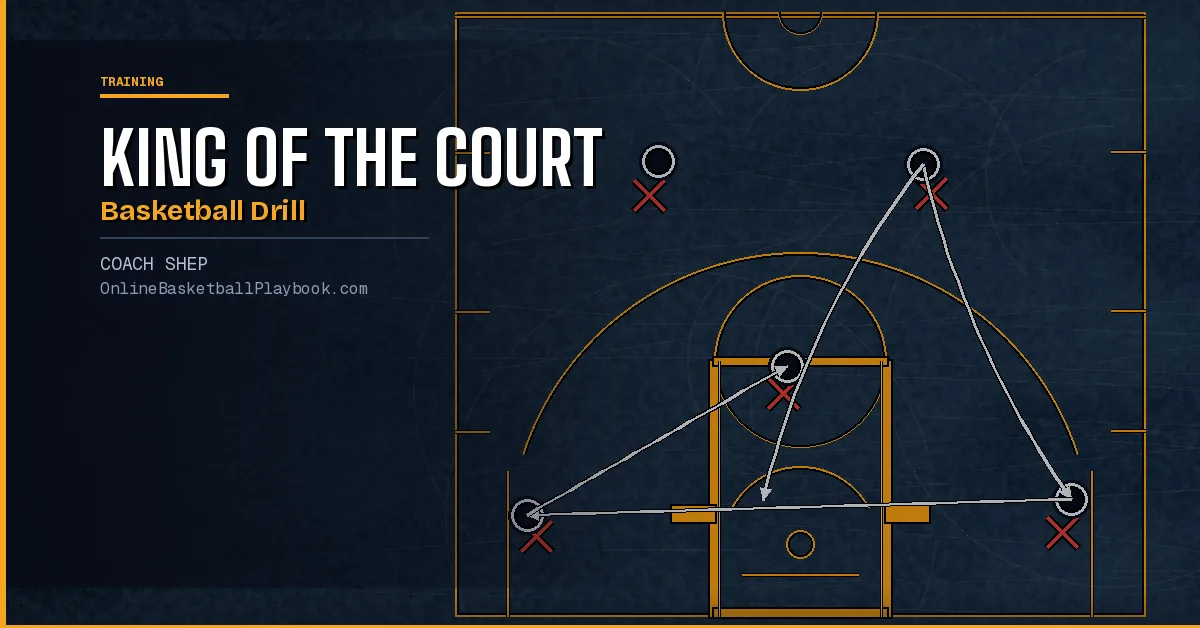
King of the Court is the most competitive drill in basketball. Winners stay, losers rotate out, and every rep is played at game speed, making it the fastest way to build pressure defense, toughness, and conditioning simultaneously.
What King of the Court Actually Is
King of the Court is a competitive basketball drill built on one simple rule: score and you stay on the court, give up a basket and you're out. A new team rotates in from the sideline, and the team that just scored now has to defend. The pressure is constant and the stakes are immediate. There is no coasting, no waiting for the next play, no team that can afford to stop competing for a single possession.
Most coaches run some version of this drill without fully understanding what it's actually training. On the surface it looks like a scoring game. At a deeper level, King of the Court is a pressure simulation. The offense always has fresh legs. The defense is protecting its spot. That dynamic creates exactly the kind of urgency and decision-making speed that your press defense needs to function in a real game.
The drill has been a staple of high-level programs for decades precisely because it compresses game conditions into a short, repeatable format. Every possession matters. Mistakes cost you your spot. Mental toughness and defensive communication are tested every single rep.
Basic Rules and Setup
The standard version of King of the Court runs with three teams of three players. You can run it with two-on-two, three-on-three, or four-on-four. The number of players per team doesn't change the core structure. What matters is the rotation system.
Standard Three-Team Setup
Two teams play on the court. A third team waits on the sideline. The team currently on defense is under the most pressure. If the offense scores, the defensive team goes to the sideline and the waiting team comes on to face the team that just scored. If the defense gets a stop, the offensive team goes to the sideline and the new team comes on to challenge the defending team.
This is the key asymmetry of the drill: a team that keeps winning never gets a rest. They are always on offense after a score, then defending, then offense again if they keep winning. That is a significant physical and mental test, and it mirrors exactly what happens to a team that gets on a run in a real game. They have to keep executing under fatigue.
Scoring Rules
You have two basic options. Run the drill live-ball, where any made basket from any spot on the court counts. Or set a constraint (for example, a made basket only counts if it was set up by at least one pass). The constrained version forces the offense to create real offensive structure instead of going one-on-one every possession.
For press-defense training, add this rule: if the offense advances past half-court within three seconds of gaining possession, they get a free throw before the next possession. This rewards a fast outlet and punishes slow defensive recovery, which is exactly what you need to drill when teaching press-break offense and press-defense recovery simultaneously.
Court and Player Count Adjustments
Run the drill on a half court for skill-building and offensive decision-making. Run it on a three-quarter court when you want to simulate transition and press defense. Full-court King of the Court is rare but brutal. Reserve it for late preseason when conditioning is already high and your press rotations are automatic.
Variations That Change Everything
The power of King of the Court as a coaching tool comes from how easily you can modify it to target a specific weakness or emphasize a specific skill. These are the most useful variations.
Win-by-Two
A team must score twice in a row to hold the court. A single score just resets the possession. The same team attacks again. This variation trains defenses to get a stop after giving up a basket, which is one of the hardest mental resets in basketball. It also punishes offenses that have no second-look play and no ability to execute consecutive possessions under pressure.
Timed Possessions
Give the offense fifteen seconds to score. No basket in fifteen seconds means the defense wins the possession and the offense rotates out. This version explicitly trains pace and shot-clock awareness. It rewards ball movement and punishes over-dribbling. For teams that tend to slow down under pressure and lose their offensive structure, this is the right version to run.
Defensive Hold Counts
Instead of a single stop, require the defending team to get two consecutive stops to take possession and stay on the court. This is the opposite of Win-by-Two. It makes defense the primary challenge and teaches teams to sustain defensive effort over multiple possessions, not just get lucky with one steal or missed shot.
Press-Entry Rule
When the offense scores, they must start their next possession by inbounding the ball from under their own basket rather than from center court. The defense can apply pressure from the moment the ball is live. This version is a direct press-defense training tool. It puts the offense in a live inbound situation every single time and forces the defense to make real decisions about when to extend and when to back off.
The Press Defense Connection
King of the Court and press defense are deeply connected, and most coaches underuse that connection. The drill naturally creates the pressure situations that make or break your press, and with small rule adjustments you can make that connection explicit.
The three-quarter court press is a perfect companion system here. A three-quarter press picks up at roughly the three-quarter line (between the offensive free-throw line extended and half court) rather than at the baseline. Unlike a full-court press, the defense is already organized and waiting when the ball carrier arrives. Unlike a standard half-court defense, the pick-up point catches the offense in the dead zone where they expect no resistance.
The tactical advantage is that the ball handler has already built momentum and expects open court. The defense springs the trap at exactly that moment. In King of the Court with a press-entry rule, you can recreate this scenario every possession. The offense is advancing the ball, feeling temporary freedom, and the defense picks up at the three-quarter line just as momentum is highest, which is the discipline the three-quarter press demands in a real game.
The critical trap principle from any press system applies directly in the drill: force the ball to the sideline before trapping. The sideline acts as a third defender. In a three-man King of the Court with press rules, one defender forces direction while the second closes to trap on the trigger. The third player is the goaltender. They never commit to the trap and they protect the basket. This is the same 2-trappers / 1-goaltender structure that makes any press rotation functional.
Running King of the Court with three-quarter court press rules teaches one thing above all else: the discipline of trapping only the uncontrolled dribble. This is the single most-repeated principle across every press system in any coaching manual. If the ball handler is head-up, looking to pass, and in a controlled dribble, the defense backs up. The trap springs when the ball handler lowers their head into a speed dribble. Players who haven't drilled this distinction will run at every ball handler regardless of their control level, and that's how presses get broken. King of the Court creates enough live repetitions to build the read automatically.
Coaching the Drill the Right Way
King of the Court fails when coaches let it run without stopping to teach. The competitive energy of the drill can trick you into thinking learning is happening automatically. It isn't. Players competing at full speed in a chaotic environment will default to their existing habits, good and bad. The coaching has to be surgical.
Stop the Action Immediately After Decision Errors
The most teachable moment in King of the Court is the bad read. When a player traps a controlled dribbler and gets beaten, stop the drill. Walk back the possession. Show the player the trigger they should have waited for. Then run it again. Letting bad reads slide because the drill has momentum means you are reinforcing the exact habits you are trying to change.
Name the Five Roles Before Running Press Variations
If you are using King of the Court to train press defense, players need to know their roles before the drill starts, not after. The Controller is the on-ball defender who forces direction and denies the ball handler a read of the floor. The Gapper closes to the trap from the weak side. The Goaltender never commits and protects the basket. Name these roles, assign them, and hold players accountable to the assignment, not just to the outcome.
Recovery Is the Lesson, Not the Steal
Press defense fails when defenders chase the ball after the trap is broken. The correct recovery in any press is to sprint to spots between the ball and the basket, not toward the ball handler. King of the Court magnifies this lesson because a broken trap in a three-on-three setting is an immediate layup. When the trap fails, the coaching point is always: where did your feet go? If they went toward the ball handler instead of toward a recovery angle, that is the correction.
Use Scoring to Measure the Right Thing
Keep score, but decide in advance what you are measuring. If you are training press defense, score the possessions where the defense got a stop by forcing a bad decision, not just possessions where they got a steal. A defense that forces a lob pass and recovers to contest the catch is doing its job correctly even if no steal results. Rewarding only steals trains gambling, not sound press discipline.
When to Use It in Your Practice Plan
King of the Court is not a warm-up drill and it is not a cooldown. It belongs in the competitive block of practice, after fundamental work and before team scrimmage. Running it too early means players haven't warmed into the read-and-react mode the drill demands. Running it at the end of practice when players are depleted means you are training fatigue habits rather than sharp decision-making.
Early Preseason: Establish the Standard
In the first two weeks of preseason, run King of the Court with simple half-court rules. No press variation, no constraints beyond the basic win-to-stay format. The goal is to establish the competitive standard. Players need to understand that this drill is real, that losing has a consequence, and that mental toughness is non-negotiable. Once the baseline competitive intensity is established, you can layer in tactical constraints.
Mid-Preseason: Layer in Press Rules
Once your press defense rotations are taught and have had a few reps in walk-through and controlled settings, bring them into King of the Court. Use the press-entry rule and the three-quarter court format. Now players are executing press reads under real competitive pressure for the first time. Expect mistakes and expect teaching moments. The goal here is not clean execution. It is exposing the gaps in your press discipline before they show up in a game.
In-Season: Use It as a Diagnostic Tool
During the season, King of the Court is most valuable as a diagnostic. Run it the day before a game that features a strong ball handler you need to press. Watch who panics, who traps the controlled dribble, who chases instead of recovering. That is your scouting report on your own team's press readiness. It is more accurate than any walk-through and delivered in fifteen minutes of practice time.
Late-Game Simulation
One of the best King of the Court variations for in-season use: set the score constraint so that the winning team must hold the court for five consecutive possessions. Run it at the end of practice when players are physically tired. The team defending possession four and five of a hold is under exactly the kind of fatigue and pressure that a real late-game press situation creates. Their decision-making under those conditions is a direct preview of how they will perform when it matters most.
Before running any press variation of King of the Court, assign the five press roles (Controller, Gapper, Goaltender) explicitly. Players who know their assignment before the drill starts make faster reads and better decisions during it. Never assume players will self-organize into the right structure when the competitive pressure is high and the drill is already moving.
- Run King of the Court on a three-quarter court to simulate press-defense pick-up points and transition recovery in the same drill.
- Stop the drill immediately after a player traps a controlled dribbler. Replay the possession and identify the correct trigger before continuing.
- Assign the Goaltender role explicitly before each press-variation rep; this player never commits to the trap and must protect the basket on any broken trap.
- Use the Win-by-Two variation to train defensive mental resets. Getting a stop after giving up a basket is one of the hardest skills to build without competitive consequences attached.
- Run timed possessions (fifteen seconds) during in-season practice to diagnose which players slow down under pressure and lose offensive structure when the stakes are real.
- Force sideline traps, never middle traps. The sideline is a third defender. Trapping in the middle gives the offense two outlet directions and increases the risk of a split and a layup.
Want more basketball coaching strategies, drills, and tools?
Join the Online Basketball Playbook newsletter →
Draw this play free in the play drawer →
Membership: the full library, playbook packs, and Pro drawing tools →
Keep Building
Related breakdowns
Fun Basketball Games for Practice: Scored Games for Any Team
Fun basketball games for practice at any level: shooting games, defense-only scoring, rebounding contests and passing games, with scoring rules and records.
Basketball Conditioning Drills for Teams: Runs, Games and Tests
Basketball conditioning drills in three styles, timed runs, conditioning inside skill drills and scored games, with the tests and yearly plans coaches use.
Basketball Agility Drills: Cone, Reaction and Ladder Drills
Basketball agility drills from timed cone tests to reaction, mirror and ladder drills and defensive circuits, with schedules and where coaches differ.