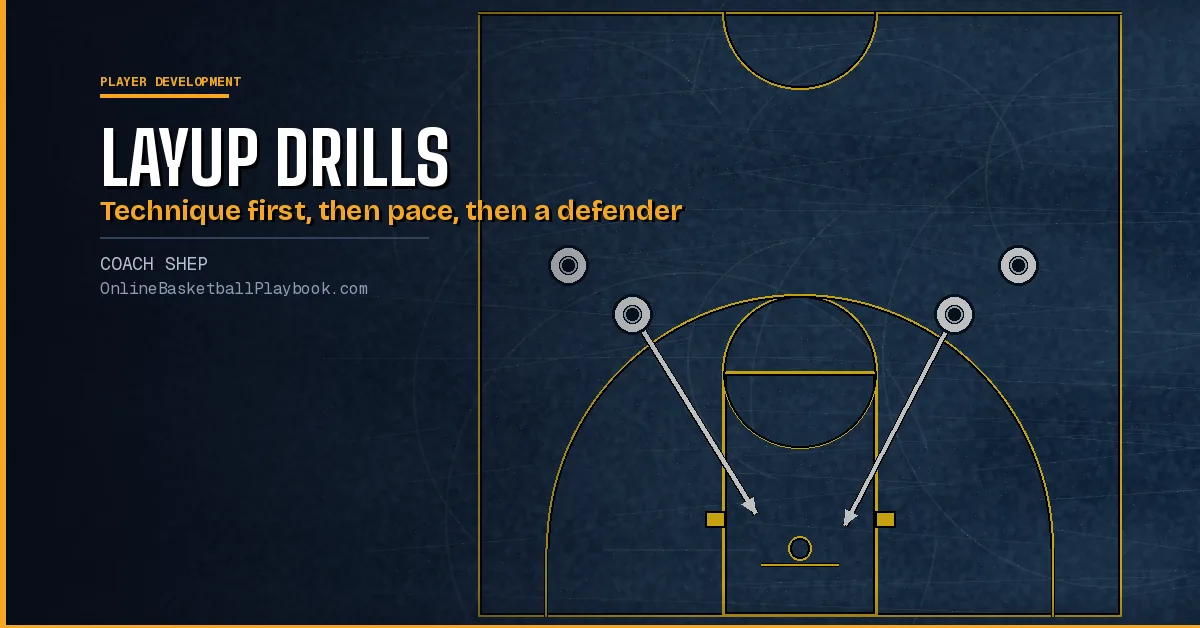
Layup drills teach a player to finish at the rim, and most of them are run in lines with nobody guarding the shooter. That works for footwork and fades once the basics are in. This guide sorts layup drills for youth and teams by stage, from a one-step layup off the block to full-court drills with a made-shot target and drills against a defender. It also lists the standards coaches give their lines and where they disagree.
Layup Drills at a Glance
| Stage | Drills |
|---|---|
| Footwork | Wall shooting, one-step, two-step, one-dribble layups, opposite-side layups |
| Individual | Mikan, 4 Way Mikan, Zig-Zag Layups, X-Out Layups, One-Minute Lay-Up Drill |
| Team lines | 2-line, 3-line, Vanderveer backdoor, Kentucky Layups |
| Full court with a goal | 2-minute left-hand layups, Hurley 80 in two minutes, Martelli 4 Minute Layups, Auriemma made-in-a-row |
| Against a defender | Around the Arc, Chase Down Layups, Attack the Ring, half-court 2-on-1, pad contact |
Layup Technique Before Any Layup Drill
Teach a right-hand layup with the left foot planted and the right knee and right arm rising together, as if a string connects them.
- Approach. A half step with the outside foot and a full stride with the inside foot.
- Head and eyes. The head is up and the eyes stay on the target, which is the top corner of the square on the backboard.
The competition footwork is the same. Pick the ball up on the outside foot, jump off the inside foot with the knee driving, keep the ball under the chin and use both hands to the height of the jump while the non-shooting arm protects. The cue for the target is the phrase "Up, Down, Kiss, In."
There are two releases:
- Push release. Two hands up and a release off the outside hand, suggested for younger or less developed players. The youth version uses a push release with a dedicated breakdown drill.
- Underhand release. Roll the ball off the fingertips for a softer touch at speed.
The six steps of a layup are eyes up, a long step with the outside foot, a high jump off the inside foot, protecting the ball with the off hand, a full follow-through and practice from varied angles and speeds. See How to Do a Layup.

Get the footwork right before you add pace or a defender.
Layup Drill Progressions for New Shooters
The steps can be taught in three orders.
- Block first. A one-step layup from the low block, a two-step layup from one step back, a one-dribble layup and a multiple-dribble layup starting behind the three-point line. The Technique Layups drill runs the first, second and last of these for a couple of minutes each. The coach explains and demonstrates each spot first. Players step with the outside foot, finish by jumping high off the inside foot and join the end of the line.
- Wall first. Wall shooting, one-step, two-step, three-step, one dribble, then the complete layup off the dribble. Both sides are practiced and the player jumps off the foot opposite the shooting hand.
- Air layups first. Four practices. Start with one-footed hops and air layups, add a one-step layup with a ball, then a running air layup, then a dribbled layup. The focus is the one-footed takeoff and making is not the early goal.
A self-correcting exercise: a player stands under the basket on the side opposite his shooting hand, aims at the upper outside corner of the backboard square and makes 50 in a row, and the rim punishes a flared elbow. Order the steps and make the footwork automatic before pace.
Individual Layup Drills
- Mikan Drill. The player starts under the basket facing the baseline, makes a right-hand layup off the backboard jumping off the left leg, rebounds quickly and makes a left-hand layup off the right foot, alternating until he reaches the target. More is on Mikan Drill.
- Mikan variations. Use 20 makes with 8 variations from two starting directions and four foot-and-hand combinations, or five minutes a day of alternating baby hooks with no dribble. A 4 Way Mikan adds two front-of-rim layups per side for 45 makes.
- Zig-Zag Layups. The player picks a start outside the three-point line, drives and finishes with a different layup each time, rebounds and retreats to a new spot. It runs two minutes, and the angle changes on its own because the starting spot changes. Finishes to use: a standard layup, a reverse, an overhand finish, a floater, a jump stop finish, a Euro step and an inside-hand finish.
- X-Out Layups. The player starts at the elbow with a left-hand layup, rebounds, dribbles out to the other elbow and returns for a right-hand layup. Run it one minute with a target of 15 makes and the emphasis on footwork, one dribble and jumping up. John Calipari's version uses one control dribble from the elbow and runs to 10 makes.
- One-Minute Lay-Up Drill. For one minute the player cycles a layup, a reverse layup and a running layup or runner, with one dribble each. For the runner he imagines a defender coming from the help side and releases before he arrives.
For the finishes inside these drills see Reverse Layup, Off-Hand Layup, Euro Step and Floater Basketball.

Use the individual drills to make the finish automatic.
Layup Lines for a Team
2-Line Layups. There is a shooting line and a rebounding line. The first shooter dribbles in and shoots. The first rebounder grabs the miss or make and passes to the next shooter cutting toward the rim. Shooter and rebounder trade lines.
- Switch sides. Every few minutes the sides switch so players finish with the other hand, and the drill can run with two balls.
- Pass and dribble. Passes are bounce passes and the dribble is with the hand that matches the layup.
- Start outside the arc. The two lines start well outside the arc, because lines too close to the basket leave little running and the drill drags.

3-Line Layups. The setup uses two balls. Several players stand at the top of the key, one waits in the right corner and the rest line up near the right sideline at half court. The first player passes to the second, cuts hard to the basket and gets the ball back for the layup. The pre-game warm-up works on passing, cutting, receiving and layups. Variations use jump shots or reverse layups for the shooting line.
Three-Line Backdoor (Tara VanDerveer, Stanford). Three lines and a rebounder under the basket. 3 passes to 1 and 1 takes a dribble or two toward 2. 2 back-cuts and takes the pass for the layup, 4 rebounds and passes to the next 3 in line.
- Bounce pass up the lane line. The pass to the back-cutter is a bounce pass up the lane line.
- Air passes, then defense. After one trip through, switch to air passes, then add token defense and reverse it for left-handed layups.
It reinforces the dribble-at, back-cut rule.

Kentucky Layups. It runs with four balls for two minutes, and 65 to 70 makes is the usual range for women's college teams.
Keep the lines moving and the passes sharp.
Get the next coaching guide in your inbox
One email when a new guide or diagram set goes up. Free.
Full-Court Layup Drills and Their Goals
Full-court layup drills get a number. The numbers differ because the drills differ, so the table keeps each drill with its goal.
| Drill | Goal | Model |
|---|---|---|
| Layups with two balls in each line | 80 layups in two minutes | Hurley |
| 4 Minute Layups, full-court pass, follow and bounce pass | 90 layups in four minutes | Martelli |
| 2-Minute Full-Court Left-Hand Layups, two balls on each end | 75 for a boys varsity team and 65 for a girls varsity team at the high school level | High school varsity |
| Dribble Pass Layup, two lines and two balls | 12 in a row with 12 players, then switch to left hand | Auriemma |
| Full-Court Transition Layup, three lines | 13 in a row, and any error restarts at zero | Auriemma |
| 1 Minute Full Court Layups | Record the score. The ball can be tossed ahead after the rebound but not past half way | Toss-ahead |
The consequence also changes:
- Run or push-ups. The team runs or does push-ups if it misses the left-hand goal, with a second chance of a half-court shot and a team celebration if one player makes it.
- 10 push-ups. Every missed drill layup costs the shooter and the passer 10 automatic push-ups, because finishing is a habit.
- Restart at zero. Auriemma's rule is a restart at zero.
The full-court drills themselves vary:
- Two-minute transition. Teri Moren's 2-minute transition drill has two lines, a coach rebounding under each basket and the first two players wide. The coach passes to O1, who takes one dribble and passes to O2 sprinting up the sideline for the layup. Players call the receiver's name and count each layup aloud.
- Russian Layups. A continuous drill of a long pass, a sprint and a layup from a pass received at full speed, for five players or more.
- A coach or parent on each high post. For a young team, with a point lost every time the ball touches the floor for older players.
Give the drill a number and a cost, and keep the pace up.
Layup Drills Against a Defender
Most layup drills are run one on zero with no pressure, so players never rehearse the decision and the contact they meet in games. There are four reasons practice layups miss in games:
- Fear of contact. Players fear contact and get blocked, so they take an off-balance fadeaway.
- No live defender. They practice almost only without a live defender.
- Too few finishes. They know too few finishes.
- Game pressure. They feel pressure in games that practice does not have.
Layup lines help a beginner with footwork and both hands but the benefit fades quickly once the basics are in place. See Why Players Miss Layups.
- Around the Arc. Two players start in a corner, one on offense with a ball and one on defense. The offensive player dribbles around the three-point arc with the defender trailing, and he can attack at any moment. The defender cannot cross the three-point line until the offensive player does. The offense can use any dribble move and fake, then protects the ball and scores while the defender contests from behind. Roles swap after each finish.
- Chase Down Layups. Two baseline lines. The offensive player gets a head start and sprints the floor while a defender chases to challenge the finish without fouling. It runs both directions to work the off hand.
- Attack the Ring. Two players sprint around cones from the baseline and a coach passes to one of them, who attacks the rim at once against the other.
- Half-Court 2-on-1. Three lines on the baseline. The coach passes to an offensive player and all three sprint around cones into a live 2-on-1. The offense keeps it simple. If the defender does not step into the lane, score, and if he does, pass.
- 3-on-2 Continuous. A full-court drill where three offensive players always face two defenders.
- Pad contact. In Leverage the Help Defender the player drives, bumps a coach holding a pad to create separation and extends into the layup. It runs 20 makes per side. Phil Martelli's teaching has contested layups showing power layups and inside-hand and reverse layups against contact.

Add the defender as soon as the footwork holds.
Where Coaches Disagree
| Question | Approach |
|---|---|
| Which stop for a layup? | Jump stops only early in the year, so players learn to gather before they meet help |
| A stride stop with the second foot inside the charge circle. After two years of jump stops, only the best athletes could score off them | |
| What does a miss cost? | 10 push-ups for the shooter and the passer |
| The team runs or does push-ups, with a half-court shot as a second chance | |
| The count restarts at zero (Auriemma) | |
| Seek contact or avoid it? | Bump a pad, absorb contact and extend |
| Euro step, pro hop and floater to get around a defender set to take a charge | |
| Where does the first rep start? | On the block, one step |
| At a wall | |
| One-footed hops and air layups |
Choose one stop, one cost and one starting spot, and teach them all season.
Want the printable playbook packs?
OBP Pro members get the premium playbook packs: the zone attack, out of bounds and practice plan PDFs, plus each new pack as it is finished. The membership page lists what is in each one. Or draw your own version free in PlayDraw.
See what OBP Pro includesQuestions Coaches Ask
What are the best layup drills for beginners?
The one-step and two-step layups from the block and a cone, then the one-dribble layup. Run them in that order and have the coach demonstrate each spot first.
What are good layup drills for kids?
The 2-line layup drill and the Mikan drill, with a push release for younger players. Spread the first layup work over four practices and do not ask for makes at the start.
What is a good team layup drill?
The 2-line and 3-line drills, the Vanderveer backdoor drill and the full-court drills in the table above. Give each a goal and a consequence.
How many layups should a team make in two minutes?
Bob Hurley's drill has 80 in two minutes with two balls per line. A left-hand drill with two balls per end sets 75 for a boys high school varsity and 65 for a girls varsity. The goal depends on the drill.
Why do players miss layups in games but make them in practice?
Four reasons: fear of contact, practicing against no live defense, too few finishes and game pressure.
How do you teach the left-hand layup?
Mirror the footwork. Shoot with the left hand and reverse all the footwork, and switch sides in the 2-line drill after a few minutes.
More Guides From This Batch
- Floater Basketball: How to Shoot It and How to Teach It
- Flare Screen Basketball: How It Works, Reads and Counters
- Basketball Dribbling Drills for Beginners and Other Basics
- Basketball Rebounding Drills for Every Age and Level
Back to Basketball Finishing Moves and every Player Development page.
Keep Building
Related breakdowns
Basketball Shooting Drills for Every Level
Basketball shooting drills for every level, from form work and youth games to team competitions and free throws, each with a score or a consequence.
Basketball Rebounding Drills for Every Age and Level
Basketball rebounding drills from technique and box-out circles to scored small-group games, War drill and youth drills, with the goals and rules coaches attach.
Basketball Passing Drills for Beginners and Full Teams
Basketball passing drills for beginners, partners and full teams: the basics to coach, drills with setups and coaching points, pressure drills and scored games.