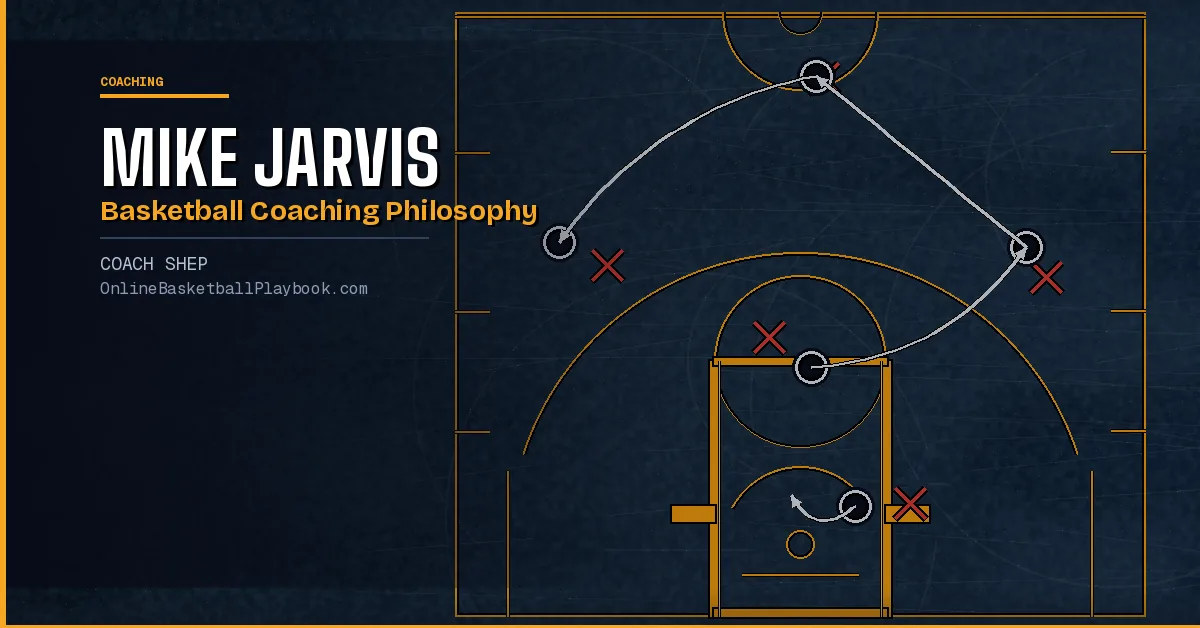
Mike Jarvis has coached at every level (high school, college, international) for four decades. What he's learned about defense, player development, and building programs that last cuts through every trend the sport has thrown at him.
Defense Is the Foundation, Not the Fallback
Mike Jarvis built his reputation on the defensive end. At Cambridge Rindge and Latin, at Boston University, at George Washington, at St. John's, and on the international stage, his teams were identifiable by the same trait: they made you work for everything. No layups. No rhythm. No easy nights.
That did not happen by accident. It happened because Jarvis treated defense as a system (teachable, repeatable, and non-negotiable) rather than an attitude you hope players arrive with. In forty years of coaching, he refined what that system looks like at its core: on-ball defenders who stay in front, help defenders who arrive before the catch, and a culture where the score of the game never changes how hard you guard.
The principle underneath all of it is straightforward. When your offensive production varies, and it always does, your defense is what keeps you competitive. The teams that go deep in tournaments are rarely the ones who shot well every night. They are the ones whose defense showed up whether the shots went in or not. Jarvis understood that early. He structured every practice around it.
What separates elite on-ball defenders from average ones, in his view, is not athleticism. It is preparation. It is knowing before the catch whether your man is a shooter, a driver, or a passer. It is adjusting your positioning and pressure based on that read, not reacting to what he does, but shaping what options he thinks he has. Good defenders do not play the dribbler. They play the decision.
What Forty Years Teaches You About Players
Jarvis has coached thousands of players across four decades, from high school sophomores to NBA draft picks to international professionals. The one thing that has never changed, he says, is what players actually need from a coach.
They need to know you see them clearly. Not their highlight moments, their habits. Their tendencies under pressure. The things they do well that no stat captures, and the things they do poorly that they have not yet admitted to themselves. A coach who can communicate that clearly, without crushing a player's confidence, is worth more than any offensive scheme.
Jarvis is direct about the traps that coaches fall into with talented players. The first is coddling: letting a gifted athlete skate on habits that will eventually expose him at a higher level. The second is overcorrection: riding a player so hard that he plays scared rather than free. The balance is what experience teaches. You learn which players need a push and which ones need to be trusted. You learn that the same words land differently depending on who is hearing them.
The players who made it, the ones who went on to long professional careers or became coaches themselves, shared one trait regardless of talent level. They were coachable in the deepest sense. Not just willing to hear criticism, but genuinely curious about getting better. They asked the right questions. They watched film on their own. They came back the next day having worked on the specific thing you pointed out, not the general area around it.
That coachability does not correlate with recruiting rankings. Jarvis saw it in unheralded players who outperformed their talent, and he saw its absence in five-star recruits who plateaued. The coach's job, in his framing, is to identify it early and build systems that reward it. Players who take shortcuts will take them if you let them. Structure prevents the shortcuts before they become habits.
Stance, Footwork, and the Fundamentals That Never Expire
Ask Jarvis what separates his best defensive teams from the ones that struggled, and he will not talk about schemes. He will talk about stance. He will talk about the first three days of practice and whether players could hold a proper defensive position for five minutes without drifting into laziness.
Defensive stance is the single most undercoached skill in basketball at every level. Youth coaches skip it because it is not exciting. College coaches assume their players learned it before they arrived. The result is that most defenders, even good ones, are playing on their heels, weight distributed wrong, hands hanging, and body angled in a way that makes them a half-step slow on every read.
The correct position is what coaches in the defensive coaching literature call "bucket down": knees bent, weight on the balls of the feet, chest out, inside hand mirroring the ball as closely as possible. It is an active posture. A defender in proper stance is not resting. He is coiled. Every movement starts faster from that base because the weight is already in motion.
Footwork is the other half of the equation. The three tools that let a smaller or slower defender stay in front of a bigger or faster player are the retreat step, the advance step, and the swing step. None of them require exceptional athleticism. All of them require repetition until they become automatic. Jarvis drilled them in isolation (defender only, no offensive player) before any competitive defensive work happened. Five minutes of Slide and Hey! drills before 5-on-5. Every session. Non-negotiable.
The reason is simple: under game pressure, players revert to what their feet know. If their feet know the right tools, they use them. If their feet only know backpedaling and lunging, that is what you get at the end of close games when composure is hardest to maintain. Fundamentals drilled in calm produce fundamentals executed under pressure.
Building a Program Culture That Outlasts Any System
Jarvis has seen coaching trends cycle through the sport several times. Full-court pressure became obsolete when guards got fast enough to handle it. Zone defenses came back into fashion after a decade of being dismissed. Three-point shooting went from a late-game tactic to the central pillar of most offenses. Through all of it, the programs that remained competitive did not change their identity with every trend. They had something underneath the X's and O's that held.
Culture is the word coaches use, but it often gets defined too loosely. In Jarvis's framing, culture is what your players do when you are not watching. It is the standard they hold each other to in the weight room, in film sessions, in the minutes before practice starts. A coach can control the two hours of practice. Culture is what governs the twenty-two hours he cannot.
Building that takes deliberate action, not inspiration speeches. It means recruiting players who already have the right habits or who are genuinely hungry to develop them. It means having veteran players who model the standard publicly enough that younger players understand what is expected before anyone tells them directly. It means being consistent yourself, not demanding accountability on Tuesday and letting things slide on Thursday when the team is tired.
The programs Jarvis admired most over his career were built on clarity. Players knew what was expected of them. They knew how playing time was earned. They knew what the coaching staff valued beyond the box score. That clarity removed the guesswork that breeds resentment, and it gave players a framework to evaluate themselves rather than waiting to be evaluated.
The Lessons Coaches Learn Too Late
Four decades in the coaching profession comes with a catalog of regrets as long as the victories. Jarvis has been public about some of his. They are not unique to him. They are the lessons most coaches learn too late, if they learn them at all.
The first is about communication. Early in his career, Jarvis communicated almost entirely through correction. He told players what they did wrong. He explained what to do instead. He moved on. What he did not do consistently was tell players what they were doing right, specifically and in the moment. The research on learning and the experience of coaching both point to the same truth: positive specific feedback accelerates development faster than correction alone. Players who know what their strengths are build on them. Players who only hear what they did wrong learn to play defensively, avoiding mistakes rather than pursuing excellence.
The second lesson is about trust. Jarvis describes a pattern he saw in himself and in coaches he respected: the instinct to over-manage in big moments. A tight game in the fourth quarter, a big tournament game, a moment where the program's season is on the line, and the coach tightens every system, calls every play, and removes the players' autonomy at exactly the moment they need to trust their preparation. The coaches who got the most out of their players in high-pressure situations were the ones who prepared them relentlessly and then got out of the way.
The third lesson is about longevity. Coaching is a profession that consumes people who do not manage it carefully. The hours are extraordinary. The emotional stakes are high year-round. The public nature of the work means that losses are visible and painful in ways that most professions never ask of their participants. Coaches who last four decades, who stay sharp and engaged rather than burned out and bitter, are the ones who found ways to sustain themselves outside the game. Families, interests, genuine friendships with people who are not in basketball. Jarvis has talked about this openly. The game will take everything you give it. Deciding in advance what you will not give is part of the job.
Coaching the Modern Game Without Abandoning What Works
The modern game looks different from the basketball Jarvis grew up coaching. The three-point line has restructured every offense. Positionless basketball has blurred the roles that once defined how teams were built. Analytics have introduced a language of efficiency and expected value that did not exist a generation ago. Players arrive with more information about the game and more exposure to elite coaching than any previous generation.
Jarvis's view on navigating that change is pragmatic. Adapt the what; protect the why. The spacing principles your offense uses should evolve with what the game demands. The defensive concepts you rely on may shift based on personnel. But the underlying reasons you do things (discipline, preparation, accountability, playing for the team), those do not change and should not change no matter what the sport looks like from the outside.
He is direct about the trap that analytics can create for coaches who apply them too rigidly. Numbers are a tool for making better decisions. They are not a replacement for the judgment that comes from watching players compete, from understanding what a specific player needs in a specific moment, from reading the emotional state of a team before a big game. A coach who can do both, who uses data as one input among many rather than as the final word, is more valuable than a coach who is fluent in only one language.
The same principle applies to player development. The information available to players today (film breakdowns, skill-specific coaches, analytical feedback on shot selection and defensive positioning) is genuinely better than anything previous generations had access to. But the fundamentals that information is built on are the same ones Jarvis was teaching in the 1980s. Stance. Footwork. Communication. Effort on possessions that do not show up in the box score. The platform has changed. The foundation has not.
When you install defensive fundamentals, sequence matters more than most coaches realize. Teach stance and the three footwork tools (retreat step, advance step, swing step) in total isolation before you put a ball or an offensive player in the drill. Players need muscle memory built in silence before it gets tested under pressure. Five minutes of isolated footwork before every defensive session will pay dividends in the fourth quarter of close games when composure is hardest to maintain.
- Drill stance in isolation first: before any competitive defensive work, run five minutes of Slide and Hey! drills with defenders only, no ball, no offense, so footwork becomes automatic rather than thought-dependent under pressure.
- Teach the three footwork tools explicitly: the retreat step (drop the threatened foot back when attacked), the advance step (pressure the dribbler before he sets up), and the swing step (cut off a drive toward the front foot). Most players have never been taught any of them by name.
- Install "nose on the ball" as the primary on-ball cue: the defender's nose tracks the dribbler's ball hand, not his hip or chest, which keeps the defender in position to deflect without reaching and creates constant psychological pressure on the ball-handler.
- Belly up the instant the dribble stops: the moment a ball-handler picks up his dribble, both feet crowd the space and both hands go active. The dead-ball situation is the maximum-pressure moment, and most defenders let it pass without taking advantage of it.
- Communicate screens before they arrive: teach players to call out screens for teammates every single time, not occasionally. A defender who knows a screen is coming can fight over the top or go underneath. One who does not know is getting hit.
Want more basketball coaching strategies and drills?
Join the Online Basketball Playbook newsletter →
Draw this play free in the play drawer →
Membership: the full library, playbook packs, and Pro drawing tools →
Keep Building
Related breakdowns
What I Have Learned Over the Years Coaching Basketball
What I Have Learned Over the Years Coaching Basketball
How to Become a Basketball Coach: Paths, First Jobs and Steps
How to become a basketball coach: where coaches start, youth, school, club and college paths, entry jobs, coaching education, networks and mentors.
Basketball Scouting Report Template and How to Fill It Out
A printable basketball scouting report template with team, offense, defense, player and game plan sections, the questions to ask and how to brief players.