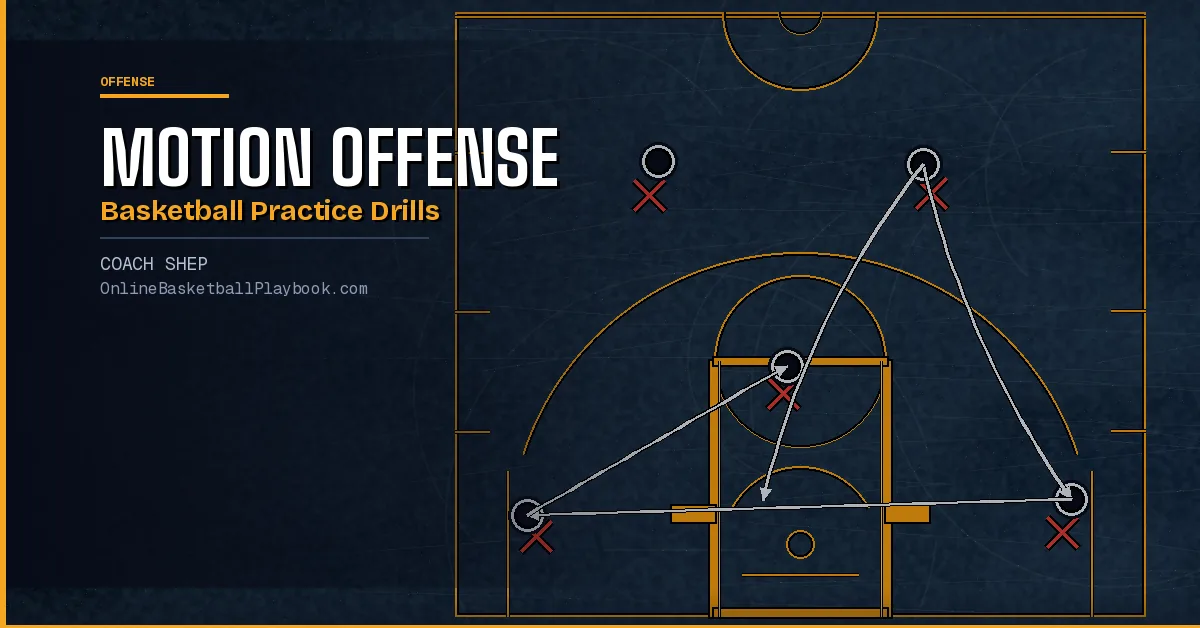
Motion offense lives or dies in practice. These drills build the habits (pass-and-cut discipline, spacing awareness, and read-and-react decision-making) that make your team impossible to scout and hard to guard.
Why Motion Offense Drills Work Differently
Most offenses are installed by teaching plays. Players memorize sequences (action 1, cut here, screen there) and execute them on command. Motion offense flips that model entirely. The goal is not to teach plays. The goal is to teach players how to play.
That phrase ("learn to play, not run plays") comes straight from the five-out motion system and captures the coaching philosophy behind every drill in this guide. When a player learns to read the defense and respond, they carry that skill for life. When they learn to run a play, they need a new play the moment the defense takes it away.
The practical consequence for practice design: motion drills are not rep drills. You are not trying to groove a fixed pattern. You are training decision-making under defensive pressure. Every repetition should force a player to look, read, and choose, not just respond to a coach's call.
This also changes how you evaluate reps. A missed shot after a good read is a success. A made shot after standing still and getting lucky is a problem. Track the decision, not just the outcome. When you install this standard in practice, it transfers to games.
The other thing that changes with motion drills: standing is now a team error, not a personal one. In a set-play offense, a player who stands after their action is just out of the way. In motion, that standing player is breaking the offense. They are removing a scoring option and making the defense's job easier. Treat it accordingly in practice. Call it out every time. The standard of "pass-and-move, every time" only holds if the coaching staff holds it relentlessly from day one.
Pass-and-Cut Foundation Drills
The core of motion offense is simple: every pass is followed by a cut or a screen. There are no exceptions. The most important habit you will ever build in a motion system is pass-and-cut discipline, and it must be automatic before you add any other layer.
3-Man Weave with Cut Discipline
Run a standard three-man weave but add one rule: the player who passes does not cross the lane until they have given their defender a jab-step or a read-step first. This small adjustment converts a conditioning drill into a motion-habit drill. Players learn to pause, look, and commit to their cut rather than drifting mindlessly.
Coaching cue: "Look before you cut." Hold players accountable by calling dead stops when someone drifts through the cut without a read-step.
2-Man Pass-and-Cut
Two players, one ball, one basket. Player A passes to Player B and makes a hard basket cut. Player B reads. If A is open, feed the layup. If A is covered, Player B drives or hits the third player filling behind. This is the foundational two-man motion action. Run it until cuts are sharp, decisive, and on time. Every youth and high school team should have at least 10 minutes of this drill per week. The cut must be a hard cut, not a drift, not a jog, not a wander. A hard cut tests the defense and creates real separation.
Pass-and-Screen Away
Add a screen option: after passing, the player sets a screen for a teammate rather than cutting. The screened player reads their defender, curl, flare, or back-cut off the screen. This drill teaches players that "pass-and-move" means two things: sometimes you cut, sometimes you screen. Both are acceptable. Standing is never acceptable. A common mistake is players who pass and drift toward the screened player without actually committing to the screen. Address that immediately.
Spacing and Gap Drills
Spacing is not the absence of movement. Spacing is active, constant work. Maintaining 15-18 foot gaps between players requires off-ball movement every time the ball moves, and that movement must happen before the gaps collapse, not after. Once the defense is clustered around the ball, spacing cannot be recovered in real time.
Ghost Spacing (5-on-0)
Five players, no defense, one rule: every time the ball moves, all four off-ball players must move. Not optional, not sometimes. Every single time. Players must fill the five spots and never allow two players to occupy the same zone. This drill sounds easy. It exposes bad habits immediately. Run it for five minutes at the start of every motion practice session and you will see exactly which players have internalized spacing and which are still thinking about their own action rather than the team shape.
Progression: add a coach walking the perimeter calling out any player who fails to maintain spacing. Naming it in real time accelerates the habit.
Spacing Gate Drill
Place four cones on the perimeter at the five-out spots. Players may only pass to a player who is standing within three feet of a cone. If the receiver drifts inside the arc, the pass is dead. Reset. This constraint forces players to maintain spacing in order to be passing options. After a few uncomfortable possessions, players begin self-policing their spacing without coaching cues.
Ball Reversal Spacing
One of the most common spacing breakdowns happens on ball reversal. When the ball swings from one side to the other, off-ball players tend to drift toward the ball rather than shifting their gaps. Run a reversal drill where the coaching staff evaluates only the off-ball spacing, not the ball action. Grade whether the weak side fills on time, whether the corner man adjusts his position on the swing, and whether the spacing holds or collapses under the reversal. Ball reversal is a pressure mechanic in motion offense; the spacing must hold for that pressure to mean anything.
Live Read Progressions
Once pass-and-cut discipline and spacing are established in 5-on-0 reps, the next phase is adding live defense and teaching players to read. Reading is a skill. It requires reps under pressure, coaching feedback, and time. Do not rush this phase.
1-on-1 Read Drill (Catch and Attack)
One defender, one offensive player catching on the wing. The offensive player catches balanced, eyes on the rim, and reads: is the defender sagging? Shoot it. Is the defender charging to close out? Drive past. Is the defender playing the drive? Kick to the corner. The key coaching point here comes directly from the motion principles: the most open a player will ever be is the instant they catch the ball. Catch ready to attack, not catch and then figure it out.
Run this drill for every player at every position. Spacing is built when every player on the floor is a threat the moment they catch. A non-shooter who catches and immediately looks to pass surrenders that momentary advantage. Teach all players to look at the rim on every catch, even if they never pull the trigger.
2-on-2 Cut-or-Screen Read
Two offensive players, two defenders. The passer makes a decision on every pass: basket cut or screen away. The receiver makes a decision: read the defense and respond. No calls from the bench. No signals. Just reads. This drill forces communication through spacing and timing rather than play calls, which is exactly how motion offense works in a game.
3-on-3 Motion with Rules
Three-on-three with one constraint: no player may hold the ball for more than three seconds. Players who hold longer automatically turn it over and the defense gets the ball. This forces quick decision-making and ball movement. It also exposes players who are waiting for a play to develop rather than reading what is available. Motion offense rewards the player who sees the open read first, not the player who waits for the perfect one.
No-Dribble Passing Games
The single most powerful motion offense drill (and the one most coaches skip) is the no-dribble passing game. Run 5-on-5, full court, no dribbles allowed. Pass only. Move without the ball constantly. Players who stand get passed over. Players who cut get the ball.
This drill comes directly from Zeljko Obradovic's practice philosophy. He runs no-dribble passing game 5-on-5 at every practice specifically because off-ball movement cannot be hoped for. It must be drilled until it becomes habit. The players who move well in no-dribble games move well in real games. The players who stand and wait for the ball in no-dribble games do exactly the same thing in games when the dribble is available and they can hide behind it.
No-Dribble Half Court
Five-on-five, half court, no dribbling. Offense has 15 seconds to get a shot. Defense plays full live defense. Offensive players who catch and immediately look to pass because they can't dribble will discover exactly how important their off-ball movement is for creating passing angles. When you reintroduce the dribble after several reps, ball movement will be noticeably faster and off-ball movement noticeably better.
One-Dribble Limit
A bridge drill between no-dribble and full offense: each player may use exactly one dribble per possession of the ball. The single dribble can be used for penetration or to improve a passing angle. Nothing else. Any dribble used to stand in place or escape pressure is wasted. This constraint forces players to value the dribble, eliminate wasted bounces, and move the ball before they are trapped. Aito Garcia Reneses, one of Europe's most successful coaches, teaches this principle directly: the dribble is for penetration, and any non-penetration dribble should improve only the passing angle. Maximum two bounces in the same spot.
Run no-dribble games at the start of every motion practice week, not as a warm-up, but as a primary drill block. Ten minutes of no-dribble 5-on-5 builds more motion-offense habits than thirty minutes of walk-through reps with the dribble available. The constraint forces players to move without the ball because it is the only way to get the ball, which is exactly the habit you are trying to build in your full offense. Ease back in the dribble as a reward, not as a default.
Installing Motion by Progression
The most common mistake coaches make when installing motion offense is trying to teach everything at once. They show players the full system (all the reads, all the options, all the spacing rules) and then wonder why it looks chaotic in the first week. Motion offense is installed in stages, and the stages must be sequential. Each stage must be automatic before the next stage begins.
Stage 1: Pass-and-Cut Only (5-on-0)
The first week of motion offense installation should contain nothing but pass-and-cut in a 5-on-0 environment. No defense. No screens. No options. Just pass-and-cut. Every player passes and cuts. Every player fills behind. The five-spot spacing is maintained. The coach calls out any standing. Run this until it feels boring. That means it is becoming automatic, which means it is ready to be tested against defense.
Stage 2: Add Defense (5-on-2)
Put two defenders on the floor and run motion against them. The defense cannot guard all five spots with two players, which guarantees open looks and successful reads early in the learning process. Players gain confidence in the system before it gets difficult. This is a deliberate coaching choice: early wins build buy-in, and buy-in accelerates skill development.
Stage 3: Introduce Screens
After pass-and-cut is solid against live defense, add the screen option. Now after a pass, the player chooses: cut or screen. Teach one screening action at a time. Do not introduce down screens, back screens, and flare screens in the same practice. Name each action. Players move faster and communicate better when they have a vocabulary for what they are doing. Introduce the name at the same time you introduce the action: "this is a screen-away, this is what it looks like, this is how you read it." The naming does not make the offense scripted. It makes the reads coachable and the communication fast.
Stage 4: Full Motion 5-on-5
Full five-on-five motion offense with all reads available. At this stage, the coaching emphasis shifts from correction to reinforcement. Call out the good reads as often as you call out the mistakes. Identify the players who are moving well without the ball and make it visible to the team. Off-ball movement is invisible in games, which means the coach must make it visible in practice. Track standing as an error in film review. Make it clear that standing is a team error that shows up in tape, not just a personal lapse.
At every stage of the progression, the coaching staff's job is to hold the standard. Motion offense has one non-negotiable rule: pass-and-move, every time. That rule must be enforced from the first 5-on-0 rep to the last 5-on-5 possession of the season. The moment standing becomes acceptable, the offense begins to collapse, not dramatically, but slowly, as defenders relax and stop working to cover players who are not moving.
The payoff for this discipline is an offense that is genuinely hard to scout and hard to defend. Because the reads emerge from how the defense plays, every game looks different. There is no tendency for an opponent to attack, no predictable action they can take away. The system adapts automatically to whatever the defense gives, which is the entire point. As the motion principles put it: the options just happen off how the defense plays. The coaching staff's job is to make sure players are trained well enough to see what the defense is giving and take it every time.
- Pass-and-cut must come before any other motion layer. Run 5-on-0 pass-and-cut until it is automatic, then add defense and screens in that order.
- Call standing as a team error every single time it happens, not occasionally. The standard only holds if it is enforced consistently from day one.
- Run no-dribble 5-on-5 at least once per week. Ten minutes of this builds more off-ball movement habit than thirty minutes of full-dribble walk-through reps.
- Name every recurring action (screen-away, flare, back-cut) when you introduce it. A vocabulary makes reads coachable and speeds up communication on the floor.
- Teach players to catch balanced with eyes on the rim on every catch. The most open a player will be is the instant they receive the ball, and they must be ready to use that advantage before the defense recovers.
- Track shot quality by decision quality, not just by make or miss. A good read that leads to a missed layup is a success. A standing player who gets a lucky pass is a problem to fix.
Want more basketball coaching strategies, drills, and tools?
Join the Online Basketball Playbook newsletter →
Draw this play free in the play drawer →
Membership: the full library, playbook packs, and Pro drawing tools →
Keep Building
Related breakdowns
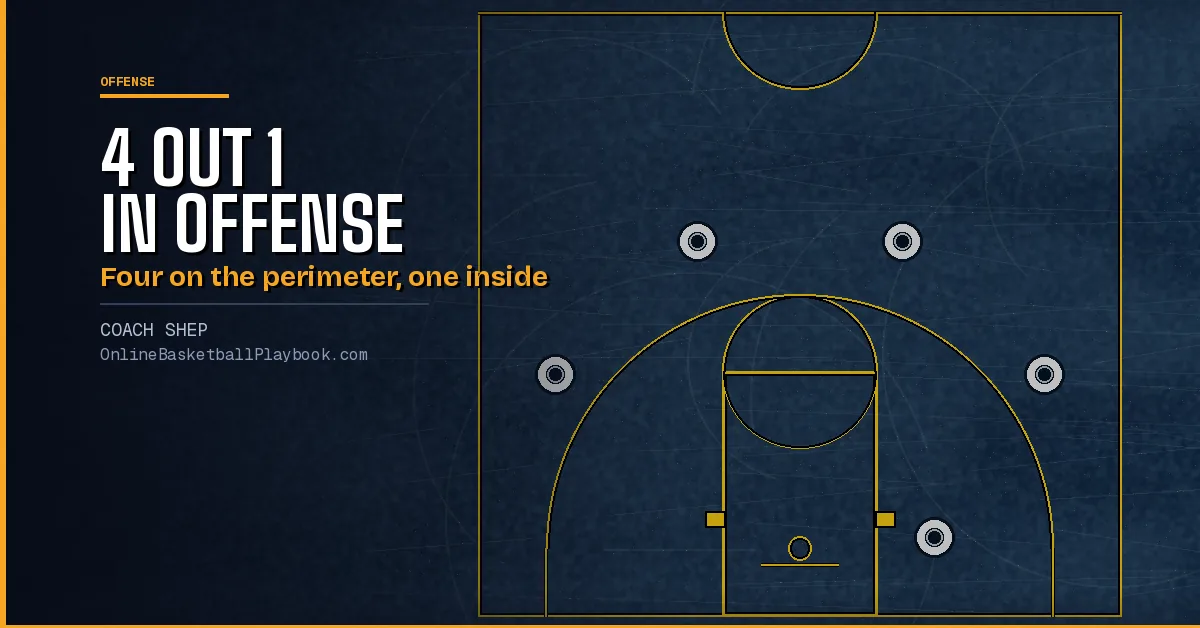
4 Out 1 In Motion Offense: Rules, Spacing and Sets
How to run the 4 out 1 in motion offense: spacing, the six rules, what the post does, pass-cut-fill, screens, quick hitters, zone adjustments and how to install it.
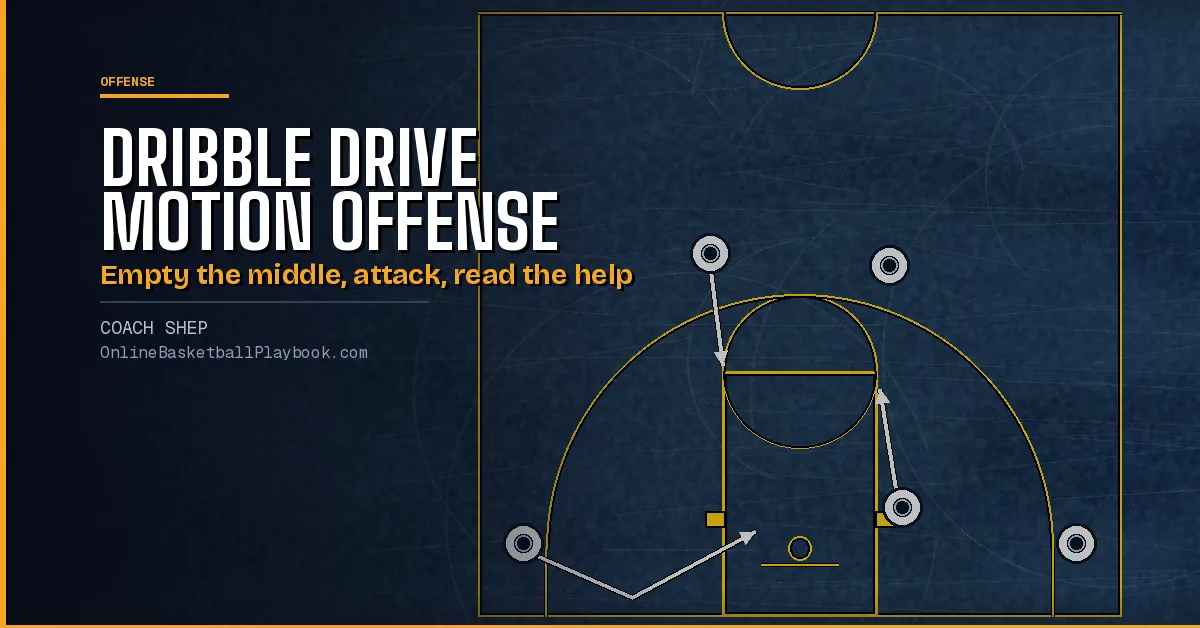
Dribble Drive Motion Offense: Spacing, Reads and Install
The dribble drive motion offense explained: 4-out 1-in spacing, the Drop, Drag and Rack zones, the read off a drive, shot diet, weak spots and the install.
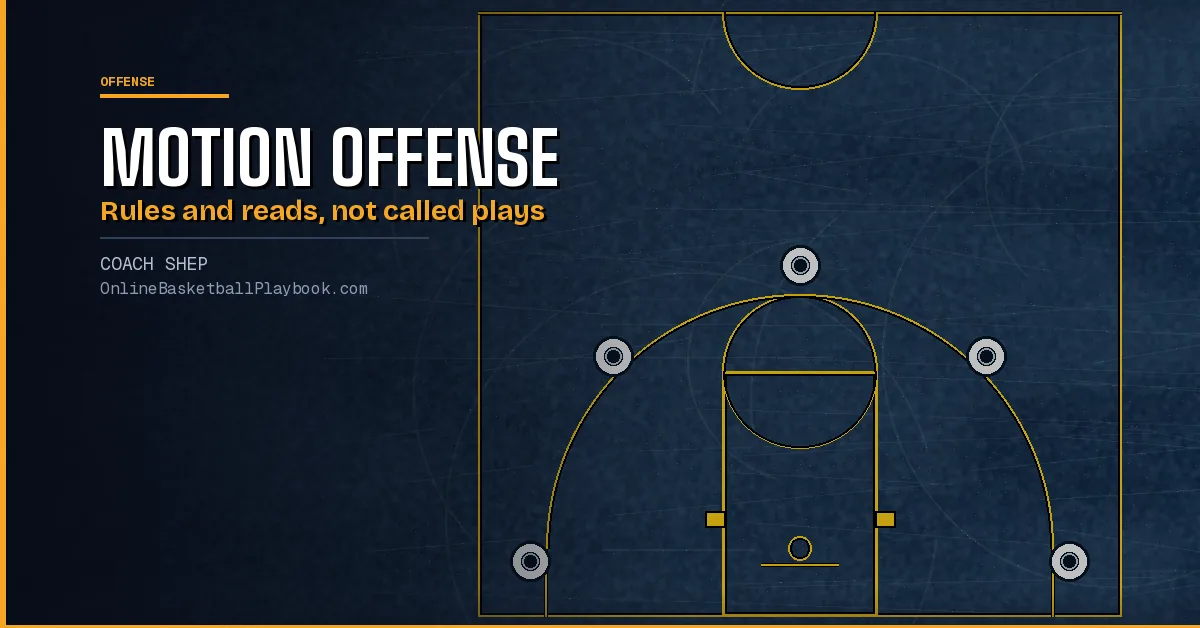
Motion Offense: Spacing, Rules, Actions and How to Install It
Motion offense runs on rules, not called plays. See the spacing, four core actions, 5-out versus 4-out 1-in, the install order, drills and where it struggles.