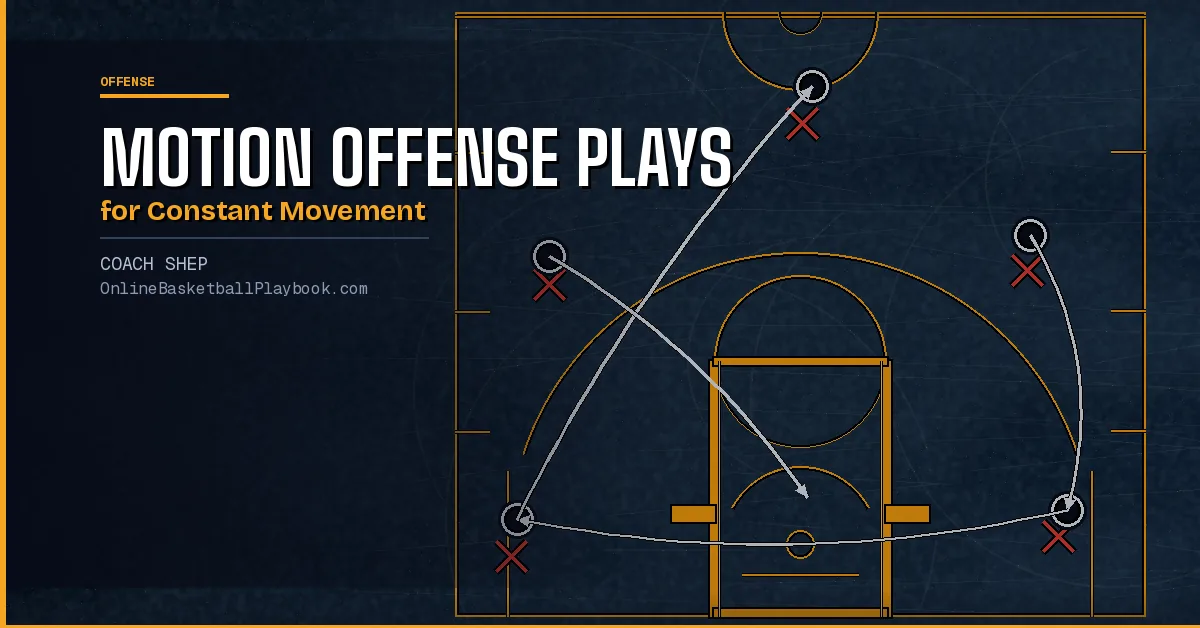
Motion offense keeps every player moving on every pass, making your team nearly impossible to scout, exposing defensive gaps, and developing players who read the game instead of memorizing scripts.
What Motion Offense Actually Means
Most coaches describe motion offense as "players moving without the ball," but that definition misses what actually makes it work. Motion offense is a rules-based system where players read the defense and choose their action (cut, screen, or receive a screen) rather than running a scripted sequence. The options emerge from what the defense gives, which is exactly why elite coaches call it unscoutable.
The foundational premise is simple: every pass must be followed by a meaningful move. Standing after a pass is not a rest. It is a mistake. It lets defenders watch the ball, collapse on cutters, and take away spacing. The Memphis dribble-drive motion coaching notes put it plainly: "every pass is followed by a meaningful move; standing is a technical mistake." That single standard, held firm, transforms a disorganized possession into a coordinated attack.
What separates motion offense from a structured continuity like the flex is that the reads are free, not predetermined. A player coming off a down screen decides in real time whether to curl, flare, or back-cut based on how the defender plays the screen. No two possessions look identical. Defenses that prep for your best play have nothing to prep for when your offense has no single best play, only the best available read.
Motion offense also builds better players. A kid who spends two years in a rigid four-play rotation knows four sequences. A kid who spends two years in motion learns to read defenders, use space, set real screens, and make decisions under pressure. The investment compounds. The reads transfer to any system they play in next.
The Core Rules Every Player Must Know
Motion offense functions on rules, not plays. The rules must be taught explicitly, drilled until they are automatic, and enforced consistently in film sessions. There are six non-negotiables that appear across the best motion systems in the game.
Rule 1: Pass and Move
After every pass, a player chooses one of three actions: basket-cut toward the rim, set a screen for a teammate, or receive a screen that a teammate is setting. Those are the only options. Standing still is a violation of the offense, and coaches should track it as an error in film review just as they track turnovers.
Rule 2: Read, Don't Call
The play is not called from the bench. It emerges from the defense. When a defender turns their head, the cutter goes. When a defender overplays the passing lane, the backdoor cut opens. When a defender sags off, the shooter pulls up. Players need to understand that the defense is always telling them what to do. Their job is to listen.
Rule 3: Fake First
One of the most undercoached motion principles comes from Ettore Messina and Svetislav Pešić's European clinics: a fake always precedes the move, and not only the shot fake. Fake a direction before cutting. Fake a catch before going backdoor. Fake a screen before slipping. An off-ball player should never cut until the on-ball defender turns their head. Moving before the read is ready wastes the action and tips off the defense.
Rule 4: Catch Ready to Attack
The most open moment for any offensive player is the instant they catch the ball. Defenders are still rotating, help is arriving, gaps exist. Every player in motion offense must catch balanced, feet ready, eyes on the rim, prepared to shoot, drive, or pass. Non-shooters still fake the shot ("fake it till you make it") because the shot-fake collapses the defense and opens the drive or kick-out.
Rule 5: Maintain Spacing
Motion offense lives and dies on 15 to 18 feet of spacing between players. When two players drift into the same zone, they collapse the gap the cutter needs and give one defender two people to guard. Maintaining spacing is active, not passive. It requires players to read the floor and fill empty spots as their teammates cut through.
Rule 6: The Screener Is Always an Option
Coach K's clinic notes are direct on this: "screeners must be prepared to catch. They are the second option every single time." A player who sets a screen and watches what happens to their teammate is giving the defense a free defender. Set the screen, read the reaction, and be ready to catch, drive, or score. The slip off a ball screen exists because defenders who over-hedge have lost track of the screener. Make them pay for it.
Spacing Is Not Passive. It's Constant Work
The phrase "spacing is offense" appears in some form in nearly every elite motion offense clinic. It is one of the most repeated coaching principles in the game, from Ettore Messina to Rick Majerus to Bob McKillop. But players often hear it as a static instruction: stand in the right spot. That misses the point entirely.
Spacing is dynamic. When a player cuts baseline, the wing must fill the corner they vacated. When a ball handler drives left, the weak-side wing must drift to the corner to give the driver a kick-out option. When a post player seals, the perimeter must expand to keep the help defenders from collapsing. Spacing is maintained through movement, not through standing.
In a five-out motion offense, all five perimeter spots must be filled unless a player is actively cutting or screening. That means when a cutter comes through the lane, they either score, kick it out, or relocate to an empty perimeter spot. The offense breathes. It expands and contracts, but it never lets gaps collapse for more than a split second.
The shot-quality connection to spacing is direct. When spacing holds, closeouts are longer and off-balance. Defenders have to cover more ground. A team that maintains 15-foot gaps forces every defender to sprint from help position to contest, and tired, sprinting closeouts create shot opportunities. When spacing collapses, a single help defender can cover two offensive players at once, and the best looks disappear.
Messina's Aito spacing rule quantifies it: a minimum of four meters between perimeter players. Teach that measurement in practice. Use cones. Measure it. Players who have physically felt what four meters looks like will hold it under pressure better than players who have only heard "stay spaced."
Pass-and-Move: The Actions That Drive Motion
Motion offense is free-flowing, but it is not formless. The recurring actions that appear within any read-based system have names, and naming them is how coaches make motion teachable and communication fast. Rick Majerus built one of the most detailed cut taxonomies in the game. Rumjahn's complete guide names every off-ball action in the 4-out-1-in and 5-out systems. Davidson's McKillop gives every reversal trigger a vocabulary.
The Basket Cut
The most fundamental motion action: the player who just passed takes one or two hard steps toward their defender to set up the cut, reads the defender's position, and cuts hard to the rim. If the ball is available, catch and score. If not, clear through and fill an open perimeter spot. This cut must be credible. A lazy jog to the rim accomplishes nothing. The cut is an attack, and the passer must look off the cutter on time.
The Backdoor Cut
Whenever a defender overplays the passing lane (reaching, leaning, or denying) the backdoor cut is available. The offensive player fakes a step toward the ball, waits for the defender to commit to the denial, and then cuts hard behind them to the rim. Treat the backdoor as always live. Patience beats pace. Build the backdoor read into every set, and treat any defensive overplay anywhere on the floor as a backdoor trigger.
The Down Screen
A player on the perimeter screens for a teammate at the block or low wing. The cutter reads the defender to choose their exit: curl if the defender trails, flare if the defender goes over the top of the screen, back-cut if the defender cheats to anticipate the curl. Majerus adds the Hornacek Curl as a specific technique, high hands, shoulder over toe to square on the catch.
The Slip
When a ball screen defender over-hedges or the defense switches early, the screener releases from the screen and dives to the basket before the screen is set. The slip is not a broken play. It is a read. A screener who is not prepared to slip is giving the defense a known quantity. Build the slip into every ball screen drill so players feel when to release it.
The Flare Screen
A screen set away from the ball to free a shooter to the wing or corner. Majerus's rule: if the defender reads and goes over the flare screen, the screener pins and the cutter fades. If the defender goes under, the screener pins and the cutter takes the short jumper off the curl. The flare is one of the most effective motion actions against defenses that chase shooters. The screener's read determines the outcome.
The Fill Cut
A read-based replacement cut that keeps perimeter spacing intact. If the defender is in a help position, the player blasts to fill the open spot. If the defender is in denial in the passing lane, the player V-cuts (a short fake toward the rim and then a sharp change of direction back to the ball). Majerus's economy-of-motion principle applies: fill cuts should be direct and purposeful, not wandering.
Ball Movement Beats Player Movement
One of the most counterintuitive principles in motion offense comes from Ettore Messina: "five players standing still but passing quickly beats five players moving with one always holding the ball." This is not an argument against player movement. It is an argument about priority.
Defenders adapt to bodies. When offensive players move, defenders move with them. But defenders adapt to the ball even faster. They have to. A quick reversal pass catches a help-side defender mid-rotation. A skip pass finds the weak-side shooter before the closeout arrives. Ball movement creates the defensive breakdown that player movement then exploits.
The practical consequence: coaches should drill ball speed. Time how long it takes to swing from one wing to the other through the top of the key. Make it a competition. A team that moves the ball in one second per pass is a fundamentally different offensive problem than a team that holds for two. Those extra seconds let defenses recover, communicate, and close out.
Messina's companion rule from Aito García Reneses makes the shooting decision explicit: when a penetration kick-out reaches the perimeter, if the defender is sagging, the receiver must shoot. Not re-penetrate. Not reset. Shoot. The defense has already conceded the shot by sagging. Take it. Rewarding that read with hesitation trains bad habits and teaches the defense that sagging is safe.
Ball movement also unlocks the weakside. McKillop's Davidson system is built around the "dead corner" concept: every reversal is simultaneously a look to the weak-side wing position that the defense has abandoned to help on the primary action. That player gets a stagger screen (Strong) on every reversal, automatically. Teaching players to find the dead corner on every swing converts a routine pass into a live scoring read. The defense cannot protect both the primary action and the dead corner. They give one up. Your job is to find which one and take it.
Run no-dribble 5-on-5 in practice at least once a week. Removing the dribble forces players to pass quickly, move immediately after passing, and read the defense instead of attacking one-on-one. Obradović uses this drill every practice. It is the single best tool for building the ball-movement and off-ball-movement habits that motion offense requires, and it exposes exactly which players are still defaulting to isolation thinking.
How to Install Motion Offense by Progression
Motion offense fails when coaches try to teach the whole system at once. Players get confused by the number of options, default to standing and watching, and the offense turns into freelancing without structure. The installation sequence matters as much as the principles themselves.
Step 1: Teach One Action to Completion
The install principle is simple. Choose one option and get your players to execute that option before giving them a choice. Start with the pass-and-basket-cut. Every pass, every time, the passer cuts to the rim. Run it 5-on-0. Run it 3-on-3 with no switching allowed. Do not add the second action until the first is automatic. This is especially critical with younger players who need the rhythm before they can handle the reads.
Step 2: Add the Spacing Rule
Once the cut is automatic, add the fill cut. After the cutter clears, the nearest perimeter player fills the vacated spot. Now the floor stays balanced after every action. Run 4-on-0 patterns until players can feel where the empty spots are without looking. Film this. Show players where they drift and where they should be.
Step 3: Introduce the Screen
Add the down screen and the back screen as the third action option. Teach both screen-setting technique (low, wide, stationary) and reading exits (curl, flare, back-cut). Add defenders one at a time: a single on-ball defender, then a help defender, then full 5-on-5 with one rule at a time being enforced.
Step 4: Name the Actions
As each action is introduced in practice, name it. Not as a vocabulary lesson but as a communication tool. When a player calls "curl!" on their way off a screen, the passer knows where to throw. When a player calls "backdoor!" before cutting, they signal to teammates to clear space and to the passer to be ready. Named actions give motion a teaching vocabulary that makes the reads coachable and the communication fast.
Step 5: Run Continuity Reads
The advanced layer of motion offense is the continuity trigger, automatic second and third actions that fire when the first action is covered. McKillop's system names them: keep an Outlet available opposite the primary action; a Middle Cross cut triggers an automatic screen-and-curl on the opposite side; Denied situations flow to backdoor first, then screen-down. These triggers are what make motion possessions last without dead resets. Teams that lack them stall when the first action is taken away.
The Most Common Motion Offense Mistakes
Motion offense mistakes fall into predictable patterns, and most of them come from the same root cause: players thinking about what they want to do instead of reading what the defense gives.
Cutting before the read is ready. The off-ball player cuts when the on-ball defender turns their head. Never before. Cutting too early tips off the defense, lets the help defender cheat, and wastes the action. Obradović's principle is explicit: the off-ball man cuts only when the on-ball defender turns his head, never before. Coach the timing of the cut as specifically as you coach the technique of the cut.
Re-penetrating after a kick-out. When a drive creates a kick-out to an open shooter and that shooter re-dribbles instead of shooting, the offense resets, the defense recovers, and the advantage disappears. This is one of the most costly reads in motion offense. When the defense concedes the shot by sagging or giving up position on a kick-out, the receiver shoots. Immediately. This must be drilled until it is a reflex.
Holding the ball over the head. Messina is direct: "hold the ball over your head and you are not dangerous. It surrenders all initiative to the defense." A player who catches and holds, looks around, and dribbles for no reason has stopped the offense. The ball must move. Every dribble that does not attack or improve the passing angle is a dribble that gives the defense time to recover.
Running the same action regardless of the defense. Motion offense is read-based. A player who curls off every down screen regardless of how the defender plays it is not running motion. They are running a pattern. The defender who learns that pattern will simply go over the screen every time and neutralize the action. The curl, the flare, and the back-cut exist because each one punishes a specific defensive mistake. Use the right one.
Standing after a screen. Setting a screen and watching your teammate use it is one of the most common motion offense errors at the youth and high school level. The screener is always an option. Immediately after the screen is set, the screener must locate the ball and be ready to catch, roll, pop, or slip. The defense will tell the screener what to do. Their job is to be ready to hear it.
- Track standing as an error in film: every possession review, count how many times a player stood still after a pass. Treat it the same as a turnover when holding players accountable.
- Use no-dribble 5-on-5 weekly: remove the dribble in at least one practice scrimmage per week to force immediate passing and off-ball movement; this exposes isolation habits faster than any other drill.
- Enforce the timing of cuts: in 3-on-3 drills, require the cutter to wait for the on-ball defender to turn before going. Players who jump the cut early sit out for one possession. The habit forms fast.
- Name every action as you teach it: introduce Post Screen Away, Flare, Rip, Slip, and Fist as each action is added to the system. Players who have words for what they're doing communicate faster and execute more consistently.
- Measure spacing at the start of every practice: use cones or tape marks at 15-foot intervals on the perimeter; players must touch the mark before catching; a week of this builds the spatial memory that holds under game pressure.
- Drill the kick-out shoot reflex: in 3-on-2 drives, require the kick-out receiver to shoot in one motion every rep. No re-dribble allowed. The hesitation habit breaks when the decision is automated in practice.
Want more basketball coaching strategies, drills, and tools?
Join the Online Basketball Playbook newsletter →
Draw this play free in the play drawer →
Membership: the full library, playbook packs, and Pro drawing tools →
Keep Building
Related breakdowns
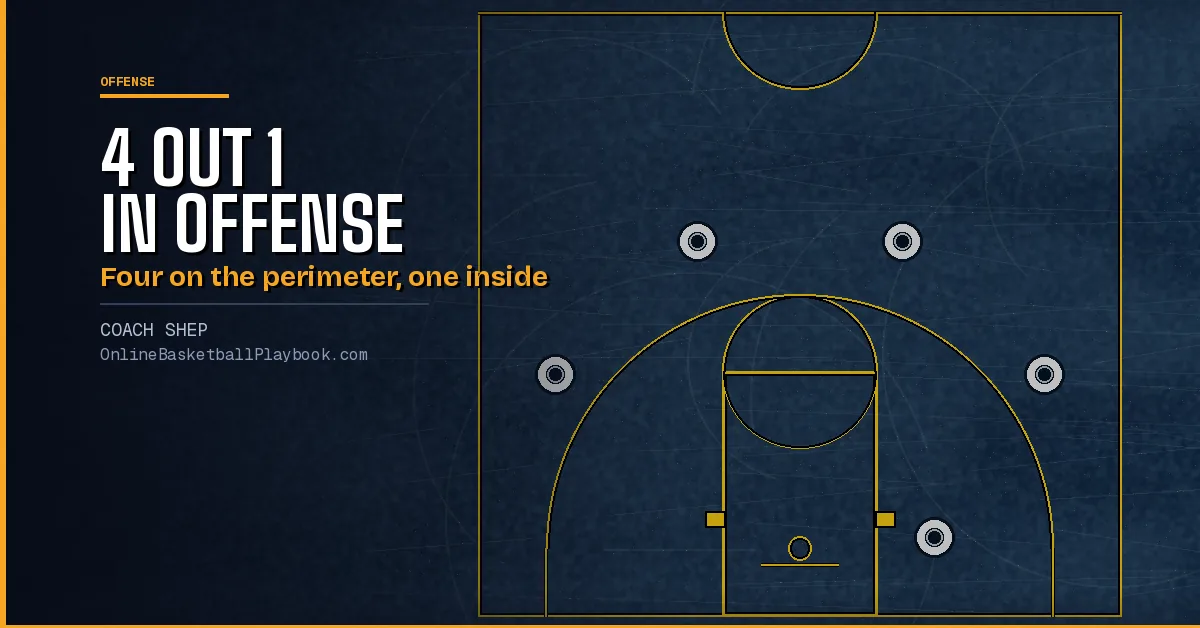
4 Out 1 In Motion Offense: Rules, Spacing and Sets
How to run the 4 out 1 in motion offense: spacing, the six rules, what the post does, pass-cut-fill, screens, quick hitters, zone adjustments and how to install it.
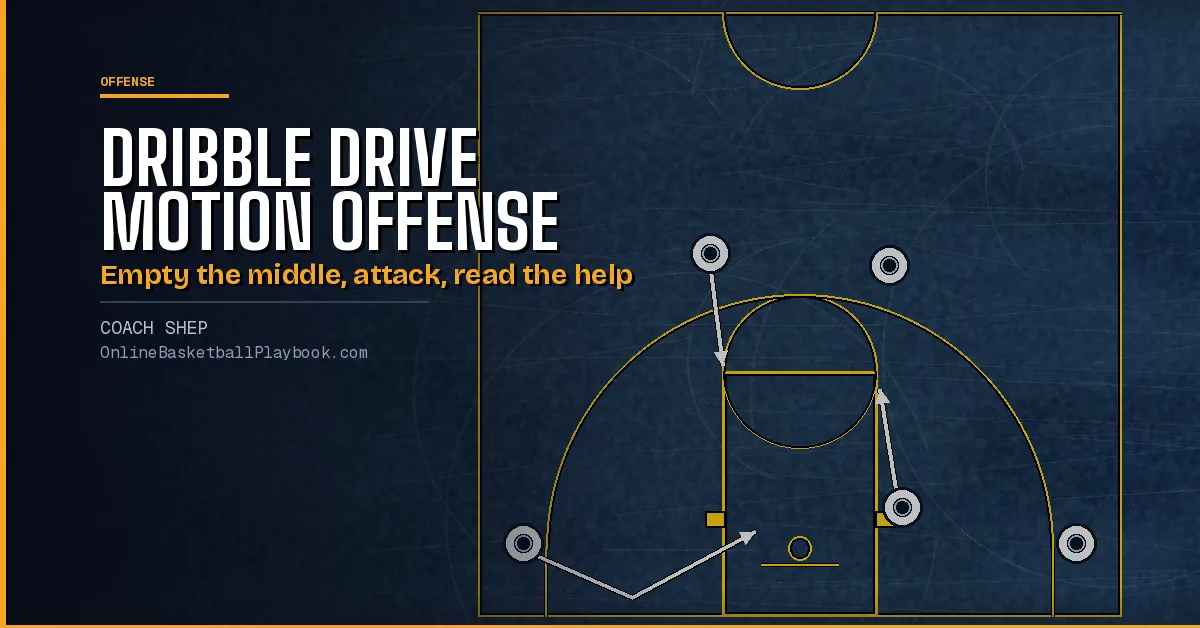
Dribble Drive Motion Offense: Spacing, Reads and Install
The dribble drive motion offense explained: 4-out 1-in spacing, the Drop, Drag and Rack zones, the read off a drive, shot diet, weak spots and the install.
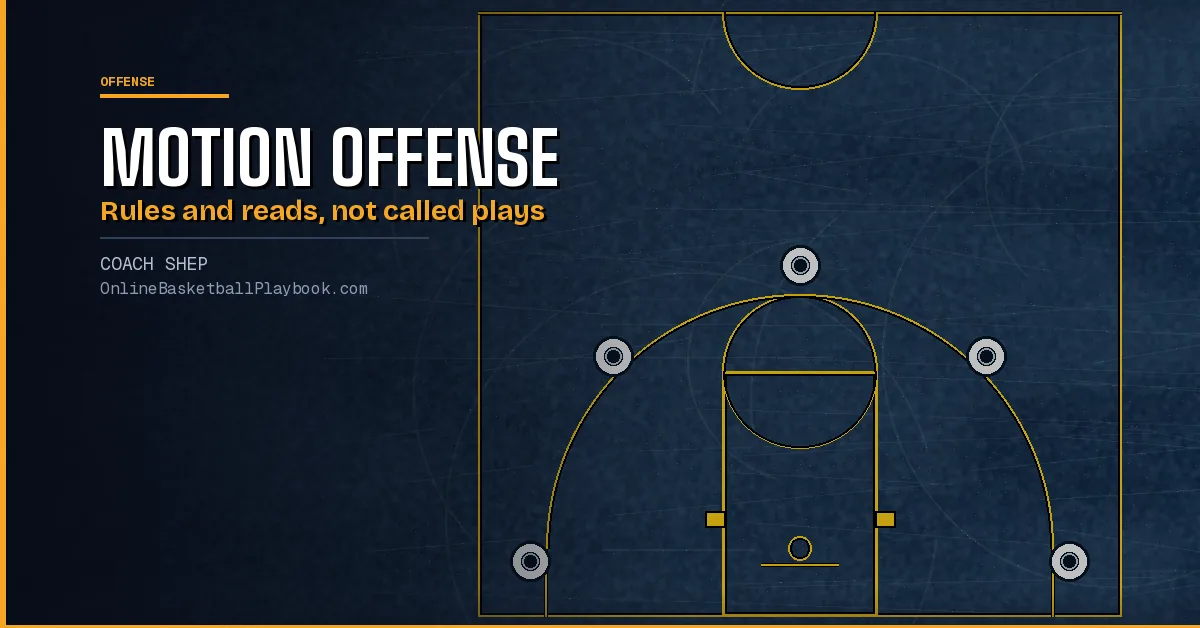
Motion Offense: Spacing, Rules, Actions and How to Install It
Motion offense runs on rules, not called plays. See the spacing, four core actions, 5-out versus 4-out 1-in, the install order, drills and where it struggles.