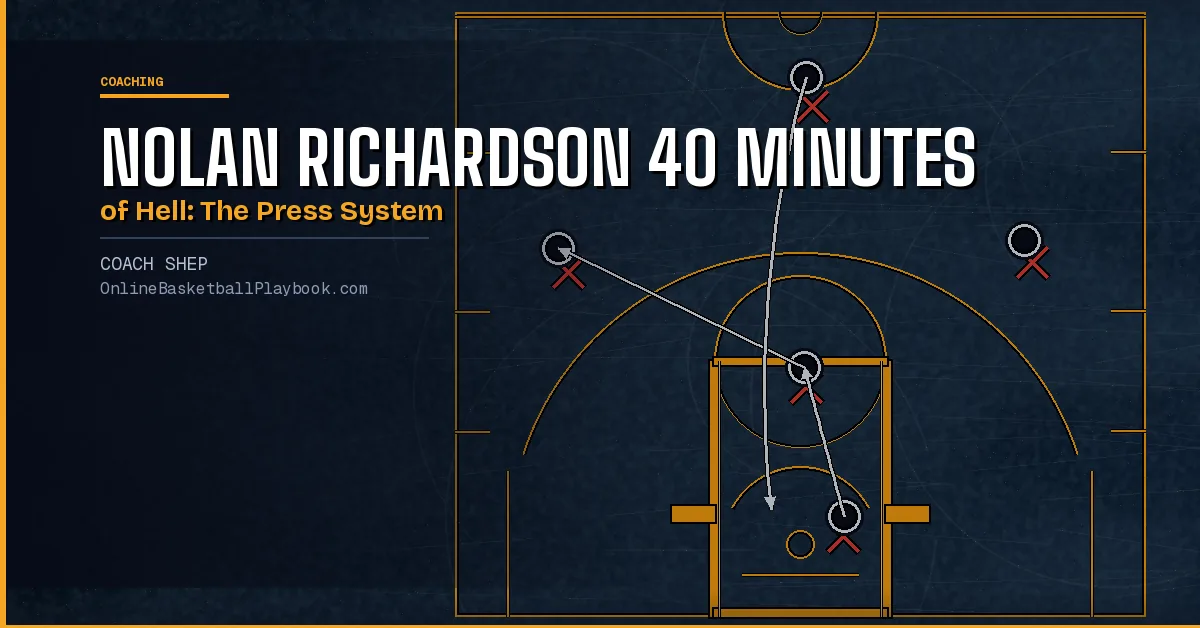
Nolan Richardson's Arkansas teams didn't just press. They pressed for 40 full minutes, every possession, every night. Here's how to install that relentless pressure system on your own roster.
The Philosophy Behind 40 Minutes of Hell
Most coaches treat the press as a weapon they pull out of the bag when they need a steal or a quick comeback. Nolan Richardson built it into the identity of his program, a permanent state of aggression that never let opponents settle, think, or run their own sets. His Arkansas teams that reached four Final Fours and won the 1994 national championship were not unusually tall or blessed with McDonald's All-Americans at every position. What they had was relentless conditioning, total buy-in to the system, and the specific skills to execute full-court pressure for 40 straight minutes without blinking.
The philosophical foundation is simple: if you make the other team work harder to get into their offense than they work running their offense, you've already won a part of the game before a single half-court possession begins. Richardson understood that fatigue, confusion, and broken rhythm are as destructive to an opponent as any shot the other team misses. The press does not need to generate turnovers on every possession to be effective. What it needs to do is make every inbound, every dribble, every pass a decision under duress.
This is the critical reframe that separates coaches who use the press well from coaches who use it poorly. Florida's Billy Donovan put it plainly: the press is successful if opponents cannot run their offense. It is unsuccessful if your team fouls, surrenders a layup, or gives up a wide-open three. The measurement is disruption, not steals. When coaches chase the steal instead of the disruption, they gamble on every possession, their defenders overextend, and a composed ball-handler walks the press for an easy bucket.
Richardson added a second layer: conditioning as a weapon. When you press for 40 minutes with deep rotation and constant substitution, you are not just playing defense. You are managing the opponent's energy reserves. A point guard who has been full-court pressured for 28 minutes is not the same player he was at tip-off. His handle gets loose. His decisions slow. His passes go where he's comfortable, not where the play calls for. That's the wear-down effect, and it compounds across quarters.
Why Coaches Press: The Tactical Payoff
Before installing any pressure system, you need an honest answer to the question Tom Davis (Boston College) asked his own staff: why are you pressing? Pressing without a purpose is just spending energy with no return. There are several legitimate answers, and each one shapes how you design and run the press.
Speed up a slow team. If your opponent is built to grind in the half court, a press that forces a 6-second inbound and a 12-second advance kills their tempo before the shot clock even matters. West Virginia used their zone press as their "ace in the hole." They kept it hidden and deployed it when they needed to shift the pace of a game that was drifting away from them.
Disrupt a hot scorer. When an opponent's best player is on a run, pressing changes the entire offensive sequence they go through to get that player the ball. Every extra pass and every second of pressure is a second that disrupts the rhythm the scorer has built.
Come from behind. The press is the single most reliable tool for manufacturing extra possessions late in a close game. You cannot score without possessions. A well-run press with smart foul management can generate two or three extra chances in the final five minutes. That's often the entire margin.
Conditioning the opponent. Walberg (who built his entire offensive and defensive systems around the 2-2-1 full-court press) framed it this way: press every miss, force the guards to speed-dribble, and substitute every two minutes so your tired players swap out for fresh ones while the opponent's point guard has no backup. The press does not just wear down the handler physically. It puts untested and uncomfortable opponent lineups into the game, lineups the other coach has not prepared for the situation they're now facing.
Controlling tempo and identity. For Richardson and for coaches like Wes Miller at UNC-Greensboro, the press is not a tactic. It is the identity of the program. When the press is your identity, recruiting, conditioning, and practice structure all align around it. Players self-select into the system. The pressure becomes second nature rather than a scripted play.
Personnel and Role Assignments
You do not need five athletes to run a press. You need the right athletes in the right spots. Every press family (whether a 1-2-1-1 diamond, a 2-2-1, or a run-and-jump scramble) organizes its players into distinct roles, and each role has a different athleticism and IQ profile.
The Point (Top Defender)
The point man is the most important position in most zone presses, and the profile surprises coaches: this is not your quickest player, it is your smartest one. Wes Miller's 1-2-2 at UNC-Greensboro made this explicit. Sacrifice athleticism for feel at the front of the press. The point keeps the ball out of the middle third of the court, plays cat-and-mouse with the ball handler, and signals when to collapse and when to hold. A point man who chases steals opens up the entire middle of the press and destroys the system in one dribble.
The Wings
The wings are your athletes. In the 1-2-2, they have a specific assignment that requires elite anticipation: they invite a cross-court pass, sprint on the air time of that pass, and declare on the flight. That means the wing cannot wait until the ball lands to decide where to go. She has to read the passer's shoulder, the trajectory of the ball, and be moving before the catch. Wing defenders who wait and react get there a full step late every time. Wings also need to communicate constantly. They are the early-warning system for the point and the safeties behind them.
The Trappers and Takers
In the 2-2-1 structure Walberg labeled the Fresno City College framing, the two front players are trappers and the two middle players are takers. Trappers apply the initial double on the first pass. Takers read the outlet and contest or steal the reversal. The breakdown point between these two groups (the taker-to-middle switch on a cross-court dribble or pass) must be drilled until it is automatic. If the taker freezes when the ball is attacked across the floor, the press collapses in the middle.
The Safety
The back defender protects the rim at all costs. No wide-open layup. No wide-open three from the corner because the safety gambled on an interception. Billy Donovan was clear: the only automatic trap in his system is the coffin corner (ballside below the block), and even then, the safety's job is to prevent the free transition bucket. The safety reads numbers. If the press is beaten 2-on-1, the safety doesn't help from the wrong side. She protects the basket and forces the ball handler to make a play.
Trapping Triggers and Decision Rules
The reason most presses leak is not lack of effort. It is lack of clarity. Defenders don't know which situations call for a trap and which ones call for staying home. The result is a defense where five players are improvising simultaneously, the scramble creates gaps, and a composed opponent picks the press apart with two passes and a layup.
Mike Dunlap's 1-1-3 zone at Metro State gives the clearest framework for solving this problem. Dunlap catalogs 14 specific ball locations and situations and assigns a binary decision to each: trap it or stay home. There is no in-between, no reading the coach, no improvising. The zone's rotations are dictated by where the ball is, not by a live call from the bench.
Apply this same principle to your press. Before you install it, map out every situation that will arise (ball caught at the wing off an inbound, ball caught at half court, ball reversed to the top of the key, ball driven into the lane) and decide in advance whether that situation calls for a trap or a flat-foot contest. Write it on the whiteboard. Make it testable. Ask your players in the walk-through: ball here, what do you do? They should answer in under two seconds without looking at you.
The situations that most coaches get wrong: the wing catch off a skip pass (do not trap. The wing is in position to attack the gap. Crowd the catch and force a dribble instead) and the high post entry above the free-throw line (stay home. No trap. Protect the lane). Both of these instinctively feel like trap situations, but both open up the defense when you commit the trap. The discipline to stay home in those moments is what separates a functional press from a gambling press.
Building the Press in Practice
You cannot install a full-court press in a single week. The press is a conditioning system as much as it is a tactical system, and conditioning requires months of consistent work. Richardson's teams pressed for 40 minutes because they spent the entire preseason teaching their bodies and minds to operate at that intensity without breaking down mentally or physically.
Start with two-man trap fundamentals before you ever run the full press. Every defender needs to understand foot position in a trap (parallel to the sideline, no split), hand positioning (high and active, not grabbing), and communication ("ball, ball, ball" from the trapper; "I got help" from the nearest outlet defender). Dunlap's four absolutes apply here: stance, high hands, jump to the ball, and block off. These are non-negotiable on every single possession, every single practice, regardless of what you're running that day. They are defensive habits, not situational reminders.
Progress to the 3-on-3 trap drill, which isolates the two trappers and the nearest outlet defender against three offensive players. This teaches the taker to read the outlet in real time and teaches the trappers to maintain the trap without fouling or splitting apart. The most common error at this stage is one trapper drifting to cut off an outlet while the other stands still. Now you have no trap, just a deflected pursuit. Both trappers commit to the trap; the nearest free defender takes the outlet.
Full-press live scrimmage must include a substitution protocol from day one. If you are teaching the Walberg wear-down system or the Richardson 40-minutes identity, sub every two minutes on the press rotation and track which players are executing the system versus freelancing. Players who freelance in the press are not taking a creative risk. They are creating a gap that the opponent will find within two possessions. Correct it immediately and without ambiguity.
What Happens When the Press Breaks
Every press gets beaten sometimes. Great press teams have a plan for it. The most dangerous moment in a press is not when the opponent beats it cleanly. It's when your defenders are scattered across the floor mid-rotation and the ball has already advanced. That's when undisciplined defenses give up a wide-open look and spiral mentally.
The first rule is always pair your press with a half-court fallback call. Wes Miller's 1-2-2 drops naturally into a 2-3 zone when the press is beaten. The alignment is almost identical in the back line, so the transition requires no scramble. Tubby Smith's system has an explicit pairing: "Black to 5" means press to half-court man. The press and the half-court defense are one connected call, not two separate systems.
The safety is the signal. When the ball beats the press and the safety is the last player between the ball and the basket, the safety calls "break," a single word that tells the rest of the defense to sprint to their half-court assignments. The press defenders do not continue trapping a ball that is now past them. They sprint to matchup spots and get organized before the offense can set up a scoring action.
NKU's "three sins" framework is useful here for your own system: never get split through the middle of the trap, never run at a handler who has no defender in front of him (that creates a behind-the-play foul situation), and never go 3-on-the-ball. All three sins produce the same result. The offense has a numbers advantage, and the safety cannot stop all of them. Teaching your players these sins by name gives you a shorthand for corrections during film and practice that doesn't require a long explanation. You say "three sins" and point to the clip.
The Mistakes That Kill a Press Defense
Most presses fail not because the concept is wrong but because coaches skip the fundamentals and jump to the live-action version too fast. Here are the mistakes that most commonly destroy a press over the course of a season.
No defined point guard on defense. The top defender in your press is the most important position. If you rotate just anyone to that role without training them specifically for it, the entire press reads wrong. The point man must be trained to invite the pass they want, funnel the ball to the sideline, and never give up the middle. That takes weeks of position-specific reps, not general press walk-throughs.
Chasing the steal. Every coach sees a wing defender leave her assignment to jump a cross-court pass and get burned. Then they see it again. Then a third time. This is the single hardest habit to correct because the steal is exciting, the correct positioning looks passive, and the "correct" play rarely produces a visible stat. Make it explicit: your job in this press is to take away the pass forward and force the ball backward or sideways. Turnovers are a byproduct. Turnovers are not the goal.
No subs in the rotation. If you are pressing for 40 minutes and your same five defenders are on the floor for 32 of them, you are not running a press. You are running five players into exhaustion. One press system calls for substituting every two minutes specifically to force the opponent into untested lineups while your fresh players maintain the same intensity level. Build your sub rotation into practice from week one.
Pressing with no purpose against a poised team. Tom Davis's question ("why are you pressing?") is not rhetorical. Against a team with a composed, experienced point guard and smart spacing, a predictable press will be dissected for layups all night. Against a slow team, a young team, a ball-handling-light team, the press is often devastating. Know when to use it and when to hold it.
Before you run your press live in a game, write out every ball location on a whiteboard and assign a binary decision (trap or stay home) for each situation. Walk your players through all 14 of them in a dry-run before you ever add offense. Defenders who know exactly what they're supposed to do in every situation execute cleanly; defenders who are guessing produce gambling fouls and layups. Make the decision tree part of your installation, not an afterthought.
- Train the point man specifically. Run dedicated reps where the point defender practices funneling the ball handler to the sideline, inviting the pass they want, and never letting the ball enter the middle third of the court. Treat this as its own position, not a rotation assignment.
- Define your 14 situations before practice 1. Map every ball location to a trap-or-stay-home decision. Walk players through the entire decision tree in a slow-walk before you add offense, and quiz them by pointing to a spot: ball here, what do you do?
- Build your sub rotation into the press from week one. Sub every 2 minutes in press segments during practice. Players learn to maintain intensity on short bursts; opponents get uncomfortable, unfamiliar lineup combinations thrown at them.
- Pair every press call with a half-court fallback. Name the pairing ("Black to 5," "press to 2-3") and practice the transition from press break to half-court setup so it happens automatically without a timeout or a live call from the bench.
- Teach the three sins by name. Get split through the trap, run at a naked handler, or go 3-on-the-ball. Name them, show film of each, and make them shorthand corrections in practice so you can fix mistakes with two words instead of a full explanation.
- Track disruption, not steals. After practice scrimmages, count opponent possessions where they could not run their half-court set. That is your press success metric. Coaches who track steals only reinforce gambling behavior. Coaches who track disruption reinforce the system.
Want more basketball coaching strategies, drills, and tools?
Join the Online Basketball Playbook newsletter →
Draw this play free in the play drawer →
Membership: the full library, playbook packs, and Pro drawing tools →
Keep Building
Related breakdowns
1-3-1 Full Court Press: Roles, Traps and Rotations to Install
The 1-3-1 full court press from setup to frontcourt trap: each role, the reversal rotations, an aggressive version, the costs and when coaches call it.
Full Court Press Defense: Types, Rules and How to Install It
Full court press defense pressures the ball for 94 feet. See the press families, shared rules, trap mechanics, the cost, the install order and drills.
Coach Shep Full Court Press: Numbered Looks, Hold Fist, Black
Coach Shep's full court press: the numbered looks 55, 22, 25 and 12, Black, Hold Fist, the fallback behind each press, his scoring target and how he practices it.