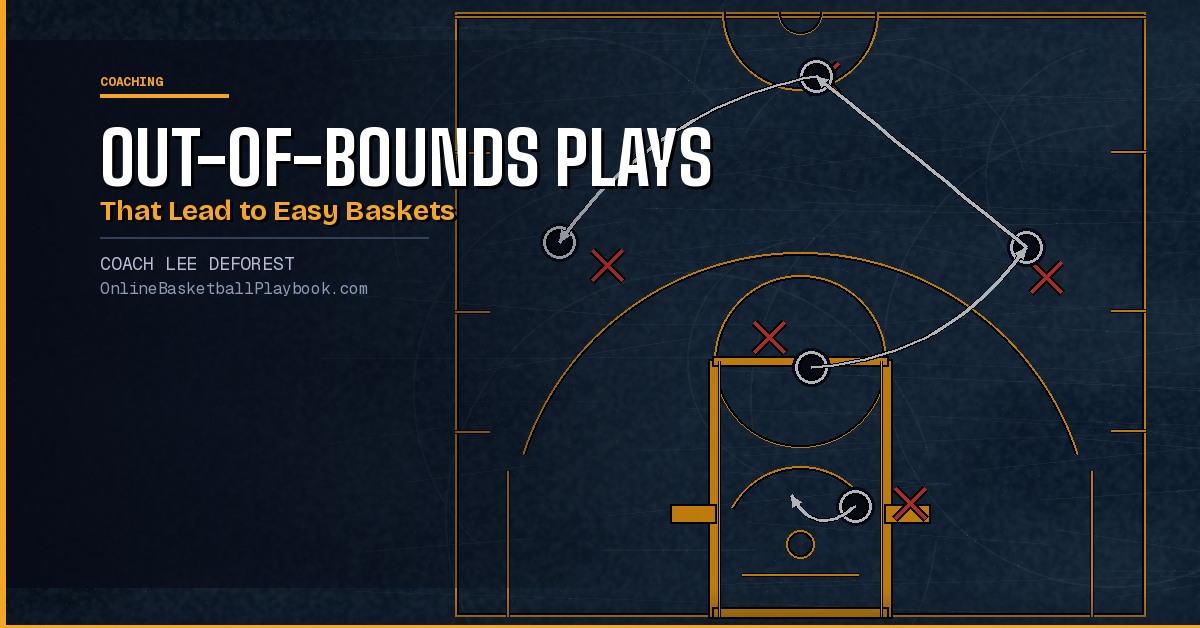

Sideline out-of-bounds situations are free possessions most teams waste. With the right plays and a simple two-phase framework, these dead-ball moments become reliable scoring opportunities your opponents are not ready for.
The Two-Phase Framework Every SLOB Needs
Most high school sideline out-of-bounds plays are built the same way: one decoy action, one cutter, and a hope that the cutter is open. When the cutter is covered — and experienced defenses will take that away — the inbounder is stuck holding the ball with the clock counting down and no backup plan in sight.
The fix is a two-phase design. Olympic-level special situations offense (documented in the 2024 Paris Olympics Playbook) uses this model without exception. Phase 1 exists solely to get the ball inbounds safely and shift at least one defender out of position. Phase 2 is where the actual scoring action happens — using whatever defensive leverage phase 1 created.
Here is what that looks like in practice. In a screen-the-screener SLOB, the first action is a downscreen to free the inbound catcher. The screener's screener cuts immediately as the ball is in the air — the defender who hedged on the downscreen is now stuck being screened themselves. The scoring action (a catch-and-drive, a catch-and-shoot, or a direct post feed) runs into a defense that is one rotation behind.
A two-phase SLOB does not have to be complicated. It just needs a primary action with a clear purpose — and a second action that exploits what the defense does to stop the first one. Teams that rep this structure generate real scoring opportunities from sideline possessions instead of burning 10 seconds to get a forced midrange jumper.
The Five Sideline Alignment Families
Every sideline out-of-bounds play starts from one of five basic alignments. Knowing these families lets you read what a coach is running and helps you build sets that fit your personnel without having to design everything from scratch.
Stack SLOB
Two or more players are stacked tight on the ball side near the inbounder. The first player peeling off the stack is the decoy — the second player cutting under or through is the primary read. The Stack creates immediate misdirection because the defense has to honor both cuts simultaneously. The Alabama Stack Backdoor (documented in the 2024 NCAA Bracket Busters collection) is the cleanest example: the first player runs a fake dribble-handoff, the second player reads the defender committing to the handoff and cuts backdoor. One trigger, one read, and it can be taught in a single 20-minute practice session.
Box SLOB
Four players set up in a box shape near the sideline. The box spacing creates wider cutting angles than a baseline set because the basket is farther away. From the box, you can run a stagger for a shooter going toward the basket or a back screen for a lob on the weakside. The Spurs EOG Triple SLOB is a box-origin set — three screeners in sequence free one shooter for a clean three-point catch-and-shoot without a dribble.
1-4 High SLOB
Four players spread across the elbow and wing line with one player at the top. This alignment clears the lane completely, which makes it the strongest look for lob actions and pick-and-roll plays off the inbound. When the floor is empty, the roll man or the backdoor cutter has a straight path to the rim with no help defender in position to rotate. Jay Wright's late-game SLOB set (from the Game Winning Specials Playbook) originates from a 1-4-ish look — the big dives to the rim while a wing runs a back screen into a lob opportunity, with a built-in counter if the first option is denied.
Line SLOB
All four players string out in a line at the sideline, creating multiple simultaneous cutting options. The Line SLOB is the most complex alignment because it presents the defense with several decisions at once. Hubie Brown's "10 Seconds or Less" SLOB (Game Winning Specials Playbook) is a five-read flow chart built from a Line — each read is only live for one second before the next opens. This alignment works for advanced teams with disciplined inbounders who can process reads quickly; it asks too much of a group that hasn't repped it under pressure.
Spread SLOB
Players spread wide to clear space for a two-man action or an isolation. The Northwestern Wide Horns Slip (2024 NCAA Bracket Busters) uses a spread alignment and a flare screen — but the actual scoring action is the screener slipping before the defender can recover. The spread is purely setup; the slip is the play. This alignment pairs naturally with teams that have a quick decision-making ball handler who can make one pass and attack.
Three Out-of-Bounds Plays Worth Installing Right Now
These three plays cover the most common sideline situations — a standard possession, an end-of-game three-point shot, and a half-court flow set. Together they give a team a complete SLOB menu that can be installed in under a week of practice.
Alabama Stack Backdoor — Your Fastest Install
Alignment: any sideline stack. Player 1 takes the ball out, Player 3 stands at the stack position near the lane. Player 1 dribbles toward Player 3 selling a dribble-handoff (DHO). Player 3 reads the defender: if the defender commits to stopping the DHO, Player 3 cuts backdoor immediately for the catch and layup. If the defender sags off, the DHO happens and Player 3 catches near the basket anyway.
There is only one read. The trigger is whether the defender honors the handoff. A player who understands that trigger can run this set correctly after one walkthrough. This is the fastest SLOB to install because it is also the most forgiving — both outcomes of the read result in a high-percentage touch near the basket.
Spurs EOG 3 Quick Hitter — Down Three with Eight Seconds Left
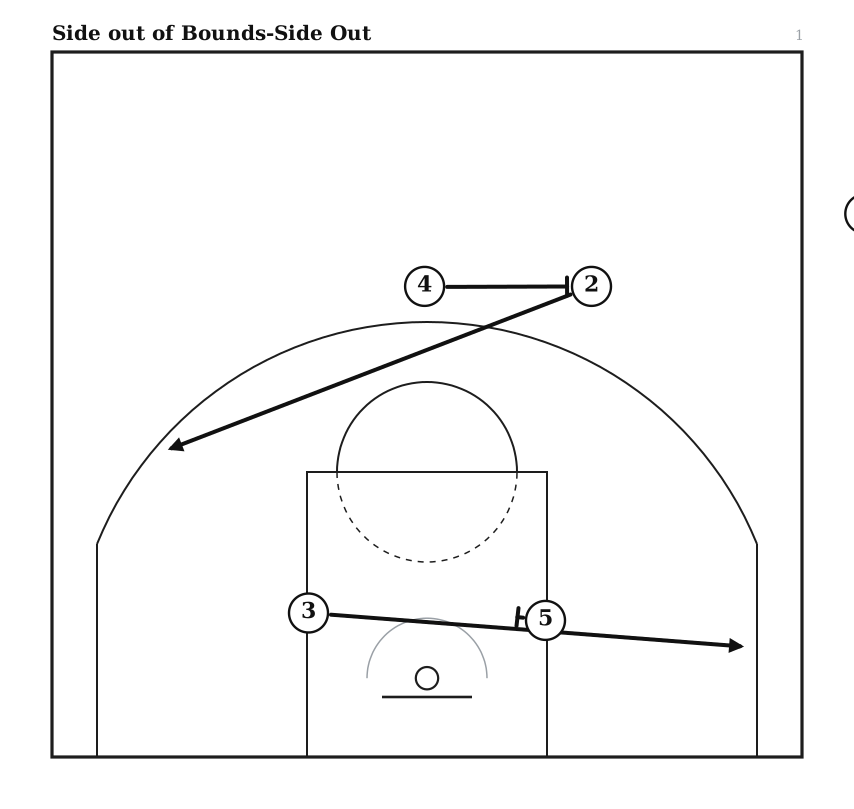
Player 1 goes to the corner (decoy and spacing). Player 4 screens for Player 5. Player 5 then screens for Player 3, who cuts to the top of the key. Player 2 (the inbounder) passes directly to Player 3 for a catch-and-shoot three-pointer. Three bodies set two screens in sequence. The chain takes roughly three seconds from first contact to the catch, which fits a sideline situation with five to eight seconds remaining.
The reason this set earns player buy-in quickly is the Spurs attribution — players recognize the name and take the set seriously. More importantly, it answers the most critical late-game question before the play starts: "Are we shooting a two or a three?" Once the team decides it needs three points, this is the call. There is no ambiguity about the target shot.
Detroit X Play — Two Shooters, Zero Dribbles
Player 5 downscreens Player 1 for a catch-and-shoot corner three (primary). If that option is cut off, Player 2 runs off a stagger set by Players 4 and 3 for a wing three-pointer (secondary). Both options are catch-and-shoot. The defense has to choose between two shooters, and there is no correct rotation that covers both cuts.
This set is ideal for teams with two reliable shooters. The inbounder must sell the first look with their eyes — looking at Player 1 before swinging to Player 2 — or the defense can cheat toward the stagger without consequence. With proper eye work, the defense is always a half-step behind one of the two options.
A SLOB that tries to score on the first pass has no recovery plan when the inbound is denied — the two-phase model is what separates a set from a hope.
— SLOB Plays Concept File, Basketball Vault
How to Attack Man-to-Man Defense on Sideline Sets
Man-to-man defenses guard sideline inbounds by locking onto individual players and trying to deny the first pass. The counter is straightforward: manufacture an overplay with a convincing first action, then exploit the defender's commitment before they can recover.
The dribble-handoff fake into a backdoor cut is the single most productive action in the sideline SLOB library against man defense. The DHO is one of the most effective off-ball actions in basketball, and defenders are conditioned to hedge toward it. The moment a defender's weight shifts to stop the handoff, the cutter has an open path to the basket. The Alabama Stack Backdoor, the Albany Women SLOB from Hackenberg's library, and Yale's Zoom set all use this exact trigger — DHO fake, read the defender's head, go backdoor.
Screen-the-screener actions add a second layer of pressure. The screener sets a downscreen or back screen to free the inbound catcher, and is immediately screened by a third player as the ball is in the air. The defender who helped on the first screen is now stuck being screened themselves. This is the dominant mechanism at the Olympic level and appears throughout the Paris 2024 SLOB sequences because it forces the defense to make two correct rotations in under two seconds — a nearly impossible task without perfect communication.
The inbounder back-cut is the most underused counter in high school basketball. After releasing any sideline inbound, the inbounder's defender habitually relaxes and watches the ball. A trained inbounder who cuts hard backdoor immediately after releasing the ball will be open nearly every time. This is not a called play — it is a habit. One repetition in practice, properly reinforced, turns every SLOB into a potential 5-on-4 situation after the catch.
Cracking Zone Defense on Sideline Inbounds
Zone defenses on sideline inbounds typically put a guard at the inbounder to take away easy gap passes. The counters focus on flooding the middle, forcing quick reversal, and attacking the side that the zone cannot reach.
The highest-percentage zone entry on a sideline SLOB is a ball-side big flashing hard to the mid-post or elbow, catching the inbound, and immediately reversing the ball to a skip pass on the far side. The zone cannot defend the middle flash and the perimeter simultaneously. Once the big catches in the middle, the weak-side corner or wing is open for a fraction of a second — enough time for a catch-and-shoot or an aggressive attack off the catch. The Sideout 4 set in the BLOBS Playbook is built on this exact entry: big flashes hard, catches, and feeds the cutter for a layup before the zone can rotate.
Quick reversal exploits the same weakness from a different angle. If the zone slides to the first pass on the sideline, the ball goes back across the lane in one extra pass before the zone can recover. Michigan's zone end-of-game SLOB set works this way — a free-throw-line cut occupies the top defender, a back screen frees a lob on the backside after the reversal, and the zone is still recovering from the first slide.
Two cutters on adjacent zone seams is the most aggressive zone counter. Two players cut to gaps on opposite sides of the zone at the same moment, forcing the middle defender to pick one. A skip-then-cut sequence — skip to the corner (one zone player chases), cut from the weak side as the middle shifts (one zone player commits) — leaves the cutter alone. The key is that both cuts happen simultaneously or within a half-second of each other; sequential cuts give the zone time to recover between rotations.
Timing Discipline: The Detail That Kills Every SLOB
The most common reason sideline sets fail at the high school level has nothing to do with the plays themselves. The inbounder takes the ball from the referee before everyone is in position. One player is still walking to their spot when the action starts. The manufactured deception in the first phase is gone before the play even begins.
Jay Wright addressed this directly in his coaching materials (Game Winning Specials Playbook): the inbounder should take time and act busy — tie a shoe, fix a sock, check the ball — before taking the inbound from the official. This accomplishes two things. Every player gets to their spot without being rushed, which is the primary goal. And the acting-busy routine is a decoy in itself — the defense watches the inbounder fidget instead of reading where the cutters are setting up.
The FCP coaching standard derived from this principle is straightforward: no player calls for the ball from the inbounder until every player on the floor has made eye contact with the inbounder and signaled their spot. No eye contact, no inbound. The inbounder reads the signals and then accepts the ball from the official.
This rule costs zero additional seconds when players know it and rep it in practice. It costs possessions at critical moments — end of quarters, end of games, tie situations — when teams have never enforced it. A team that practices this habit for two weeks runs every SLOB with the same composure at the end of a game that they have at the beginning of practice.
Building a Three-Play SLOB Menu for Your Team
Three plays repped to automatic execution are more valuable than six plays that require a huddle reminder to call. The research on high school special situations offense consistently shows that team performance on sideline sets improves with fewer options, not more — because fewer options means more repetitions per option and fewer mistakes under pressure.
The right three-play menu depends on your personnel. Before you install any set, answer three questions about your roster: Do you have a shooter who can catch and fire a three-pointer without a dribble? Do you have a big who can catch a lob near the basket off a back screen? Do you have a ball handler quick enough to sell a DHO and read the defender in real time?
A shooter-heavy team should carry the Detroit X Play as the standard SLOB (two shooter reads, catch-and-shoot), the Spurs EOG 3 as the designated down-three set, and the Alabama Stack Backdoor as the misdirection option. A team without two reliable shooters should replace the Detroit X with Tigers 2 — a PnR-based SLOB that flows directly into half-court offense — and lean on the backdoor action and the inbounder cut as primary scoring mechanisms.
Regardless of the specific plays, the menu should always include: one quick-hitter catch-and-shoot set, one two-phase flow set that transitions into half-court offense, and one misdirection backdoor set. Those three categories cover every common sideline situation and give a coaching staff a confident answer for every scenario before the game starts.
Introduce your SLOB menu in the second week of practice — after your base offense is set — and rep each play at least 10 times a week in a live walkthrough setting. Players build confidence in special situations sets through repetition, not through diagram review. The play has to feel routine before it can work in a game.
- Use the two-phase model on every sideline set: phase 1 gets the ball inbounds safely and shifts a defender; phase 2 is the actual scoring action against a shifted defense.
- DHO fake into backdoor cut is the top man-to-man SLOB action: defenders are trained to stop the handoff, which means any defender who commits is already out of position for the backdoor.
- Teach the inbounder back-cut as a habit, not a play: after releasing any sideline inbound, players cut backdoor immediately if their defender relaxes — this habit turns every SLOB into a potential 5-on-4 for free.
- Zone counters: flash to the middle first, then reverse quickly: the zone cannot cover the mid-post catch and the weak-side corner at the same time — attack both seams in one possession.
- Keep your SLOB menu at three plays maximum per team: one shooter set, one flow set into half-court offense, one backdoor misdirection set — repped to automatic execution beats six plays requiring a timeout reminder.
- Enforce Jay Wright's timing rule every practice: no player calls for the ball until everyone has made eye contact with the inbounder and signaled their spot — install this once in week one and it runs on autopilot for the rest of the season.
Want more basketball coaching strategies, drills, and tools?
See it drawn up
Related diagrams
Keep Building
Related breakdowns
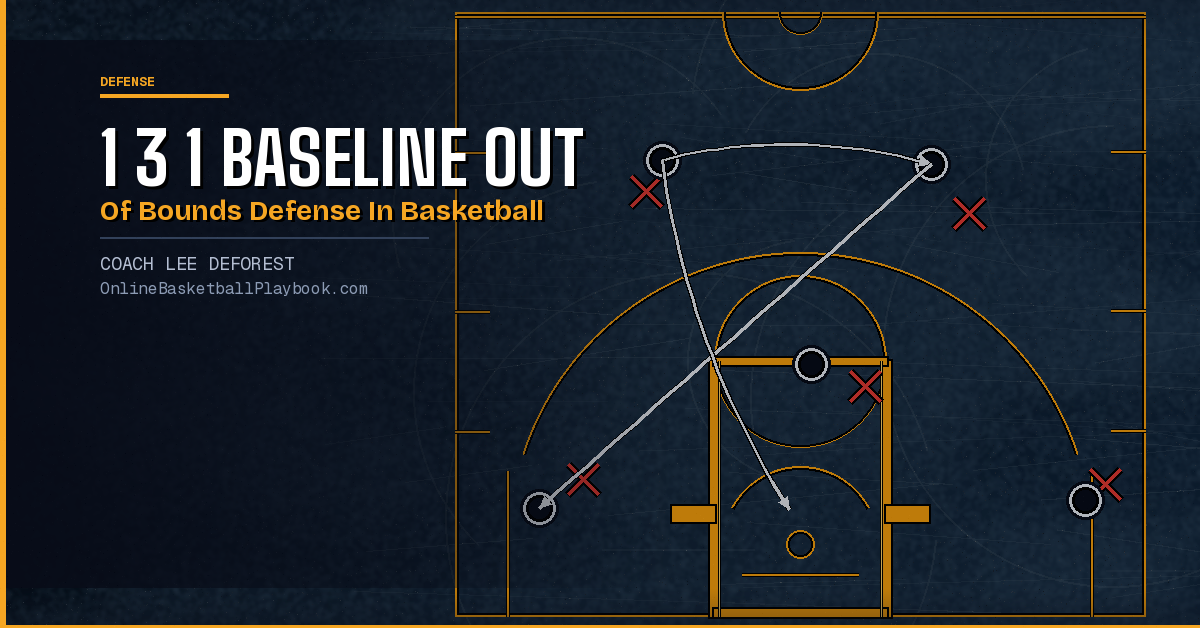
1-3-1 Baseline Out of Bounds Defense in Basketball
1-3-1 Baseline Out of Bounds Defense in Basketball
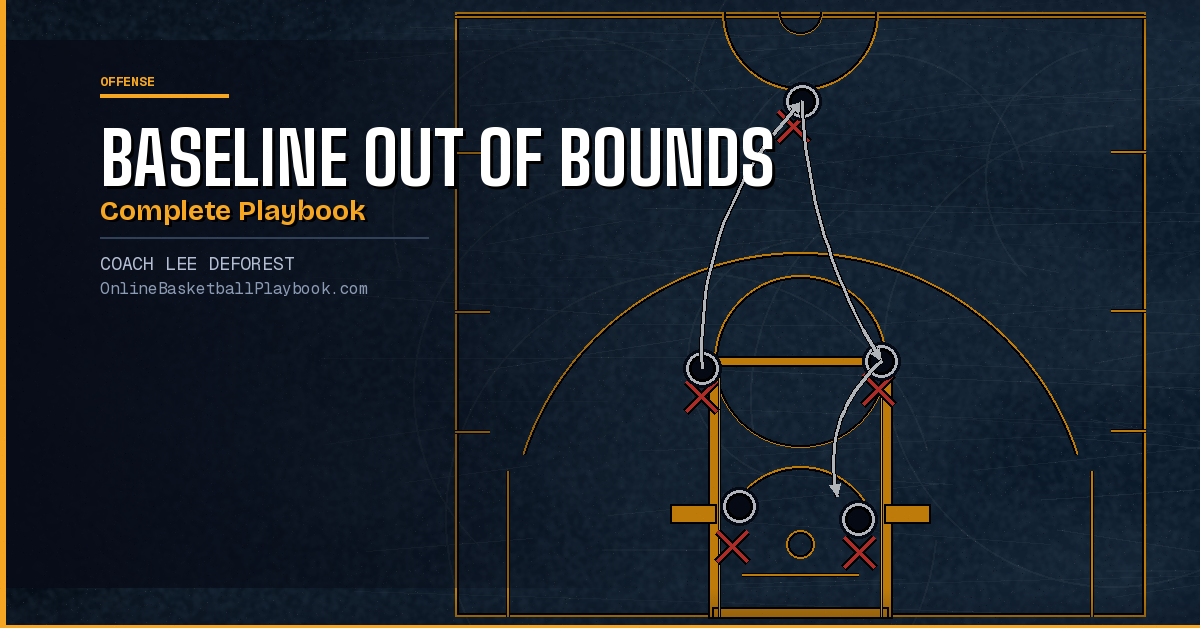
Baseline Out of Bounds Plays: Complete Playbook
Baseline Out of Bounds Plays: Complete Playbook
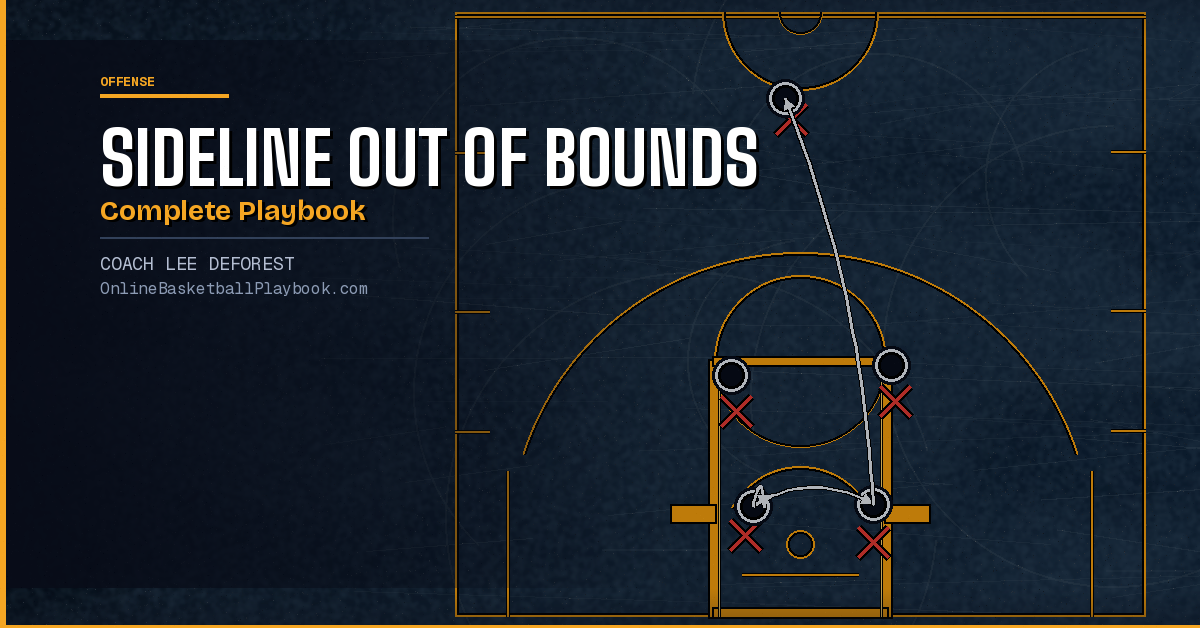
Sideline Out of Bounds Plays: Complete Playbook
Sideline Out of Bounds Plays: Complete Playbook