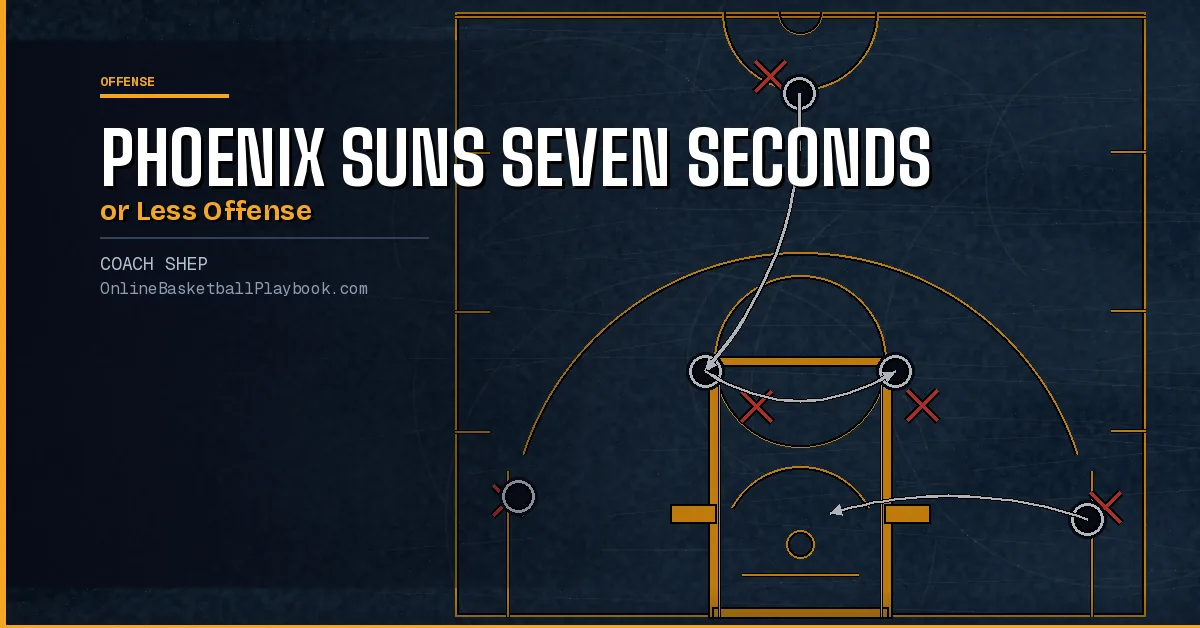
Mike D'Antoni's Seven Seconds or Less offense turned the mid-2000s Phoenix Suns into the most exciting team in basketball. Here is exactly how it worked and what every coach can take from it.
The Philosophy Behind Seven Seconds or Less
The name says everything. Mike D'Antoni wanted his Phoenix Suns teams to shoot within seven seconds of gaining possession whenever possible. Not as a gimmick, but as a deliberate strategic weapon rooted in a simple mathematical truth: the faster you play, the more possessions you generate, and more possessions mean more scoring opportunities over the course of a game.
D'Antoni was not the first coach to value pace. But he was among the first at the NBA level to make pace the central organizing principle of an entire offense rather than a situational tactic. Most teams in the early 2000s pushed in transition when the opportunity was obvious, then settled into a half-court set. The Suns made the push the default and the half-court set the exception.
The system was built on a read-first mentality. Players were not running scripted plays to a predetermined shot. They were reading the defense at every moment and attacking whatever the defense surrendered. If the defense sprinted back and set up, the Suns would run their pick-and-roll offense and manufacture a shot from there. If the defense got caught in transition, the Suns would push immediately and score before the defense could organize. The same principle applies to any level of the game: make the defense pay for every mistake and force them to cover the full floor at all times.
D'Antoni had three non-negotiable rules that governed every possession. Get the ball up the floor immediately. Attack before the defense can set. If the shot is not there in the first seven seconds, run a quick pick-and-roll and get a quality shot before fourteen seconds. Standing and watching was the cardinal sin. Every player moved with purpose on every possession, which is itself a motion-offense principle that predates D'Antoni and has outlasted him.
Personnel and Spacing Requirements
The Seven Seconds offense only works if the spacing forces the defense to cover the entire floor. D'Antoni built his rosters accordingly. He wanted five players on the court who could each make an open three-pointer when the ball swung to them. That requirement changed how he used his big men.
Amar'e Stoudemire was the prototype big for this system in his prime Suns years. He was an elite pick-and-roll finisher who could catch a lob at the rim, finish over defenders, and draw fouls at a high rate. He did not need to shoot threes. But he had to set effective screens, roll hard to the basket, and finish with two hands above the rim, because the system depended on the defense respecting the roll man and the shooters simultaneously.
Boris Diaw and later Grant Hill showed what a stretch-big or versatile wing could add to the system. A big who could also step out and catch a kick-out pass for a mid-range jumper or a three made the defense choose between protecting the paint and protecting the perimeter. That choice, made under time pressure because the Suns were pushing pace, was almost always the wrong one.
The perimeter players needed to be decisive catchers. D'Antoni demanded that his guards and wings catch the ball ready to shoot. A player who caught and then gathered and then decided was too slow for the system. Every catch was a pre-read: feet set or in rhythm for a pull-up, reading the defender's position before the ball arrived. This is the same discipline that motion offense coaches teach at every level. Catch ready to attack.
Steve Nash was the irreplaceable piece because he could do what very few players in NBA history have done: operate a pick-and-roll at top speed with perfect decision-making. He read the defense while running at full pace, delivered pocket passes to rolling bigs, found shooters in the corners before they were open, and shot off the dribble with devastating accuracy from every angle. The system needed a point guard who made all five options on every pick-and-roll available simultaneously. Nash did that better than anyone in the league.
The Pick-and-Roll as the Engine
Once the Suns crossed half court and the transition opportunity was gone, the offense ran almost entirely through two-man pick-and-roll actions between Nash and a big, most often Stoudemire. Understanding how D'Antoni structured these actions is the most transferable coaching lesson from the entire system.
The Suns ran pick-and-roll from ball screen positions that gave Nash multiple angles to attack. The screen could come on the wing, at the top of the key, or off a dribble-handoff action. The starting position mattered less than the spacing around it. The three remaining players were spread to the corners and the weak-side wing, pulling three defenders as far from the action as possible.
Nash's reads off the pick-and-roll followed a clear hierarchy. If the screener's defender dropped to protect the rim, Nash pulled up for the mid-range jumper over the coverage. If the screener's defender hedged hard to cut off Nash's drive, Stoudemire rolled under the coverage for the lob or the catch at the rim. If the defense switched, Nash attacked the mismatch with a drive or a pass to the post. If the help defenders rotated to cover, the ball moved to a shooter on the weak side.
What made this read structure devastating under D'Antoni was pace. Most pick-and-roll defenses are designed with the assumption that the offense will take time to set the screen, run the action, and process decisions. The Suns ran the screen at a speed most teams were not prepared to match because their defenders were still getting into position. By the time the defense organized a coverage, Nash was already into his decision, and the ball was leaving his hands.
D'Antoni also used multiple ball-screen actions in sequence. If the first pick-and-roll did not produce a quality shot, the offense flowed directly into a second action rather than resetting. A player who set the first screen would relocate to set a second one. The defense had to recover and reset twice in the same possession, and against players moving at Nash's pace, that was nearly impossible to do cleanly.
Transition Attack and Early Offense
The first seven seconds of every possession began the moment the Suns touched the ball. Defenders who had just missed a shot or turned the ball over faced an immediate full-court decision: sprint back or allow a quick-hitter before the defense was set.
D'Antoni drilled what he called the "secondary break", the attack that came not off a clean steal or fast break, but off a made basket or a controlled rebound when the defense was retreating. Most teams jogged up the floor and called a play. The Suns pushed the ball to the rim side, found Nash, and put the ball ahead to a wing running the lane. The push itself was the play.
The rim-runner was a critical piece of the early offense. Each possession had a designated player, often Stoudemire or a cutting wing, whose job was to sprint directly to the rim the moment the Suns gained possession. That player was the first look for the outlet pass. If he received the ball with a step on his defender, the Suns had a layup or a foul before the defense organized. If the defense jumped the rim-runner, the ball swung wide for an open three-pointer in rhythm.
Nash's half-court approach was a weapon in itself. He rarely walked the ball up. He pushed pace even when the defense had numbers back, because his speed off the dribble and his willingness to shoot the pull-up at seventeen feet kept the defense from loading up at the rim. Defenders who sagged to protect against the pick-and-roll left Nash open for the pull-up. Defenders who pressured Nash gave ground to Stoudemire at the rim. There was no safe coverage because the threat was real at every angle.
The kick-ahead pass was Nash's signature in transition. Before a teammate finished his sprint to the wing, Nash had already delivered the ball. The receiver caught it in stride rather than stopping to receive and then starting again. That one habit, placing the ball where the cutter would be rather than where he was, is something every point guard and coach can practice in any gym at any level.
You do not need NBA athletes to run the core ideas from this system. Drill the outlet-and-push with every rebounder in practice until sprinting ahead is a reflex. Add a rim-runner assignment to every defensive rebound so your transition attack has a first option every time. Once players internalize the pace and the spacing, the reads come naturally over time.
Teaching the System at Your Level
Coaches at the high school and youth level often look at the Seven Seconds offense and conclude that it requires elite athletes to execute. That misses the point. The system is built on habits and reads, not on individual talent. A team that has internalized the habits will outperform a more talented team that has not.
Start with the transition habit. Every practice should include a drill where the outlet pass and the push up the floor are the automatic responses to gaining possession. Players who jog should be corrected immediately, not after the drill ends. The pace of the system is a discipline issue before it is a talent issue.
Teach the spacing rules as absolutes. The three players away from the ball-screen action have one job: stay in their spot and catch ready to shoot. Walking into a catch, catching flat-footed, or drifting out of the corner all collapse the spacing and remove options from the ball handler. Spacing discipline is the easiest teaching point in this system because it does not require athleticism. It requires attention.
Install the pick-and-roll reads one at a time. Begin with the pull-up read when the screener's defender drops. Run it at game speed until every player understands that a dropping defender means the pull-up is open. Then add the roll read when the defender hedges. Then add the kick-out to the corner when help rotates. Building reads sequentially ensures players own each option before layering the next one, which is the same install discipline that motion offense coaches have used for decades.
Condition players to catch and decide simultaneously rather than catching and then deciding. Place a defender in the corner before passing to the shooter and require the shooter to make a decision (shoot, drive, or swing) before the ball arrives. This forces pre-reading. The Suns shot quickly because their players had already processed the decision by the time the ball was in the air toward them.
- Assign a rim-runner on every defensive rebound and hold every rebounder accountable for the outlet pass. Push the ball within two seconds or reset and walk it up intentionally.
- Drill the drop-coverage pull-up three times per week: set a screen, screen defender drops, ball handler shoots the pull-up on the wing before the defense recovers. Make it game-speed every rep.
- Require all three perimeter players off the ball to keep their feet set in their spots with hands ready. Any player who drifts, walks in, or catches flat-footed runs a sprint and resets the drill from the start.
- Teach the kick-ahead pass by having the passer deliver to where the cutter will be in two steps, not where he is now. This single habit turns a jog-it-up team into a push-the-pace team in a few weeks of consistent practice.
- Run the full five-on-zero pace sequence (outlet, push, early offense, pick-and-roll) every practice before adding defense, so players internalize the spacing and the reads before any defensive pressure is introduced.
Modern Influence and Legacy
The Seven Seconds or Less Suns did not win a championship. They came close in 2005 and 2006, and many analysts argue they were the best team in the Western Conference in those years. The lack of a title is one of the great "what ifs" in recent NBA history, partly because the league's officiating and physical style of defense in that era limited what pace-and-space offenses could do in the playoffs.
But the influence of D'Antoni's system is impossible to overstate. Every NBA team today runs elements of what the Suns pioneered. The emphasis on three-point shooting, pick-and-roll efficiency, spacing through the use of stretch bigs, and attacking in transition before the defense sets. All of it traces directly back to Phoenix between 2004 and 2008.
The Golden State Warriors dynasty, widely credited with transforming the NBA into the pace-and-space era, is a direct descendant of D'Antoni's concepts. Steph Curry operates off ball screens and transition opportunities with exactly the read hierarchy Nash used. The Draymond Green role, a versatile big who does not need to shoot threes but can facilitate offense from the elbow and make every read available, echoes what D'Antoni tried to build with Boris Diaw. The kick-ahead pass, the corner spacer, the early offense before the defense sets: all of it is D'Antoni's DNA running through the modern game.
At the coaching level, the most lasting lesson from the Seven Seconds offense is that pace is a choice. A team that chooses to play fast and disciplines itself to execute at high speed will create advantages that a more talented but slower team cannot match. The Suns repeatedly outscored opponents with superior talent because they played more possessions, created better shots per possession, and forced defenses to make decisions under time pressure they were not prepared for.
The motion offense principles that underpin the system (read the defense, move the ball before the defense sets, make every player a threat, catch ready to attack) are principles that work at every level. A high school team that commits to them and executes them consistently will play better basketball than its raw talent suggests. That is what the Seven Seconds or Less offense ultimately demonstrated: a well-designed system, executed with discipline and at pace, beats raw talent playing without structure.
Coaches who want to adopt elements of this system should start small. Take one habit (the transition push, the corner spacing, the pre-read on the catch) and drill it until it is automatic. Add the next habit on top. The Suns did not install Seven Seconds or Less in a week. They built it through repetition, accountability, and a coaching staff that held the standard every practice. The habits compound over time, and once a team owns them, the reads become instinctive.
Want more basketball coaching strategies, drills, and tools?
Join the Online Basketball Playbook newsletter →
Draw this play free in the play drawer →
Membership: the full library, playbook packs, and Pro drawing tools →
Keep Building
Related breakdowns
Basketball Quick Hitters: 25 Sets by Action and Formation
Basketball quick hitters sorted by the action you want, catch-and-shoot to post feed, with each set's formation, diagrams, the read and the counter.
Princeton Offense Drills: Breakdowns, Shooting and Live Reps
Princeton offense drills that teach the reads: spacing, backdoor and hand-off breakdowns, 3-0 Chin and wave drills, Point shooting, a drive drill and an install.
Four Corners Offense Basketball: Roles, Rules and Versions
Four corners offense basketball: the set, the chaser, the corner and post rules, three versions, when to run it, the shots it hunts and shot clock limits by level.