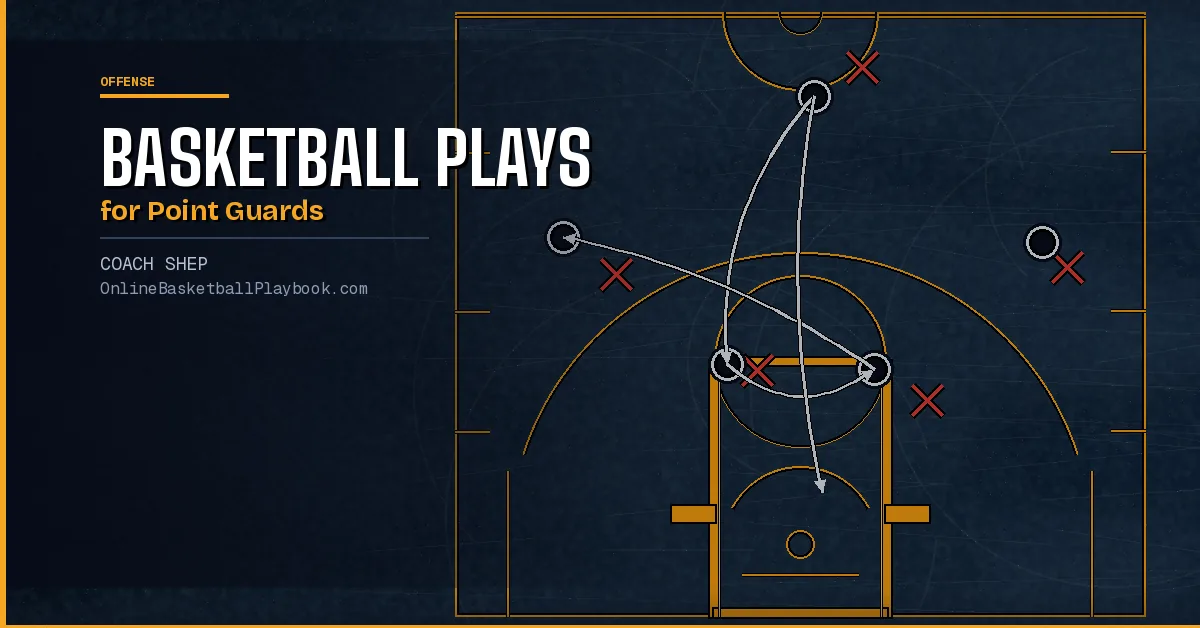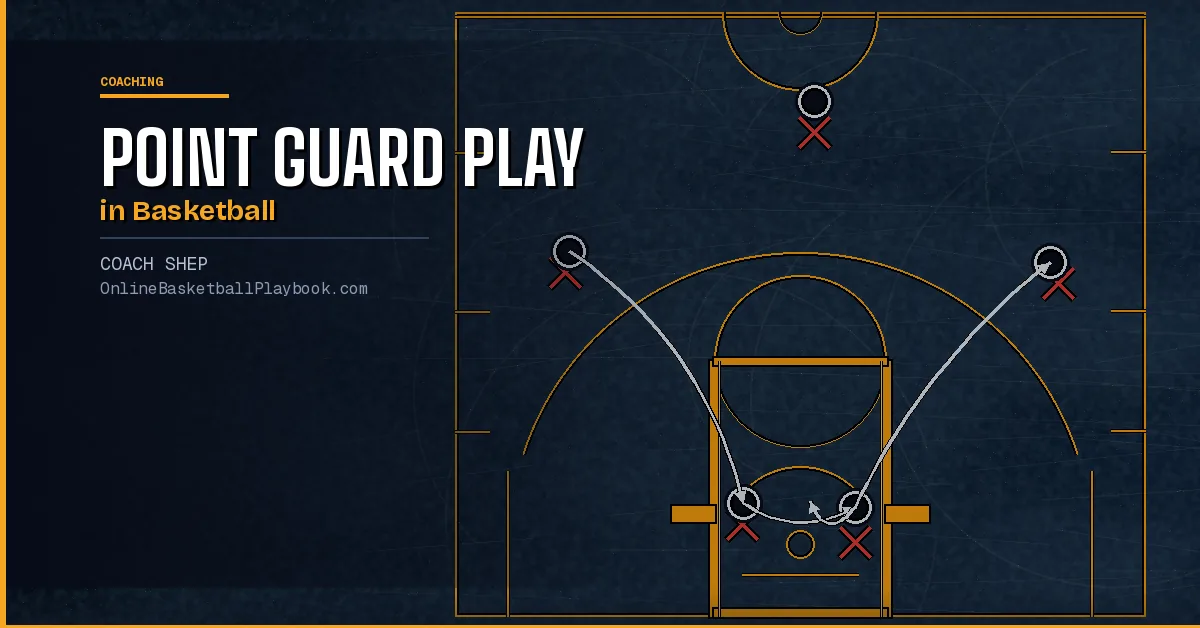
The point guard sets the tone for every possession. This guide breaks down the footwork, ball-handling, and decision-making skills that separate a floor leader from a scorer who happens to dribble.
Why Balance Is the Foundation of Every Guard Move
Most coaches teach point guards a move. The best coaches teach them balance first because every move in the game breaks down or succeeds at the moment a guard either controls their body or loses it.
Elite guard development, from Steve Nash's training habits to one NBA workout system, starts and ends with the same organizing principle: every rep begins in perfect balance, and every rep returns to perfect balance. Eyes up, feet shoulder-width, weight centered. That recovery position is not a detail. It's the whole point.
The reason is practical. In a game, a point guard rarely catches a clean pass standing still. They come off a screen at a sprint, receive a skip pass off-balance, or get bumped at the catch. If balance is only present at the start of a drill, it won't be there in a game. The training must challenge balance with step-offs, separation moves, 90-, 180-, and 360-degree spins so that recovering from disruption becomes automatic. "Life is about balance" is how a coach framed it to Nash, and it applies directly to high school guards learning to play through contact.
A guard who has drilled balance recovery can take a tough shot in traffic because their body already knows what "stable" feels like under duress. A guard who has only drilled moves will look polished in walkthroughs and fall apart when a defender gets a hand in.
For coaches: build your guard workouts around the balance premise before you teach any specific move. That single shift in framing changes how quickly players transfer drill work to live play.
Footwork Fundamentals Every Point Guard Needs
Footwork is the hidden layer beneath every guard skill. You can know a dozen moves and still be an average player if your footwork is inconsistent. One footwork framework establishes several mechanics that apply across the full range of guard situations.
The Inside-Heel Pivot
The most transferable footwork cue in guard development is the inside-heel pivot. Regardless of whether a guard is catching off a flare screen, pulling up off a dribble, or receiving an entry pass on the wing, the action is the same. The inside heel, the foot closest to the basket, drives into the floor at the moment of the catch or the last dribble contact. That heel-brake stops lateral drift, squares the body automatically, and puts the guard in a position to shoot, drive, or pass without an extra gather step.
For pull-up shooters specifically, the cue simplifies the whole sequence: "Last dribble down, inside heel down, same instant." Coaches who teach this cue watch their guards stop drifting on pull-ups within a single practice. It works because it gives the body one concrete anchor point instead of a general instruction to "square up."
The V-Cut Is Not a Jab Step
Most guards treat a V-cut as one jab step toward the basket followed by a cut back to the ball. That's wrong, and it's why defenders stay attached. A proper V-cut is a minimum three-step sequence. The first two steps push the defender in the false direction aggressively enough that they actually commit to it. The third step, the cut back, creates real separation because the defender is still moving the wrong way.
This distinction matters enormously for point guards operating in motion offenses. A one-jab cut gives the defender no reason to move. A three-step V-cut with conviction forces the defender to over-help and opens passing lanes, curl options, and flare cuts that simply don't exist against lazy cuts.
The Blast Move vs. The Front Crossover Drive
When attacking from triple threat, the read off the defender's feet determines which first step to take. If the defender's lead foot matches the guard's free foot, step directly at that lead foot, almost due north rather than east. This is the blast move. Stepping laterally gives the defender recovery space. Stepping into them removes it, and the guard scrapes off the defender's shoulder to cut off the angle of pursuit.
If the defender's lead foot is on the pivot side, the front crossover drive applies: rip the ball low and hard across the shoe tops, let the free leg front-pivot across and scrape the defender's shoulder, and start the dribble as the foot lands. These two reads, which foot the defender is showing, are a simple diagnostic that guards can apply every time they catch in triple threat.
Catch Footwork in Multiple Scenarios
How a guard catches the ball is as important as what they do after the catch. When catching with the back to the basket, coming off a curl, popping out, or receiving a wing entry, the decision splits based on the guard's intent. If the plan is to shoot immediately, the inside foot becomes the pivot and the heel fires down to stop momentum. If the plan is to drive or pass first, the outside (baseline) foot serves as the pivot, which opens the baseline drive naturally and keeps the inside foot as a live option toward the lane.
When catching already facing the basket, off a flare or in transition, the same inside-heel pivot applies with only a short swing of the free foot needed to complete the square-up, since the guard is already mostly aligned. Pre-catch preparation ties this together: angle the inside shoulder toward the basket before the ball arrives, guide hand up in the shooting pocket as a target to the passer. These are small habits that coaches can drill in 6 minutes at the start of practice using a simple passing and pivoting breakdown drill with the full squad working simultaneously.
Ball-Handling: Free Your Mind, Read the Defense
Ball-handling practice has one ultimate goal: make the dribble unconscious so the guard's mental resources are fully available for reading the defense. A guard who has to think about the ball cannot simultaneously track the weak-side cutter, recognize that the help defender has left their man, and decide in a fraction of a second whether to drive, kick, or pull up.
The two-ball handling battery is the fastest way to build that mental separation. Stationary work first, both balls together, alternating, crossover, push-pull, around the head and legs, behind the back, before progressing to non-stationary half-court reps where the guard changes moves on jump stops without ever stopping the dribble. Eyes must stay up throughout. The moment the guard looks down at the ball, the drill has failed its purpose.
The change-of-angle dribble is among the most undercoached ball-handling skills at the high school level. Think of it as a parallel park in reverse: stop forward momentum, apply a fake, go backward, and then attack the newly opened lane. Guards who can execute this move create driving angles that don't exist on straight-line drives, particularly against help defense that has collapsed to the paint.
The 1-on-3 full-court ball-handling drill from the Billeter/Augustana system is a pressure-handling staple worth installing in any program. A single handler beats three defenders in succession, each covering one-third of the floor. The drill does something standard cone-dribbling work can't do: it puts a live body in the guard's path, forces decision changes at speed, and introduces the psychological pressure of knowing that a mistake means a full-court sprint back to line. It's one of the fastest routes to game-ready handle.
Building a Named-Move Library
One of the most transferable coaching practices is naming every move after a player who used it at a high level. Nash's hesitation. Parker's "never expose yourself." Bodiroga's body fake. Jordan's cross-step turnaround. The names do three concrete things: they credit the player who mastered the move (building culture and film-study habits), they give the guard a self-directed learning assignment to watch that player on film, and they give the coach a one-word shorthand instead of a two-sentence description during a workout.
The Nash hesitation deserves special attention because most programs teach only half of it. The hesitation is knee up, read the defender, and either pull up or execute a pull-back dribble pump-fake, what some coaches call "shake and bake." The pull-back is the escape valve. Guards who only know the pull-up version are predictable after two possessions. Guards who can pull back off the hesitation keep the defender guessing indefinitely.
The Bodiroga body fake is one of the most underused moves in high school basketball because it isn't flashy. The shoulders fake one direction, but the ball stays in front of the body and the hands switch. It is explicitly not a crossover. The ball never goes wide. That's the entire advantage: the guard keeps their live dribble and their shot fake available at the same moment. Against a closeout defender, it's one of the most efficient moves in the game.
Tony Parker's "never expose yourself" principle is a screen-reading rule, not a dribble move. When a defender goes under a ball screen, the guard stops right behind the screener and shoots. The screen itself is the shot opportunity. Guards who keep moving past a free pull-up are training themselves to miss the easy reads. Parker's name makes the rule stick in a way that "take the shot when you have it" never quite does.
A practical installation plan: introduce one named move per week of pre-season workouts. Post a player clip to the team film account for that week's move. By the start of the season, guards have a six-to-eight-move vocabulary they can call on, name, and self-correct without needing a coach to prompt each rep.
Reading Screens and Making Live Decisions
Individual skill work alone does not produce smart point guards. The reads have to be trained under pressure, against live defenders, or the skills stay isolated from game reality. Two frameworks, the skeleton offense approach and constraint games, fill that gap.
Skeleton Offense: Training Reads Without Full-Court Chaos
A skeleton offense workout uses a passive defender to teach decisions in a controlled environment before introducing full live defense. The guard learns to come to a stop and create contact, not avoid it, because contact is information. A defender who gets leaned on reveals their weight distribution and helps the guard determine the right counter. Most high school guards learn to avoid contact. Skeleton offense teaches them to use it.
The go-under vs. go-over read off ball screens is one of the most valuable skill packages in this format. If the defender goes under the screen, the read is stop and shoot, Parker's rule. If the defender goes over, the guard uses the hesitation off the show: as the helping defender recovers toward the ball, the guard hesitates, lets the recovery begin, and then attacks the space that opens as the help defender is still moving back into position. That sequence, screen, read coverage, hesitation, attack, is a complete possession decision that guards can only really learn by experiencing the timing in live (or semi-live) reps.
Constraint Games: The Scoring System Is the Instruction
The constraint-game approach is one of the cleanest teaching methods in guard development because it removes the lecture and lets the scoring structure do the coaching. In the No Paint Drill, the guard earns one point for getting two feet into the paint and two points for reaching the charge circle. No shots taken. The drill teaches shot diet and paint attack without a coach stopping play to explain when to drive. The guard figures it out through the scoring consequences.
The Paint Game works the same way for closeout and gap recognition. When guards discover that certain habits earn zero points while other choices consistently score, the behaviors change faster and more durably than chalk-talk correction. Constraint games are also easier to run competitively, which means the conditioning and the decision-making training happen simultaneously.
Run the Get Open Drill in live 2-on-2 before you ever name the off-screen move on the whiteboard. When guards discover through live reps that fading to the corner works when the defender goes under and that curling works when the defender goes over, the read sticks faster than any diagram can teach it. Experience first, label second. The name then gives them a handle on something they already understand in their body.
Training Game Shots on Tired Legs
One of the most honest assessments in guard development came out of one guard development system: shooting percentages in fresh, isolated drills are meaningless. Games are decided by the shots guards make when they're exhausted in the fourth quarter. If a program's shooting training never puts guards under physical fatigue, those guards will shoot worse in games than their practice numbers suggest. Every time.
The "all-game-shots, make 11" circuit builds conditioning directly into skill work. Each station uses a real game action: elbow catch-and-shoot off the dribble, handoff, side pick-and-roll into the lane. The circuit finishes with five-spot shooting on tired legs. The target is a real percentage earned after physical exertion, not a fresh-start percentage. Every station runs to a "make 11" team standard, which introduces the competitive pressure of shared accountability. A single player's miss costs the whole group.
The Florida guard development sequence adds a structural principle that most programs overlook: every drill has a progression built in, from simpler form work to live defensive pressure within the same session. Guards practice full-court shooting off a dribble move first with no defender, then add a live closeout on the catch. The two-stage format installs the skill pattern and then stress-tests it in the same workout day, rather than separating skill development and competition into different weeks. That compression accelerates transfer to game situations considerably.
For pull-up shooters specifically, the conditioning element reveals footwork breakdowns that don't appear in fresh shooting drills. A guard who lands perfectly balanced on the first rep of a shooting drill but drifts badly on the eighth rep after a sprint sequence has a conditioning-dependent footwork problem, and that's exactly what fourth quarters expose. Building conditioning into skill training is not just efficient. It's diagnostically honest.
How to Apply These Skills in Your Program
The guard development system described above is not a single workout. It's a sequence of layered skills that build on each other. Balance first, then footwork mechanics, then ball-handling autonomy, then live reads. Skipping layers is why many guards look skilled in individual drills and disappear in real games.
A balance-first daily routine requires no special setup and scales across all team levels. Begin every guard workout by challenging balance: a step-off into a pull-up, a spin to a floater, a separation dribble into a catch. The recovery to perfect position, eyes up and feet set, is the drill within the drill.
The "passers step east/west, drivers step north" distinction is one of the best teaching moments available to a coach. Guards at every level have a tendency to dribble sideways rather than attack the basket. One sentence, repeated consistently, corrects a posture that otherwise requires drilling individually because it gives the guard a mental model to self-diagnose in the moment.
The Offensive Pivoting and Passing Breakdown Drill runs six minutes with all 12 players working simultaneously on jump stop, step-out, rip-through, and shooting footwork. It requires no defenders and no extensive setup. As a pre-practice habit, it establishes the footwork vocabulary that makes every other skill drill in the session more efficient.
Named moves give the coaching staff a common vocabulary with players that survives loud gym environments, substitution calls, and time-outs. "Parker" means stop and shoot off the screen. "Shake and bake" means hesitation pull-back. One word replaces three seconds of explanation during a live-action stoppage.
- Start every guard workout with balance challenges: step-offs, spins, and separation moves that demand recovery to an eyes-up, feet-set position, not just a clean starting stance.
- Teach the inside-heel pivot as the universal footwork cue: last dribble down and inside heel down at the same instant for pull-ups. Same heel fires at the moment of the catch for off-screen shots. One cue covers a dozen situations.
- Correct the V-cut before any off-ball drill: require a minimum three-step sequence, two steps selling the false direction, then the cut back. One-jab cuts train defenders to stay attached.
- Use two-ball handling with eyes-up as the standard: any rep where the guard looks down at the ball resets the drill. The goal is to make the dribble unconscious, not to add fancy moves.
- Install one named move per week of pre-season: post a player clip to the team film account, cue the move by name in workout, and repeat the name at the next practice to reinforce retention.
- Run the make-11 circuit on tired legs weekly: game shots after a conditioning sequence produce a real shooting percentage that tells you far more than fresh-start drills about where each guard actually is.
- Use the blast-vs.-crossover read as a daily triple-threat diagnostic: before live drills, have guards identify which foot the defender is showing and call the correct first step. One decision, named and rehearsed, transfers immediately to live situations.
Want more basketball coaching strategies, drills, and tools?
Join the Online Basketball Playbook newsletter →
Draw this play free in the play drawer →
Membership: the full library, playbook packs, and Pro drawing tools →
Keep Building
Related breakdowns
Shooting Guard Drills for Basketball Practice
Shooting Guard Drills for Basketball Practice