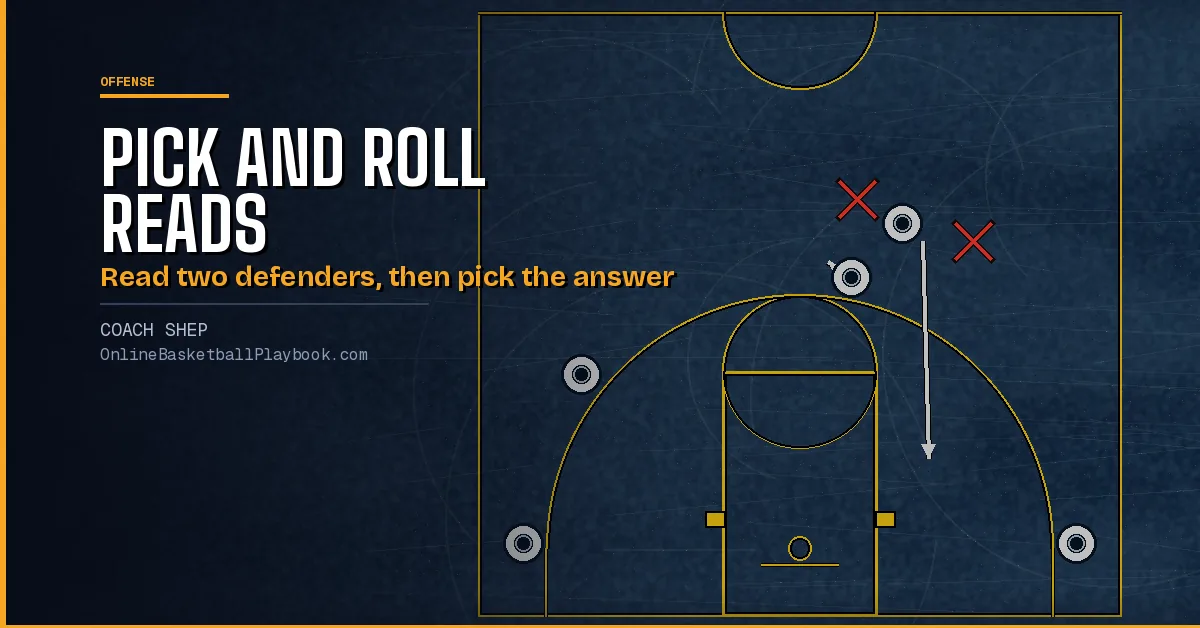
Pick and roll reads are the decisions that finish a ball screen. The handler reads how his own defender and the screener's defender play the screen, then scores, attacks or passes. The screener reads the same two defenders and rolls, pops, slips or screens again. This page is the read menu, coverage by coverage, for both players.
The action itself (the screen, the angle, the timing and the basic roll, pop and slip) is on the pick and roll, the defensive side is on how to defend the pick and roll, and a full offense built on these reads is on the spread pick and roll offense.
Before the Screen
Every read depends on what the handler does before the screen arrives. Set the defender up with a jab, a hesitation or a change of speed, because those setups decide whether a guard comes off clean or dirty. Billy Donovan's Florida guard squares up and jabs baseline first. A defender who commits early to the screen side can then be turned the other way.
Coming off is just as specific. The handler comes off at the level of the screen, not higher and not lower, shoulder to shoulder with the screener. Coaches differ on the dribbles:
- One dribble to the paint. Two at most.
- Two hard dribbles. With intent to score.
The angle of the screen and the moving-screen errors are covered on basketball screening technique.
Spacing comes first in Donovan's system.
- Fill four spots. Florida starts from 1-4 High or 4 Flat so four shooting spots are filled before the screen.
- Two on one side. When two players end up on one side, one holds the corner and the high guard holds the sideline.
- Lift the corner. On every wing screen the ball-side corner lifts into the spot the handler left, as a rule, not a read.
- Weak side in the backside slots. Keep the weak side in the backside slots whenever the post screens, so the kick-out three is always there.
- Empty the post. A side pick and roll is hard to guard only when the post is empty.
The wider picture is on what is spacing in basketball. Fill the spots first and the reads get easier.
Pick and Roll Reads: Score First
The first look is the handler's own shot. He hunts it, and the passes come from the defense's reaction to it. The order of reads changes by approach:
| Approach | Order of reads |
|---|---|
| Florida spread | Attack the rim, dump to the roller, hit the popping screener |
| Drive, shoot, pass | Drive first, the shot second, the pass last |
| Drive to score | Drive to score and let the pass come off the collapse. A drive meant as a pass invites the passing lane |
| Youth order | Layup or floater, pull-up jumper, pocket pass to the roller, then the skip to the weak side |
The screener has his own first read, made before contact. In Donovan's system he reads the height of his own defender. A high hedge means slip to the rim before the screen is set. A defender who contains or drops means roll hard. A switch or a sag means pop. The handler watches the same defender, so both players reach the same answer from the same picture. Hunt your own shot first and let the defense hand you the pass.
The Handler's Answer to Each Coverage
Each coverage has more than one answer, and none is ranked first. The table puts the answers side by side.
| Coverage | Answers coaches teach |
|---|---|
| Drop, the big sits back in the paint | Pull up or float over the dropped big, and the screener pops |
| Over, the defender fights over the top | Turn the corner off the screener's hip and attack downhill. Drop it off if a baseline defender helps, kick it out if a wing sags |
| Under, the defender goes beneath the screen | Pull up or step back behind the screen. A non-shooter re-screens instead. Or footrace to the rim in two dribbles |
| Soft or quick hedge | Attack the big's outside hip, because many bigs move poorly sideways. Hesitate while he recovers, then go. Or post the best shooter in the spot the helper just left |
| Hard hedge | Split it when there is daylight. Hesitate and go when the gap is narrow. Cross over. Retreat dribble, re-screen or drag the hedge. Against a half blitz, go right at the big and throw back to the popping or rolling screener |
| Trap | Get the ball out of two defenders fast. Two quick passes beat the long closeout. Drag the trap out and attack off the pass, or pitch it back and play four on three |
| Switch | Seal and roll or post the smaller defender. A shooting big pops. Keep the floor spread so the defense cannot switch back |
| Ice or deny | Attack a weak denial like a normal screen. Refuse a strong one and pass to the post spacing at the elbow, or flip it into a step-up screen and snake back to the middle |
| The defender cheats over early | Reject the screen and drive the other way |
Under. Most coaches have the handler shoot it. The shot comes right behind the screen, with no extra dribble. The exception is the guard who cannot shoot. He comes off, turns back and uses a second screen from the same big, which turns a poor three into a drive or a mid-range shot.

Hard hedge. This coverage has the most answers.
- Split. The cue is "fire the dribble back to the screener's butt," which takes the handler between the hedging big and the trailing defender. When that gap is too narrow, he changes pace to freeze the hedger and then accelerates.
- Drag. A patience read. Attack the hedger's outside shoulder, drag him out, rip and pass back with the outside hand while the screener opens to the ball.
- Slip. The screener can also answer the hard hedge for the handler by slipping.

Trap. Donovan's spread welcomes two defenders on the ball. The ball goes back to the screener, who attacks four on three and passes to where the help came from. The handler can also take two retreat dribbles while the screener short rolls a step, which is drawn on the pick and roll.
Reject. When the defense jumps under the screen early, the handler turns the screen down. In the reject below the screener loops behind him to the wing for the kick-out, and the floor looks for the baseline drift and the extra pass.

Switch. The choice follows who the screener is.
- Seal and roll. A big who cannot shoot seals the smaller defender and rolls for a bounce pass, or posts him.
- Pop. Florida's shooting big pops to three, and that pop is the whole switch answer in the spread.
- Dive, pop or pass. A three-word menu.
- Force the switch. Set the screen toward the elbow to get the mismatch on purpose.

Name the coverage and the answer follows.
Get the next coaching guide in your inbox
One email when a new guide or diagram set goes up. Free.
Eight Ball Handler Reads
There are eight ways to use a ball screen, each drilled as its own option so guards recognize which one they are in. The screeners set low and wide with the back to the paint, and the guard brings his man to the level of the screen and aims for one dribble to the paint.
- Turn the corner. Off the screener's hip and downhill.
- Hesitate and go. Slow the dribble to freeze the defender, then go.
- Split the hedge. Between the hedging big and the trailing defender.
- Fake the split, then inside-out. Fake the split, then an inside-out dribble.
- Reject. Turn the screen down and go the other way.
- Shoot behind. Pull up behind the screen.
- Re-screen. Come back for a second screen from the same big.
- Early slip. The screener slips before contact.
These reads for guards, with drills, are on pick and roll drills for guards. Drill each read as its own option.
The Screener's Reads
The roll, the pop, the slip and the short roll are drawn on the pick and roll, and the pop has its own page at the pick and pop. The longer menu has six options: roll, pop, short roll, re-screen, a flare screen for a third player, and a roll to the opposite block when the whole defense collapses on the drive. The screen itself can be the first scoring decision, with the screener choosing to pop, dive, flash or fake.
The slip is part of the plan. In the Florida system the slip fires on the defender's stance before the screen is set. Slip when the defense over-shows, and draw the slip into the play itself.
The second screen. The second and third picks are better than the first. When the first screen is blown up, the screener turns and sets it again at a better angle, and the handler uses a behind-the-back dribble to get a full dribble past the first screen so it can be reset.
Roll footwork. This is a real split.
- Wait, open, roll diagonally. Donovan's roller waits until the guard is completely off the screen, opens up, never turns his back on the ball and rolls diagonally to the low block.
- Pivot and sprint. Pivot and sprint at once.
- Turn the back and sprint. John Calipari's dribble drive version is the exception. The big turns his back and sprints for a lob.
Pick the roll footwork and teach it to every big.
Read the Third Defender
The best read is often a defender who is not in the screen at all. In the big lifted version of a two-big pick and roll, the weak-side big lifts high and pulls his defender away from the rim, so the roll is open, especially against a hedge. The lifted big catches and looks first to the roller.

The same skeleton has a second read:
- Duck in. The weak-side big ducks in hard in front of the rim while the screener pops.
- Roll, then duck in. In an NBA set the first look is the roll because the help big is busy with a down screen, and if that big scrambles to the rim, the read flips to the duck-in.
- Time the lift. Time the shooter's lift to the moment the help defender tags the roller.
The corner lift works the same way, as a choice forced on the tag defender, who must stop the roll or guard the lift. Read the helper and make him choose.
Naming the Reads
Coaches who build on reads name them so the bench and the players can call them. The words below are common, but their meanings vary from team to team. The full team glossary is on basketball terminology.
| Word | Meaning |
|---|---|
| Reject | The handler turns the screen down and goes the other way |
| Snake | The handler comes off to the middle and weaves back out |
| Probe | The handler keeps his defender on his back until the help big leaves |
| Short roll | A roll that stops early, usually fed with a pocket pass. The pass out when the help takes it is a shake, lift or fill |
| Ghost | Several meanings. A fake screen where the big fades to the arc without contact is one, a reject is another |
| Shocker | A fake screen where the big slips to the rim |
| Flip | The screen angle turned around into a step-up |
| Gortat | Sealing the help defender after the defense switches |
Coaches also stack a trigger in front of the screen, such as a screen on the screener (ram), a pin-down into a step-up, or a hand-off (see the dribble hand-off). The early version, fired on the run before the help is set, is on early offense. Pick words your players can call without thinking.
Teaching the Reads
The common thread is one tree drilled against live coverage. The reads belong to the coverage, not the play, so the same answers carry over to hand-offs and post-started screens. Ways coaches build it:
- Same reads, same order, every day. Run the reads in the same order with the same verbal commands daily, with a coach on defense.
- Change the coverage every rep. The defender on the screener plays a different coverage each time, so there is no pattern to memorize.
- A four-step ladder. One versus nobody, then against a coach, then a controlled advantage, then the game.
- The cone drill. The screener's defender must touch a cone before he recovers, which makes a two on one for a moment and lets the read happen.
- Screener drills. A set of five drills works the roll, two short rolls, the fake and slip, and the pop.
- A weekly calendar. A twelve-week plan runs the basic use-or-reject day on Monday and the coverage and counter days on Tuesday and Wednesday.
Two youth errors break every read: using the screen before it is set, and leaving before the handler turns the corner. Both draw a moving-screen call and kill the action. More drills are on pick and roll basketball drills and drills to teach ball screen offense, and offenses that repeat these reads side to side are on ball screen continuity offense. Teach the tree, then let the coverage choose the read.
Questions Coaches Ask About Pick and Roll Reads
What are the reads in a pick and roll?
The handler reads his own defender and the screener's defender, then scores, attacks or passes. The screener reads the same two and rolls, pops, slips, short rolls or screens again. The coverage decides which answer fits.
What should the ball handler do when the defender goes under the screen?
Most coaches have him pull up right behind the screen. A handler who cannot shoot comes back for a second screen instead, or he races to the rim in two dribbles.
How do you beat a hard hedge?
Split it when there is daylight, hesitate and go when the gap is narrow, cross over, or retreat and drag the hedge. The screener can also slip it.
When should the screener pop instead of roll?
In the Florida read a switch or a sag means pop, and a contain or drop means roll hard. A screener who shoots well makes the pop the switch answer.
What is a reject in basketball?
The handler turns down the ball screen and drives the other way, usually because his defender cheated early.
How do you teach pick and roll reads to young players?
Give them a short order: layup or floater, pull-up, pocket pass, then the skip. The two timing errors to watch are using the screen before it is set and rolling before the handler turns the corner.
Want the printable playbook packs?
OBP Pro members get the premium playbook packs: the zone attack, out of bounds and practice plan PDFs, plus each new pack as it is finished. The membership page lists what is in each one. Or draw your own version free in PlayDraw.
See what OBP Pro includesMore Coaching Guides From This Batch
- Basketball Play Calling and Signals: How Coaches Call Sets
- Tagging Up in Basketball: Crash the Glass or Get Back
- Secondary Break Basketball: Lanes, Options and Trailers
- 1-1-3 Zone Defense: Man-Zone Rules, Slides and Traps
Back to Pick and Roll and every Offense page.
Keep Building
Related breakdowns
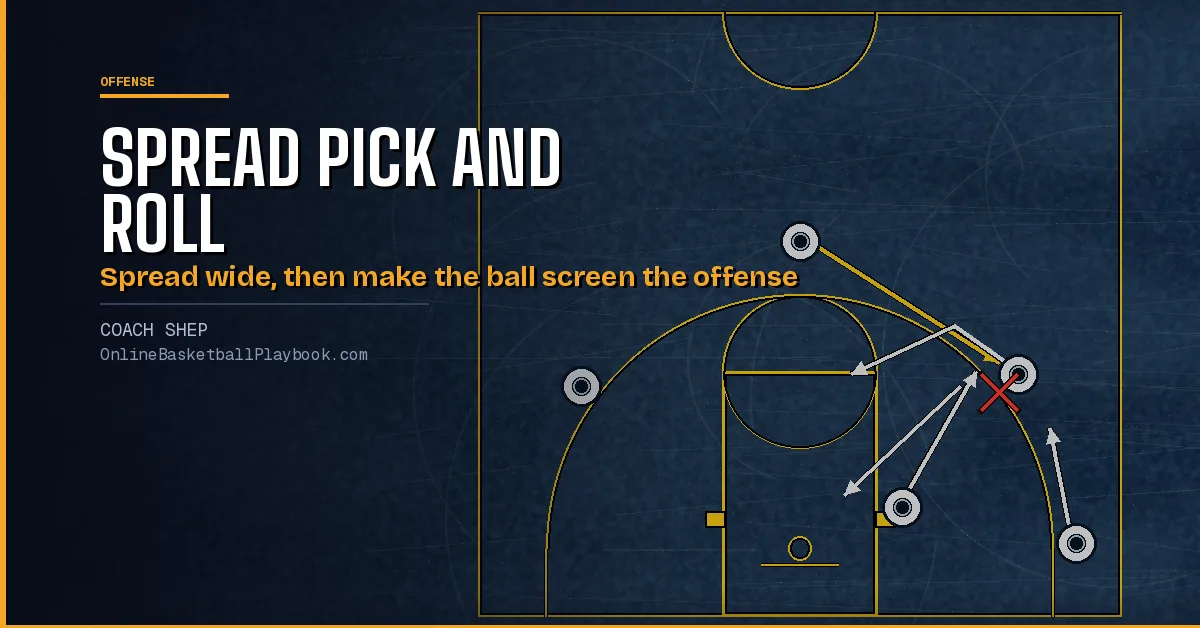
Spread Pick and Roll Offense: Flat Screens, Reads and Counters
Billy Donovan's spread pick and roll offense step by step: the trail pass, the angled wing screen, the second side, the flat screen and the counters.
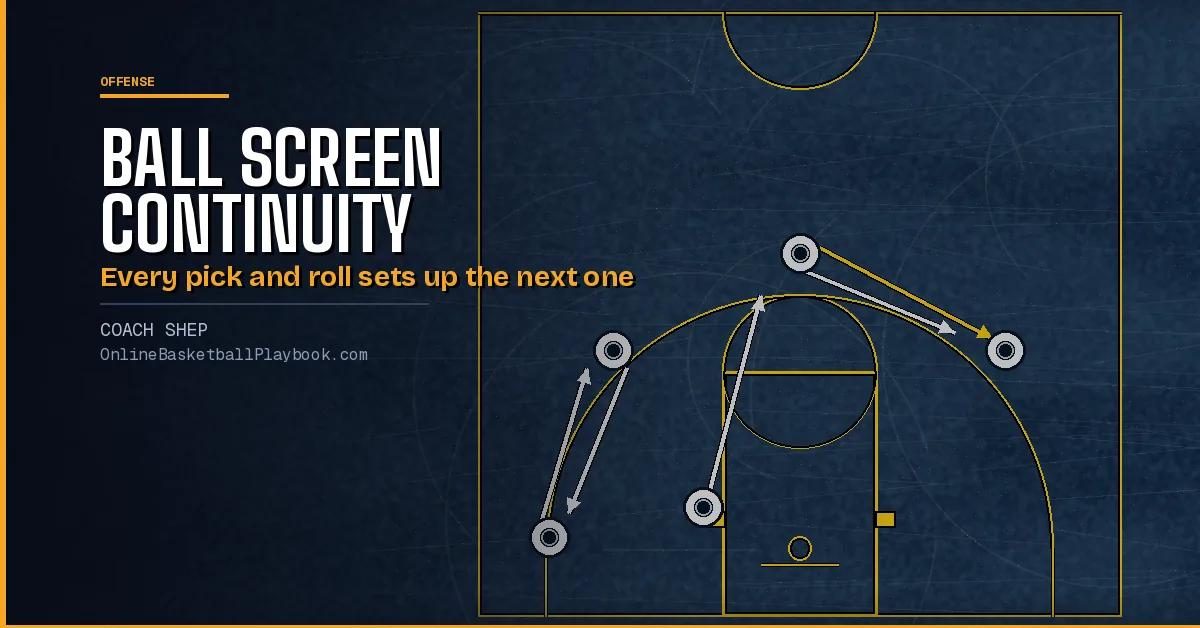
Ball Screen Continuity Offense: Pick and Roll Rules and Reads
Ball screen continuity offense in full: the 4-out and two-big engines, reload rules, spacing, angles, reads, counters, Spain, Ram, double drag and zone sets.
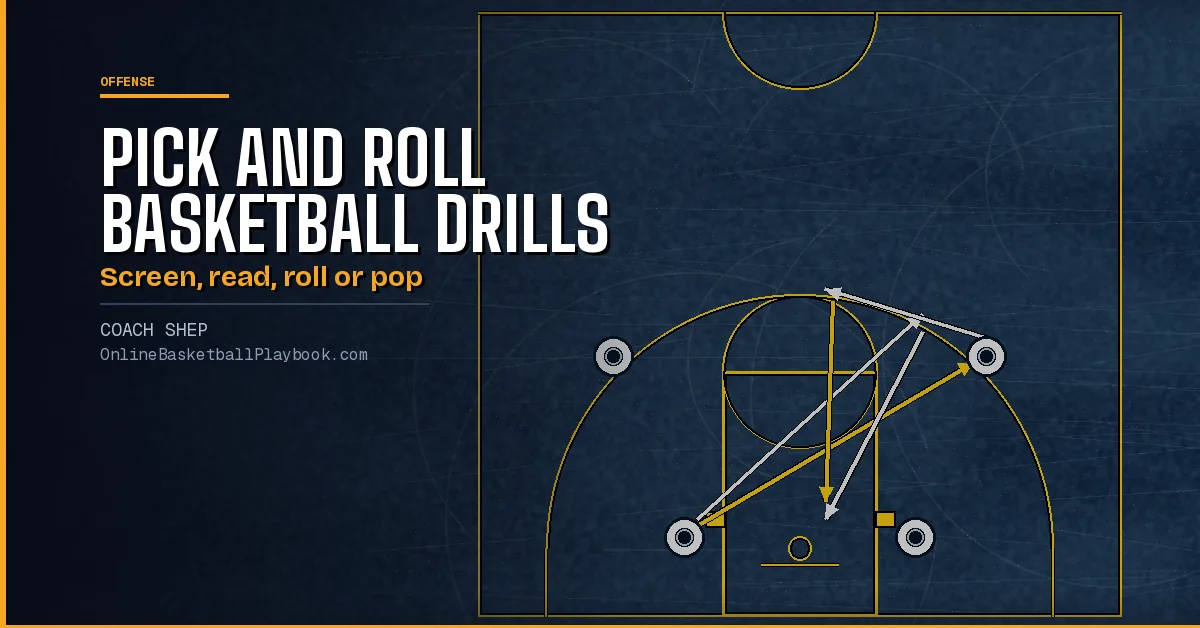
Pick and Roll Basketball Drills: From 2 on 0 to Live Reads
Pick and roll basketball drills that teach the action in order: a 2 on 0 screener series, chair reads, advantage drills, live coverage drills and youth steps.