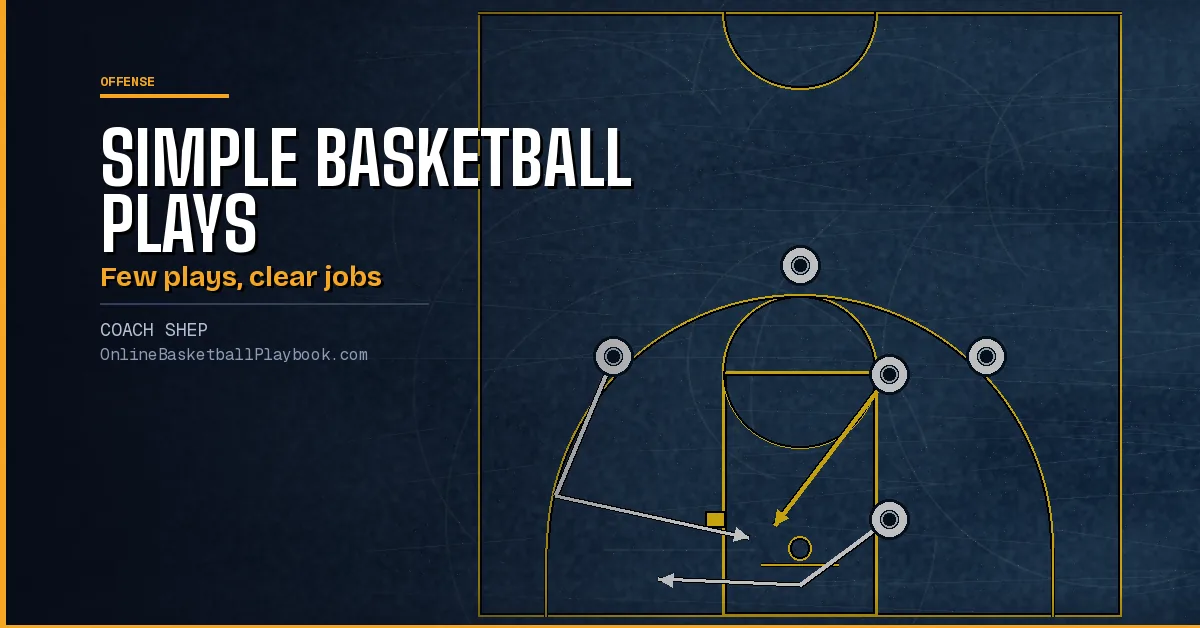
Simple basketball plays keep the decisions small. Every player knows where to start, what to do and what to look for. This guide draws six easy basketball plays for youth basketball teams and beginners, including a simple inbounds play, with plain steps for each one and a note on the counter. It also covers how to choose a small menu, how to teach it and where coaches disagree.
The Six Plays at a Glance
| Play | Type | What it teaches |
|---|---|---|
| 5-Out Pass and Cut | Motion rule | Cutting and filling after every pass |
| Back Cut When Denied | Motion rule | Reading an overplay |
| Horns Screen and Dive | Ball screen | Screening, diving and the high-low feed |
| Baseline 3 | Backdoor | Off-ball screens and misdirection |
| Blazer | Hand-off and lob | Hand-off with a screen and a lob finish |
| Box 1 | Baseline out of bounds | Screening for a post catch |
Simple Basketball Plays: How to Pick a Menu
Four things decide the menu. Age and practice time come first, because a team with one short practice a week cannot install a complex system. Then come your philosophy, your personnel and the fit with your defense. Under age 10, set plays are not needed. Teach players how to play and let them read the game.
- Keep the system small. Few actions with clear reads beat a big playbook.
- Cover the basics. A team needs a half-court man-to-man offense, a zone offense, a few plays, out-of-bounds plays and a press breaker.
- Build in a counter. Give each quick hitter three options or a counter, such as a slip when the screen is switched or a seal on a smaller defender.
- Cast the play to your players. Some plays need a switch mismatch, a big who can pass or a guard who can cut for a lob.
Youth Basketball Plays: 5-Out Cuts
A 5-out offense puts all five players outside. It fits youth teams because nobody knows who will grow, and the early bloomer parked in the post never learns to dribble or shoot. Three rules run it. Cut to the basket after every pass. Fill to the ball when a spot opens. Back cut when denied. Use cones for the five spots: both corners, both wings and the top of the key. See 5 Out Motion Offense.
Play 1: 5-Out Pass and Cut

- Five players start on the corners, the wings and the top of the key.
- The player with the ball passes to a wing.
- The passer cuts hard to the basket, then goes to the far corner.
- The players behind him fill up to the open spots.
Play 2: Back Cut When Denied

- A wing is denied one pass away from the ball.
- The passer looks at him.
- The wing cuts behind the defender to the rim right away.
- The passer throws the ball to the cutter.
If a player can beat his man to the rim on the catch, he should do it. Drills for these rules are on Drills to Teach 5 Out Motion Offense.
Easy Basketball Plays with a Screen or Hand-Off
Play 3: Horns Screen and Dive
Horns is one alignment with many plays. Both posts sit up high, the point guard is on top and two shooters wait in the corners. It is easy to run off an inbounds pass and in transition. Pulling the posts away from the rim opens room for screens and cuts.

- The point guard (1) dribbles off the screen by 5 toward a wing.
- After screening, 5 dives to the rim.
- The other post (4) pops to the top of the key.
- 1 hits 5 on the dive, or passes to 4, who feeds 5 posting up.
See Horn Sets for more plays from the same picture.
Play 4: Baseline 3
This simple backdoor play runs from a 3-out 2-in look or a 1-3-1. The name is the trick. The defense hears a three-point call and expects a shot. The point guard is at the top of the key, the wings are 2 and 3, a low post (5) and a high post (4) complete the set.

- 1 passes to 2. 3 slides toward the corner. 4 flashes to the ball-side elbow.
- 2 passes to 4 at the elbow.
- 5 sprints along the baseline and screens for 3.
- 3 cuts hard off the screen into the lane. 4 hits him on the backdoor cut, or 2 passes to him directly.
- 2 slides toward the rim behind the cut. 1 stays at the top of the key as a release for an open three.
The counter: if 3's defender switches through the screen, 3 clears out and 5 seals the switched defender and cuts to the rim for the pass. More backdoor ideas are on 3-Out 2-In Motion Offense.
Play 5: Blazer
Blazer is a hand-off play built on a switch. The hand-off and the screen on it leave the defense unsure who takes whom. Even when they switch, the new defender is often a step behind the cutter. It suits a quick guard and a post who can pass over a smaller defender.

- Put 2 in the right corner and 3 in the right short corner. 4 and 5 move to the high post and the top of the key.
- 1 dribbles to the right wing and keeps the dribble alive as 5 comes over.
- 1 hands off to 5 and screens 5's defender. 5 squares up in triple threat.
- 1 cuts around 4 to the rim. 5 throws the lob over the top.
The counter: if 4's defender switches onto 1 cleanly, the pass goes to 4 at the ball-side elbow.
A Simple Out-of-Bounds Play
Have a couple of baseline plays against man-to-man, a play or two against a zone and one sideline play. Box 1 is a good place to start.
Play 6: Box 1

- Set a box. 4 and 5 are on the ball side at the low block and the elbow. 1 and 3 are on the weak side at the elbow and the block. 2, a good passer and shooter, takes the ball out.
- On the call, 4 screens for 5, who cuts to the opposite block.
- 4 then seals the defender he screened and rolls to the rim.
- 2 passes to 5, or to 4 if the defense switches the screen.
- On the weak side, 3 cuts around a screen from 1 and goes out to the top of the key. 1 cuts to the weak corner. If nothing is open inside, look for a three from 1 or 3.
Read more on Baseline Out-of-Bounds Plays, Sideline Out-of-Bounds Plays and Basketball Inbounds Plays. Inbound safely first and score second. If the quick look is not there, do not throw it.
Get the next coaching guide in your inbox
One email when a new guide or diagram set goes up. Free.
How to Teach Simple Plays
- Add one play at a time. Every player must know where to start and have a job on every possession.
- Teach in small groups. Small-sided games isolate one teaching point such as a back cut, a v-cut or screening away. Layer a drill from 1-on-1 to 2-on-2 to 3-on-3 so each role and the help read gets reps.
- Run the simple version first. Once the defense adjusts, teach a fake of the same action as the counter.
- Limit the talk. One or two points at a timeout is plenty for young players.
- Use names that hide the action. Baseline 3 sounds like a three-point call, which is why it works.
For more, see How to Run Quick Hitters, Drills to Teach Quick Hitters and Small-Sided Games.
Where Coaches Split
Coaches split on set plays. Supporters like control of shot selection and a designed look late in a game. Critics say set plays are many to remember, cannot be overused and keep the ball in a few hands, which hurts development. Motion offenses teach how to play, but the reads are hard for young players and it looks ugly at first. Coaches also split on how many plays a youth team needs. One list runs 20 plays, one gives five that layer onto a base offense, and one says none until age 10. Pick the smallest number your players can run without a reminder.
Coach Cheatsheet
- Pick three to five plays and stop there.
- Give every player a spot and a job.
- Know the counter before you run the play.
- Teach cuts and screens in small games first.
- Keep one baseline play against man and one against zone.
- Make the play fit your best passer and your best shooter.
Questions Coaches Ask About Simple Plays
What are the best simple basketball plays for youth teams?
5-out cutting rules, a Horns screen and dive, Baseline 3, Blazer and Box 1 are simple to teach and each has a built-in counter.
How many plays should a youth team run?
As few as your players can run without a reminder. Some coaches use none before age 10 and others keep a short menu of five.
What are easy basketball plays for beginners?
Pass and cut, back cut when denied and a screen with a dive. They need only two reads.
Do young players need plays at all?
Under age 10, set plays are not needed. Teach spacing, cutting and passing so players learn how to play.
What is a good out-of-bounds play for beginners?
Box 1. One post screens for the other, who cuts to the far block, and the screener seals and rolls.
All offense pages sit under the Offense hub and Basketball Plays. Related pages are Best Inbound Plays, Coaching Youth Basketball and 3 Man Weave Drill.
Want the printable playbook packs?
OBP Pro members get the premium playbook packs: the zone attack, out of bounds and practice plan PDFs, plus each new pack as it is finished. The membership page lists what is in each one. Or draw your own version free in PlayDraw.
See what OBP Pro includesMore Plays
Back to Basketball Plays and every Offense page.
Keep Building
Related breakdowns
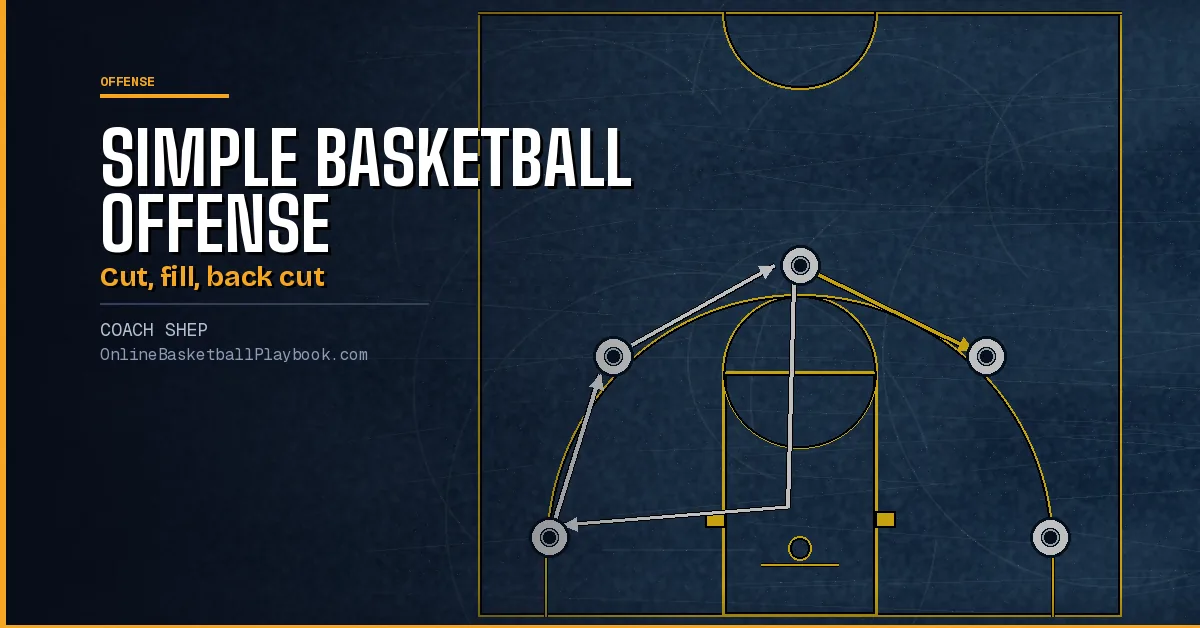
Simple Basketball Offense for Youth and Beginner Teams
A simple basketball offense for youth, middle school and beginner teams: a spacing set, the three-rule 5-out, 4-out options, a zone answer and a press break.
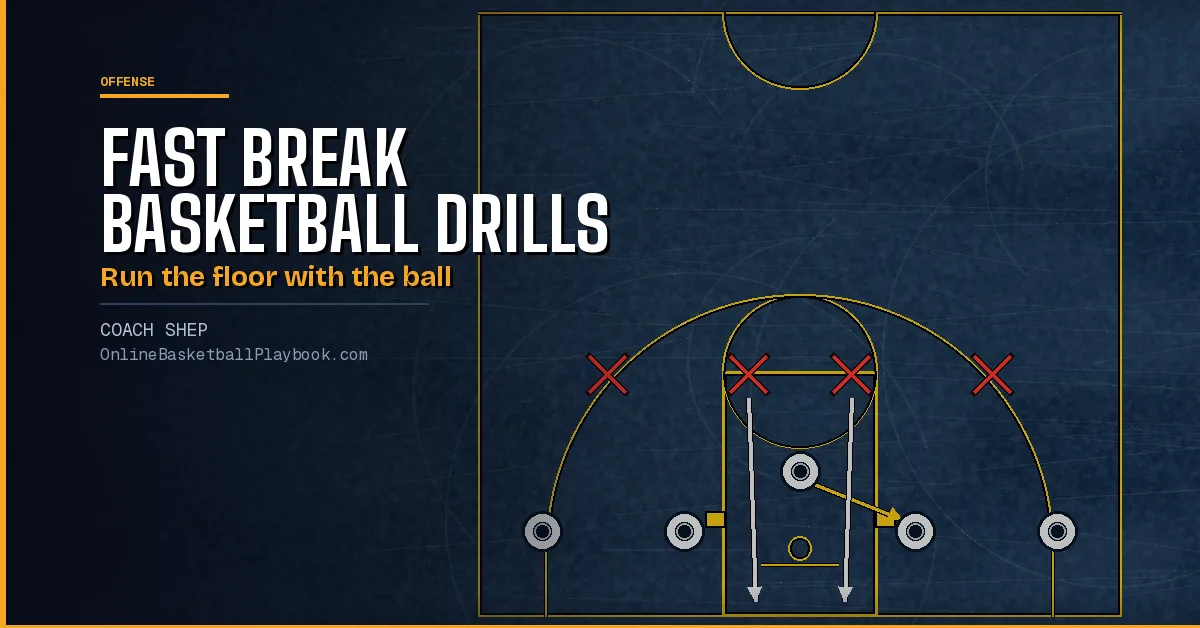
Fast Break Basketball Drills for Youth and Varsity Teams
Fast break basketball drills that run the floor with the ball: weaves, partner and no-dribble drills, catch-up drills, a finishing series and youth versions.
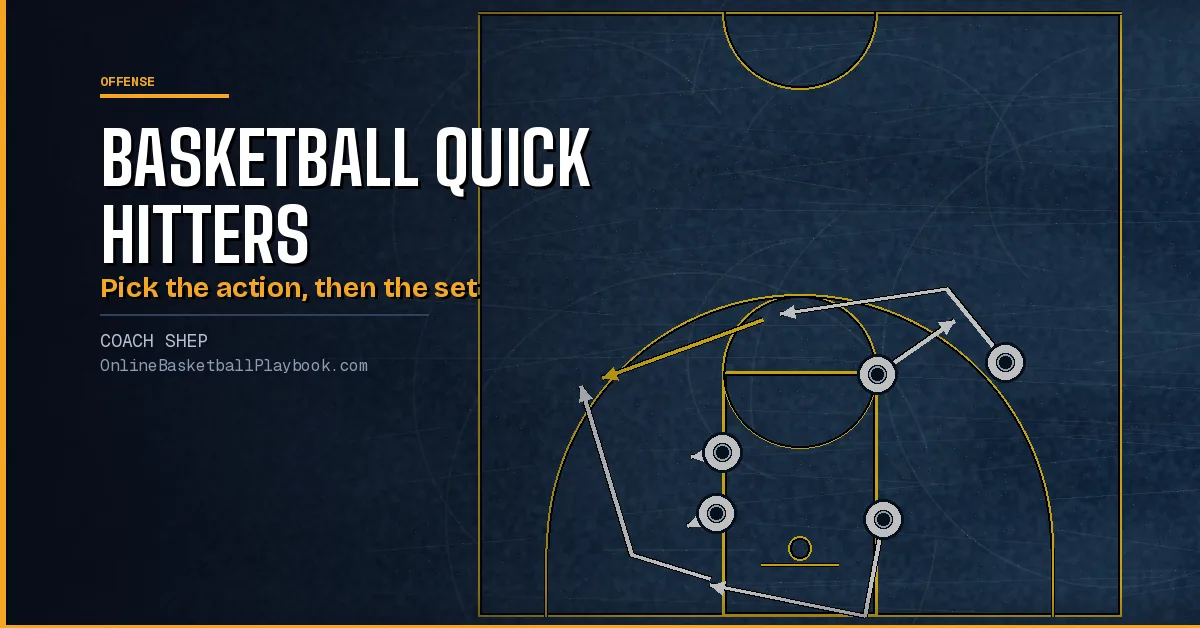
Basketball Quick Hitters: 25 Sets by Action and Formation
Basketball quick hitters sorted by the action you want, catch-and-shoot to post feed, with each set's formation, diagrams, the read and the counter.