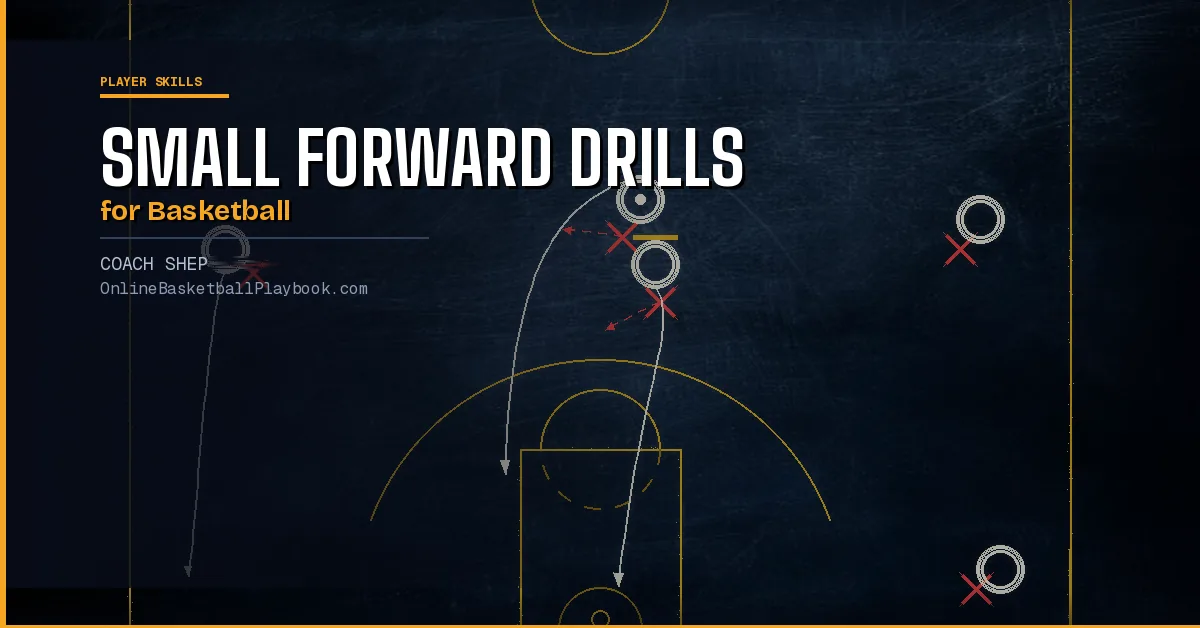
Small forwards win games when they can finish at the rim, shoot off the catch, drive and kick under pressure, and guard multiple positions. These drills build all four skills systematically.
Finishing Footwork: The Foundation
Before a small forward can read and react, they need a reliable finishing package. Every other skill in this guide falls apart without it. This is where the training starts, not with 3-point shooting, not with ball-handling, but with layups. Both hands. Both sides. At game speed.
The drill framework that serious programs use comes from the individual skill progression taught by coaches like Fred Walberg and Greg Welling: the layup sequence runs straight layup → reverse layup → crossover layup → hesitation layup, repeated from both sides of the floor. No shortcuts, no skipping the weak hand.
The Layup Progression
Set up two lines at the elbows. Players alternate going to the rim with one of these finishes per rep, at game speed, no walking in. The coach or a manager tracks makes. Count misses. Missed layups in a real game almost always trace back to a player who never drilled the specific finish they needed.
Add the jump-stop power layup once the basic sequence is owned. A small forward who catches a skip pass in the short corner and can power-step into a contact layup without traveling is a genuinely hard cover. That specific skill, the jump-stop that controls the body before a strong-side or off-hand finish, takes repetition in isolation before it shows up in a game.
X-Layups
Set up lines at each elbow extended. Player 1 drives baseline from the right elbow. Player 2 simultaneously drives baseline from the left elbow. They cross paths at the rim. Player 1 finishes left-hand, Player 2 finishes right-hand. Rotate back through. The crossing paths create a decision-making environment even in a drill that looks like a pure finishing rep.
Run it at game speed. Score it: teams of five compete to hit a target number (say, 15 makes) before the other group. Losers run. The competition adds the mental pressure that makes the reps transfer.
The Crack Back Drill
A player sprints to a cone placed at the wing, touches it, then cracks back toward the basket as the passer leads them to the inside shoulder with a bounce pass. The player catches in stride and finishes. This replicates one of the most common small-forward finishes in motion offenses, the curl read where the player changes direction after a screen and attacks the rim on a catch that is already in motion.
Do 5 reps left, 5 reps right. Require the correct footwork on the catch: inside foot hits first, outside foot plants, layup with the inside hand on the right side, outside hand on the left. Count footwork errors separately from misses. They are different problems with different fixes.
Catch-and-Shoot Drills for Wings
A small forward who catches ready to shoot, feet already pointed at the basket, knees loaded, hands in the shooting pocket, is a completely different weapon than one who catches and then sets their feet. The difference is footwork habits built in isolation before they are needed live.
The Five-Spot Shooting Circuit
This drill, used in multiple high-level programs, places the shooter at five positions around the arc: left corner, left wing, top, right wing, right corner. A rebounder works from under the basket. The shooter catches, shoots, and sprints to the next spot. No standing still between reps. The footwork before every catch is squared. Feet toward the basket before the ball arrives, not after.
Target: 5 makes at each spot before rotating. Some coaches run it as a competition: two shooters racing through all five spots, first to 25 makes wins. That structure forces game-speed footwork even when the shooter is tired from sprinting between spots.
Olympic Shooting
Two lines at the wing. Two passers, one at the top of the key and one in the short corner. Shooter catches from the top of the key, shoots, sprints to the short corner, catches from there, shoots, sprints back to the wing. The drill never stops. There is always another catch coming. The physical demand of continuous movement is exactly what a small forward deals with in a real game: by the fourth quarter, every catch and shoot rep requires athleticism under fatigue, not just skill in a rested state.
Backpedal into Catch-and-Shoot
The player backpedals from the elbow to half-court, sprints hard to the corner, receives a pass, and shoots. The sprint replicates the burst a wing makes to get to a spot on a fast break or after a transition stop. The catch-and-shoot is the same in both cases, but the physical state before the catch is very different from a static drill rep. Do the work to close that gap in practice so there is no gap in games.
Screening Angle Drill
Place a chair or cone where a screen would be set, at the elbow or at the wing, depending on the system. The shooter walks through the correct path off the screen at half-speed first, then goes at full game-speed on subsequent reps. The pass comes as they clear the screen angle. They catch in the shooting position they practiced. This drill bridges the gap between isolated shooting reps and the screened catch-and-shoot look that a small forward gets most often in an actual offense.
Drive-and-Kick Decision Drills
The drive-and-kick is the small forward's primary offensive contribution in most modern systems. But it is only as good as the finish at the end of it, and it is only a real weapon when the player can make the correct kick decision under defensive pressure. Drilling the drive in isolation, without the decision, builds only half the skill.
Partner Penetrate and Pitch
Two players set up 20 to 25 feet apart on opposite sides of the arc, one at the guard spot, one at the forward spot. The player with the ball drives hard toward the rim, reads the imaginary help defense, and pitches to the partner at the guard-forward or baseline release angle. The partner catches ready to shoot and fires. Switch roles every five reps. The passer is learning the drive read. The catcher is getting the catch-and-shoot rep under the condition that always precedes it in games, receiving the ball from a driver, not from a stationary position.
Drive-and-Kick 4-on-4 Blood
This drill structure, described at the Alabama and Memphis program levels, sets up four offensive players against four defenders. The read is simple: drive, kick, the receiver drift or slot skips. The constraint is severe. A mid-range pull-up counts as a turnover. The only valid shot off the drive is a layup or a kicked-out catch-and-shoot. That constraint forces the small forward to attack all the way to the rim or make a disciplined kick. Neither is easy under live defensive pressure.
The scoring: each completed possession where the ball moves correctly gets a point. Turnovers (including mid-range pull-ups) subtract a point. Losers run the difference. The scoring coaches decisions without the coach stopping play every possession to lecture.
2-on-2 Advantage Drive Reads
The coach sets the advantage deliberately. When the ball is on the offensive player's outside hip, the baseline drive is open. Go. When the ball is on the inside hip, the middle drive is on. Attack. The defender must hi-five the coach before closing out, which controls the size of the advantage. Small advantage means the player must make a quicker decision and faster move. Large advantage is used to install the correct footwork and path before the pressure increases.
This "coach controls the advantage" design, developed by coaches working in constraint-based systems, gives every player a decision to make on every rep rather than waiting in a line for a turn. The small forward learns where to attack based on what the defense is giving, not based on a predetermined move.
1-on-1 and 2-on-2 Read Drills
Small forwards need to be able to score one-on-one against a single defender. They also need to recognize when the double comes and make the right play before the trap closes. These drills build both.
1-on-1 from the Wing. Full Decision
Set up the offensive player at the wing with the ball, a live defender in front. The offensive player makes one decision (drive, shoot, or pass) based on what the defense gives. No scripted moves. The defender plays real defense. This sounds simple, but the specific constraint matters: the offensive player has a dribble limit (usually two or three dribbles). The limit forces them to attack early, read quickly, and make a decision before the dribble runs out.
Score it: the offensive player gets one point for a made basket or a drawn foul. The defensive player gets one point for a stop. Any shot that misses without a foul, or a forced turnover. Play to five. The competition level changes what the players do. Without competition, the offensive player takes the safe read every time. With competition, they push to find a real advantage.
Post Double Pass-Out
The small forward catches in the post. The coach sends a double-team from one of two predetermined spots. The offensive player must make the pass-out before the double arrives, or recognize they can still attack if the double is late. Winner stays. The format is live, self-scoring, decision-under-pressure, and it replicates the specific scenario where a small forward posting up a smaller defender suddenly faces a second body.
3-on-2 Scramble
Three offensive players against two defenders. The offense has a numbers advantage but must execute. The two defenders can force turnovers and easy stops with good positioning. The constraint: the offense scores a point only if the ball moves at least twice before a shot. A drive directly to the rim counts, but a catch-and-shoot off the first pass does not. The ball must move again. This teaches the small forward to see the third player, not just the open teammate.
When introducing any read drill to your small forwards, run it at half-speed the first two repetitions so the player understands what decision they are supposed to be making. Then go live immediately on rep three. Half-speed reps beyond two reinforce slow habits and those habits show up at the worst possible moment in a game, which is when the defense forces a fast decision and the player hesitates instead of attacking.
Transition and Conditioning Drills
Small forwards run. In a modern system, the three or the wing is responsible for filling the outside lane on every break, getting back first on transition defense, and arriving at the catch in rhythm on secondary breaks. All of that requires conditioning that is specific to basketball movement patterns, not just generic fitness work.
Full-Court Speed Layups
Make 50 in two minutes. Both sides, alternating. A manager counts. The constraint is the clock. Two minutes for 50 makes is roughly one every 2.4 seconds, which means players are running the full length of the floor continuously. This builds the kind of cardiovascular base that a wing needs to sprint into every break and still finish cleanly in the fourth quarter. The scoring adds mental focus: a player who misses two in a row has to push harder to hit the target. That mental recovery under fatigue is exactly what a small forward deals with in a competitive game.
The Chase
A player drives to the rim. A second player starts three steps behind them and sprints to challenge the layup. The driver must finish through the contest or do pushups. This replicates the specific scenario that knocks out players who only practice against stationary or passive resistance. The driver knows the contest is coming. They still have to make the play.
11-Man Continuous 3-on-2
Three offensive players attack two defenders. After the possession ends (regardless of result), the two defenders become the offensive players on the other end, joined by one of the three who just attacked. The outlet pass goes to one of the remaining players waiting on the baseline. The drill never stops. Players learn to push pace on the advantage, convert or stop without any rest, and get back in position immediately. A small forward who can do this for 10 straight possessions at practice pace will do it in games without thinking about it.
North Carolina 32
The ball pushes ahead to the wings, who run banana-cut outlets to the corners. The point guard brings it up against "fist" shadow defenders and distributes with overhand passes around the horn. No defenders on the wings. The drill installs the correct transition spacing and floor position before adding live pressure. Run it 10 times in a row at sprint pace. Then run a live three-on-two set immediately after so the positions just drilled are the ones the players arrive at in a real transition situation.
- Finishing footwork first, always: Run the full layup sequence (straight, reverse, crossover, hesitation) both hands before any other wing drill. One missed layup per session traced to skipped footwork work will convince you.
- Score every drill to make it real: Drills without scoring produce players who play carefully. Assign points for makes and subtract for turnovers or banned shots (mid-range pull-ups, low-percentage long twos); losers run the difference.
- Set dribble limits in 1-on-1 work: A maximum of two or three dribbles forces the small forward to attack early and read quickly, eliminating the bad habit of dribbling until a decision appears.
- Use constraints instead of stopping play to coach: A rule that says "mid-range = turnover" teaches shot selection faster and more durably than a whistle and a lecture every possession.
- Run the Crack Back and Pepper drills as a five-minute pre-scrimmage rotation: These two drills together cover the two most common wing catches in motion offense (the curl finish and the lead-pass finish) and they warm up the exact footwork patterns that the scrimmage will test.
- Add a decision to shooting drills as soon as the footwork is clean: Once a player can catch and shoot with correct form, add a live closeout and let them decide to shoot or drive. The decision is what transfers, not the isolated shooting rep.
How to Build These Into Practice
The mistake most coaches make with small forward development is running all these drills as separate stations without connecting them to the reads that appear in the actual offense. A player can make every catch-and-shoot in the Five-Spot drill and still hesitate on a game catch because the drill never required them to read a closeout. The fix is progressive structure.
Phase 1: Individual Skill Installation (10 minutes)
Run finishing footwork and catch-and-shoot work with no defense. This is not game preparation. It is skill installation. The Layup Progression, X-Layups, and Five-Spot Shooting belong here. Players move at game speed, footwork is the focus, and the coach is watching for specific mechanical errors rather than outcomes. Get the physical pattern correct first.
Phase 2: Breakdown Drills with One Constraint (12 minutes)
Add one defender or one rule. The 1-on-1 from the wing with a dribble limit goes here. So does the Penetrate and Pitch drill with a live help defender. The constraint is deliberately simple, one rule, one read. Players who are still processing the basic footwork will struggle with two constraints. Give them one read to make correctly before adding complexity. This is the part-whole principle: isolate the single decision before connecting it to the full system.
Phase 3: Connected Reads (10 minutes)
Once individual reads are stable, connect two actions. The drive-and-kick 4-on-4 Blood drill goes here. So does the 3-on-2 Scramble where the ball must move twice before a shot. The player is no longer reading one thing. They are reading the first action, then continuing to read after it. This is the skill gap between a player who performs well in isolated drills and one who performs well in a game. The connection between reads is what makes the game skill real.
Phase 4: Transition and Conditioning (8 minutes)
End with the full-court work: 11-Man Continuous 3-on-2, Chase Drill, Full-Court Speed Layups. Players are now tired, and the finishing and decision reps done at the end of practice are the ones that transfer to the fourth quarter. A small forward who has only ever drilled the Crack Back finish at the start of practice when they are fresh will not execute it automatically when they are exhausted and the game is close. Build the physical and mental pattern in the condition the game will test it.
The total structure is roughly 40 minutes of developmental work that covers every major small-forward skill: finishing, catch-and-shoot, drive-and-kick reads, 1-on-1 decision making, and transition conditioning, without a single drill that feels disconnected from what the position demands in real play. That connection between the drill and the game situation is what makes the reps compound over a season instead of just filling time.
One more principle worth holding onto: every drill should end with a make. Hubie Brown's rule, built from decades of NBA practice, is that the final rep of any sequence should be a successful execution. Players condition their minds to finishing. A practice that ends on a miss, or on a lost sprint, trains the mind to accept that outcome. A practice that ends on a made shot or a successful decision trains the mind to expect success. Over a season, that distinction compounds into something visible in how a small forward performs when the game is close and the pressure is real.
Want more basketball coaching strategies, drills, and tools?
Join the Online Basketball Playbook newsletter →
Draw this play free in the play drawer →
Membership: the full library, playbook packs, and Pro drawing tools →
Keep Building
Related breakdowns
Small Forward Position in Basketball: Complete Guide
The small forward blends guard skills with forward size and usually draws the toughest defensive assignment on the floor. Here's what the role actually requires and how positionless basketball has reshaped it.
Power Forward Position in Basketball: Complete Guide
The power forward has split into two distinct tracks: the traditional interior scorer and the modern stretch four. Here's the physical tools, key skills, and development priorities for the position.
Basketball Positions: What Each of the 5 Positions Does
The point guard, shooting guard, small forward, power forward and center, what each one does on offense and defense, and when to ignore the numbers.