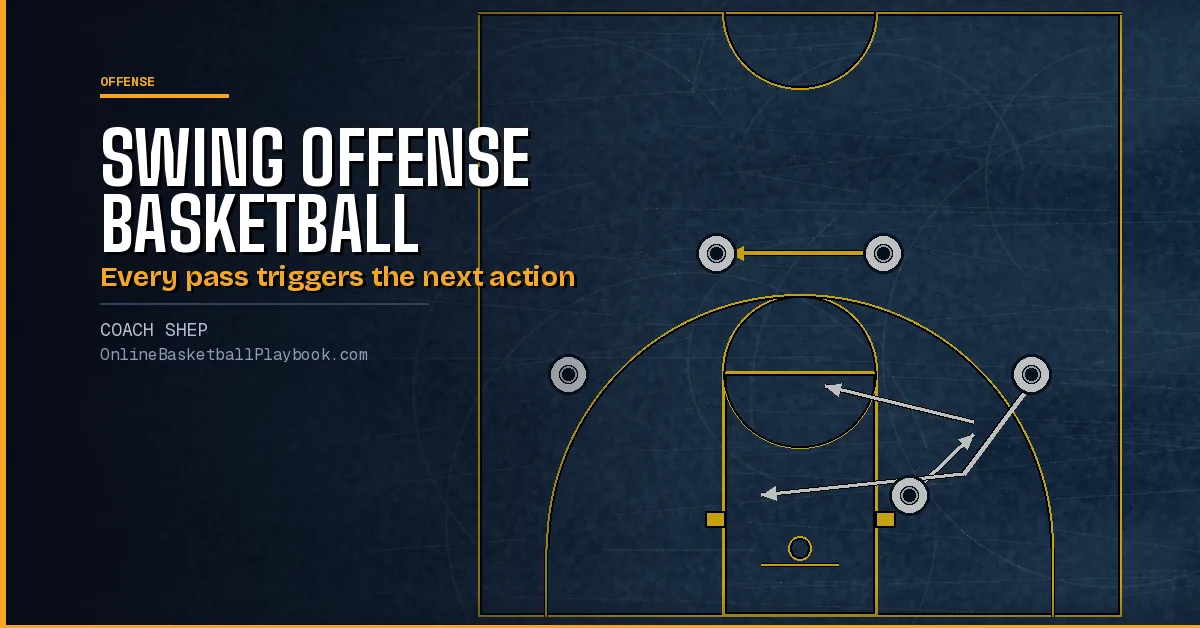
The swing offense in basketball is the 4-out 1-in continuity Bo Ryan built at UW-Platteville and ran at Wisconsin. Two players start in the slots, two on the wings and one in the post, and every pass sets off a known action: a UCLA screen, a flare screen or a flex screen. The pattern runs from side to side until a player is open inside, so the offense is patient and built to get the ball into the paint.
This swing offense basketball guide covers the set, the pass rules, the full cycle, post entries, the counters for pressure, the drive rules and who the offense suits. It sits with the other patterned offenses on continuity offense basketball, part of the offense section.
What Is the Swing Offense?
The swing is a patterned man-to-man offense with continuity. It is a mix of parts of the UCLA offense, the flex and the triangle. Ryan names its roots as an up screen, the flex and Bob Knight's principles. The pieces repeat on both sides of the floor, so after a full cycle the team is back in its starting set with players in new spots.
Three features set it apart from other offenses:
- Everyone plays every spot. All five players are interchangeable, and the bigs learn to play on the perimeter while the guards learn to post up.
- The first look is inside. Every perimeter catch looks into the post before anything else, and the offense values high-percentage inside shots and free throws.
- It is deliberate. Possessions often take several passes, and the good look may come on the third or fourth side of the floor.
Two other things share the name and are not this offense:
- A youth pattern. A 2-3 set pass, cut and fill pattern with back-cut counters.
- A quick hitter. A 4-out 1-in quick hitter called "Swing" that clears one side for a wing hand-off, then a screen for the post who swung to the block.
This page is about Ryan's continuity. Learn it as one pattern, not five plays.
The Set and the Spots
The base set is 4-out 1-in with five named spots:
- Two slots above the arc, balanced on each side of the lane line (1 and 4 in the diagrams).
- Two wings outside the arc (3 and 2). Ryan puts them half a step off the sideline. Wings V-cut to get open for the catch.
- One post just above the block, not below it (5). The post can also start on the block.
With four players on the wings or higher, the baseline stays open for drives. With the ball on one side, the slot, the wing and the post form a passing triangle on the ball side. That triangle is a key point: when a called play breaks down, the team rebuilds the ball-side triangle and runs the swing again.

Fill the five spots the same way every time.
Swing Offense Basketball Rules: One Pass, One Trigger
The offense runs on a short list of rules tied to where the ball goes. The same pattern holds in every telling and the screens agree. The weak side exchanges two ways.
| Pass or ball spot | What it triggers | Variation |
|---|---|---|
| Slot to wing | The post sets a UCLA screen for the passer, who cuts to the rim and becomes the new post. The screener steps out. | Same either way |
| Ball on a wing | The two weak-side players exchange spots. | Basket cuts: both make hard basket cuts, then come back out. Elbow trade: both cut to the elbow and trade. |
| Wing back to the slot | The weak-side wing sets a flare screen for the weak-side slot. | Same either way |
| Slot to slot | The post sets a flex screen for the wing, who cuts to the ball-side block. | With basket cuts, the screener flashes to the middle after the screen. |
Two passing rules sit on top of the triggers. Every perimeter player catches in triple threat and looks into the post first. The pass into the post is a bounce pass or an overhead pass, never a lob, with one exception covered under post entries below. The screens themselves are explained on basketball screens and flare screen basketball. Teach each pass with the screen that goes with it.
Running the Continuity
Follow the ball through one full side. The ball starts with 1 in the left slot.
1. The wing entry and the weak-side exchange
1 passes to 3 on the wing, and 3 looks for 5 posting up. On the weak side, 4 and 2 exchange. As drawn here they make hard basket cuts, so 3 can hit either cutter, and the cuts keep the help defenders busy. If no pass comes, both cutters go back out to the other's spot.

2. The UCLA cut
If 5 is not open, he steps up to the elbow and back-screens for 1. 1 makes the UCLA cut to the rim on whichever side of the screen the defense gives him, and 3 looks for him on the way. If the pass is not there, 1 posts up on the ball-side block and 5 pops out to the slot. The UCLA screen is a good way to attack a size mismatch inside.

3. The flare on the pass back out
3 passes back out to 5 in the slot. That pass triggers the weak-side flare: 4 screens for 2, who fades toward the wing. 5 may have a jump shot himself, or he looks for 1 in the post. If 2 is open off the flare, 5 can skip the ball to him.
2 should walk his defender down to the level of the screen before he flares. Otherwise 4 steps out to the slot for the reversal.

4. The flex cut on the reversal
5 reverses the ball to 4, a slot-to-slot pass. 1 steps out of the post and screens for 3, who flex-cuts to the ball-side block, now on the right. After the screen, 1 flashes to the middle, so 4 can hit either the cutter or the screener. The screener often gets the shot because the defense watches the cutter.

5. Start again on the other side
The new wing V-cuts, catches and looks into the post, and the same chain runs on the right side: the wing pass brings the UCLA screen and the weak-side exchange, the pass back out brings the flare, and the slot-to-slot pass brings the flex.
The offense is at its most dangerous after several reversals, since by then the defense has guarded several actions in a row. The UCLA cut chances usually start to show after a couple of reversals. Run the chain the same on both sides.
Post Entries
Since the point of the offense is to get the ball inside, the post entry gets its own rules.
- Top-down entry. Feed the post from the slot, since help is harder to give with the ball in the slot. When the post is fronted or played on the high side with the ball on a wing, he spins or "leg whips" the defender as the ball goes back to the slot, keeping the defender on his back and opening the entry.
- The lob exception. The only allowed lob comes when the post defender is fronting hard and the post can seal him up the lane line.
- After the entry. Leave it to the coach, but the moves must be set and rehearsed. Two examples: the weak-side slot dives to the far block, or the passer makes a Laker cut to the opposite block. Dive the opposite slot to the opposite block when the weak-side defender doubles down.
- Practice it daily. In Ryan's teaching, the skip pass into a post entry is practiced every day.
Post technique for guards and bigs alike is on how to post up in basketball. Make the entry the first look every time.
Counters and Pressure Releases
Like every patterned offense, the swing can be pressured and scouted, so add releases and teach them for when denial breaks the pattern.
- Wing denied. The post steps out and back-screens the defender who is denying the wing, and the wing cuts to the rim. The post can then step out for an easier wing entry.
- Slot pass denied. The ball handler dribbles at the other slot, which triggers a shallow cut. The team treats it like a slot-to-slot pass, so the post sets the flex screen.
- Overplay, Ryan's answer. The point guard dribbles at the wing, and the wing back-cuts as the post leaves to open the lane. A down screen also gets the team into the offense.

Four more counters each answer one defensive habit:
| Counter | Against | What happens |
|---|---|---|
| Flex Duck-In | Switching | The flex screener seals the defender who switched. |
| Flex Bump | Help on the flex cut | The cutter bumps back out for a skip pass. |
| Flare Slip | A defender who jams the flare | The screener slips to the basket. |
| UCLA Bump | A defender who cheats the UCLA cut | The cutter bumps back to the three-point line. |
More answers:
- Three-man game. Two posts and a guard run flex actions to isolate a post mismatch against a switching team.
- Two-man game. A wing ball screen from the post against a big who struggles to guard ball screens.
- Take the big to the corner. In one of Ryan's plays, a switch is answered by the guard taking the big to the corner and catching there, since the guard can beat the big.
Ball-screen reads are covered on pick and roll basketball. Teach the releases before the first denial.
Drive Rules
The open baseline invites drives, so give the other four players a job when someone puts the ball down.
- Baseline drive. The post I-cuts up the lane to clear space and stay available. The weak-side player drops to the baseline for a drift pass. The nearest slot gets behind the drive as the safety.
- Middle drive from the strong-side slot. The corner drifts and the weak-side slot fills behind.
- Weak-side wing drive. The weak-side slot cracks back, the opposite corner drifts and the strong-side slot looks for a kick-out window.
- Middle drive from the strong-side wing. The post steps out to the short corner.
- Post steps up on a baseline drive. On a baseline drive, the post steps up the lane.

Spacing for drives in any offense is on basketball spacing drills. Give every player a job the moment the ball is put down.
Get the next coaching guide in your inbox
One email when a new guide or diagram set goes up. Free.
Set Plays From the Swing
The swing carries its own called plays, and each one flows back into the base pattern if it does not produce a shot.
- Eight Ryan plays. They include a play that sends a shooting point guard off a UCLA screen and then a double staggered down screen for a three, two ball-screen plays, a post isolation for a mismatch or a post defender in foul trouble, and plays built on back screens and a shallow cut.
- Four more Ryan plays. A ball screen for the 1, a clear-through with a hand-off to the 2, a back screen where the screener keeps going for a wing back pick, and a skip to the 1 that leads into the switch counter described above.
- Nine quick-hitting entries, several of which move straight into the continuity, such as one built for teams that deny the wing entry.
Ryan also says the swing set always leaves a stagger screen available. Other quick hitters by alignment are on basketball plays. Run the play, then fall back into the pattern.
Who the Swing Fits
The strengths and costs:
| Strengths | Costs |
|---|---|
| Inside shots and free throws | It needs patience, often to the third or fourth side |
| The defense has to guard consecutive actions | Bigs must handle and pass on the perimeter |
| An open baseline for drivers | Equal opportunity, so roles and good shots must be defined |
| Big guards can post smaller guards | It is patterned, so pressure and a scouting report can disrupt it without releases |
| Every player learns to play inside and out | Up-tempo coaches may find it too slow |
On age, high school players can learn it and junior high players probably can, while youth teams with little practice time may be better off with a true motion offense such as the 5-out motion offense. A shape with one post and four perimeter players is also covered on the 4 out 1 in offense page. Match the offense to your players and your practice time.
Swing vs flex
The swing borrows the flex cut, but the two are separate offenses.
| Point | Swing | Flex |
|---|---|---|
| Set | 4-out 1-in: two slots, two wings, one post | Two guards high and three players low |
| What a guard-to-guard pass does | Triggers a flex screen from the post for the wing | Triggers the flex cut off a baseline screen, then a down screen for the screener |
| Other screens in the pattern | UCLA screen on the wing entry, flare on the pass back out | The down screen after the flex cut |
The full flex pattern is on flex offense basketball, and a role-based motion offense with assigned screeners is on blocker-mover offense.
Want the printable playbook packs?
OBP Pro members get the premium playbook packs: the zone attack, out of bounds and practice plan PDFs, plus each new pack as it is finished. The membership page lists what is in each one. Or draw your own version free in PlayDraw.
See what OBP Pro includesQuestions Coaches Ask
What is the swing offense in basketball?
A 4-out 1-in continuity offense built by Bo Ryan in which each kind of pass triggers a screen: a UCLA screen on the wing entry, a flare when the ball goes back to the slot and a flex screen on a slot-to-slot pass.
Who created the swing offense?
Bo Ryan developed it at UW-Platteville and ran it at Wisconsin.
Is the swing offense a motion offense or a continuity?
A continuity. The cuts and screens follow a set pattern that repeats from side to side, with counters for pressure, instead of free rules for each player.
What alignment does the swing offense use?
Two slots, two wings and one post just above the block.
Is the swing offense good for youth basketball?
High school players can learn it and junior high players probably can, but youth teams with little practice time may do better with a true motion offense such as the 5-out.
How do you beat a denial in the swing offense?
A denied wing gets a back screen from the post and cuts to the rim, and a denied slot pass becomes a dribble-at with a shallow cut that is treated like a slot-to-slot pass.
More Guides From This Batch
- Continuity Offense Basketball: Types, Rules and How They Work
- 5 Out Motion Offense Drills: Install Steps and Live Games
- Basketball Rules and Regulations by Level: NFHS, NCAA, NBA, FIBA
Back to Continuity Offense and every Offense page.
Keep Building
Related breakdowns
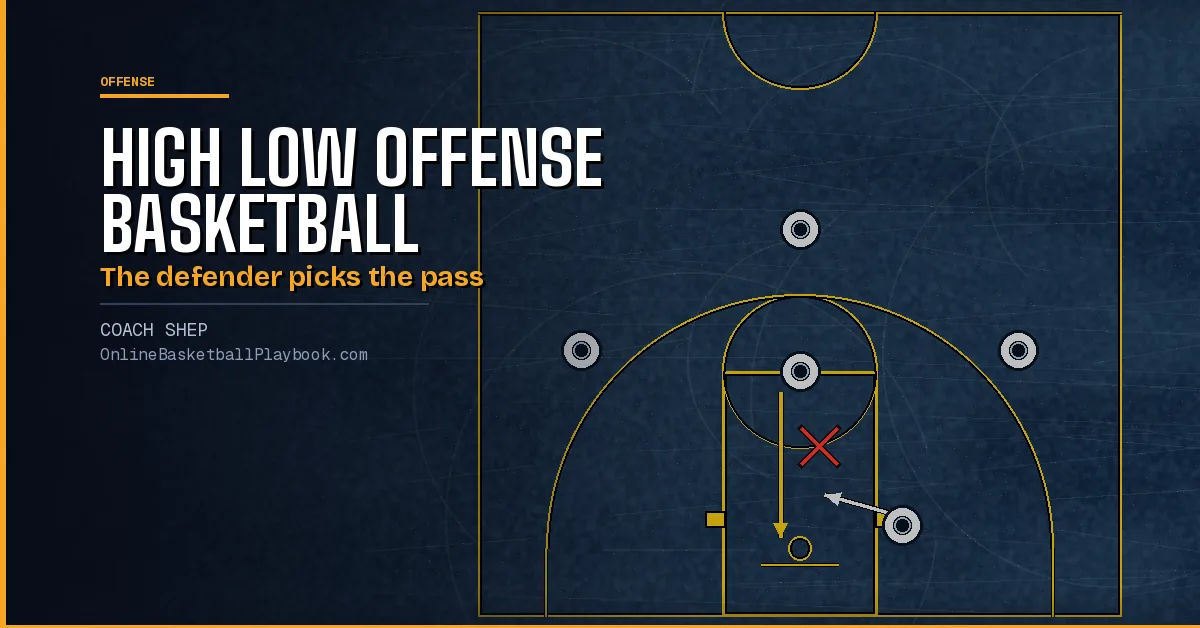
High Low Offense Basketball: Reads, Counters and Zone Rules
High low offense basketball explained: the two-post shell, the lob and bounce reads, answers to a front, down-screen reads, 1-4 low sets and the hi-lo against zones.
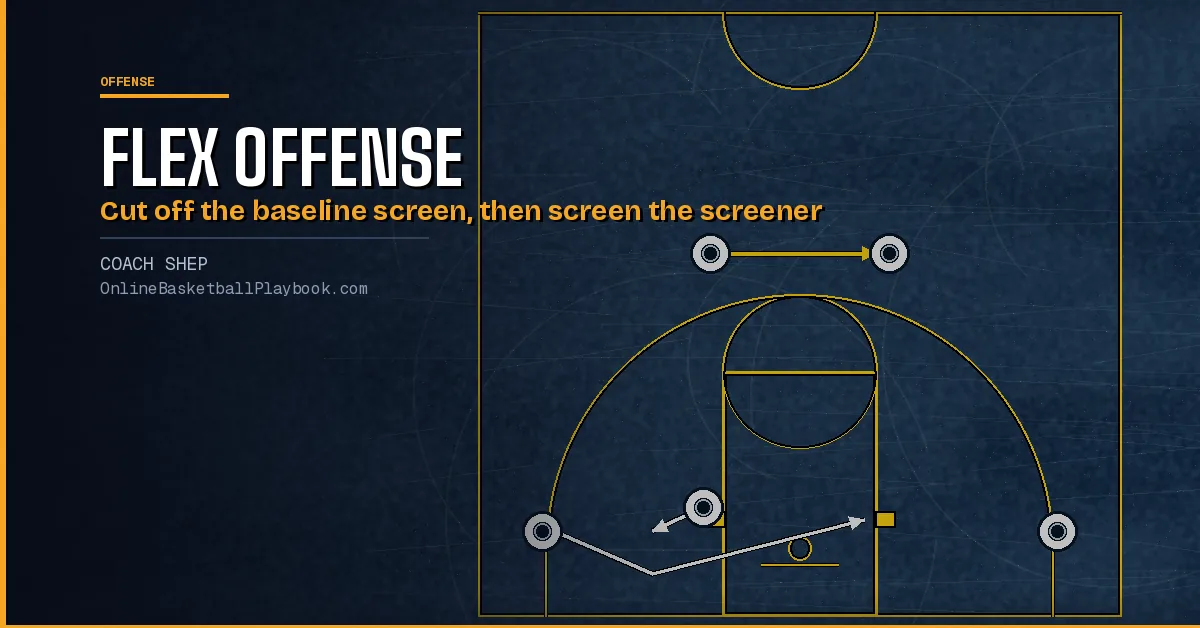
Flex Offense Basketball: Cuts, Sets, Counters and Drills
Flex offense basketball in full: the flex cut and down screen, seven after-cut options, eight starting sets, counters for denial and switching, and install drills.
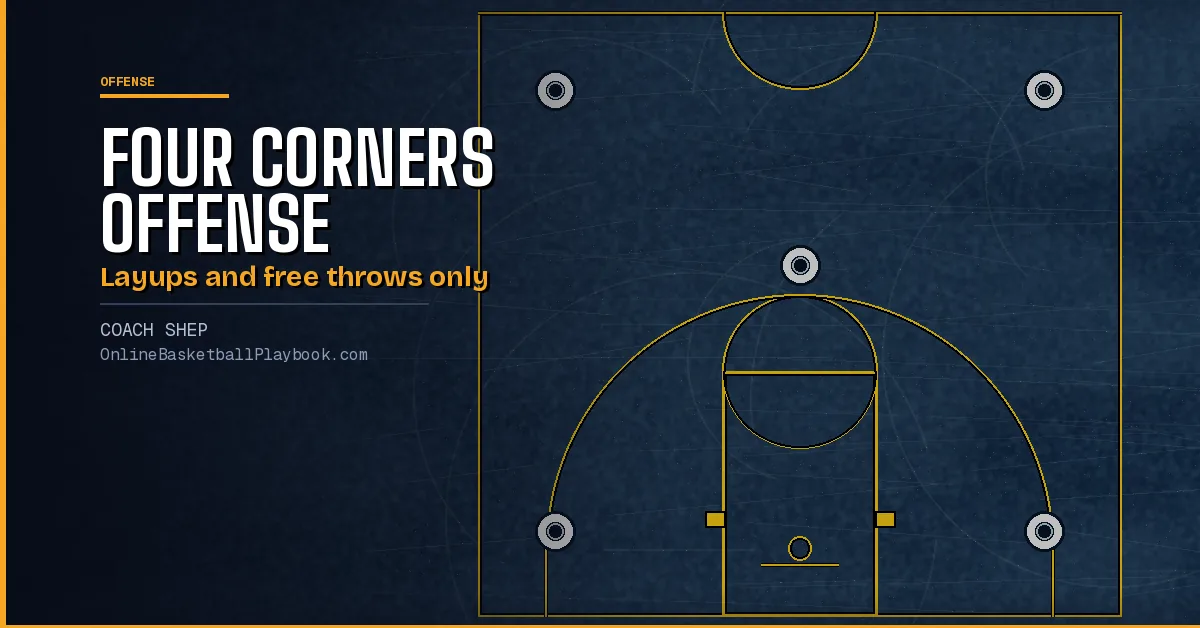
Four Corners Offense Basketball: Roles, Rules and Versions
Four corners offense basketball: the set, the chaser, the corner and post rules, three versions, when to run it, the shots it hunts and shot clock limits by level.