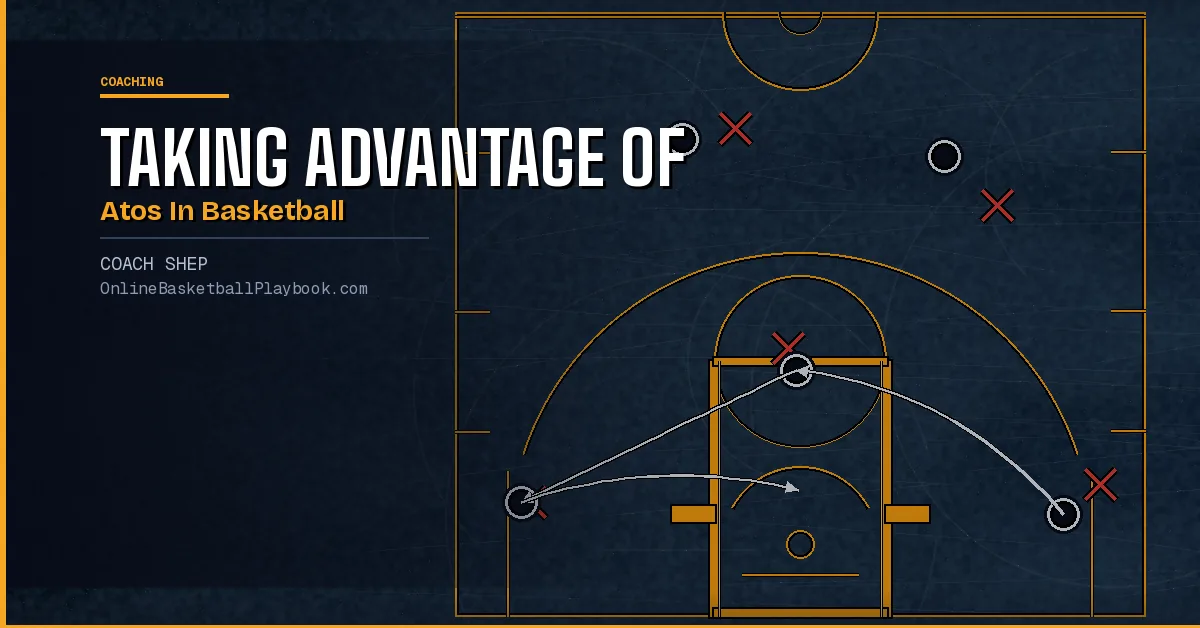
An after-timeout play hands your team a free, organized possession. The defense hasn't set yet and your players are fresh. Most coaches waste it. Here's how to make every ATO count.
What an ATO Actually Is
ATO stands for "after-timeout offense." It refers to any set play your team runs out of a dead ball following a timeout, either a timeout you called or one called by the opponent. The ball is inbounded from the sideline or baseline and your offense runs a scripted action designed to produce a specific shot.
The key word is scripted. ATOs are not "run your regular offense." They are short, precise sequences (often just two or three actions) built to attack a specific defensive weakness in five to eight seconds. At the highest level, NBA coaches diagram them on a whiteboard during the timeout itself. At every level below that, the same principle applies: every timeout is a coaching possession, and you owe your players a plan.
ATOs differ from baseline out-of-bounds plays (BOBs) and sideline out-of-bounds plays (SLOBs) in one important way: the ball is not yet in play. You control the clock. The inbounder becomes a weapon. He can pass to any of four teammates, move laterally along the boundary, and create spacing before the first pass is even caught. Good ATO design starts with that truth.
You will typically design ATOs for three moments: end-of-half with time to score, late-clock game-tying or go-ahead situations, and momentum-changing timeouts in the middle of runs. Each context shifts how aggressive or conservative your action should be.
Why Most ATOs Get Wasted
The most common reason ATOs fail is not talent. It's habit. Teams run their regular motion offense because that's what they practiced all week. The timeout provides the opportunity. The practice schedule determines whether the team can execute something sharper.
The second reason is over-complexity. Coaches draw up five-step plays in thirty seconds and then wonder why their players hesitate at the inbound. Hesitation is a signal that the play is too complicated for the time constraint, not that the players are too slow. A two-option play your team can run cold is worth more than a six-option masterpiece they freeze on.
Third, many coaches call ATOs without a clear target. "Get a good shot" is not a play. A good ATO names the player, the spot, and the action: "high ball screen for your two-guard, kick to the corner three if they go under" is a play. The difference between those two instructions is the difference between an open look and a forced shot at the buzzer.
Finally, teams waste ATOs by not accounting for the defense. If the opponent just called timeout to set a box-and-one, running your normal pick-and-roll will not beat it. The timeout is also reconnaissance time. Watch how the defense aligns, listen to what the opposing coach is telling his players, and attack the mismatch they just created.
Designing an Effective ATO
Every ATO should be built around one primary action and one secondary action. The primary action is the play you want to run. The secondary action is what happens if the defense takes it away. Your players should be able to read which option has opened up without a verbal call. The read should be built into the movement.
Start with spacing. Where do you want your best shooter when the ball is inbounded? Work backward from that spot. The other four players exist to get him there or to punish the defense for overplaying him. If you put your best three-point shooter in the corner and run a flare screen for him, the defense must choose between covering the screen or sagging to protect the paint. That choice is your advantage.
Next, define the inbounder's role. The inbounder is often an afterthought, but a smart ATO uses him as a release valve. After he passes, he can cut baseline, pop to a wing, or set a back-screen. Teams that move all five players make the defense guard five options. Teams that treat the inbounder as a spectator give the defense a free body.
Timing matters more than elegance. A play that results in a catch-and-shoot within four seconds of the inbound beats a complicated action that takes eight seconds and leaves your player catching off-balance. Practice your ATOs against a clock. If the primary action hasn't produced a catch within five seconds, the secondary must trigger automatically.
The Three-Action Framework
A reliable ATO structure follows three steps. First, an initial action to pull the defense (a flare, a pin-down, or a simple curl) that forces the help defender to commit. Second, a ball-screen or cut that attacks the gap created by that first action. Third, a skip pass or drive-and-kick that finds the open shooter on the weak side. Each step flows from the one before it, and your players need to see all three as connected, not separate.
Teaching ATOs to Your Team
ATOs only work if players can execute them under pressure without thinking through each step. That means practice volume. The most successful coaches treat ATO reps the same way they treat free throw shooting, a daily or near-daily habit, not a once-a-month walkthrough.
Install ATOs in layers. Week one: walk through the action with no defense. Week two: add a stationary defense to build visual recognition. Week three: live defense at half-speed. Week four: game speed with a shot clock. By the time you run it in a game, every player has seen the play hundreds of times and the reads are automatic.
Name your ATOs so players can receive the call and line up without a diagram. Simple names work best: color names, number names, or single-word cues. Complicated naming systems create the same cognitive load as complicated plays. You want the player thinking about the read, not translating the call.
Importantly, drill the secondary action as much as the primary. Most coaches over-practice the base play and under-practice the reads. In a game, the defense will take away your primary option at least half the time. Your players need the secondary action to feel just as automatic. Run "defense takes away primary" reps deliberately. Have your scout team deny the primary every time and force players to find option two without hesitation.
That planning principle applies directly to ATO instruction. A short, sharp ATO rep at the top of practice (when players are fresh and locked in) builds the muscle memory faster than a long, tired walkthrough at the end of a session.
ATO Concepts That Work at Every Level
Certain actions are reliable at every competitive level because they exploit constraints that do not change with talent: defense must guard the ball, defenders sag toward the paint, and man-to-man defenders follow their assignments. The following concepts exploit each of those tendencies.
The Flare-and-Relocate
Your best shooter sets a back-screen for a cutter, then flares to the three-point arc. The defense is momentarily watching the cutter, and the shooter catches the ball in rhythm on the move. This works at the youth level because defenders follow the ball, and it works in college because even trained defenders lose sight of off-ball screeners. The catch and shot happen in one motion. There is no dribble, no hesitation, and no time for the defense to recover.
The High Ball Screen Wrinkle
Run your two-man game at the top of the key, but start it from an inbound rather than a live possession. The ball-handler curls off the screen; the screener rolls or pops based on how the defense hedges. What makes this effective as an ATO is the inbounder's positioning. He can be a trailer who catches a dump-off near the elbow, creating a third option the defense didn't anticipate.
The Overload Corner
Stack three offensive players on one side of the court: one in the corner, one at the wing, one at the elbow. The inbound pass goes to the elbow player. The corner player pin-screens the wing's defender. The wing cuts to the ball; if the corner defender helps, the corner player pops free. This overloads one side of the court and forces the defense to pick which player they leave open. Against a zone, it is even more effective because the seams between defenders widen under the triple threat.
The Lob or Layup Action
Not every ATO ends with a jump shot. A simple lob to a cutter who back-screens the inbounder's defender, or a baseline cut that catches a sleeping help defender, can produce the easiest two points your team scores all game. Keep at least one "paint action" ATO in your rotation. Defenses that lock onto three-point shooters during timeouts are especially vulnerable to this.
Scouting and Adjusting on the Fly
The best ATO coaches are also the best in-game scouts. During every timeout (even one your team called), watch where the opposing coach points during his huddle. That direction tells you what the defense is about to prioritize. If he's pointing at your best shooter, run action that uses that player as a decoy. If he's drawing on a clipboard, he's installing something new. Attack it before his players fully process it.
Pre-scout ATOs the way you pre-scout half-court defense. Before the game, identify two situations where you are likely to have a timeout: end of the first half and a late-game tie. Have a specific ATO installed for each. Your players should know the name before tip-off. That preparation eliminates the chaos that turns timeouts into rushed improvisations.
Track your ATO results the same way you track shooting percentages. Over a season, which plays produce the best shots? Which produce turnovers on the inbound? Which get shut down by zone? That data lets you retire ineffective plays and double down on what works. Most coaches carry the same four ATOs all season without reviewing whether they're producing. A quick end-of-game review ("which play worked, which didn't") builds the same compounding effect as any other coaching feedback loop.
Finally, teach your players to communicate during the ATO setup. If a player recognizes that his defender is ball-watching or is out of position, he should signal the inbounder. A simple hand signal (open hand for "I'm open," fist for "wait") gives your team a real-time adjustment mechanism that no whiteboard diagram can provide. Coaches design plays; players execute reads. The best ATOs give players enough structure to succeed and enough freedom to respond to what the defense actually does.
Install two to three ATOs per season and drill them enough that every player can execute both the primary and secondary options without a verbal prompt. Depth of reps on a few plays beats a long playbook of half-learned ones. Run them daily in the last two minutes of practice, against live defense, with a five-second shot clock running.
- Name every ATO simply. A one-word or one-number call keeps cognitive load low and gets players aligned faster than a descriptive phrase called in a noisy gym.
- Practice the secondary option more than the primary. Defenses take away option one regularly. Your players need option two to feel automatic, not like a fallback they're guessing through.
- Include a paint action in your ATO package. A lob or baseline cut punishes defenses that crowd the three-point line; mixing looks keeps the defense from settling into one assignment.
- Scout the opposing huddle during the timeout. Where the opposing coach points tells you what they are about to defend. Design your play to attack the coverage before his players fully digest the instruction.
- Track ATO results across the season. Review which plays produce open looks and which produce turnovers; cut the losers and sharpen the winners just as you would any other part of your system.
Want more basketball coaching strategies and drills?
Join the Online Basketball Playbook newsletter →
Draw this play free in the play drawer →
Membership: the full library, playbook packs, and Pro drawing tools →
Keep Building
Related breakdowns
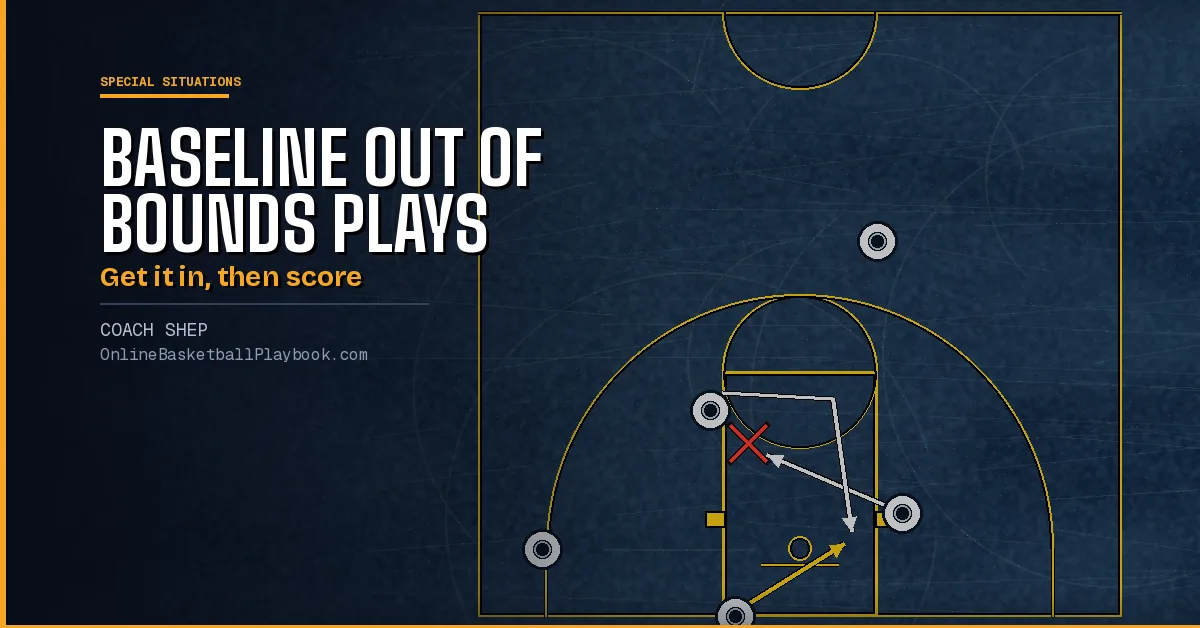
Baseline Out of Bounds Plays: Sets vs Man, Zone and for Youth
Baseline out of bounds plays drawn step by step: a box back screen and roll, Pick the Picker, the double stack, a 2-3 zone play, youth one-pass plays, the rules and the reads.
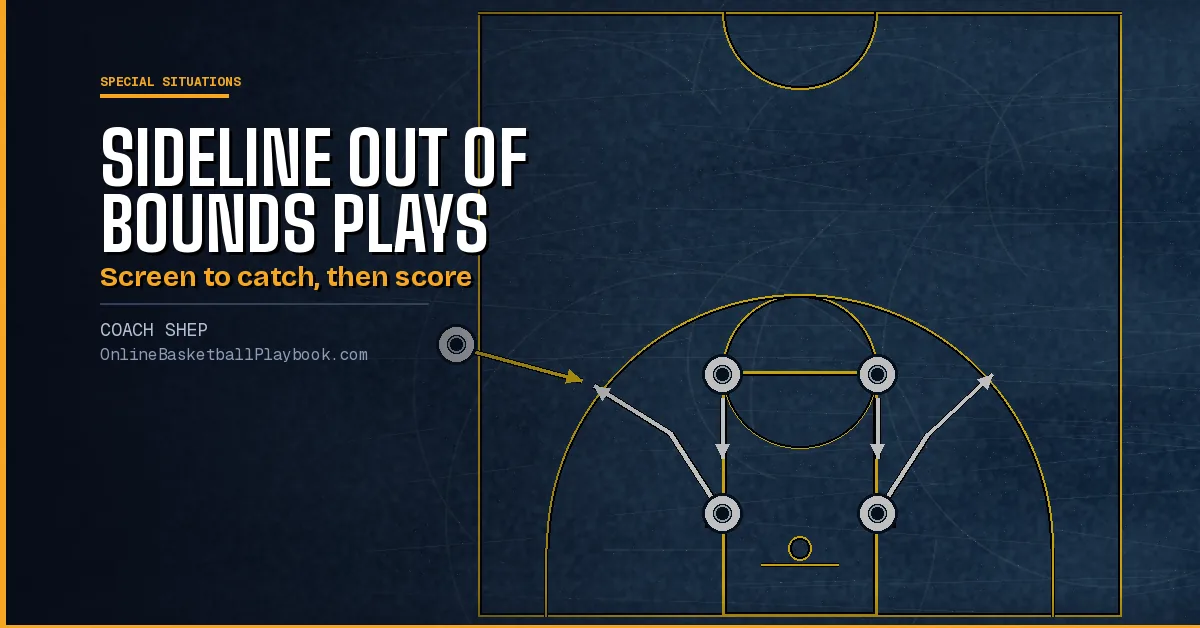
Sideline Out of Bounds Plays: SLOB Sets, Reads and Practice
Sideline out of bounds plays for coaches: SLOB sets from a box, stack and line, the inbounder's reads, plays against zone and denial, the clock and practice.
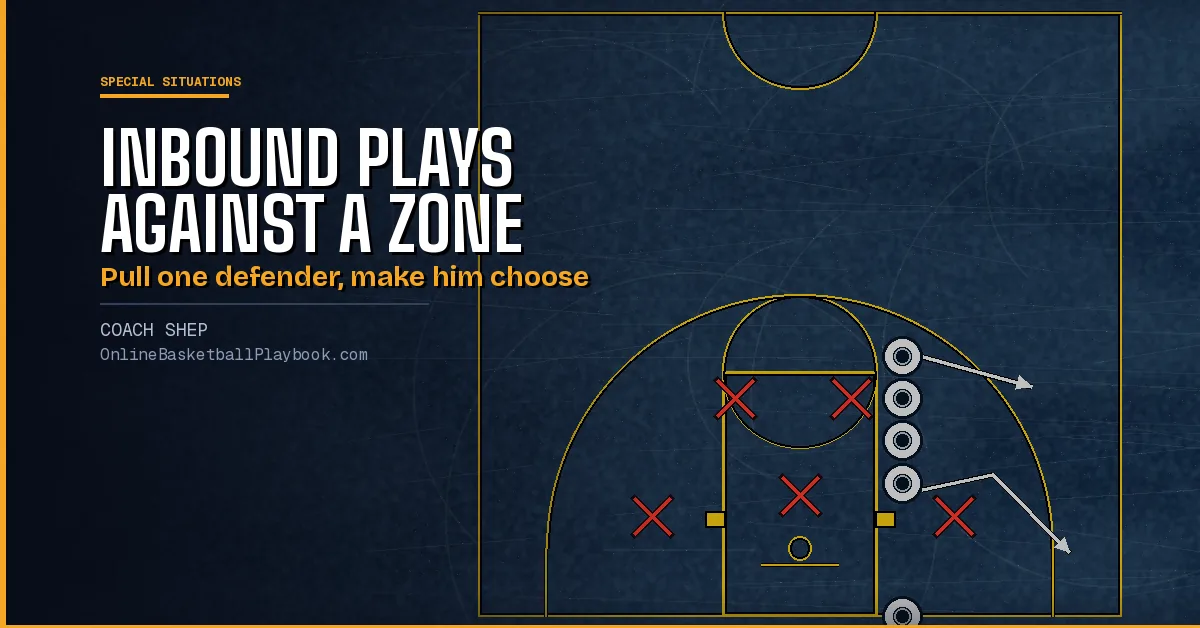
Inbound Plays Against a Zone: Baseline and Sideline Sets
Inbound plays against a zone from the baseline and sideline: the read, the stack near the elbow, short-corner pulls, split cuts, two-part sets and sideline answers.