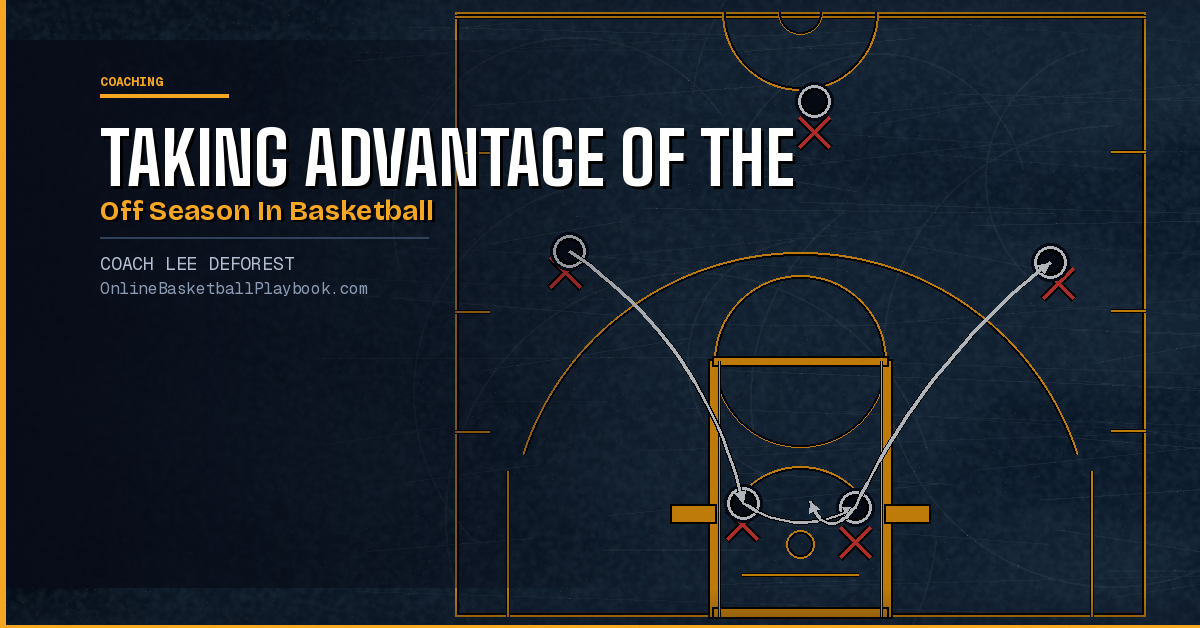

The off season separates players who maintain from players who transform. What you do in the months between final buzzer and first practice shapes everything that follows when the season starts again.
Why the Off Season Is the Real Development Window
During the regular season, coaches are managing rotations, game plans, and results. Players are executing systems under pressure. There is very little time to slow down, isolate a weakness, and actually fix it. The off season removes all of those constraints and gives players and coaches something the regular season almost never allows: uninterrupted time to work on the things that actually need work.
This is not a trivial distinction. During a game or a competitive practice, a player who struggles with weak-hand dribbling will default to their strong hand. A shooter who rushes under pressure will never slow down enough to repair their release point when the stakes are live. The off season is the only period where you can deliberately practice the uncomfortable skill without consequences, which is precisely when real changes in muscle memory happen.
Think about the players at your school or in your program who showed the biggest jumps from one season to the next. Most of them did not transform by accident. They found a gym, put in focused repetitions, addressed a specific weakness, and showed up the following fall as a different player. The coaches who develop those players intentionally structure the off season so that kind of growth is the expected outcome, not a happy coincidence.
The off season also matters for players who are still young and building their foundational movement base. According to long-term athlete development frameworks, the window between ages 9 and 14 is when players absorb fundamental skills most efficiently. If that window is spent in only game settings, much of that trainable time goes to competition rather than skill acquisition. An intentional off-season program captures those reps.
Building the Fundamental Base Without Game Pressure
The off season is the right time to go back to fundamentals — not as a punishment for poor performance, but because fundamentals are the highest-leverage work any player can do. Ball-handling, passing, footwork, and shooting are the four skills that every level of basketball demands. They transfer across any system a player will play in, and they compound over time.
Ball-handling in the off season means working with both hands deliberately. Players who only dribble with their dominant hand during the season will revert to that habit under pressure, but the off season offers the space to train the weak hand until it becomes automatic. Start with stationary two-ball dribbling, progress to movement, and eventually add pressure from a defender or a cone course. The goal is to make the weak hand boring — so routine that the player stops thinking about it.
Passing accuracy is one of the most underworked skills in youth basketball, and the off season is the best time to address it. Wall work, partner drills with targets, and three-person weave patterns all develop the timing, footwork, and touch that make a player a genuine playmaker. Coaches who run structured passing sessions in the off season consistently notice that their players enter the regular season looking sharper in transition and in the half-court before a single play has been drawn up.
Footwork deserves its own block of off-season time. Jump stops, pivots, drop steps, and triple-threat positioning are the body-control fundamentals that every other skill is built on. A player who cannot pivot cleanly under pressure will travel. A player who cannot execute a proper jump stop will lose balance on drives. These skills are entirely trainable without a defender and without competition — which makes the off season the natural time to lock them in.
Shooting form is the fourth pillar, and it is also the skill that requires the most repetition before changes become permanent. During the season, players cannot afford to experiment with a new release point or a different foot alignment — those adjustments cost confidence and results in live games. The off season removes that risk. A player can spend three weeks rebuilding their shooting mechanics, look awkward in the process, and emerge with a fundamentally better shot before the next season tips off.
Designing a Smart Off-Season Individual Workout Plan
The most common off-season mistake is unstructured volume. Players who go to the gym every day with no plan often put in significant time without targeting what actually needs to improve. A smart off-season individual plan has three features: it is specific, it is progressive, and it builds in measurement.
Specificity means identifying one or two skills that genuinely limited your game last season and making those the primary focus of your off-season work. If turnovers on the drive were a problem, the off season is the time to develop a better finishing package and cleaner decision-making in the paint. If late-game free throw shooting broke down under pressure, build a routine that simulates fatigue before your foul-shot sets so the pressure feels familiar. General fitness has value, but targeted skill work is what changes the ceiling.
Progression means the workouts should get harder over time — not just longer. Start with lower speeds and cleaner environments, then add complexity as the skill solidifies. A ball-handling workout that starts with stationary dribbling should eventually include movement, then a live defender, then contested finishing at the rim. That progression mirrors how the skill will actually be tested in a game, and the brain adapts better to incremental increases in challenge than it does to random difficulty spikes.
Measurement keeps the work honest. Pick two or three metrics you can track — your shooting percentage from three spots, your time through a dribbling course, the number of clean pivot sequences in a row before losing your footing — and check them every few weeks. The numbers give you feedback that effort alone cannot. They also keep motivation high because progress becomes visible, which is especially useful for younger players who need to feel that the work is leading somewhere real.
Getting Extra Reps Without a Gym
Not every player has access to a full gym during the off season, and that should not become an excuse to stop developing. Ball-handling can be worked on any flat surface. Shooting form — footwork, release mechanics, follow-through — can be practiced against any wall or with any target. Defensive slide footwork and jump-stop progressions require nothing but space. Players who are genuinely committed to their development find ways to get quality reps regardless of what facility is available to them. The constraint often forces a creative focus that structured gym time can actually dilute.
What Coaches Should Do During the Off Season
Coaches have their own off-season work, and much of it happens away from the court. The months between seasons are the right time to review what the team struggled with, to assess individual player development needs, and to plan the upcoming season with intention rather than momentum.
Start with an honest program review. What did the team execute well? Where did the offense break down consistently? Which defensive rotations were never clean? Which players entered the season underprepared for the physical demands? Writing those answers down while they are fresh gives the coaching staff a real agenda for the next off season rather than a vague commitment to "work on defense."
Skill-gap assessment by player is one of the most valuable things a coach can do in the off season. For each player, identify the one or two skills that, if developed, would make them meaningfully more effective next season. Then communicate that directly — not in a critique, but as a challenge with a clear goal. A player who knows exactly what to work on is far more likely to use the off season productively than one who gets general encouragement to "keep training." Give players their targets before school lets out so the work can begin immediately.
The off season is also the time to build the culture infrastructure for the next year. Holding a team meeting before the first practice, establishing a short team code that all players buy into, and setting parent expectations in writing before the season starts prevents the majority of friction that derails programs mid-season. Youth coaching experts consistently identify proactive culture-building as a coaching discipline, not a personality trait — and the off season gives you the calm to do it right before the pressure of games arrives.
Coaches should also use the off season to plan practice structure for the upcoming year. Detailed practice templates — not just general outlines — save enormous time during the season and ensure that every session is efficient and purposeful. A coach who has already planned the first four weeks of practice before the season begins can put their full attention on player development and real-time adjustments once games start, rather than scrambling to fill practice time.
Returning to the Season Ready — Not Just Rested
There is a meaningful difference between a player who took the off season off and a player who used it. Both walk into the first practice looking physically present. The difference shows up in the second week, when conditioning demands peak and skill sets are tested under a real defensive load. Players who spent the off season working are ahead of the conditioning curve and ahead in the confidence that comes from having already done the hard repetitions away from competition.
Returning ready also means returning with a practice mindset, not just a rest mindset. Players who have been in a gym regularly through the off season are easier to coach when the season starts. Their habits are sharper, their attention to detail is higher, and they are quicker to absorb new information because their basketball brain has been active. Players who have been completely away from the game for three months need the first few weeks of the season just to wake back up — which delays the team's ability to work on more complex material.
For coaches, returning ready means arriving at the first practice with clarity: you know each player's off-season progress (or lack of it), you have your practice templates built, your team code is established, and your parent communication is already scheduled. The season opener feels controlled rather than reactive, and the team picks up on that composure immediately.
The players who surprise you most in any given season are usually the ones who showed up to the first day of practice having quietly done the work no one was watching. That is not luck — it is the direct result of a deliberate off season. Coaches who build a culture where off-season development is the expectation, not the exception, produce those surprising leaps consistently rather than occasionally.
The greatest indicator of a successful youth season is whether players want to come back next year — track skill progression and end with individual conversations about what each player improved and one forward challenge for them.
— Youth Coaching Fundamentals, Basketball Vault
Before players leave for the summer, give each one a specific written target — one skill, one measurable goal — so their off-season work has a clear direction. A player with a target trains with purpose; a player without one trains with volume. Volume without direction rarely produces the gains you are hoping to see in the fall.
- Identify one weakness, then target it daily. Every player should know the single skill that most limited their game last season and have a simple drill routine to attack it through the off season.
- Schedule a pre-season parent meeting, not a mid-season one. Cover playing-time philosophy, communication expectations, and game-day behavior before the first practice so those conversations never derail a game week.
- Build your practice templates before the season starts. Pre-built plans for the first four to six weeks let you spend in-season time coaching players, not organizing sessions on the fly.
- Measure player progress on two or three specific skills. Shooting percentages, dribbling course times, or jump-stop accuracy checks give players real feedback and keep off-season motivation grounded in visible results rather than abstract effort.
- End every off-season workout on a positive rep. The last rep a player does in a solo session is the one their brain files as the reference point. Make it clean, make it confident, and leave the gym on a make.
Want more basketball coaching strategies and drills?
Keep Building
Related breakdowns
Taking Advantage of Early Offense in Basketball
Taking Advantage of Early Offense in Basketball
Taking Advantage of the Sideline in Basketball
Taking Advantage of the Sideline in Basketball