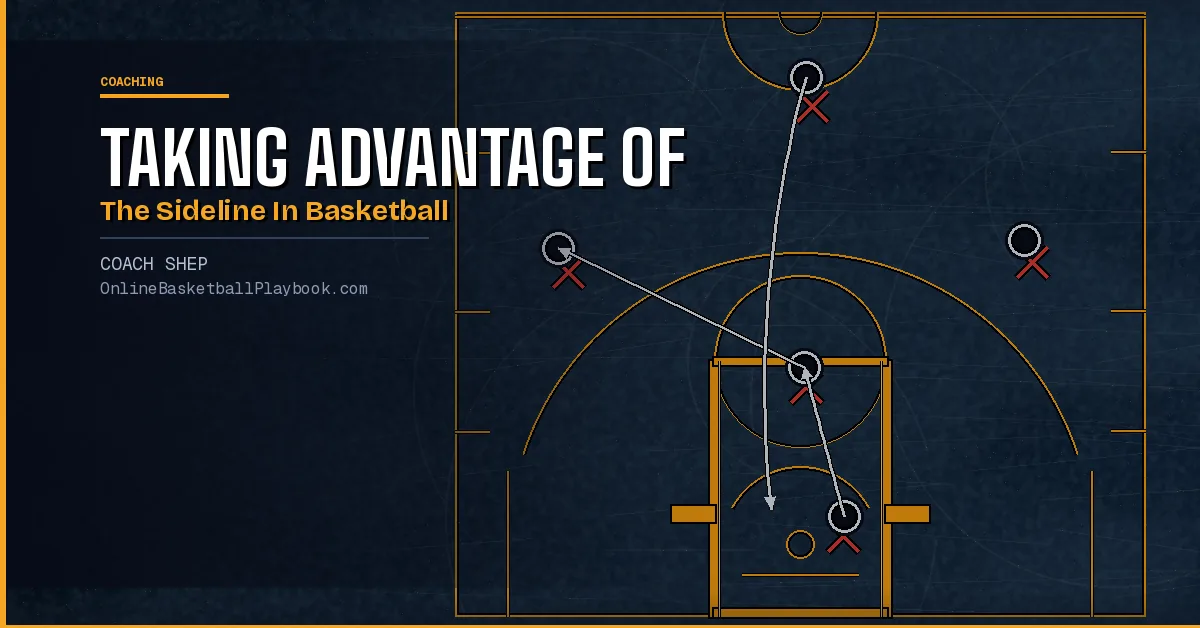
The sideline is the only defender on the floor that never gets tired, never commits a foul, and never misses a rotation. Coaches who teach their players to use it gain a consistent edge on both ends of the floor.
Why the Sideline Is Your Best Defender
Most coaches think about the sideline as a boundary, a line that ends play when the ball goes out. The best defensive coaches think about it as an asset. The sideline eliminates one full half of every dribbler's options the instant you force them toward it. That reduction in decision-making is worth more than almost any other defensive adjustment you can make.
On a full-width court, a ball-handler with the ball near the three-point arc has roughly 180 degrees of penetration angles available. Push that same player two steps toward the sideline and the viable penetration angles drop to about 90 degrees. Push them to the sideline itself and you've eliminated roughly 150 of those original 180 degrees, all without a help defender doing anything extra.
This is the foundational reason that nearly every serious man-to-man defense tells its on-ball defender to "push baseline" or "force sideline." The help defense is always on one side of the floor. The sideline handles the other side for free.
Understanding this geometry changes how you coach defense. Instead of thinking about all the things a ball-handler might do, you start thinking about one thing: get them to the sideline and let the line do the work. That simplicity is what makes the concept so teachable, even to younger players.
Forcing Baseline: The Core Principle
When coaches say "force baseline," they mean one specific thing: position your on-ball defender so that the only comfortable dribble direction is toward the sideline or the baseline, never back toward the middle of the floor. The middle of the court is where offenses live. The baseline and sideline are where defenses thrive.
The technique starts with foot position. The on-ball defender should overplay the offensive player's strong hand slightly, with their lead foot splitting the offensive player's outside hip. This angle makes driving to the middle awkward and slow while leaving the baseline path open, but only as a trap. The sideline is waiting.
The Baseline as a Dead End
When a ball-handler drives baseline, they quickly run out of court. The corner of the court, where the baseline and sideline meet, is one of the most defensively favorable spots on the floor. The offensive player has almost no room to maneuver, and any pass out of that corner must travel across a large section of floor, giving help defenders time to recover or intercept.
Contrast this with a drive to the middle. A player who gets to the middle of the lane has direct access to the basket, a short kick-out to the opposite wing, and a dump-off to a rolling big. The defense must account for three or four viable options instantly. Force them baseline, and one of those options, the middle, is already gone before the drive even starts.
Sideline Trap Mechanics
A sideline trap is one of the most effective defensive weapons in basketball when it is run with precision. The idea is simple: funnel the ball-handler toward the sideline and trap them there with two defenders while the remaining three defenders rotate to deny easy outlets.
The Two-Man Trap
The primary defender forces the dribbler toward the sideline. That part should already be happening in your base defense. The trap defender, usually the nearest wing defender, reads the dribbler's momentum and closes hard the moment the dribbler's outside foot approaches the sideline boundary. The goal is to arrive just as the dribbler picks up the dribble, eliminating any comfortable passing or driving lane.
The two trappers should form a "V" shape around the ball, with the primary defender cutting off the middle and the secondary defender cutting off the path back into the court. The sideline closes the third side automatically. The only remaining option is a lob pass over the trap or a skip pass across the floor, both of which are low-percentage and slow to develop.
Rotation Reads
A trap without proper rotation is worse than no trap at all. When two defenders commit to the trap, three defenders must cover four offensive players. The rotation rules need to be clear and practiced:
The off-ball defender nearest the basket drops to take away any lob pass to the paint. The defender on the weak-side wing sinks to deny the skip pass. They should be positioned to see both the ball and their player simultaneously. The fifth defender, usually guarding the inbounder or the furthest offensive player, becomes the safety valve and reads the ball first.
If every defender knows their role before the trap is sprung, the offense will feel surrounded. If even one defender is slow to rotate, the trap becomes a gift, a two-on-three fast break in the opposite direction.
Using the Sideline on Offense
The sideline is not only a defensive tool. Offensive teams that understand court geometry use the sideline deliberately to create advantages, stretch the defense, and set up scoring actions in the middle of the floor.
Spacing to the Corners
Corner three-point shooters are valuable partly because of the shorter corner three distance, but also because placing a shooter in the corner keeps the defense honest about a very specific area of the floor. A defender who has to guard a corner shooter cannot also help on a drive from the wing. The sideline and baseline create a natural boundary that keeps the corner shooter's defender committed to that spot.
When a ball-handler drives away from a corner shooter toward the elbow or the lane, the corner shooter's defender faces a direct conflict: stay to deny the corner three, or help stop the drive. Good offensive teams make that conflict a feature of every half-court action they run.
Dribble Penetration Along the Baseline
Baseline drives, when a wing player catches in the corner or on the wing and drives along the baseline, are among the most disruptive actions in modern offense. The baseline drive creates a direct line to the basket while keeping the driver below the level of every help defender. The help must come from a long distance or a poor angle, which means the drive often produces either a layup or a kick-out to a wide-open shooter on the perimeter.
Teaching players to read the baseline drive as an offensive option, not just a defensive failure, develops their court vision and their ability to operate along the full width of the floor.
Teaching Sideline Awareness to Young Players
For younger players, the sideline is often just the place where the ball goes out of bounds and everyone stops. Building genuine sideline awareness (understanding the sideline as an active tactical element, not just a boundary) takes deliberate coaching and the right teaching progressions.
Start With the Geometry
Before you can teach a player to force baseline or exploit a sideline trap, they need to understand why the sideline matters. Walk them onto an empty court. Stand a player at the elbow. Ask them to point to all the directions they could dribble. They will gesture all around. Now walk them to the sideline and ask again. The visual is immediate and memorable. Half their options are gone. The lesson lands faster than any diagram.
Reduce Decisions to Simple Binaries
Young players struggle with complex reads. The sideline makes the decision tree shorter, which is a gift for youth coaches. When teaching on-ball defense, the decision for the defender is binary: are you keeping the ball out of the middle? If yes, the sideline and baseline are doing the rest of the work. Two-choice reads are the right cognitive load for developing players, "middle or baseline?" is a question they can answer in real time.
The same principle applies on offense. A player near the sideline has a simpler read: use the space near the line to create separation, then attack back toward the middle. Teaching players to deliberately use the sideline for misdirection (stepping toward the line to pull their defender in that direction, then reversing toward the basket) turns a boundary into an offensive weapon.
Build It Through Games
The most durable way to teach sideline awareness is through competitive small-sided games that make the sideline consequential. One-on-one games played on a lane-width strip of floor force the offensive player to use the sideline wisely and the defensive player to master foot positioning. Two-on-two games where the defense earns bonus points for trapping near the sideline give defenders a reason to practice the rotation without being drilled explicitly. When players feel the sideline's effect in competition, the lesson sticks in a way that no chalk-talk can replicate.
Drills That Build Sideline IQ
Building sideline awareness takes repetition in the right contexts. The drills below target the specific reads and habits that turn abstract understanding into instinctive on-court execution.
One-on-One Boundary Drill
Set up two cones four feet inside the sideline, creating a narrow vertical channel from the mid-court line to the baseline. Play one-on-one within the channel only. The offensive player must use the space within the boundaries; the defensive player must keep the offensive player from crossing toward the middle. This drill builds foot positioning for defenders and teaches offensive players to read angles under spatial constraint. Run it for two to three minutes of live play, then rotate pairs.
Force Baseline Repetitions
Start with a wing player catching the ball at the three-point line. The defender takes a position that makes the middle uncomfortable. The wing player must try to beat the defender, but can only score if they finish from the baseline side of the lane. The defender's job is to keep the drive on the baseline without fouling. No help defense in this drill. Isolate the one-on-one angle so the defender develops confidence in the foot position without relying on rotation.
Trap-and-Rotate Live Reps
Five-on-five half-court defense with a specific rule: any time the ball-handler puts a foot on the sideline, the nearest wing defender is required to trap. The remaining three defenders rotate on a predetermined scheme. No freelancing. Stop the action any time the rotation breaks down and walk through the correct assignment. This drill builds the communication and timing that make trap-and-rotate effective in games. Run it at game speed with a shot clock so the offense feels the urgency of a real possession.
Corner Catch-and-Shoot
This drill develops offensive comfort near the sideline and baseline junction. A ball-handler drives from the wing toward the lane; the corner shooter catches and shoots a corner three off the kick-out. The defender guarding the corner has to decide: help on the drive or stay home. The ball-handler's job is to read that decision and deliver the pass at the right moment. Rotate all five players through both roles over 10 minutes. Players who do this drill regularly develop automatic recognition of the corner kick-out window, which is the single most common scoring opportunity generated by baseline pressure.
When introducing sideline traps to your team for the first time, walk through the rotation at half-speed before you run live reps. The trap itself is easy to teach; the rotation is where most teams break down. Get your three non-trappers to rotate correctly in a slow walkthrough at least three times before you add a live ball. This saves practice time and prevents bad habits from setting in under game-speed pressure.
- Overplay the strong hand, split the outside hip: This is the foot position that consistently funnels the ball-handler toward the sideline without overcommitting and giving up the middle drive.
- Trap at the moment the dribble is picked up: Arriving too early lets the ball-handler reset. Arriving too late gives them time to make a pass before the trap closes. Timing is everything.
- Three rotators drop before the trap closes: If your off-ball defenders wait for the trap to form before rotating, the offense will always beat them to the outlet pass. Rotation starts the instant the trap defender begins their close-out.
- Corner three always threatens: On offense, keep a shooter in the corner whenever you run sideline-baseline actions, so the defense can never fully commit to stopping the drive without giving up a three.
- Debrief every blown rotation in practice: Trap-and-rotate breaks down at the weakest link every time. Name exactly who was wrong, give the correct assignment, and re-run it before moving on.
Want more basketball coaching strategies and drills?
Join the Online Basketball Playbook newsletter →
Draw this play free in the play drawer →
Membership: the full library, playbook packs, and Pro drawing tools →
Keep Building
Related breakdowns
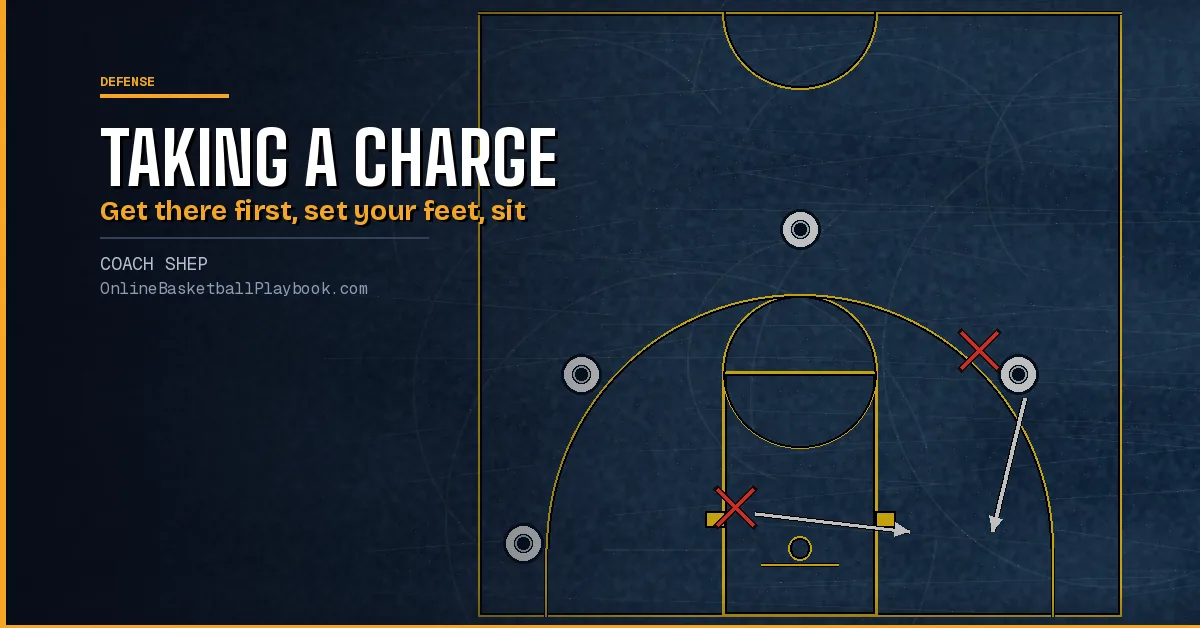
Taking a Charge in Basketball: Technique, Falls and Drills
Taking a charge in basketball: where charges come from, setting the feet, the legal spot by level, three ways to fall, the drills and when to wall up instead.
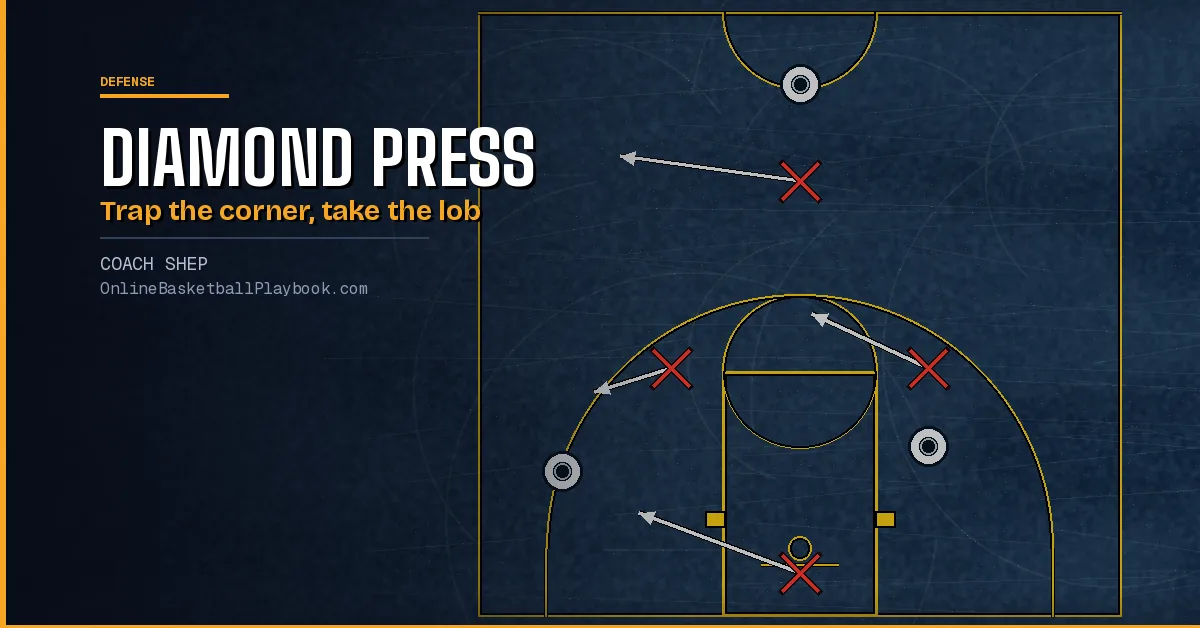
1-2-1-1 Diamond Press Basketball: Roles, Traps and Install
How to run the diamond press in basketball: who plays each role, how to trap the corner, what to do on the reversal and the lob, and how to install it step by step.
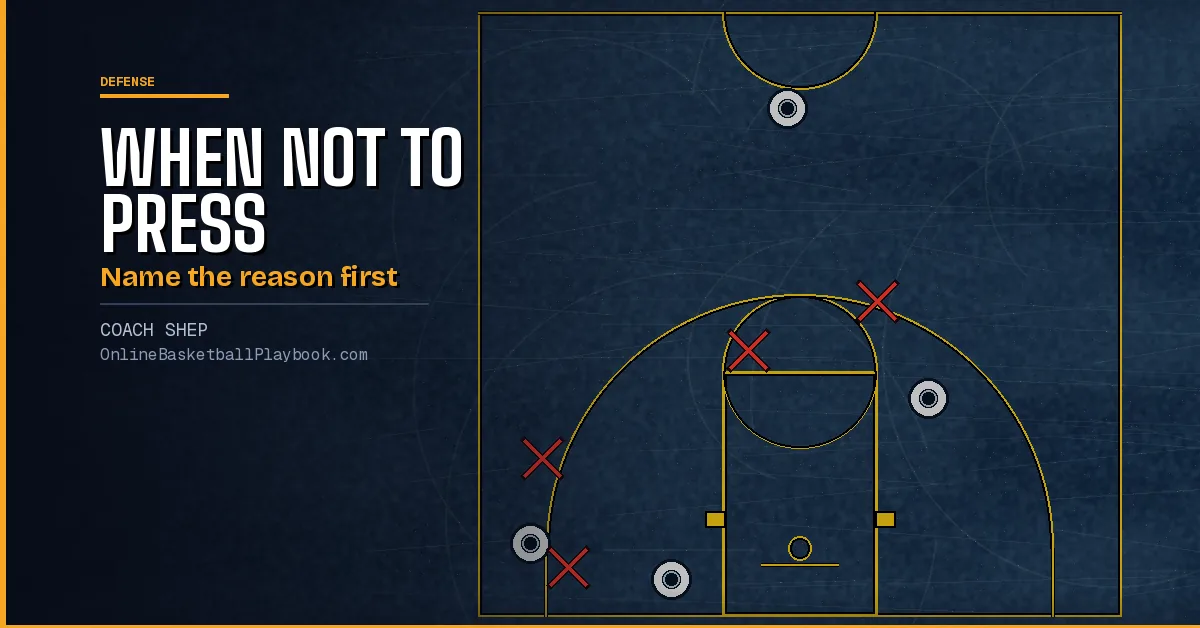
When Not to Press: Bad Reasons, Thin Benches, Poised Guards
When not to press in basketball: the bad reasons, the roster you need first, the opponents who beat it, the moments to drop it and the youth limits.