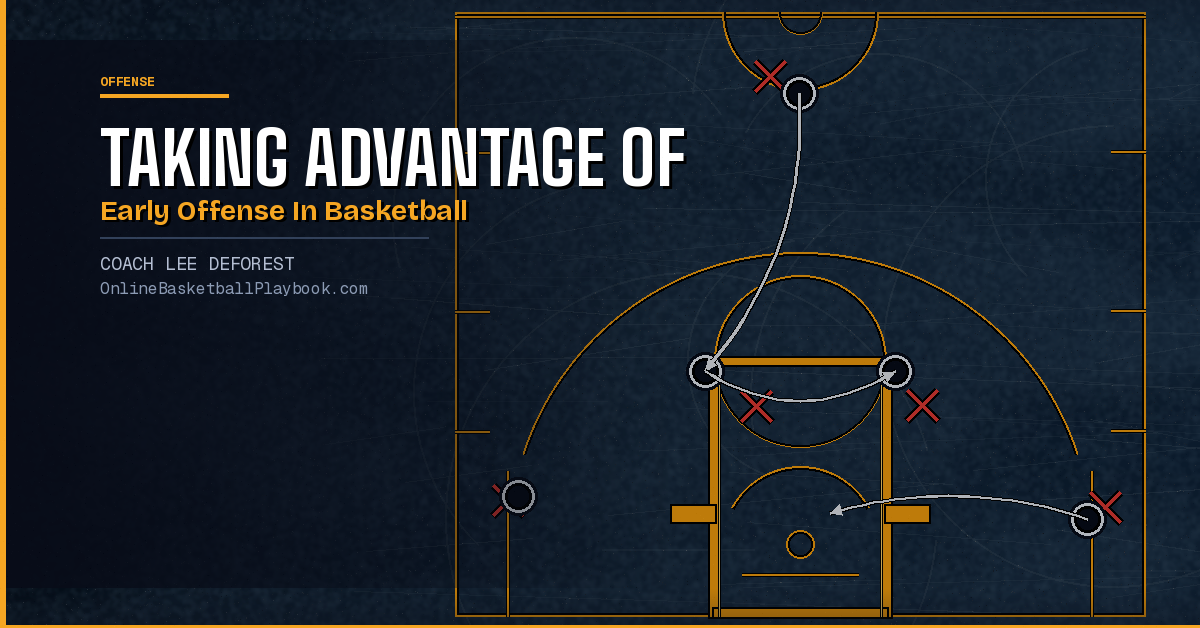

Early offense attacks a defense before it can set — get the ball past half-court in three to five seconds and flow straight into your primary action. Done right, pace becomes a conditioning weapon that pays off in the fourth quarter.
What Early Offense Actually Means
Early offense is not just running fast. It is a deliberate system for attacking a defense before match-ups form, before help side rotations load, and before the opposing point guard gets back to deny the first pass. The distinction matters because coaches who simply tell their players to "push the pace" often get chaotic possessions — bad shots, careless turnovers, and a deflated half-court offense when the quick look isn't there.
At its core, early offense has one organizing goal: get a high-value shot (a layup or open three) in the first seven seconds of a possession. Every system detail — outlet location, lane responsibilities, secondary break actions — exists to serve that target. Coaches like Dan Hurley have codified this into a shot diet rule: threes and layups only in transition. No pull-up mid-range jumpers that feel safe but produce low points-per-possession. The structure is ruthlessly selective about what qualifies as a "good" early look.
Equally important is understanding when early offense ends. If the defense recovers and the advantage is gone, the team must flow into the half-court offense without a sloppy reset. The best early-offense teams don't have two separate systems — they have one continuous attack that simply runs faster when the opponent is scrambling.
The 3–5 Second Rule and Why It Works
The Memphis and Florida spread systems both share the same tempo benchmark: get the ball over half-court in three to five seconds after a change of possession. That number is not arbitrary. Most defenses need five to seven seconds to get all five players back into recognizable positions. Attack in the three-to-five-second window and you are guaranteed to face at least one scrambling defender — often two.
The outlet pass is where the three-to-five-second rule starts. Hubie Brown's fast-break guidelines are specific: the rebounder turns in the air to the outside and fires to the point guard who has moved to free-throw-line extended — not twenty-eight feet, not at half-court, but right at the free-throw-line extended. That positioning creates a long outlet that skips the danger zone near the rebounder and puts the ball in the point guard's hands at full speed. From that catch, the guard is already two steps into the push.
The weak-side forward runs wide — all the way to the sideline — while the rim runner sprints below the net to seal. These are assigned responsibilities, not freelance reads. The structure is what makes the pace sustainable over thirty-two minutes rather than burning out in the first half. John Brannen at NKU installed precise timing gates: ball up by twenty-seven seconds on made baskets, twenty-six on misses, all five players in the frontcourt by twenty-four seconds, a paint touch by twenty-three. These numbers seem like micro-management until you watch a team that runs them — the habit becomes automatic, and opponents can never catch their breath.
Push for 32 minutes; run them early to wear them out late — pace is a conditioning weapon that compounds as the game goes on.
— Memphis / Walberg system, Basketball Vault
Freedom Off Stops, Structure Off Makes
Dan Hurley's single sharpest rule for early offense: freedom off stops, structure off makes. It sounds simple, but it resolves one of the most common coaching headaches — when do you free-lance and when do you call something?
Off a miss or a turnover, the defense is scrambling. Guards should blast the ball ahead, attack the paint, and drive-and-kick. No ball screen. Hurley is emphatic on this point: the drag ball screen has become a crutch, and it kills the speed advantage the moment it is called. A guard who reaches for the ball screen instead of winning one-on-one against a scrambling defender will never develop the individual attack skills to win late in close games. The transition ball-screen ban is simultaneously a system rule and a player-development rule.
Off a made basket, the defense has a head start. Every defender gets to sprint back and find their man. In that situation, freelance transition is unlikely to produce a good look — the advantage has to be manufactured with structure. Hurley calls a named action: a pistol, a wide pin, a dribble hand-off, a step-up. The structure creates the early advantage that pure speed cannot.
This framework also governs shot selection. In the freedom mode, the only acceptable shots are threes and layups. Mid-range pull-ups are the offensive equivalent of the drag ball screen: they feel comfortable, they occasionally go in, and they systematically underperform. A seven-second possession that ends in a wide-open three or a layup scores more efficiently than a twelve-second possession that ends in a guarded mid-range jumper.
Three Ways to Initiate the Early Attack
Stephen Silas identified three specific reads a ball-handler can use coming up the floor to start the drive-and-kick before the defense finishes loading. Each one exploits a different defensive error.
The Pass-Ahead
When a wing has a position advantage on his defender — he is ahead of the ball and ahead of the man guarding him — throw the ball ahead and rip to the baseline. The wing catches with space, the baseline drive is open, and the kick-out finds a shooter before help rotates. This read requires the ball-handler to see the wing's advantage before the defense corrects it. Most coaches practice this read in 3-on-2 and 4-on-3 drills; the best teams see it in live 5-on-5 transition.
The Skip-Pass in Transition
When the defense loads heavily to the ball side coming back — which is the natural instinct for most defenders — the skip-pass to the weakest defender attacks a desperate closeout. A skip-pass in the open floor to a shooter who catches with space creates one of the most efficient shots in basketball: an open three off a defender who has no choice but to sprint at the ball.
The Slip
When a big man slips to the rim in the early clock, he opens the driving gap for the point guard. The defense has to account for the slip — either a defender follows, which widens the lane, or no one follows and the slip becomes a lob or a layup. Scott Silas's slip read is the transition expression of the same off-ball movement that makes drive-and-space offense work in the half court: the five's movement creates the guard's advantage.
These three reads work because they attack the defense at the exact moment of maximum vulnerability — when defenders are still moving, still finding their assignments, and still making eye contact with the ball rather than their own man. The window closes fast. Coaches must train these reads to the point of reflex.
Install these three early-offense reads in dry offense first — no defense at all — so players learn to see the advantage and make the decision before it becomes a habit under live pressure. The read must be automatic before you put a scrambling defense in front of them.
Installing Early Offense With Drills
Early offense breaks down under live pressure because players have not made enough decisions at game speed. The solution is progressive transition drill work that starts simple and adds defenders one at a time.
The Scramble drill (three-on-two) is the foundational rep. Two defenders try to stop three attackers — the attacking team has a numbers advantage, but only if they make the right read quickly. Coaches use the Scramble to train the key decision: pass first or drive first. The Texas drill extends this to four-on-three. Both drills teach players to process the numbers advantage without slowing down to think.
Glenn Oats at Alabama runs progressive transition as a complete practice system: two-on-one reps lead to four-on-three, which leads to five-on-four. Each level adds a defender and forces attackers to adjust their reads. The key coaching point at every level is the same: go downhill, attack, go to score. Players who hesitate waiting for a "perfect" look give the defense time to recover. The open look in early offense is available for roughly one second before a rotating defender closes the gap.
Bob Davidson and Bob McKillop at Davidson took the installation one step further by naming every secondary break action. Their menu includes Early Go, Early Drag, Early Kick, Trail Man, Break, Break-Away, and Break-Reversal-Into-Offense. The Break-Reversal action is particularly useful: when the primary break is not there, reverse the ball and flow directly into the motion offense rather than resetting. Transition and half-court are one continuous attack, never two separate systems with a pause in between.
Kokoškov's NBA secondary break adds another layer for teams with capable ball-screen players: hit ahead or kick ahead to a wing, run a shuffle-cut away, reverse the ball, and set a side pick-and-roll with the screen placed in the middle of the lane so the defense cannot shoot the gap. This is not freelance — it is a named action (Oklahoma, Point, Weak, Thru) with rehearsed counters for when the defense takes away the primary option.
Pace vs. Control — Choosing the Right Fit
Early offense is not universally superior. Dick Bennett's control-tempo approach — deliberate half-court execution, hunting the good-percentage shot, keeping the possession count low — has produced winning basketball at every level. The choice between pace and control is a personnel decision, not a philosophy debate.
Athletic, deep rosters with multiple guards who can handle the ball in transition should push every miss and make. They have the redundancy to absorb turnovers and the depth to maintain pace for thirty-two minutes. Pace becomes a weapon for them specifically because they can rotate players and keep intensity high while the opponent tires.
Smaller, skilled, thinner rosters often cannot sustain that tempo. A team with six reliable players does not want to trade possessions at high volume — each wasted possession costs more. For those teams, the Bennett model makes more sense: slow it down, find the highest-quality shot the half-court offense can generate, and protect possession.
Sergio Laso's insight bridges the two approaches: roughly seventy percent of a team's offensive actions can run inside the transition offense — not as a fast break, but as the on-ramp to the half-court. The off-ball screens, the pick-and-roll actions, the drive-and-kick reads are already there in transition. What changes is the speed at which they are executed. That means even a control-tempo team can use early-offense principles selectively, attacking when the numbers are there and slowing down when the defense recovers. The choice is not binary.
- Push in 3–5 seconds: Get the outlet to free-throw-line extended immediately — not at half-court — so the guard catches at full speed and attacks before match-ups form.
- Freedom off stops, structure off makes: Blast ahead and drive-and-kick after turnovers and missed shots; run a named action (pistol, wide pin, DHO) after made baskets when the defense has a head start.
- Shot diet — threes and layups only in transition: A mid-range pull-up in the first seven seconds is the equivalent of a drag ball screen — it feels safe but systematically underperforms open threes and layups.
- Install with progressive transition drills: Start with 2-on-1 and Scramble (3-on-2), build to 4-on-3 and 5-on-4; train the reads at game speed before adding live defenders.
- Name the secondary break: Give every action a name (Early Go, Early Kick, Break-Reversal) so players can trigger them without a timeout — and flow directly into the half-court offense when the quick look disappears.
Want more basketball coaching strategies and drills?
Keep Building
Related breakdowns
Taking Advantage of the Sideline in Basketball
Taking Advantage of the Sideline in Basketball
Taking Advantage of the Off Season in Basketball
Taking Advantage of the Off Season in Basketball