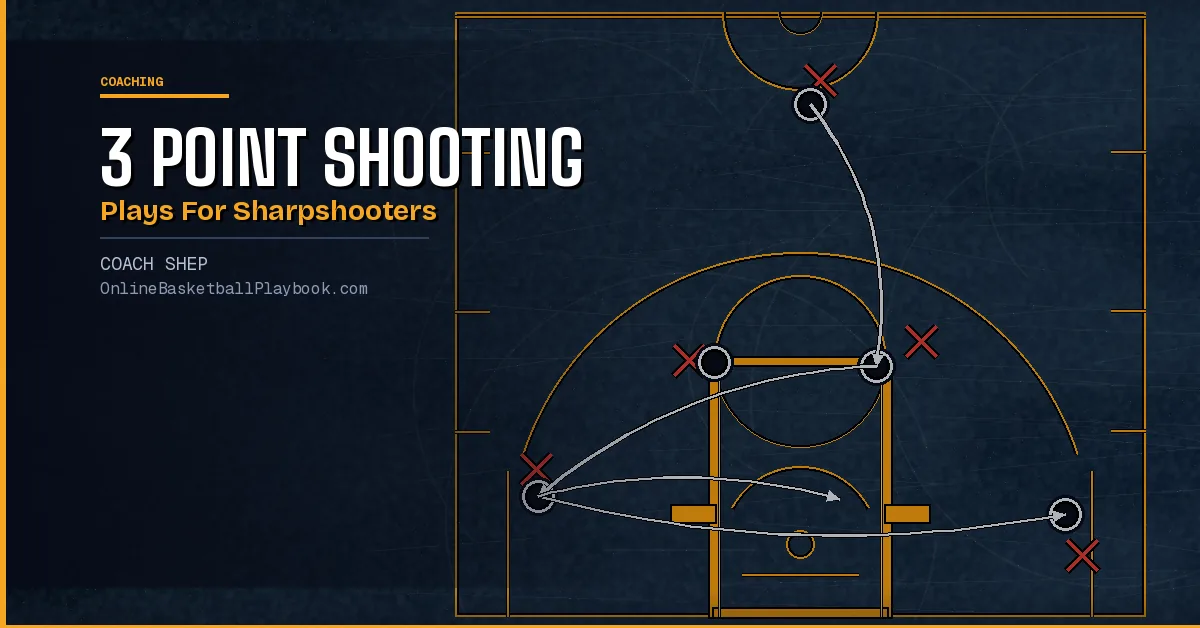
Your best shooter is only as dangerous as your ability to free them up. These five 3-point shooting plays use screens, cuts, and spacing reads to generate clean catch-and-shoot looks for your sharpshooters in real game situations.
Why Sharpshooters Need Designed Plays
Every coach wants a player who can create their own shot off the dribble. Most rosters have one or two. The rest of your shooters (the ones who shoot 38% or better from three on catch-and-shoot attempts) need deliberate play design to get open. Without it, defenses make them disappear.
The problem is not the shooter. A player who catches on rhythm, with feet already set, and fires within one second of the catch is one of the most efficient offensive weapons in basketball. The problem is the system around them. When the ball handler holds the ball too long, when spacing collapses on a drive, or when there are no actions designed to move the shooter into open space, even the best shooter becomes invisible.
Designed 3-point shooting plays solve three specific problems at once. First, they force the defense to guard a specific action rather than simply sag off a non-ball-handler and clog the paint. Second, they put the shooter in motion. Moving into a catch is fundamentally harder to guard than a stationary target. Third, they create a read structure so the ball handler knows exactly when to deliver the pass and the shooter knows exactly where to set their feet before the ball arrives.
The plays below work at multiple levels because they share a common architecture: an action that demands defensive attention, a movement pattern that puts the shooter in space, and a clear pass trigger. Run them with discipline, and your sharpshooters will see more clean looks in four quarters than they would in a week of spot-up shooting drills.
The Corner Pindown Series
The pin-down screen is one of the most reliable tools in half-court offense for getting a shooter a three-point look. The shooter starts in the corner, a big or wing pins down on a defender who has positioned themselves between the ball and the shooter, and the cutter reads the defense to determine whether to curl, straight-cut, or flare.
Base Action
Set up with your point guard at the top of the key, your shooter in the strong-side corner, and a screener at the elbow or block. The guard holds the ball high to force the defender into a denial position. The screener walks up and sets a firm pin-down screen on the shooter's defender. The shooter reads the defender's hip. If the defender goes under the screen, the shooter curls tight and catches near the elbow for a mid-range look. If the defender fights over the top, the shooter flares to the wing for a three. If the defender trails, the shooter catches at the original spot on the wing.
The Key Footwork Detail
Jay Wright at Villanova built his entire off-screen shooting system around one footwork rule: plant the inside foot first. Coming off a pindown, the shooter must step with the inside foot (the foot closer to the screener) before squaring to the ball. When this happens naturally, the shooter is already in a balanced catch-and-shoot position before the pass arrives. Teach players to say the sequence aloud in practice: "cut, inside foot, lift." Once that footwork becomes automatic, the shooting motion takes care of itself.
Countering Defensive Adjustments
When defenses start hedging the pin-down hard, the screener becomes the release valve. After setting the screen, the screener rolls or pops to the opposite side of the floor. The point guard now has two reads: the shooter coming off the screen and the screener popping to the wing or short corner. A smart defense cannot cover both simultaneously. Run the counter three or four times across a game and your opponents will stop hedging aggressively, which means cleaner looks for your shooter on the base action.
Horns Flare Action
Horns (two bigs at the elbows, guard at the top of the key, shooters in the corners) is one of the most versatile sets in modern basketball. Most coaches use it primarily as a ball screen or pick-and-roll action. Fewer use it to free up a three-point shooter on the weak side, which is exactly where the flare option lives.
Setting It Up
Run your primary ball screen action on the strong side. The point guard attacks off a high ball screen toward the paint. As the defense collapses to protect the rim, the weak-side elbow big turns and sets a flare screen on the weak-side wing shooter who has dropped into the corner. The shooter uses the flare, curls behind the screen toward the three-point line, and catches from the point guard on a skip pass.
The timing is the hard part. The skip pass has to arrive as the shooter is planting that inside foot and squaring to the basket. This requires practice reps at game speed. The shooter cannot hesitate after clearing the screen. Hesitation kills rhythm and gives the trailing defender time to recover. Walk through it slowly in the first practice, then run it at full speed immediately. Players need to feel the timing at game pace, not at teaching pace.
Why It Works
The ball screen forces a defensive decision: collapse on the handler, stay with the roll man, or hedge hard. Any of those choices creates a hole somewhere. The flare action exploits the most common one, the weak-side help defender who rotates toward the ball. That rotation leaves the weak-side corner and wing shooter wide open if the flare screen is set on time. The play essentially makes the defense's most common help rotation work against it.
Zipper Cut to Slot Three
The zipper cut (a player cutting from the baseline through the lane straight up to the elbow or three-point line) is one of the most underused actions for generating a shooter a clean look. When it is used, it most often results in a mid-range catch at the elbow. With one small tweak, it becomes a three-point opportunity.
The Read
Your shooter starts at the baseline on the ball side. A back screen or ghost screen from a teammate pulls the defender's attention. The shooter cuts hard up the lane toward the three-point line. Not the elbow, but the slot, which is the area just above the break between the top of the key and the wing three-point line. As the shooter reaches the slot, the ball handler delivers a quick pass on the shooter's chest so they can catch and shoot without an extra dribble.
The zipper cut works because defenders cannot defend a straight-line cut the same way they defend a curl around a screen. There is no screen to fight over, no hedging opportunity, and no angle to go under. The defender has to chase a straight sprint and often arrives half a step late, which is exactly enough time for a catch-and-shoot three.
Loading the Action
The zipper becomes more effective when paired with a weak-side exchange that pulls the help defender out of the lane. While the shooter cuts through, the weak-side guard and wing swap, creating motion that keeps the defense from simply sending a helper to choke off the slot. The ball handler must be patient and wait for the shooter to reach the slot before throwing. The common mistake is delivering the pass before the shooter gets there, which turns a clean three into a rushed mid-ranger.
Stagger Screen Pop
The stagger screen (two screeners set consecutively for one shooter) gives a sharpshooter the maximum distance and time to come off the action and catch in rhythm. Used primarily as a baseline corner three, the stagger can also be adapted to pop a shooter to the wing or slot for a different look.
Base Stagger to the Corner
The shooter starts at the top of the key or wing. Two teammates set up in a staggered line along the lane, one at the block, one at the mid-post. The shooter cuts down and through, using both screens consecutively. The first screen sets the trajectory; the second screen creates the separation. The shooter comes off the second screener and catches in the corner for a three-point attempt.
The stagger is most effective when the shooter sells a drive look before cutting. A shoulder dip, a hesitation step, anything that makes the defender think they are going to cut toward the ball before they actually cut away from it. One sold fake buys enough space for the stagger to operate cleanly even against a disciplined defense.
The Pop Variation
Instead of continuing to the corner, the shooter can pop off the second screen to the wing above the three-point line. This variation catches defenses that overcommit to the corner. The ball handler on the perimeter makes a quick reversal pass to the shooter catching at the wing three. Combining both options across a game means the defense cannot cheat toward either destination, which keeps the stagger alive for 40 minutes rather than being shut down after the first two possessions.
Drive-and-Kick With a Shooter Curl Read
The drive-and-kick is the simplest way to generate a three-point attempt, but most coaches run it without a designated shooter read. The ball handler drives, the corner player catches and shoots. That works if the corner player is a shooter and their defender is helping. It stops working the moment the defense adjusts by keeping the corner defender home.
Adding the Curl Read
The adjustment is straightforward. As the point guard initiates the drive, the weak-side shooter does not stand still. Instead, the shooter reads the strong-side corner defender. If that defender helps on the drive, the shooter relocates to the vacated corner for the kick-out three. If the corner defender stays home, the shooter curls off a weak-side screen toward the slot or opposite wing, putting themselves in the path of a skip pass over the defense.
This read structure turns a reactive play into an active one. The shooter is always moving, always creating a new angle, always forcing the defense to make a choice. A shooter who stands in the corner and waits is easy to guard. A shooter who reads and relocates while the defense is focused on a drive is nearly impossible to account for without switching communication from one side of the court to the other mid-action.
Teaching the Trigger
The ball handler needs a clear visual trigger for the kick-out pass. Teach them to read the corner defender's feet: if the corner defender's near foot steps toward the lane, the corner is open. If the feet stay square to the corner, the corner is guarded and the skip pass to the curling weak-side shooter is the right read. Two reads, two destinations, one driving action. It takes a week of reps to install, and then it runs on autopilot because both players understand their roles within the structure.
When teaching any of these plays, run the footwork and catch mechanics in isolation before adding the screen or drive. Villanova's standard (inside foot first, catch ready to shoot, one motion) must become automatic before the full play is live. Bad reps on the footwork create bad habits that survive into games. Run fewer reps perfectly rather than more reps carelessly, and your shooters will execute when it matters.
- Pindown series: Shooter reads the defender's hip at the screen, curl if they go under, flare to the wing if they fight over. Inside foot plants first every time on the catch.
- Horns flare: The skip pass timing is everything. Deliver as the shooter plants their inside foot behind the screen, not before or after. Walk it through, then immediately run at game speed.
- Zipper cut: The shooter cuts to the slot (above the arc), not the elbow. Ball handler waits until the shooter reaches the three-point line before passing. Patience makes the play work.
- Stagger pop: Shooter sells a drive fake before cutting through the stagger. One fake buys the separation that makes both the corner and pop options viable for 40 minutes.
- Drive-and-kick with curl read: Shooter reads the corner defender's feet, near foot toward the lane means the corner is open; square feet means the corner is guarded and the skip pass goes weak-side.
Want more basketball coaching strategies and drills?
Join the Online Basketball Playbook newsletter →
Draw this play free in the play drawer →
Membership: the full library, playbook packs, and Pro drawing tools →
Keep Building
Related breakdowns
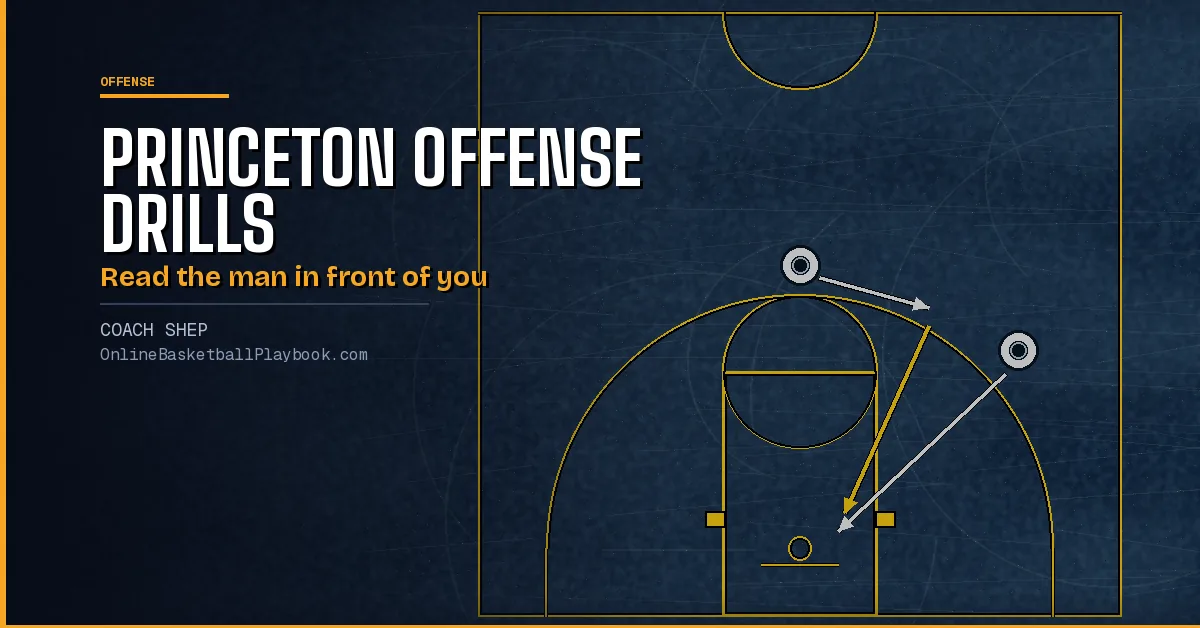
Princeton Offense Drills: Breakdowns, Shooting and Live Reps
Princeton offense drills that teach the reads: spacing, backdoor and hand-off breakdowns, 3-0 Chin and wave drills, Point shooting, a drive drill and an install.
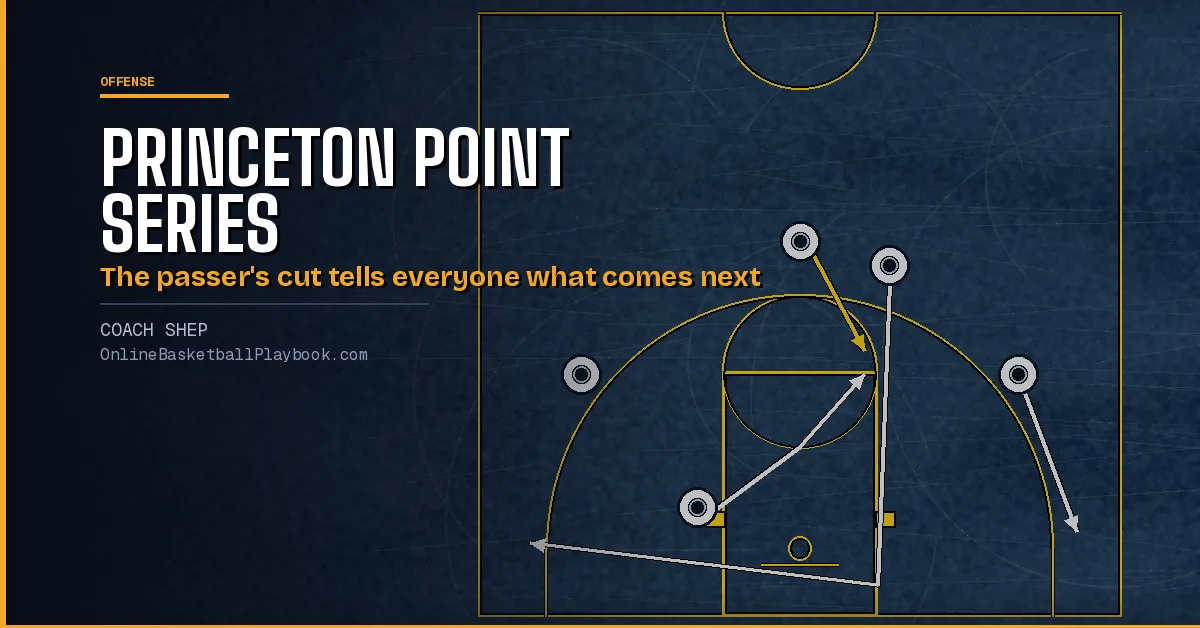
Princeton Point Series: Over, Away and Under Reads
The Princeton Point series: the wave-through entry, the Over, Away and Under cuts, the side ball screen, post and flare options and the spin counter.
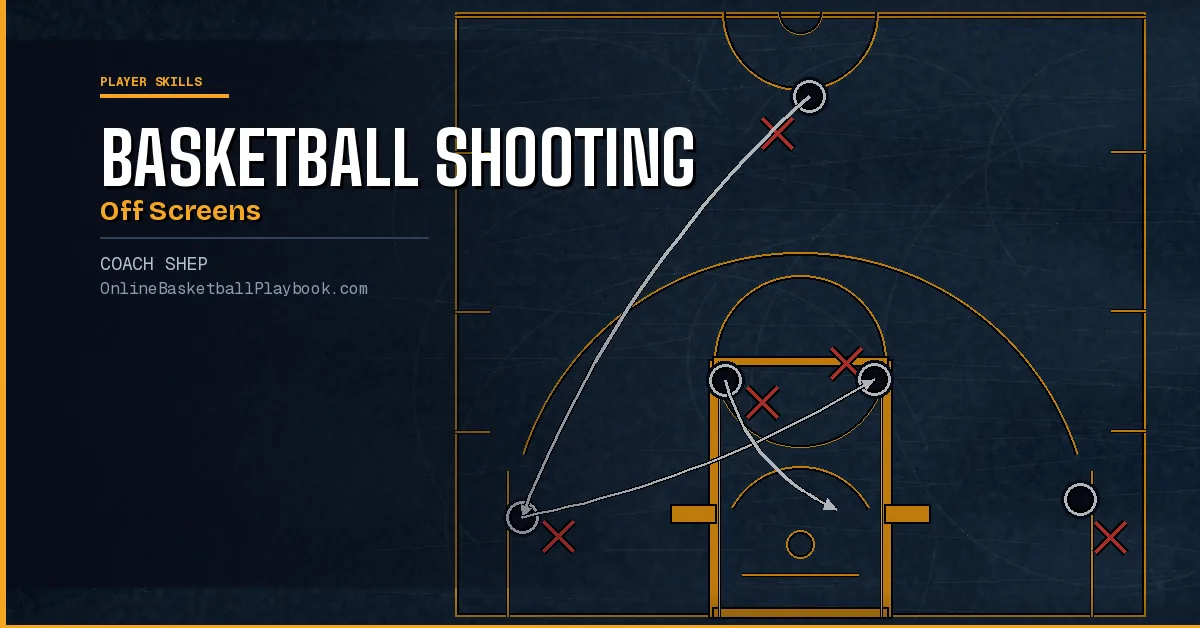
Basketball Shooting Off Screens: Complete Guide
Basketball Shooting Off Screens: Complete Guide