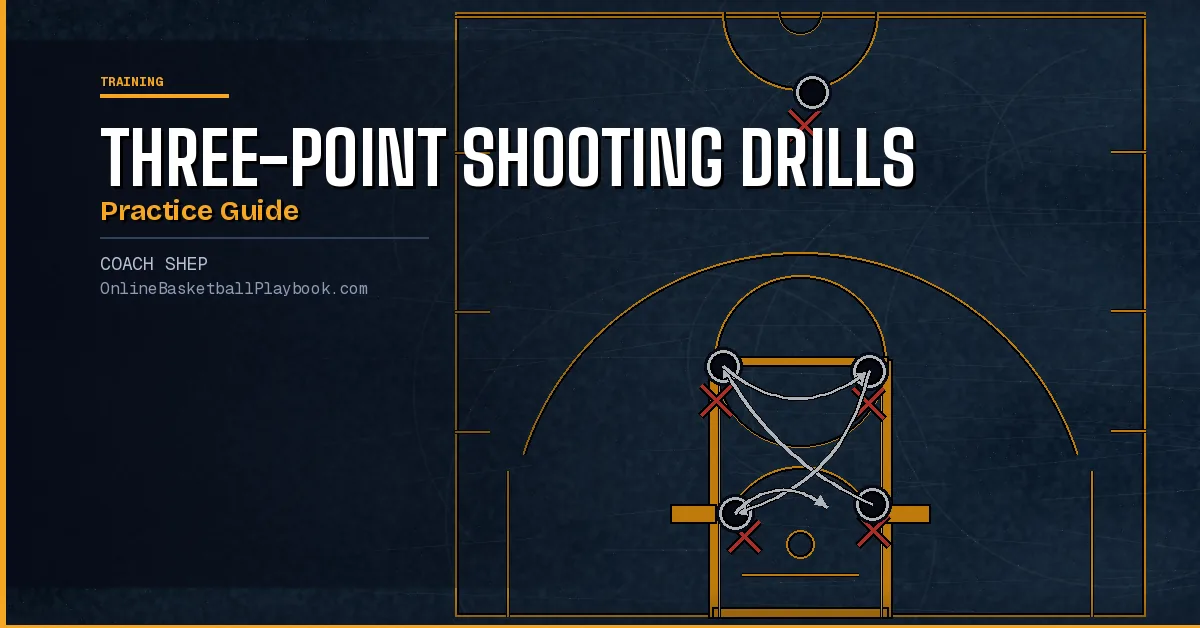
Three-point shooting is a trainable skill, not a gift. These drills build sound form, create competitive reps, and teach players to shoot at game speed from range. Use them in individual workouts or team practice.
Form Before Volume: The Foundation
Before any player shoots three-pointers at volume, they need to own their mechanics. Rushing to the arc with a broken shot only bakes in bad habits. The sequence that works, at every level from youth to varsity, is to build the shot progressively: without the ball, then against a wall, then to a basket at close range, and only then stepping back toward the three-point line.
The fundamentals are straightforward. The player starts in an athletic, balanced stance with feet shoulder-width apart and knees slightly bent. The shooting hand goes under the ball like a "pizza waiter" carrying a tray. Palm flat, ball resting on the fingerpads, not the palm. The elbow stays under the hand and aligned over the knee of the shooting-side foot. The guide hand is on the side of the ball, never pushing. The release goes straight up and forward, finishing with the shooting hand in a high "cookie jar" reach, fingers pointed down toward the rim.
Coaches often skip this step in a hurry to get players shooting threes. That is a mistake. Ten minutes of wall-work and one-handed form shots does more for long-range shooting than an hour of aimless catch-and-shoots. Correct basketball shooting form is the multiplier. Every drill in this guide builds on it.
One-Handed Form Shot Drill
Stand six feet from the basket. Use only the shooting hand. Focus on the "pizza waiter" position, elbow alignment, and a high finish. Shoot 10-15 makes, then step back slightly. This drill is how elite trainers open every shooting workout. It locks in mechanics before adding the guide hand and jumping.
Wall Shooting for Alignment
Face a wall from two feet away. Set the shooting hand under the ball and push it straight at the wall, catching the return. The ball should bounce back cleanly if the release is straight. Any side spin means the guide hand is influencing the shot. Adjust until the ball comes back true. This drill costs zero gym time and zero basketballs. A player can do 50 reps in a bedroom.
Competitive Three-Point Drills
Aimless volume shooting is the most common mistake in player development. A player who shoots 200 threes in practice with no score, no opponent, and no clock is not training their shot. They are just moving. The moment you attach a scoreboard, everything changes. Players focus. They feel pressure. They find out if their form holds when something is on the line.
The drills below all have a winner. Use them in individual workouts, partner sessions, or team practice. Post results. The player who shot a personal best last Tuesday will push harder this Tuesday because their name is on the board.
Spot Shooting. Beat Your Record
Pick five spots around the three-point arc: both corners, both wings, and the top of the key. Shoot five balls from each spot for a total of 25 attempts. Record makes. That number is your score. Next workout, you beat it. The goal is a personal best, not a preset standard. Every player competes against their own mark, which keeps the drill scalable from youth to varsity.
Beat the Pro
One player shoots. Every make counts as one point for the shooter. Every miss counts as two points for the "Pro" (an imaginary opponent, or a coach keeping score). The shooter needs to make at least two-thirds of their attempts just to stay even. This drill applies pressure immediately. A shaky shooter discovers their real percentage fast, which creates honest self-awareness and motivation to fix mechanics.
3-Minute Burner
Set a timer for three minutes. The player shoots threes continuously, getting their own rebound and moving to a new spot after every make. No repeating the same spot twice in a row. Count makes only. Post the score. Keep a team record board. Elite trainers have reported records over 40 makes in three minutes, a number that gives every player a mountain to climb.
Movement and Catch-and-Shoot Drills
Three-pointers in games almost never come from standing still. They come off a curl, a skip pass, a dribble handoff, a pin-down screen, or a kick-out after a drive. Practice that matches. If a player only shoots stationary threes in workouts, they will hesitate or misfire the first time they catch one while running to a spot in a game.
Movement shooting drills train the footwork, timing, and catch mechanics that translate directly to game situations. Pair these with the basketball footwork drills your team already uses and the carryover to games will be immediate.
Star Shooting
Place five balls at five spots around the three-point line. The shooter starts at one spot, catches and shoots, sprints to the next spot clockwise, shoots, and continues until all five balls are shot. That is one round. Record makes out of five. Rest and repeat. Variations: add a coach or passer who feeds the ball so the player never touches the ball until the catch; add a screen to simulate a curl or flare before each shot; require two dribbles off the catch before shooting to simulate a pull-up.
Catch and Shoot Off the Pass
A passer stands at the top of the key. The shooter runs from the corner baseline to a wing spot, plants, catches the pass, and shoots in rhythm. The key coaching point is the "gather". The feet and hands must arrive at the same time. A shooter whose hands arrive before their feet will rush the shot; one whose feet arrive first will have to wait and lose rhythm. How to shoot a basketball in rhythm off the catch is a learnable skill. Drill it with a passer and it becomes automatic.
Dribble Handoff Into Three
Two players face each other near the three-point line. Player A dribbles toward Player B. Player B takes the handoff, uses one or two dribbles to create space, and fires a three. Switch after five reps. This drill simulates one of the most common ways threes are generated in modern offense, the DHO action seen in motion-heavy systems. If your team runs motion offense in basketball, this drill is a direct game-prep rep.
Corner Kick-Out Drill
One player drives baseline from the wing and dishes to a shooter standing in the corner. The shooter must be in a ready stance: knees bent, hands ready, before the ball arrives. No late preparation. Catch and fire. Rotate positions after every five reps. This drill teaches corner shooters to stay engaged even when they are not the primary option, and it builds the habit of being catch-ready every time the ball could swing their way.
Building a Shooting Culture With Records
The best shooting programs in the country do not just run drills. They keep records. Team records for named drills. Individual personal bests. A visible board in the gym where players sign their names when they break a mark. This is not optional. It is the mechanism that turns a shooting drill into a shooting culture.
Pick three or four drills and name them. Run them consistently every week. Keep a physical or digital record board. When a player breaks the team record for Spot Shooting or the 3-Minute Burner, they sign it. Their name stays up until someone beats it. That record board does something a coach's voice alone cannot: it gives players a concrete goal that exists before practice starts and after it ends.
Shaka Smart's program at Texas posted explicit team records for drills, numbers like "3-Minute Record: 157 makes" next to player names. That number is a living challenge. Every player walks into the gym knowing what they are trying to beat. The coaching staff does not have to manufacture motivation. The board does it. Building this kind of structure into your basketball practice plan pays compounding returns over a season.
A record board costs nothing to create and generates more daily motivation than most structured drills. Post it in a visible spot, keep it current, and let players own their marks. The moment a new name goes up, every other player has a target. That self-sustaining competitive pressure is one of the most underused tools in player development.
Integrating Three-Point Work Into Practice
Three-point shooting practice fails when it is treated as an afterthought, a few minutes of shooting at the end of a tired practice. Build it in deliberately, with time blocks and intentional rep quality. Here is a practical structure for teams that want to develop real range across a roster.
Pre-Practice Shooting Block (10–12 minutes)
Before any team activity, players run form shots and one competitive drill. This sets the tone that shooting is a skill that gets focused attention, not leftover energy. Players who arrive early shoot more. Players who arrive exactly on time still get their competitive drill reps before team drills begin. Keep this block short and purposeful. No more than 12 minutes, scored, recorded.
Embedded Shooting Within Skill Work
Every ball-handling drill can end in a three. Every screen-and-roll rep can include a kick-out three for the corner shooter. Every fast break drill can finish with a spot-up three from the trailer. This approach eliminates the artificial separation between "ball handling practice" and "shooting practice" because in games, shots come off dribbles, passes, and actions, not standing in line waiting for a catch.
Competitive Team Shooting to End Practice
Finish practice with a competitive shooting contest. Team splits into two groups. Each group has a set number of attempts. Most makes wins. Losers run, or winners get a rest day the next morning, whatever fits your program culture. The competition at the end of practice simulates late-game fatigue, which is when three-point makes matter most. Players learn to execute their form when their legs are tired.
Common Three-Point Shooting Mistakes to Fix
Most three-point shooting breakdowns come from the same small list of mechanical errors. Recognizing these in film or live observation lets coaches intervene early before the error becomes habitual.
Shooting off the wrong foot. A right-handed shooter who consistently lands to the left is probably not squaring up their feet before catching. Drill catch-and-shoot footwork without the ball first. Step-step into a balanced stance until the footwork is automatic before any ball is added.
Guide hand pushing the ball. This is the most common cause of misses to the off-hand side. The guide hand should release early in the upswing. A simple fix: practice one-handed shooting at close range until the guide hand's role becomes passive by habit.
Rushing the shot to compensate for poor footwork. Players with slow feet try to speed up their shot to make up time. The fix is the footwork, not the release. Slow the drill down, fix the feet, then add speed.
Not being catch-ready. A shooter who is not in a ready stance, knees bent with hands at chest height, when the ball arrives will take an extra beat to set their feet and hands. Against good defense, that beat means the shot is contested or blocked. Train catch-readiness explicitly: during any drill, if the shooter is flat-footed when the ball arrives, the rep does not count.
Neglecting the pull-up. Too many players only practice catch-and-shoot threes. The pull-up three off one or two dribbles is one of the most valuable shots in the modern game. Build it into workouts with the same intentionality as spot shooting. A player who can hit a pull-up three from the wing is a different threat than one who only shoots off the catch.
Catching and correcting these errors early is part of broader basketball player development: The shooting habits players build in the offseason are the ones they bring into games. Make sure those habits are the right ones.
- Form before volume: one-handed form shots and wall work before any three-point drill.
- Make every rep competitive: use a timer, a partner score, or a personal best to attach consequence to each shot.
- Post team records: name your drills, track scores, and keep a visible board players sign when they break a mark.
- Train movement shooting: Star Shooting, catch off the pass, and DHO threes. Not just stationary spot shooting.
- Build catch-readiness: knees bent, hands ready before the ball arrives; if the shooter is flat-footed at the catch, the rep does not count.
- Add pull-up threes: off one or two dribbles, especially from the wing. One of the most underdrilled shots at every level.
- Embed shooting into team drills: every fast break, DHO, and ball-handling rep can finish with a three-point shot.
Get free play diagrams, drills, and coaching guides delivered weekly.
Draw this play free in the play drawer →
Membership: the full library, playbook packs, and Pro drawing tools →
Keep Building
Related breakdowns
Basketball Shooting Form: Step-by-Step Mechanics
Basketball shooting form step by step, from the ready stance and grip to release and follow-through, with drill progressions and where coaches disagree.
Free Throw Shooting: Routine, Form and Drills
Free throw shooting starts with a routine the player never changes. Form cues, the mental side and drills that copy the fatigue and pressure of a game.
Competitive Shooting Drills: Scored Games and Records
Competitive shooting drills with a score on every shot: streak games, timed targets, Beat the Pro, plus and minus, 2-on-1 shooting and record boards.