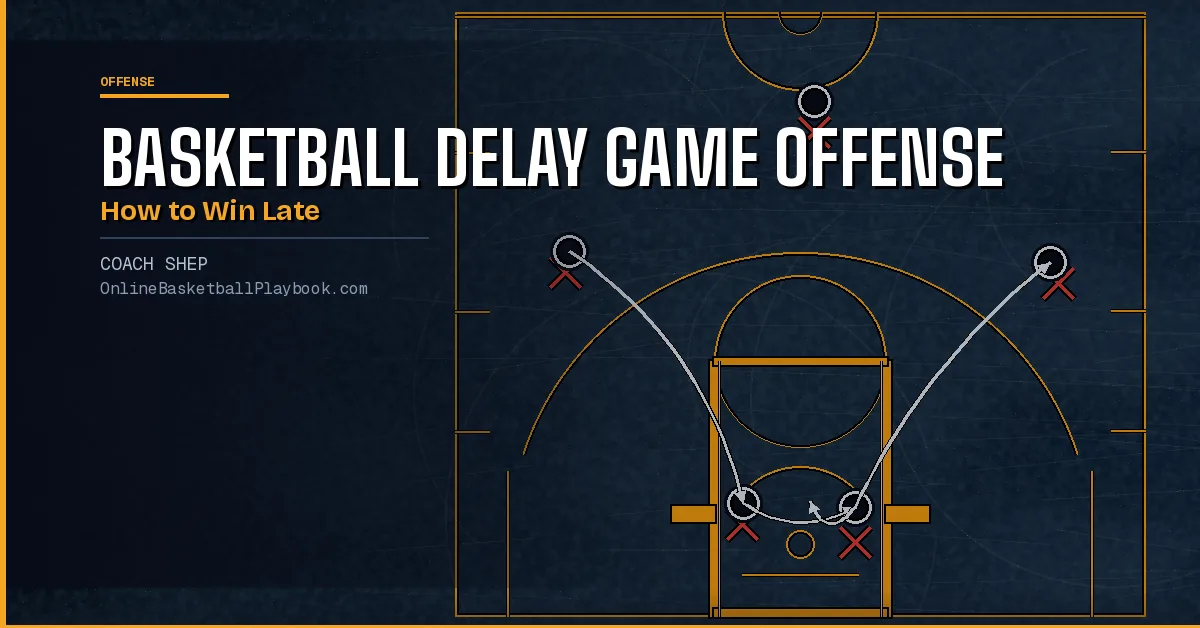
When you are ahead late, sloppy offense kills leads faster than any opponent. A disciplined delay game keeps the ball moving, the clock running, and forces the defense into a decision it cannot win.
What the Delay Game Offense Actually Is
The delay game offense is not a stall. It is a structured, read-based offense designed to control tempo, manage the clock, and force the defense into fouling or giving up a layup. The distinction matters because a true stall, five players passing across half court while running time off the clock, is both hard to execute and, at many levels, illegal under shot clock rules. A delay game is active, patient, and threatening.
The best delay games in basketball are built on motion principles. Players cut, screen, and read the defense. The ball moves. The difference from a regular half-court offense is intent: every action is designed to consume time first and score second, unless the defense breaks down and gives a high-percentage look. That priority flip, clock over points, changes how players think on every possession.
Understanding the delay game as motion offense running at a lower scoring temperature helps coaches teach it. The reads are the same. The spacing principles are the same. The discipline required, no dribble penetration into traffic, no forced threes, no 50-50 passes, is simply the motion offense rules taken to their most conservative expression.
When to Use a Delay Game
The lead margin and the time remaining are the two variables that determine when to go to a delay game. A common coaching rule of thumb is the "score equals time" guide: if you lead by four points, you might start a delay with four minutes remaining. If you lead by six, you might start it with six minutes remaining. These are starting points, not absolutes. Opponent quality, foul situation, and your team's comfort with the delay all factor in.
There are three scenarios where a delay game is the right call:
Protecting a Small Lead Late
This is the most common use. You are up three to eight points in the final four minutes and you want to force the opponent to foul or give up layups. The delay game takes the randomness of contested jump shots out of the equation and makes the defense earn every defensive stop the hard way, by committing fouls and sending your best free-throw shooters to the line.
Matching Up Against Superior Talent
When you are facing a team with a significant talent gap, controlling pace is a competitive equalizer. Fewer possessions means fewer opportunities for the other team's best players to hurt you. A 58-52 loss is still a loss, but keeping a game in the 50s gives an underdog a chance. The delay game is a legitimate tactical choice, not a surrender. It is chess, not retreat.
Neutralizing an Opposing Press or Full-Court Defense
Some teams trap and press as their primary defensive identity. A delay game built around quick ball reversal, patient spacing, and no dribble-drive isolation attacks the press's biggest weakness: the defenders are out of position if they do not get steals, and they foul at a high rate chasing the ball. Patience beats aggression in this matchup.
Ball Movement Rules That Keep the Clock Running
The foundational principle of any delay offense is that the ball must move, not because moving the ball is inherently virtuous, but because a stationary ball surrenders all initiative to the defense. As Ettore Messina's motion principle states, speed of ball beats speed of players. When the ball moves quickly from one side to the other, defenders must scramble. That scramble creates fouls and layups.
Specific ball movement rules for the delay game:
No Dribble Penetration Without a Clear Lane
In a delay game, dribble penetration that does not end in a layup is a disaster. It collapses the spacing, it risks a turnover or charge, and it puts the ball at risk in traffic where the defense wants it. Dribbling is for improving passing angles, no more than two bounces in the same spot, or for a clear and obvious drive to the basket where the defense has broken down completely.
Catch, Fake, Pass
Every catch in a delay game should follow the same rhythm: receive the pass in triple-threat, make a ball fake or shot fake to hold the defender, then pass to the next player on a clear pass lane. This rhythm slows the defense, holds closeouts, and generates foul opportunities. Players who catch and immediately swing without a fake give the defense a free reset.
Ball Reversal Is the Primary Tool
Ball reversal, swinging the ball from one side of the floor to the other, forces the defense to change sides. In a delay context, this is especially valuable because weakside defenders must cover long distances, and the trailing defender is often late. The reversal creates the layup opportunity in a delay game more reliably than any set play because it is built off a defensive scramble, not a scripted action the defense has practiced stopping.
Eliminate the Turn-and-Shoot
In a delay game, the only shots your players should be taking are (a) uncontested layups when the defense gives up the lane, and (b) free throws. No pull-up jumpers. No step-back threes. No contested mid-range looks. The shot you are protecting against is the one that misses, gives the opponent a quick rebound and outlet, and cuts your lead before your defense gets set. A missed shot in the final two minutes of a close game is far more damaging than not taking the shot at all.
Spacing and Player Movement in the Delay
Spacing is offense. This is as true in a delay game as it is in any up-tempo system. The 15-to-18-foot gaps between players that motion offense requires do not shrink in a delay. They become even more critical because the defense is going to extend and apply ball pressure, and your players need room to pass away from that pressure without driving into traffic.
Five-Out Spacing as the Default
Most effective delay games use a five-out alignment: four players spaced around the three-point arc with one player above the arc at the top of the key. This alignment forces the defense to cover all five perimeter spots simultaneously, spreading the floor and opening the drive lane in the middle. When the defense overplays one side, the skip pass to the opposite corner becomes a layup opportunity off the drive, not a three-point attempt.
Pass and Move. Never Stand
In a delay game, standing is a mistake just as it is in a motion offense. A player who catches and holds while teammates stand still makes every defender's job easy. After every pass, a player should cut toward the basket (looking for a return pass in the lane), space to a new spot on the perimeter, or set a screen. The defense cannot rest when all five players are moving. Moving players draw fouls. Standing players do not.
Keep a Ball-Side Outlet
One of the most consistent mistakes teams make in delay game situations is leaving the ball handler without an easy pass outlet. When the defender traps or the ball handler's primary pass is taken away, there must be a teammate one pass away who is open and ready to receive. This is the "outlet alive" rule from motion offense: the ball handler is never stranded without a clear exit option.
Built-In Counters When the Defense Reaches
A delay game without counters is a trap. If your players simply pass the ball around the perimeter with no intent to score, the defense will sag, deny passing lanes, and eventually force a turnover or a shot clock violation. The best delay game offenses have three to four built-in counters that punish the defense for reaching or overextending.
The Backdoor Cut
When a defender overplays a pass receiver, the backdoor cut is the automatic answer. This is true in motion offense and it is especially true in a delay game, where defenders who are behind on the shot clock and desperate to steal a pass will overplay aggressively. Every player in a delay game needs to be trained to read the defender's position: if the defender's hand goes for the passing lane, cut backdoor immediately. The layup that results is the delay game's highest-percentage shot.
The Drive Off Ball Reversal
When the ball is reversed from one side to the other, the weakside defender is late. The player who catches the reversal pass often has a half-step on their defender driving baseline or attacking the middle of the lane. This is not a forced drive. It is a read. If the catch-and-drive lane is there, take it. If it is not, swing the ball again. Teaching players to read the reversal defender's position at the moment of the catch is the key coaching point that turns a passive delay into an active scoring threat.
The Post Entry Counter
Many teams run a delay game with a post player at the elbow or the short corner. When perimeter defenders are scrambling to cover skip passes and ball reversals, the entry pass into the post becomes open. A post player who catches in a delay game context should look first to score with one move, look second to kick out to an open corner shooter, and hold the ball no longer than needed. Extended post play in a delay burns clock and creates foul opportunities, two things a delay game needs.
The Two-on-One Break After a Steal
When the defense overextends trying to trap or steal, it becomes vulnerable on the other end. If your team generates a turnover out of the delay game, run immediately. Do not walk the ball up the court. A delay game that can convert steals into fast-break layups forces the opposing coach to choose between trapping (and giving up easy baskets) and sagging (and giving up ball movement and clock).
Install the delay game in practice before you need it in a game. Run five-on-five delay situations in the final ten minutes of practice at least twice per week. Simulate clock pressure by putting three minutes on the board and a four-point lead. Your players need to feel the urgency before they face it in a game that matters. The teams that execute delay games well have practiced them just as deliberately as they practice fast breaks and half-court sets.
Clock Management and Foul Awareness
The delay game is ultimately a clock management tool, which means every player on the floor needs to know exactly how much time is left, how many fouls the opponent has in the period, and what the score differential means in terms of urgency.
Know the Bonus Situation
If the opponent is in the bonus, foul-drawing becomes a primary goal of the delay. Your best free-throw shooters should be getting the ball in positions where they can draw contact, coming off screens, catching in traffic, driving into the lane with control. Teams in the bonus will often foul immediately in the final minute rather than allow the ball to keep moving. Your players should expect the foul and finish through it rather than pulling up in surprise.
Know When to Ice the Ball
In the final thirty seconds of a game where your team has the lead and the ball, the calculus changes. The goal is no longer to score. It is to avoid turnovers and get fouled. Players need to be able to dribble in space, protect the ball, and identify the foul as it comes. Practice end-of-game ball security as a specific skill: pivot footwork, back-to-the-defense dribbling, and absorbing contact while maintaining possession.
Know the Lead's Value
A three-point lead in the final forty-five seconds is very different from a five-point lead. With a three-point lead, a made three by the opponent ties the game. Your players need to know not to contest three-point attempts from a position where they might foul, but they also must not give up an uncontested corner three. A five-point lead requires the opponent to score twice. Play accordingly: take away the quick three, allow the two, and live with the foul.
How to Install the Delay Game in Practice
The delay game is not a system that installs in one practice. It is a set of decision-making habits built over multiple sessions. Here is a practical progression for introducing it to your team.
Step One: Five-on-Zero Ball Movement Drill
Start without defense. Run your five delay alignments (spacing, pass patterns, movement after the pass) until every player knows where to be and why. The goal in this phase is eliminating the standing habit. Every catch must end in a pass and a move. Run this drill at game speed, not slow. Slow five-on-zero drills create slow game habits.
Step Two: Five-on-Three Pressure
Add three defenders in the most dangerous positions: on the ball, denying the primary pass, and in the lane. This simulates the defensive pressure your team will face while keeping the advantage clearly on the offense's side. The focus here is on reading the denial and hitting the backdoor cut. The highest-value skill in the delay game is the backdoor off an overplay, and three-on-five drills build that habit.
Step Three: Five-on-Five Timed Situations
Put a real score and real clock on the board. Give your offense the ball and a lead. The defense's goal is to get a stop; the offense's goal is to execute the delay without a turnover or a forced shot. Debrief after each possession: what was the read? Did the outlet stay alive? Was the backdoor read taken? The situational practice habit, running scenarios with real stakes attached, is what separates teams that execute delay games from teams that lose leads.
The Mental Side: Patience Over Panic
The biggest enemy of a delay game is not the opposing defense. It is your own team's panic. Players who are conditioned to score will feel uncomfortable when the instruction is to move the ball and wait. They will force shots out of impatience. They will drive into traffic because they are used to driving. Building the patience that a delay game requires is a practice habit. Film review helps: show your players the possessions where patience created a backdoor layup versus the possessions where a forced drive created a turnover. The data makes the coaching point more powerfully than any chalk talk.
- Use five-out spacing as your default delay alignment. Spread all five perimeter spots and keep the drive lane open for backdoor cuts and reversal attacks.
- Ball reversal is your primary scoring tool. Teach players to read the weakside defender's position at the moment of the catch and drive if there is a half-step advantage.
- Never pass and stand. Every pass must be followed by a basket cut, a screen, or a fill to an open spot. Standing kills the delay and gives defenders easy positioning.
- Train the backdoor cut as a reflex response to defensive overplay. Any denial in the passing lane is an automatic backdoor trigger, not a coaching call from the bench.
- Know the foul count and the lead value at all times. Put players in simulated end-of-game scenarios in practice so clock awareness is a trained habit, not a game-day panic calculation.
- Protect dribble penetration for clear lanes only. No forced drives, no pull-up jumpers, no contested threes. The only accepted shots are uncontested layups and free throws drawn through contact.
Want more basketball coaching strategies, drills, and tools?
Join the Online Basketball Playbook newsletter →
Draw this play free in the play drawer →
Membership: the full library, playbook packs, and Pro drawing tools →
Keep Building
Related breakdowns
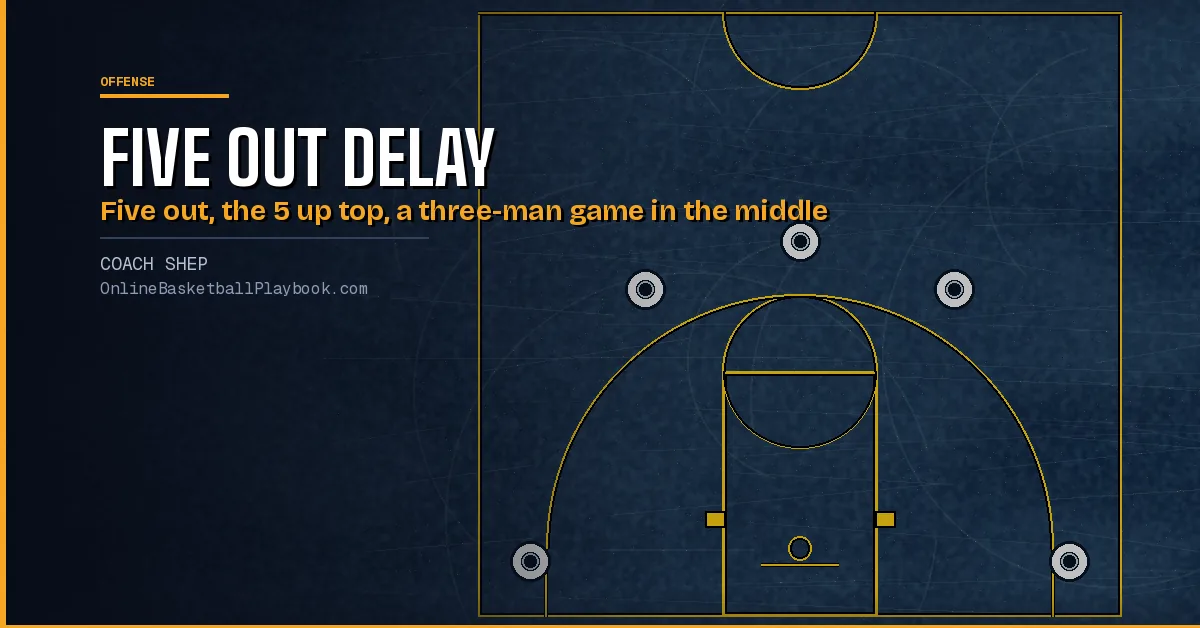
Why Every NBA Team Runs the Same Offense: Five Out Delay
Modern NBA offense explained: the five-out delay front, the away trigger, Ram, Spain, zero cuts and zoom, the two outcomes each action hunts, and the history.
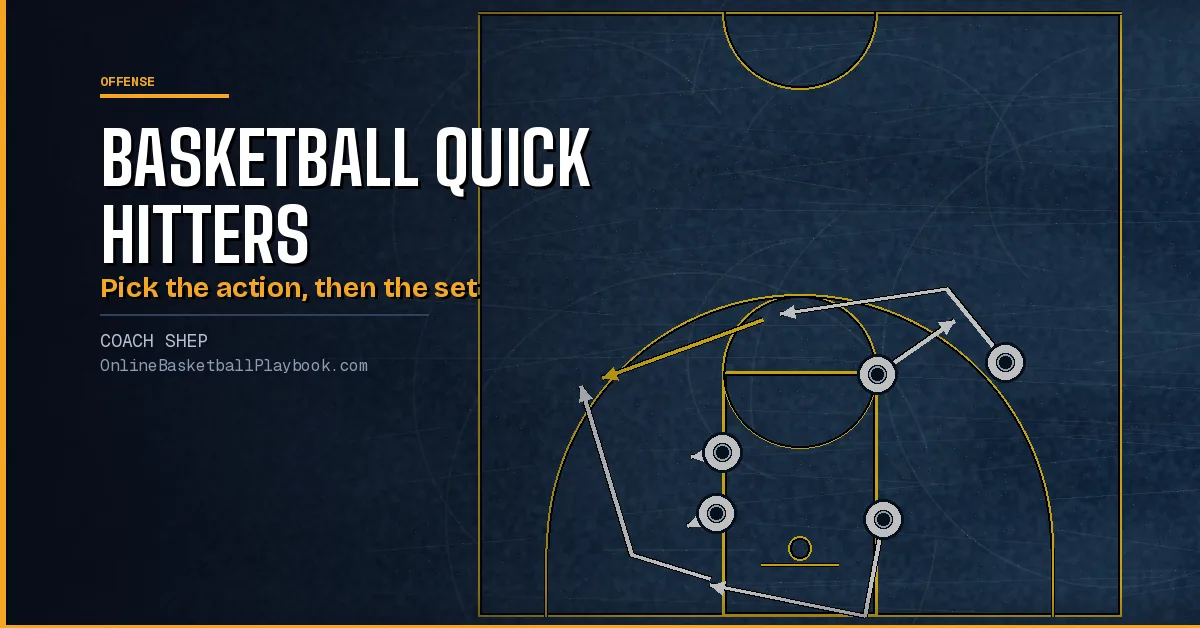
Basketball Quick Hitters: 25 Sets by Action and Formation
Basketball quick hitters sorted by the action you want, catch-and-shoot to post feed, with each set's formation, diagrams, the read and the counter.
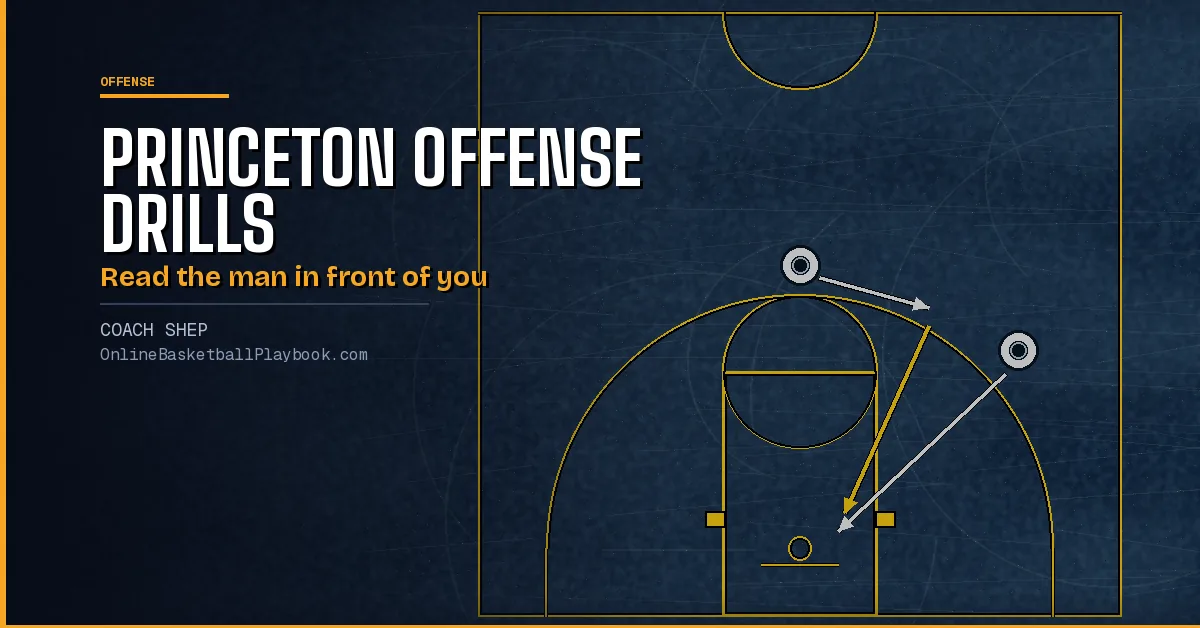
Princeton Offense Drills: Breakdowns, Shooting and Live Reps
Princeton offense drills that teach the reads: spacing, backdoor and hand-off breakdowns, 3-0 Chin and wave drills, Point shooting, a drive drill and an install.