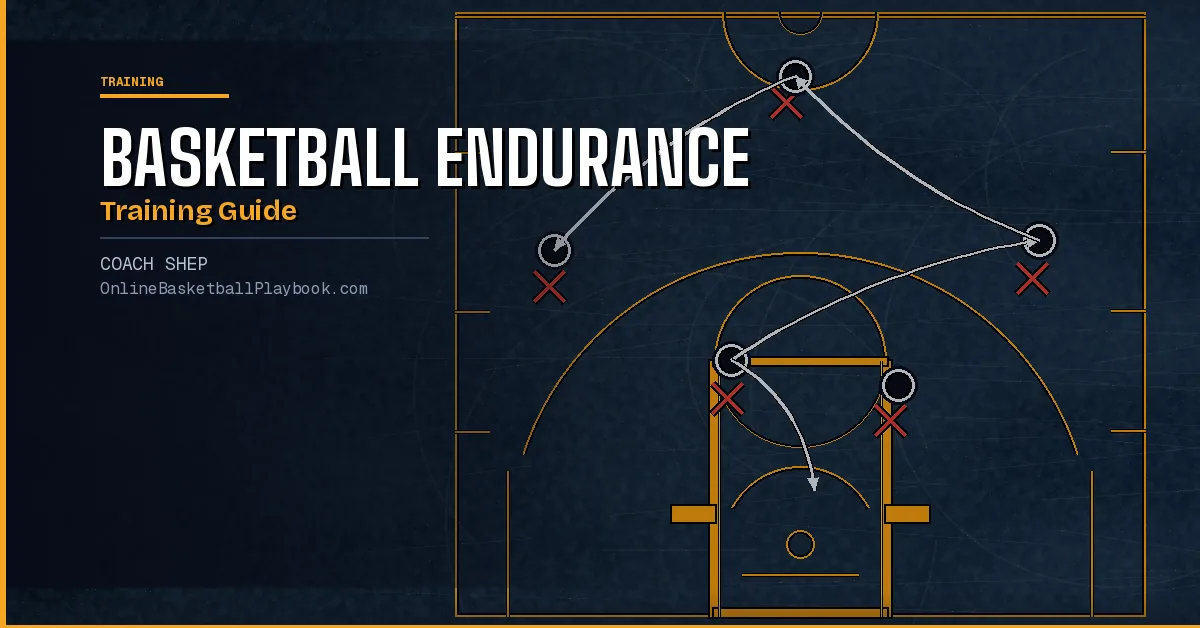
Basketball fitness is anaerobic. Short bursts, full effort, repeated all game. This guide covers the conditioning runs, work-to-rest ratios, and testing benchmarks that build the endurance players actually need on the court.
Why Basketball Endurance Is Anaerobic
Most players and coaches think of endurance as a long-distance quality, the ability to run forever without tiring. Basketball fitness works almost nothing like that. A point guard pressing full court, a wing sprinting in transition, a big chasing down a fast break. These are short, explosive efforts that last anywhere from three to thirty seconds. The energy system driving those efforts is anaerobic, not aerobic.
This distinction changes everything about how you train. Distance running builds a cardiovascular base, and that base has real value, but it does not replicate what happens to a player's body during forty minutes of live basketball. The stops, the direction changes, the repeated sprint-and-recover cycles. These demand anaerobic capacity. A player who runs three miles easily may still gas out in the fourth quarter because their anaerobic engine has not been trained to handle repeat high-intensity efforts.
The goal of basketball endurance training is to push the lactate threshold higher, to delay the point at which fatigue and lactic acid accumulation begin breaking down a player's technique. When that threshold is low, players start making technical mistakes under duress: dribbles go weak, shot mechanics fall apart, defensive footwork breaks. Raise the threshold, and players hold their form longer. That is what conditioning is actually buying you.
When building a basketball practice plan, it helps to understand that anaerobic conditioning should be woven into the structure rather than treated as a separate afterthought. The conditioning happens during competitive reps, not only at the end of practice when everyone is already exhausted and technique is at its worst.
On-Court Conditioning Runs
The most effective conditioning for basketball happens on the basketball floor, in basketball movements. Treadmill running and road miles have their place in the offseason, but when you are building in-season fitness, keep the work on the court. Every sprint should look like something that happens in a game.
Suicides are the classic standard. A full suicide runs baseline to foul line, back, baseline to half court, back, baseline to far foul line, back, baseline to far baseline and back. Well-conditioned players complete this in 28 to 32 seconds. That time window gives you a benchmark. If a player cannot break 32 seconds, they have work to do.
17s and 9s are width-of-the-court runs timed for speed. The player sprints sideline to sideline: 17 trips for the 17s drill, 9 trips for the shorter version. These are excellent for tracking improvement over a season because the standard is simple and repeatable.
Lane slides are a defensive conditioning tool that doubles as footwork training. The player starts on one lane line and defensive slides the full width of the lane for 15 seconds, staying low, keeping the stance active. This targets the specific muscles used in man-to-man defense and is harder than it looks when done with real effort. Pair it with your basketball conditioning drills library for variety across a week of practice.
The 4-8-16 is a progression drill that builds across a single run. Players sprint four lengths of the floor, rest briefly, sprint eight lengths, rest, then sprint sixteen lengths. The work volume increases each round and forces players to manage effort across a sustained block. Cross-court suicides and volleyball runs add change-of-direction demand that straight-line sprints miss entirely.
30-second suicides are worth calling out specifically because they include a built-in competitive element: players mark where they reach at the buzzer, then chase that mark every subsequent run. This turns a generic sprint into a personal benchmark that evolves with the player's fitness level.
Work-to-Rest Ratios and Lactate Threshold
The ratio of work time to rest time determines whether conditioning is actually improving anaerobic capacity or just creating tired players. Get the ratio wrong (too little rest) and players cannot produce a true maximum effort on each run. The training stimulus becomes mediocre, and fitness gains are slow. Too much rest, and you are never stressing the system hard enough to force adaptation.
The target range is a 1:2 to 1:3 work-to-rest ratio. If a suicide takes 30 seconds, the rest window before the next run is 60 to 90 seconds. Early in a preseason program, lean toward 1:3. More rest, true max effort on each run. As players build fitness, compress the ratio toward 1:2. The player is now recovering faster because their anaerobic engine has improved.
This is where lactate threshold becomes the real metric. The lactate threshold is the exercise intensity at which lactic acid starts accumulating in the bloodstream faster than the body can clear it. When a player crosses that threshold during a game (because they sprinted hard twice in ten seconds, or ran a long possession press) their muscles start burning, technique deteriorates, and decision-making slows. Proper conditioning training pushes that threshold higher, buying players more room before the breakdown hits.
The key mistake coaches make is running conditioning without enough rest between reps. Players jog back to the line and go again before they have recovered. This feels harder and looks more intense, but it is training a different energy system, a lower-intensity aerobic zone. For true anaerobic development, the rest must be long enough for a genuine max effort on every single run.
Testing and Tracking Fitness Gains
Conditioning that cannot be measured cannot be improved. Many programs run players through sprints all preseason and never know whether fitness actually changed. Building repeatable tests into your program solves this: players know their numbers, coaches can track progress, and the team has objective proof of improvement rather than just a feeling.
The 300-yard shuttle is one of the most useful team conditioning tests. Players run twelve trips between the baseline and the near foul line. Each trip is 25 yards, totaling 300. The coach records two timed runs with a recovery window between them, then averages the results. This average score becomes the player's 300-yard shuttle benchmark for the season. Re-test every three to four weeks.
The 30-second suicide mark serves as a second benchmark. Each player runs a full suicide at max effort and marks where they reach at exactly 30 seconds. This mark gets recorded and tracked. As fitness improves, players reach farther. As fatigue accumulates mid-season, you may see marks drop, which tells you the team needs a recovery week, not another conditioning block.
Testing also creates accountability. When players know their number is being tracked, effort on conditioning runs increases. A player who is barely trying in practice sprints becomes obvious when their benchmark score is not moving. And players who are working hard see the payoff in their numbers, which builds buy-in for the conditioning program overall. This connects directly to basketball player development principles: objective measurement accelerates improvement because players can see what they are working toward.
Game-Pace Practice as Conditioning
The most efficient conditioning in basketball is a practice that runs at game speed, consistently, throughout the session. Bill Oats put it plainly: pace is a product of how you practice. When coaches allow players to jog through drills, walk between reps, and coast through competitive segments, they are not just building bad habits. They are missing the conditioning window entirely.
Game-pace 4-on-4 and 5-on-5 segments done at full intensity are conditioning. A competitive shell drill where every defensive rep is max effort is conditioning. A transition drill where the offense sprints the floor on every possession is conditioning. The difference between this and dedicated sprint work is that game-pace conditioning also trains decision-making, skill execution, and competitive habits simultaneously, none of which a line of suicides will ever develop.
The losers run principle amplifies this effect. When the losing team in a competitive drill runs after the possession, the competitive intensity of every rep goes up. Players are now fighting for reps, not just going through motions. The conditioning load increases because effort increases, and the team gets fitter without adding a single extra minute of sprint work to the schedule.
This does not mean dedicated conditioning runs are optional. They serve a different purpose: they test the system past what game-pace practice reaches, and they build the mental toughness to push through discomfort without the distraction of a competitive drill. Both belong in a complete program. A well-structured basketball practice sequences them intentionally, competitive game-pace work builds the base, dedicated conditioning runs stress the ceiling.
Game-pace competitive segments count as conditioning only when the pace is actually enforced. Walk-throughs and casual reps do not accumulate meaningful anaerobic load. Set the standard for tempo at the beginning of every practice session and hold it through the final whistle.
Periodizing Toward the Season
A conditioning program that does not change across the season is a conditioning program that stops working. The body adapts. What was hard in week two of preseason becomes manageable by week six. If the program does not evolve, fitness plateaus, and the team arrives at their most important games at the same fitness level they were at weeks earlier.
Periodization means deliberately structuring the training load to build toward peak fitness at the right time. Early preseason, the work-to-rest ratio sits at 1:3. Volume is moderate. The emphasis is building a base and establishing benchmarks. Players are learning the conditioning system: what is expected of them, what the standards are, how to pace a 300-yard shuttle.
As the season approaches, the ratio compresses toward 1:2. Rest windows shrink. Players are now recovering faster because fitness has improved, and the shorter rest creates a new stress. A weekly physical toughness day (a designated session where the conditioning load is highest) gives the training block a clear focal point and helps players mentally prepare for the hardest sessions of the week.
In-season, the goal shifts from building fitness to maintaining it. The cumulative fatigue of a full schedule means volume must come down even as intensity stays high. This is where the 30-second suicide mark becomes a monitoring tool, not just a training tool. A drop in marks across the team signals accumulated fatigue, not reduced effort, and the appropriate response is a recovery week, not more sprints.
Athletic base work belongs throughout the calendar: ankle strength, one-foot balance drills, eyes-closed balance work, quickness training with tennis ball reactions and fast feet around cones. Most youth breakdowns in conditioning programs are athletic before they are tactical. A player's conditioning capacity is only as high as their underlying movement quality allows. Incorporate these athletic development elements alongside the sprint work, and the conditioning returns compound over a full season.
- All-out efforts only: If players are not running at true max effort on every conditioning rep, the anaerobic stimulus is too low. Enforce the standard.
- Respect the rest window: A 1:2 to 1:3 work-to-rest ratio is not negotiable early in the program; compress it only as fitness builds.
- Test every three to four weeks: Run the 300-yard shuttle and mark the 30-second suicide, scores that do not move mean something is wrong with the program.
- Game-pace practice counts: Competitive segments at full intensity accumulate anaerobic load; losers run after every competitive rep to keep effort high.
- Periodize the ratio: Start preseason at 1:3, compress toward 1:2 as the season nears; in-season, monitor marks and drop volume if benchmarks fall.
- Build the athletic base: One-foot balance, ankle work, and fast-feet quickness drills belong in the program, movement quality caps conditioning capacity.
Get free play diagrams, drills, and coaching guides delivered weekly.
Draw this play free in the play drawer →
Membership: the full library, playbook packs, and Pro drawing tools →
Keep Building
Related breakdowns
Strength Training for Basketball: Lifts, Loads and Seasons
Strength training for basketball: the lifts that carry to the court, the conjugate method, loads and reps, jump training, in-season lifting, youth rules and tests.
Basketball Training: Strengths Vs Weaknesses
Basketball Training: Strengths Vs Weaknesses
Where to Practice Basketball: Complete Guide to Finding Courts and Training Spaces
Where to Practice Basketball: Complete Guide to Finding Courts and Training Spaces