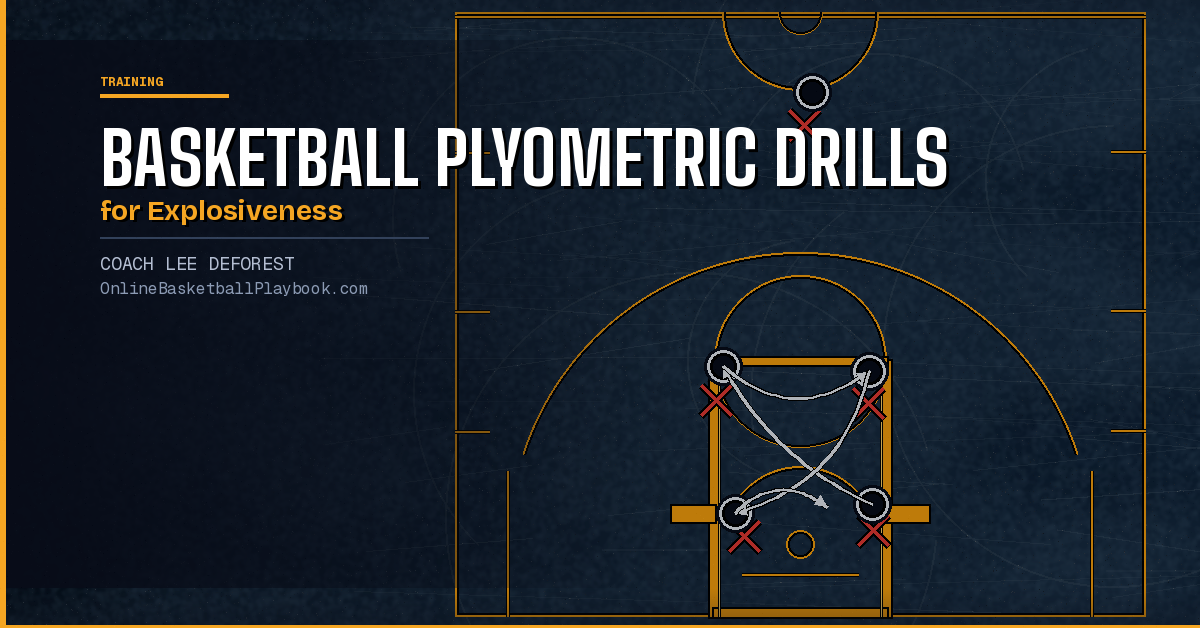

Plyometric training builds the explosive power basketball demands — vertical jump, first step quickness, and lateral burst. These drills close the gap between athletic potential and on-court performance faster than any other training method.
Why Plyometrics Matter for Basketball
Basketball is a game of short, explosive bursts — a two-step drive to the rim, a box-out and leap for a rebound, a lateral close-out on a shooter. None of those actions are sustained aerobic efforts. They are quick, violent contractions of the lower body that require the neuromuscular system to produce maximum force in minimum time. That is exactly what plyometric training develops.
The mechanism behind plyometrics is the stretch-shortening cycle (SSC). When you land from a jump, your muscles and tendons stretch under load, storing elastic energy. If you immediately redirect that force into a jump or push-off, that stored energy is released, adding free power to the movement. Athletes who train the SSC with plyometrics develop faster, more powerful contractions — meaning a higher vertical, a quicker first step, and better lateral change of direction.
What makes plyometrics uniquely suited to basketball is the sport's demand for repeated explosiveness under fatigue. A player who can jump 36 inches fresh but only 28 inches in the fourth quarter is losing athletic ground when it counts. A well-designed plyometric program raises the floor — athletes maintain more of their peak output as conditioning builds around the training.
Integrating plyometrics with your basketball conditioning drills ensures that explosive power and aerobic capacity develop together. Players who train explosiveness in isolation and never apply it in game-pace situations rarely transfer those gains to the court. The two systems need to talk to each other.
For youth players especially, plyometric training also builds structural resilience. Ankles, knees, and hips that have been trained to absorb and redirect force are less prone to the non-contact injuries that derail developing players. This is not a program just for elite athletes — it is foundational to basketball player development at every level.
Foundation Plyometric Drills
Before loading athletes with depth jumps or bounding sequences, the foundation must be solid. The ability to land, absorb force cleanly, and stabilize before redirecting is the prerequisite to every advanced drill. Skipping this phase produces sloppy mechanics and invites injury.
Jump Rope and Fast Feet
Jump rope is underrated as a plyometric primer. Ten to fifteen minutes of rope work trains the Achilles tendon and calf complex — the spring mechanism that powers both vertical jump and lateral movement. Focus on light, quick ground contacts, not big jumps. The goal is minimal time on the ground. Singles, doubles, and alternating-foot variations all have a place in warm-up sequences before plyometric work.
Bilateral Box Jumps
Box jumps are the foundational plyometric drill for basketball athletes. Stand in front of a box (18–24 inches for most players), load into a quarter squat, and jump with maximum intent. Land softly on the box, absorbing through the hips, knees, and ankles. Step down — never jump down — reset, and repeat. The emphasis is on maximal effort on each rep, not rushing through a set. Quality of contraction matters more than box height. A player jumping 20 inches with perfect mechanics develops faster than a player clearing 30 inches with a crash landing.
Broad Jumps
The broad jump trains horizontal power — critical for driving baseline, attacking a close-out, or pushing in transition. From a standing position, load and drive forward as far as possible. Stick the landing, hold for two seconds to demonstrate control, and reset. Progress to continuous broad jumps — a sequence of three to five jumps without pausing — once single-rep mechanics are clean.
Ankle Hops
Ankle hops isolate the spring mechanism in the lower leg. Arms are kept quiet at the sides, knees remain nearly straight, and the athlete hops rapidly using only ankle and Achilles action. The goal is maximum height with minimum ground contact time. This is a technical drill that looks simple but requires genuine neuromuscular precision. Five sets of ten reps develops the reactive strength that underpins every explosive movement in basketball.
Vertical Jump Drills
The vertical jump is the most visible expression of explosive power in basketball — the blocked shot, the offensive rebound putback, the finish above the rim. Improving vertical jump requires training both the slow-stretch, strength-dominant approach (squats, RDLs) and the rapid-fire reactive approach (depth jumps, repeated vertical jumps). Both have a place in a complete program.
Depth Jumps
The depth jump is the most powerful vertical jump training tool available. Step off a box (12–18 inches to start), land on both feet, and immediately redirect the force upward into a maximal jump. The key word is immediately — ground contact should be under 0.2 seconds. If you are pausing on the ground, you have lost the stretch-shortening cycle benefit and turned it into a squat jump. Depth jumps are high-intensity and should be programmed conservatively — two to three sets of five reps, twice per week, is enough to drive adaptation without overtaxing the system.
Repeated Vertical Jumps
Set a timer for 30 seconds. Jump for maximum height on every rep. Focus on quick ground contacts and continuous effort. This drill trains both the neuromuscular system for repeated explosive output and the anaerobic energy systems that power fourth-quarter play. Track the player's touch point on a wall or backboard and monitor over time — vertical height in the final ten seconds relative to the first ten seconds reveals conditioning-specific power loss.
Single-Leg Vertical Jumps
Most game situations require single-leg takeoffs — driving to the rim off one foot, jumping for a rebound mid-stride. Single-leg vertical jumps develop the asymmetry-specific power that bilateral jumps cannot fully address. They also expose imbalances between legs, which are common in basketball players and can contribute to knee and ankle injuries if left unaddressed. Three sets of five each leg, with full recovery between sets.
"Basketball is anaerobic — train it that way."
— Basketball Vault
Lateral Explosiveness Drills
Lateral quickness separates good defenders from great defenders. It determines whether a guard can stay in front of a ball handler, whether a post player can close out without getting beat baseline, and whether a help defender can rotate in time. Lateral plyometric work is often underprogrammed — coaches spend time on vertical development and neglect the horizontal plane entirely.
Lateral Box Shuffles
Place a box (6–12 inches) to one side. Shuffle laterally, step onto the top of the box with the near foot, push off hard, and land on the opposite side. Reset and repeat in the other direction. The emphasis is on a powerful push-off from the box top — not a passive step-over. Ten reps each direction for three sets. This drill directly mirrors the footwork pattern used in basketball footwork drills for defensive positioning and closeouts.
Lateral Bounds
From a single-leg stance, drive laterally as far as possible, landing on the opposite leg and sticking the landing for a full second. Reset and drive back the other direction. The goal is maximum lateral distance per bound. Lateral bounds develop the glute and hip abductor strength that powers defensive slides and lateral cuts, and they train the stabilization needed to redirect force effectively. Five bounds in each direction for three sets.
Resisted Lateral Slides
With a resistance band anchored at waist height and looped around the hips, push laterally against the band's resistance. Drive with the outside leg, maintain a low defensive stance, and keep the feet from crossing. This drill builds sport-specific lateral power in the exact movement pattern used on defense. Combine with unrestricted lateral bounds in the same session for both resisted and explosive training in one sequence.
Lane Slides
Defensive lane slides — shuffling baseline to baseline in the lane while maintaining a defensive position — are a dual-purpose drill: conditioning and lateral plyometric work in one. Set a timer for 15 seconds and challenge athletes to maximize the number of trips. This is one of the drills that bridges plyometric training and on-court conditioning, making it a natural fit inside any basketball practice plan that blends skill and fitness development.
Programming Plyometrics Into Practice
Plyometric training is not a conditioning circuit. It is neural training that demands freshness to produce adaptation. The worst mistake coaches make is stacking plyometric work at the end of a long practice when players are fatigued. Athletes jumping on tired legs develop poor mechanics, increase injury risk, and fail to produce the high-velocity contractions that drive explosive adaptation.
The correct approach is to program plyometrics at the start of a session, after a thorough warm-up but before any significant skill or conditioning work. A 15–20 minute plyometric block before practice begins is enough to drive adaptation. After that block, proceed into skill work and finish with conditioning as needed.
Work-to-rest ratios matter. For high-intensity plyometric drills — depth jumps, maximal bounds, lateral bounds — rest two to three minutes between sets. For lower-intensity primer work — ankle hops, broad jumps, box jumps — 60–90 seconds of rest between sets is appropriate. Rushing rest periods produces accumulated fatigue that compromises every subsequent rep.
Programming across a week should balance volume and intensity. Two dedicated plyometric sessions per week is the sweet spot for most basketball players. A Monday session might emphasize vertical power (box jumps, depth jumps, repeated verticals). A Thursday session might focus on lateral explosiveness (lateral bounds, resisted slides, lane slides). Never program high-intensity plyometrics on back-to-back days.
As athletes progress, periodize the difficulty. Early in a training cycle, focus on bilateral drills and clean mechanics. Progress to unilateral work. Then introduce resisted drills. Finally, add reactive drills where athletes respond to a visual or auditory cue — catching a ball and immediately bounding, or reacting to a coach's signal for direction. Reactive training bridges the gap between the gym and the game more directly than any pre-planned drill sequence.
Plyometric work belongs at the front of a training session — not the end. Athletes who jump on fatigued legs are reinforcing slow, sloppy mechanics. Fresh legs, full recovery between sets, and maximal intent on every rep are non-negotiable for actual explosive adaptation to occur.
Common Mistakes and How to Fix Them
Most plyometric programs fail not because the drills are wrong but because the execution is compromised. These are the errors that show up consistently — in youth programs, in high school gyms, and even at the college level.
Too Much Volume, Not Enough Intent
A coach programs five sets of 20 box jumps and calls it explosive training. It is not. By rep 12 of set three, the athlete is grinding through a conditioning drill with no speed of contraction left to develop. True plyometric adaptation comes from 3–6 reps per set, maximum intent on every rep, and full recovery. If the goal is conditioning, design a conditioning drill. If the goal is explosiveness, protect the quality of each contraction.
No Landing Mechanics
Athletes who crash land — knees caving in, trunk pitching forward, ankles collapsing — are absorbing force through passive structure rather than active muscle. This produces knee and ankle injuries over time and limits the ability to redirect force. Every landing in every plyometric drill should be soft, controlled, and stable. Teach landing before teaching jumping.
Skipping Single-Leg Work
Basketball does not happen on two legs. Drives, layups, rebounding while moving — all single-leg. Coaches who run only bilateral plyometrics are training a movement pattern that barely exists in the game. Progress to single-leg hops, single-leg bounds, and single-leg depth jumps as soon as bilateral mechanics are clean.
No Progressions
Starting athletes with depth jumps before they can stick a clean broad jump landing is a recipe for injury. Every plyometric program needs a progression ladder. Foundational movements first. Controlled landing mechanics before reactive work. Bilateral before unilateral. Ground-based before elevated. This is not about being conservative — it is about building the movement quality that makes high-intensity plyometrics actually transfer to the court.
Ignoring Recovery
Plyometric adaptations happen during recovery, not during the drill. Neural pathways are reinforced, tendon stiffness develops, and fast-twitch fiber recruitment patterns are consolidated between sessions. Athletes who plyo five days a week with no rest days are accumulating fatigue faster than they are driving adaptation. Two sessions per week is almost always the right answer for in-season and pre-season basketball players.
- Warm up first, always: 10 minutes of jump rope, dynamic stretching, and fast-feet work before any plyometric drill.
- Max intent, every rep: if an athlete is not jumping as high as possible, they are not training explosiveness — slow the session down.
- Full recovery between sets: 90 seconds minimum for low-intensity, 2–3 minutes for depth jumps and maximal bounds.
- Stick every landing: hold each landing for two seconds during foundational drills to build the stabilization that prevents injury and powers the next takeoff.
- Progress from bilateral to unilateral: master two-leg mechanics before moving to single-leg hops and bounds — unilateral work reveals and corrects imbalances.
- Two sessions per week: more is not better for plyometrics — the neural system needs recovery to consolidate the adaptation between sessions.
- Track performance: measure vertical jump height and broad jump distance monthly — objective data shows whether the program is working and motivates athletes to train with intent.
Get free play diagrams, drills, and coaching guides delivered weekly.
See it drawn up
Related diagrams
Keep Building
Related breakdowns
The Best Basketball Plyometric Exercises for Explosive Power
The Best Basketball Plyometric Exercises for Explosive Power