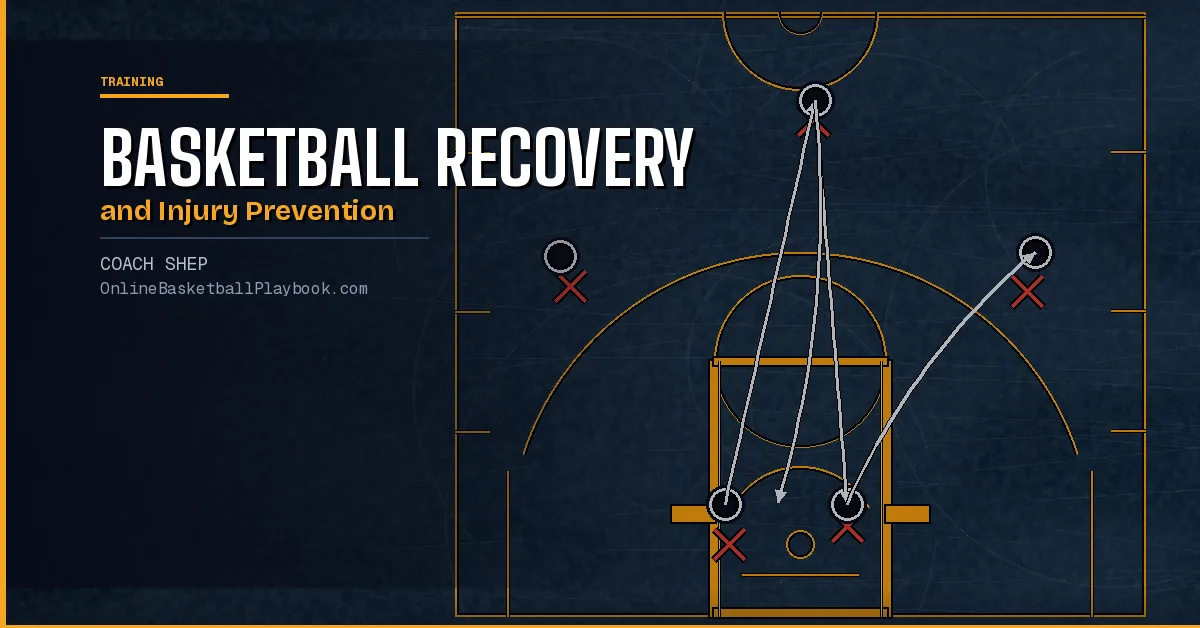
The best basketball players stay available. Recovery and injury prevention keep athletes on the floor, protect their long-term development, and directly determine how much a team improves over a full season.
Why Recovery Matters as Much as Training
Most coaches spend enormous energy designing practice plans, building defenses, and installing offenses, but recovery gets an afterthought at best. That's backwards. A player who breaks down in February is unavailable for the playoff push. A player who is chronically sore and moving at 80 percent never reaches the ceiling you see in preseason. Recovery is not a luxury; it is a performance variable the same way conditioning is.
The physiology is straightforward. Every hard practice, every sprint, every physical confrontation in a drill creates micro-damage in muscle tissue. That damage, repaired properly with adequate rest, nutrition, and sleep, produces adaptation: stronger muscles, better movement patterns, higher lactate threshold. Skimp on recovery and the cycle breaks down. The body never fully repairs, tissue becomes vulnerable, and soft-tissue injuries follow. This is why athletes who train harder without recovering smarter do not always improve faster. They often regress.
For a team sport like basketball, the math gets more complicated. Players carry varying loads within the same practice. Your starter logging 32 minutes in a scrimmage needs a different recovery protocol than the reserve who played eight. A well-structured basketball practice plan accounts for this. It varies intensity across days and builds in active recovery segments so the highest-minute players are not always absorbing the most punishment.
The mental side matters too. Fatigue is not purely physical. A player who is emotionally spent from a week of high-pressure competition and poor sleep is at higher injury risk because their reaction time drops, their movement mechanics degrade, and their focus on body positioning slips. Recovery protocols that address sleep and mental reset are not soft. They are the difference between an athlete who holds technique under fatigue and one who rounds a corner wrong and rolls an ankle.
Think about the teams that consistently go deep in the postseason. They are almost always the healthiest teams, not necessarily the most talented. A roster with eight available, well-rested players who have been managed carefully outperforms a roster with twelve where four are hobbling and two more are playing through pain. Availability is a competitive advantage, and recovery is how you manufacture it.
Ankle and Joint Strength: The Foundation
Most youth basketball injuries are not contact injuries. They are non-contact soft-tissue failures (ankle rolls, knee sprains, hamstring strains) that happen because the athlete's joints and supporting musculature cannot handle the demands of the movement they are making. Build the foundation first and you eliminate a large percentage of your injury risk before any contact occurs.
Ankle strength and balance work should be non-negotiable year-round. Single-leg balance drills (standing on one foot with eyes closed for 30 to 60 seconds) are a simple, zero-equipment starting point that coaches routinely skip. The proprioceptive feedback from that drill trains the ankle stabilizers in exactly the way that prevents rolls on landing. Progress it by adding movement: single-leg reaching in multiple directions, single-leg mini-squats, and lateral single-leg hops with controlled landings.
The knee depends heavily on hip strength. Weak glutes and hip abductors create valgus collapse (that inward knee buckle you see on landing), which is the primary mechanism for ACL injury. Lateral band walks, clamshells, and single-leg Romanian deadlifts are not glamorous, but they address the root cause rather than treating the symptom. Any program serious about ACL prevention builds hip strength as a pillar, not an accessory.
Jumping and landing mechanics deserve specific attention because basketball involves hundreds of landing repetitions across a season. Teach players to land on a full foot (not toes), with soft knees that track over the second toe, and with their chest over their hips. This is coachable technique, no different from basketball shooting form. Run jump-landing drills at the start of the season and revisit them periodically. Players who learn to absorb force correctly through their hips and knees rather than loading their joints vertically cut their soft-tissue injury risk substantially.
For the upper body, shoulder and wrist integrity matter more than most coaches acknowledge. Resistance band external rotation work for the rotator cuff, wrist flexor and extensor strengthening, and thoracic spine mobility drills protect the joints players land on and shoot with hundreds of times per week. Do not wait for an injury to start this work. Start it in the first week of preseason and maintain it in short daily sessions throughout the year.
Proper Warm-Up and Cool-Down Protocols
A warm-up that actually prepares the body for high-intensity basketball looks very different from having players jog a lap and stretch statically. The research is clear: static stretching before activity can actually reduce power output and may not reduce injury risk in the acute setting. What does work is a dynamic warm-up that progressively raises core temperature, activates the nervous system, and takes joints through sport-specific ranges of motion under control.
A solid basketball warm-up sequence runs eight to twelve minutes and builds systematically. Start with light locomotion (jogging, skipping, lateral shuffling) to raise heart rate gradually. Move into dynamic leg swings, hip circles, and thoracic rotations to open range of motion without the drawbacks of static holds. Add activation work: bodyweight squats with a pause at the bottom, lateral lunges, and glute bridges to fire the stabilizers. Finish with progressive intensity: half-speed defensive slides, basketball-specific cutting patterns, and a few short acceleration bursts so the neuromuscular system is primed before the first drill.
The cool-down is equally undervalued. After high-intensity work, the body needs a structured transition rather than an abrupt stop. A five to eight minute cool-down (easy jogging transitioning to walking, followed by static stretching of the major muscle groups) helps clear metabolic byproducts, reduces post-exercise soreness, and begins the recovery cycle immediately. This is the correct time for extended static holds on the hip flexors, hamstrings, calves, and shoulders. Hold each stretch 30 to 60 seconds and do it while the muscles are still warm.
Foam rolling, either before or after practice, is an effective addition when time allows. Self-myofascial release on the IT band, quadriceps, calves, and thoracic spine improves tissue quality over time and addresses adhesions that develop from repetitive basketball movements. Ten minutes of rolling before a practice also functions as an additional warm-up layer for players who arrive stiff or with chronic tightness.
For coaches working with youth players, the warm-up is also a teaching moment. Players who understand why they are doing hip activation exercises before drills begin to self-manage better. They arrive early and do their own prep rather than waiting for someone to tell them. That self-awareness compounds over years of development and produces athletes who stay healthier because they take ownership of their body preparation. A mindset that transfers directly to how they approach basketball player development overall.
Sleep, Nutrition, and Lifestyle Recovery
No recovery protocol outperforms sleep. During deep sleep stages, the body releases the greatest concentration of growth hormone, which drives tissue repair. Reaction time, decision-making, and muscular power are all measurably degraded by sleep restriction. Studies have shown that athletes sleeping fewer than seven hours per night are nearly twice as likely to suffer injuries as those getting eight or more. For developing players, this is compounded by the fact that adolescents need even more sleep than adults to support growth and neural development.
The practical challenge for coaches is that sleep is largely outside your control. What you can do is educate players and parents on the research, encourage consistent sleep and wake times, and design your practice and game schedule to protect morning sleep when possible. Early morning shootarounds that cut into an adolescent's deepest sleep phase are actively counterproductive from a recovery standpoint. When you have schedule flexibility, protect the morning.
Nutrition before and after practice directly influences recovery speed. Pre-practice, players need adequate carbohydrate to fuel glycolytic effort. Basketball's primary energy pathway. A meal two to three hours before practice with complex carbohydrates and moderate protein sets the tank. Within 30 to 45 minutes after high-intensity work, a combination of carbohydrates and protein (roughly a 3:1 ratio) replenishes muscle glycogen and begins protein synthesis. This post-workout window is not optional; it is when the adaptation actually happens.
Hydration is the most commonly neglected variable. Even mild dehydration (two percent of bodyweight) measurably impairs cognitive function, reduces endurance, and increases injury risk. Players should arrive at practice already hydrated, drink throughout, and continue rehydrating afterward. Thirst is a lagging indicator; by the time a player feels thirsty, they are already behind. Set a culture where water breaks are structured into practice rather than treated as a reward.
Anti-inflammatory nutrition habits (adequate omega-3 intake from fish or supplementation, plenty of vegetables, and limiting heavily processed foods) reduce baseline inflammation throughout a season. This matters less on any single day and more across a 30-game schedule where accumulated systemic inflammation is the difference between a player who holds up and one who breaks down in late February.
Load Management During the Season
Load management is not rest for its own sake. It is the deliberate calibration of practice intensity and volume so that players absorb training stress at a rate they can recover from, accumulating fitness without accumulating injury risk. Every coach manages load. The question is whether you do it intentionally or accidentally.
The simplest framework is the concept of hard days and easy days. After a high-intensity practice or back-to-back games, the following session should be lower in physical demand: skills work, walkthrough, film, or light shooting. This alternating rhythm allows tissue to repair between high-stress exposures rather than layering damage before recovery is complete. A team that goes hard every single day does not improve faster. It gets hurt more and peaks too early.
Track minutes for your highest-usage players. A point guard logging heavy minutes in practice and then heavy minutes in games is accumulating stress with no recovery buffer. Be willing to pull a starter out of a late-game blowout to protect their tissue. Be willing to reduce a player's practice load during a stretch of three games in five days. These decisions feel soft in the moment and reveal themselves as smart over a full season.
Watch for the subtle injury signals that precede actual injury: persistent soreness that does not resolve overnight, a player favoring one leg during sprints, a shooter whose form degrades as practice goes long. These are early warning signs. Address them with modified load before they become structural problems. The player who limps through two weeks of practice before the knee finally gives is a failure of load management that announced itself well in advance.
Periodization (building your season's intensity in planned waves) is the advanced version of this. High-intensity blocks are followed by deliberate recovery weeks. Physical demands ramp before key games and taper in the days before. This is standard practice in professional sports and entirely applicable at the high school and college level. A structured approach to basketball conditioning drills plugs directly into this framework, with sprint volumes and intensities adjusted by where you are in the season cycle.
Returning from Injury the Right Way
The most dangerous moment in an athlete's injury cycle is not the injury itself. It is the return to play. Players who come back too early, either from external pressure or their own eagerness, re-injure at dramatically higher rates. A re-injury to an ankle or knee is often more severe than the original, and repeated injuries to the same site create chronic instability that follows a player for years.
Return-to-play should be a graduated process, not a binary switch. The athlete goes from injured to limited movement to non-contact basketball activity to full contact practice to game play, with clear performance benchmarks at each stage rather than just a time target. Can they plant and cut without pain? Can they sprint at full speed? Can they jump and land with proper mechanics and no compensation patterns? These functional tests matter more than "it's been three weeks."
During the rehabilitation period, keep the athlete engaged with the team in every way that their injury allows. They can still do upper-body work if it is a lower-body injury. They can do film study, mental reps, and bench coaching. Athletes who feel disconnected during injury often rush back psychologically before they are physically ready. Keeping them in the environment and giving them meaningful roles maintains their mental readiness and team connection without stressing the healing tissue.
Communicate with medical professionals. A sports medicine professional or athletic trainer's clearance should be a prerequisite for return to contact practice, not a suggestion. This is especially non-negotiable for concussions and significant joint injuries. The coach's judgment about how a player "looks" is not a substitute for a medical evaluation. Build a relationship with a local sports medicine provider and have a clear protocol for what information you need before returning a player to full activity.
After return, continue monitoring. The first two to four weeks back are high-risk. Keep training load slightly below pre-injury levels and watch for compensation patterns (the way a player protects an ankle they rolled by shifting weight subtly, which then loads the knee abnormally). These secondary compensation injuries are entirely preventable with attentive coaching and a willingness to pull someone back slightly when the signs appear.
Spending 10 minutes per practice on ankle balance work, dynamic warm-up, and post-practice static stretching costs less time than managing a player through a four-week ankle sprain, and the benefit compounds across an entire roster over a full season. Invest in the work before the injury, not after.
- Run a dynamic warm-up every practice (leg swings, hip circles, glute activation, progressive sprints) before any drill starts.
- Program single-leg balance and ankle stability work weekly; players stand one-foot, eyes closed, 30–60 seconds each side.
- Follow every high-intensity session with a cool-down and static stretching while muscles are still warm.
- Alternate hard days and easy days. After back-to-back games or a high-intensity practice, the next session is lower physical demand.
- Enforce the post-workout nutrition window: carbohydrates and protein within 45 minutes after practice to kick off recovery.
- Track minutes for your highest-usage players and reduce their practice load during stretches of heavy game schedules.
- Return injured players through a graduated protocol with functional benchmarks, not just calendar time.
Get free play diagrams, drills, and coaching guides delivered weekly.
Draw this play free in the play drawer →
Membership: the full library, playbook packs, and Pro drawing tools →
Keep Building
Related breakdowns
How to Handle Injuries and Recovery in Your Basketball Program
How to Handle Injuries and Recovery in Your Basketball Program
Fun Basketball Games for Practice: Scored Games for Any Team
Fun basketball games for practice at any level: shooting games, defense-only scoring, rebounding contests and passing games, with scoring rules and records.
Basketball Conditioning Drills for Teams: Runs, Games and Tests
Basketball conditioning drills in three styles, timed runs, conditioning inside skill drills and scored games, with the tests and yearly plans coaches use.