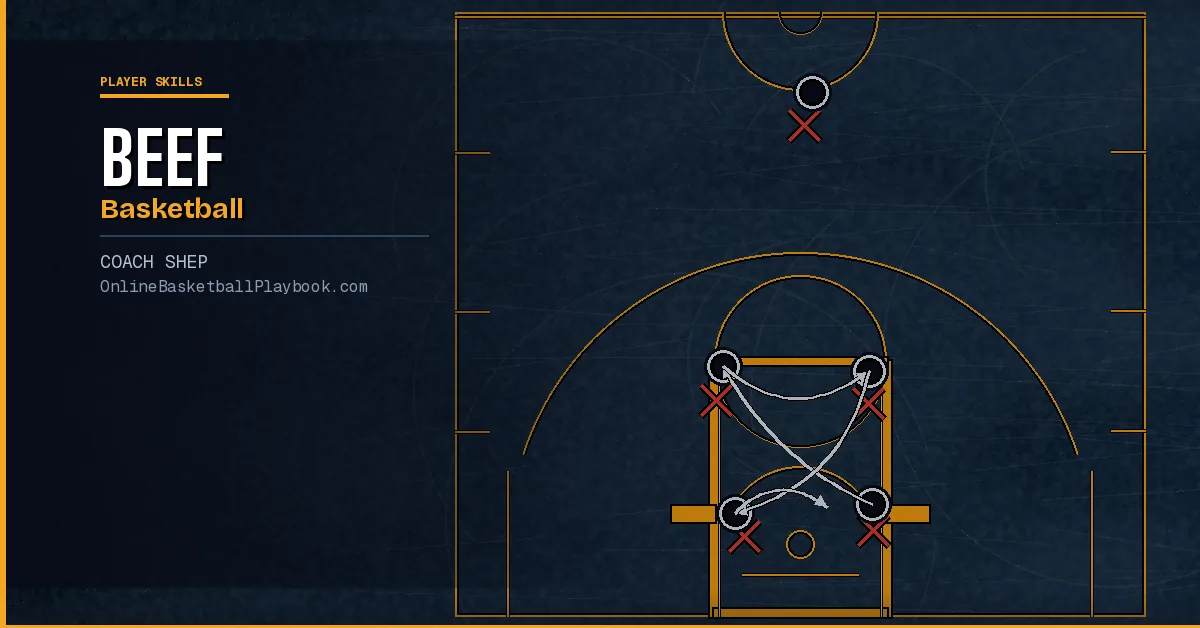
BEEF stands for Balance, Eyes, Elbow, Follow-through. Four mechanical checkpoints that give coaches a shared vocabulary and give players a self-correction checklist they can run in real time.
What BEEF Stands For
BEEF is a teaching acronym, not a style of play. Its job is to compress the four non-negotiable elements of a sound basketball shot into a word a seven-year-old can memorize and a high school junior can self-audit mid-workout. Every credible shooting curriculum, from youth development manuals to NBA skills coaches, builds the same mechanics. BEEF just gives them a handle.
The four letters map to four discrete mechanical events that happen in sequence every time a well-coached player shoots the ball:
- B. Balance: feet, hips, and shoulders aligned before and through the shot
- E. Eyes: pick a spot on the rim and lock on before catching the ball
- E. Elbow: shooting elbow under the ball at the set-point, over the knee
- F. Follow-through: wrist fully flexed, fingers pointing down at the rim until the ball lands
These four elements have been verified by shooting experts across decades. They appear in the Hal Wissel diagnostic framework, in Jay Wright's Villanova practice progressions, in John Beilein's Michigan standards, and in every youth coaching manual that prioritizes form before volume. BEEF does not invent anything. It organizes what already works into a sequence a player can self-check.
Breaking Down Each Letter
B. Balance
A shot built on poor balance is a shot that cannot repeat. Balance means feet shoulder-width apart (or slightly wider), toes pointed at the basket or turned slightly inward toward the shooting-hand side, knees bent and loaded before the ball arrives. Weight sits on the balls of the feet, not the heels. The center of gravity stays over the base with no leaning forward or drifting backward at the moment of release.
The most common balance error is loading the weight back as the shot goes up. Players who lean back to "add something to it" are transferring the power burden to their arm and shoulder. The legs drive the shot; the arm guides it. When a player consistently shoots long or releases the ball off-line, check the base first. Nine times out of ten the error starts at the feet, not the hands.
For younger players, the balance check happens before the catch. Feet should be set and loaded by the time the ball arrives. "Ready position" is not a passive stance. It is an active coil.
E. Eyes
The eyes tell the body where to aim. Lock onto a specific target on the rim before the catch, not after. Most players pick up the rim late. They catch, then look. By then the shot is already building on an incomplete feedback loop. The technical cue is simple: "See the rim before you see the ball."
Some players focus on the back of the rim; others use the front edge of the cylinder. What matters is consistency. A player who changes their aiming point from shot to shot introduces uncontrolled variation into an otherwise repeatable motion. Find one target, commit to it in every practice rep, and it becomes automatic in games.
The eyes also govern arc. A player who "shoots flat" is often aiming at the near edge of the rim rather than up and through the basket. Shifting the focal point to the back of the rim (or to a spot on the net) naturally increases the launch angle without any conscious mechanical adjustment.
E. Elbow
The shooting elbow is the hinge that determines where the ball goes. At the set-point (the moment before the wrist snaps) the elbow must be directly under the ball and directly over the shooting-side knee. Not flared out. Not tucked too tight. Under the ball, over the knee.
An elbow that flares wide produces side spin and pushes the ball left or right of center. An elbow that collapses inward forces the guide hand to compensate, which usually means the off-hand thumb pushes across the ball at release. This is the single most common cause of a shot that breaks sharply to the off-hand side. Elbow alignment is the mechanical checkpoint that determines hand position downstream. Get the elbow right and the hand position usually follows.
The drill coaches use most often to isolate elbow alignment is the one-handed form shot. Remove the guide hand entirely and shoot from close range. Without the guide hand to compensate, the elbow has to be right or the ball will not track straight. This is the foundation of Jay Wright's Set Lift progression at Villanova. Every player shoots one-handed form shots before any workout adds volume or movement.
F. Follow-through
Follow-through is where missed shots betray themselves. A player who drops the wrist the moment the ball leaves the hand has already cut the arc short. The wrist must snap fully through the ball so that the hand finishes palm-down, fingers hanging toward the floor, pointing at the rim. Hold it. Do not let the elbow drop. Hold the finish until the ball hits the net or the rim.
The follow-through is not decorative. It is the last point at which the fingers are in contact with the ball and directly influence its spin and trajectory. A full wrist snap produces clean backspin. Clean backspin on a shot with good arc produces a higher make percentage on shots that hit the rim. The ball is more likely to bounce up and in rather than long and out.
The "cookie jar" cue (reach up and put your hand in a cookie jar on a high shelf) is the standard youth teaching image. The mechanical target is: at the end of the follow-through, the shooting hand should look like it is reaching into a jar above the head. Index finger pointing at the rim, wrist fully flexed, elbow above eye level.
How to Teach BEEF by Age Group
Ages 6–9: Form Without the Rim
At this age the mechanics live in isolation. Start without the ball. Teach the balanced stance, the "pizza waiter" hand position (palm up, ball resting on the pads like a waiter carrying a tray), the elbow alignment, and the wrist snap before the player touches a basketball. Then add a ball, shoot against a wall, verify the form, then move to a low rim. Volume comes last.
The best teaching tool at this age is the one-handed shot. Remove the guide hand from the equation. Shoot from a few feet from the basket. Make the child feel a correct release before they learn any compensating habits. Compensations learned at seven are still there at seventeen.
Ages 10–13: Form Under Movement
Once the four checkpoints are reliable in isolation, add a catch. The player must land in a balanced position (inside foot first on a cut or screen-catch) and shoot from that balanced catch without resetting their feet. The form does not change. The trigger changes.
At this age, footwork and BEEF merge. The inside foot principle (plant the foot closest to the ball-handler first on any V-cut or screen-catch) gives players a consistent landing pattern from which to execute the shot. BEEF applies from there.
Ages 14 and Up: Form Under Pressure
High school players should be able to self-audit all four BEEF checkpoints in real time. When a player misses three in a row, they should be able to identify which letter failed without a coach telling them. That self-correction habit is built in practice, not in games. Create competitive environments (tracked makes, time pressure, opponent) where the player has to maintain form under stress.
Common BEEF Errors and How to Fix Them
Every missed shot has a mechanical cause. The Hal Wissel diagnostic framework (the most rigorous published shooting error guide in the coaching literature) works backward from the miss pattern to the root cause, then prescribes a specific drill. The same logic applies to BEEF errors.
Shot Breaks Left or Right
Cause: the guide-hand thumb pushes across the ball at release. This is an elbow alignment problem (second E) that creates a hand-position problem at the follow-through (F). Fix: thumb-lock drill. Hold the guide-hand thumb up and away from the ball. Shoot one-handed form shots until the ball tracks straight. Then reintroduce the guide hand as a passive shelf, never a driver.
Shot Consistently Short
Cause: release point too low; the ball leaves the hand before the arm reaches full extension. The elbow drops early. Fix: hold the follow-through after every release. The shooting arm should be fully extended (elbow above eye level) until the ball lands. If the elbow drops before the ball arrives at the rim, the shot was short in the arm, not the legs.
Flat Arc (Line Drive)
Cause: the wrist does not fully flex through the ball. The follow-through is short. Fix: pick a spot on the gym ceiling above the front of the rim and arc the ball there. Players who think "ceiling" immediately gain four to six inches of arc without any other adjustment. Pair this with exaggerating the wrist snap so the index finger is the last contact point.
Inconsistent Release Timing
Cause: rushing the release before the jump peaks. The player shoots on the way down or at the start of the jump rather than at the natural apex. Fix: a three-beat rhythm cue. Sight, Set, Shoot. Three distinct beats. The ball reaches the set-point above the shooting shoulder (Set) before the wrist fires (Shoot). Rushing collapses all three beats into one continuous motion and loses the stable platform the set-point creates.
Side Spin
Cause: shooting hand is cocked to the side at the set-point; the wrist turns rather than flexes forward. Fix: elbow-in alignment check at set-point. The shooting elbow must be directly under the ball and over the shooting knee before the wrist snaps. A cocked wrist is almost always a downstream symptom of a flared elbow upstream.
Making BEEF Stick in Practice
Knowing the acronym is not enough. BEEF becomes a shooting habit through form-first practice sequences, competitive reps, and a scoring system that makes the player accountable to the mechanics, not just the result.
The most effective practice sequence follows this order: form shots without the ball, one-handed form shots to a low rim, two-handed form shots from close range, catch-and-shoot from mid-range with a passive passer, then game-speed movement shooting from game spots. Each step adds one variable. The mechanics do not change from step one to step five. The player applies the same four checkpoints at every stage.
Volume without form is not practice. It is repetition of error. Jay Wright's principle at Villanova is direct on this point: sloppy drills create bad habits. A player who fires four hundred threes in a session with a broken elbow alignment is not building a shot. They are building a broken shot with a high volume of reps attached to it. Four hundred reps of a compensated motion is harder to undo than forty reps of correct form.
The practice design that works best pairs a form check with a competitive element. The player shoots form shots first (pure BEEF, no scorecard) then transitions to a timed or tracked drill where makes are counted. The form check grounds the mechanics. The competition adds the stress under which the mechanics must hold. Both are required.
Run your first five minutes of every shooting workout as pure form shots (one-handed, close range, no competition). This primes the mechanics before volume or speed enters the session. Players who skip this step rush their set-point under pressure because they never established it clean first. Five minutes of correct form at the start of a workout is worth thirty minutes of high-volume shooting that never checks the mechanics.
Moving Beyond the Acronym
BEEF is a starting point, not a ceiling. Players who have internalized the four checkpoints stop thinking about them consciously. The mechanics become automatic and the player shifts attention to reads, timing, and shot selection. That is the goal. The acronym earns its retirement when the player no longer needs it.
The most accomplished shooting coaches in the game teach past BEEF quickly. Jay Wright adds footwork (inside foot first on every screen-catch), competitive make standards (six out of ten in thirty seconds), and movement variety (players cannot shoot the same spot twice). John Beilein's Michigan standard (seven out of ten in thirty seconds coming off a down screen and flare screen sequence) assumes that BEEF-level mechanics are already present and applies pressure on top of them.
Pull-up shooting is the natural extension. The pull-up and the hesitation pull-up are what shooting coaches call "lost arts" (undercoached skills that turn a catch-and-shoot player into a complete offensive threat). The mechanics are the same. The trigger is different. A player who can execute BEEF off the catch can also learn to execute it off one or two dribbles. That player becomes difficult to guard because the defense cannot drop back to prevent the three without conceding the pull-up at the free-throw line.
Free throws deserve separate attention. Free throws are shot without defensive pressure and from a fixed spot. They should be the highest-percentage shot any player takes. But free throws late in games are shot under fatigue and anxiety, which is why they must be trained under fatigue and anxiety. The correct practice method is to shoot free throws at the end of a hard competitive drill, not at the beginning of a session when the player is fresh. BEEF applies at the free-throw line exactly as it does everywhere else; the difference is that there is no excuse not to run all four checkpoints on every attempt.
Finally, contested shooting. Rick Pitino tracked his Louisville teams' shooting percentage on challenged shots. Twenty-two percent versus a roughly forty-two percent baseline in professional play. His practice rule was explicit: if a shot would be contested, pass it back and restart the action. No exceptions. The lesson for any program is that BEEF mechanics under contest pressure are a different skill than BEEF mechanics on an open catch. Train both. Track both. Know the difference.
- Start with one-handed form shots: Remove the guide hand and shoot from a few feet out before adding any volume or movement to the session. This isolates elbow alignment and wrist action without compensation.
- Hold every follow-through: Require players to hold the wrist-flexed finish position until the ball lands. If the elbow drops before the ball reaches the rim, the shot was mechanically short before it was physically short.
- Check the elbow before anything else when a shot breaks sideways: A flared elbow at the set-point is the upstream cause of most guide-hand and off-line release problems. Fix the hinge, and the hand corrects itself.
- Shoot free throws last, not first: Put free throws at the end of competitive blocks so they are shot under fatigue, which is when they actually matter in games. Fresh free throws in a quiet gym do not transfer.
- Make one rep competitive before ending any shooting block: A timed drill, a make total, or a head-to-head challenge. Form without competition does not prepare players for the stress that breaks mechanics in games.
Want more basketball coaching strategies and drills?
Join the Online Basketball Playbook newsletter →
Draw this play free in the play drawer →
Membership: the full library, playbook packs, and Pro drawing tools →
Keep Building
Related breakdowns
Basketball Shooting Form: Step-by-Step Mechanics
Basketball shooting form step by step, from the ready stance and grip to release and follow-through, with drill progressions and where coaches disagree.
Free Throw Shooting: Routine, Form and Drills
Free throw shooting starts with a routine the player never changes. Form cues, the mental side and drills that copy the fatigue and pressure of a game.
Competitive Shooting Drills: Scored Games and Records
Competitive shooting drills with a score on every shot: streak games, timed targets, Beat the Pro, plus and minus, 2-on-1 shooting and record boards.